Savagely Raging

N.B. This will include spoilers for Final Fantasy XIV’s Dawntrail expansion.

Among the habits I picked up during the COVID-19 pandemic was playing Final Fantasy XIV with my partner and a close friend of mine. During the initial months, another friend reached out to let us know she was happy to assist us with anything while we progressed through this story-heavy MMO, and she started affectionately calling us her sprouts. I will preface this journey with the fact that I am rarely someone who plays anything on a hard difficulty. While I can find mastery of a game fun to play around with, extremely challenging content is just as apt to frustrate me. So imagine my surprise when my group’s FFXIV mentor (we’ll call her Ming) reached out to ask if we’d be interested in trying the latest hard content.

The way FFXIV is structured, harder content is a revision of content that is available on normal difficulty. Bosses, who are normally relegated to Trials, get extreme versions, which offer various ways of eking out and grinding for gear upgrades (as well as flashy mounts). Raids are 8-person content that see you go through a story in three different sets of four fights each. The current series sees you fighting in an arena against fighters who augment their powers with animals through regulators (a system by which they were previously given functional immortality). These then have a harder mode called Savage, which again give out a drip feed of equipment upgrades that are quickly outdated as new content comes (though given the patch cycle is every four or so months, you have some time for that gear to be best in slot).

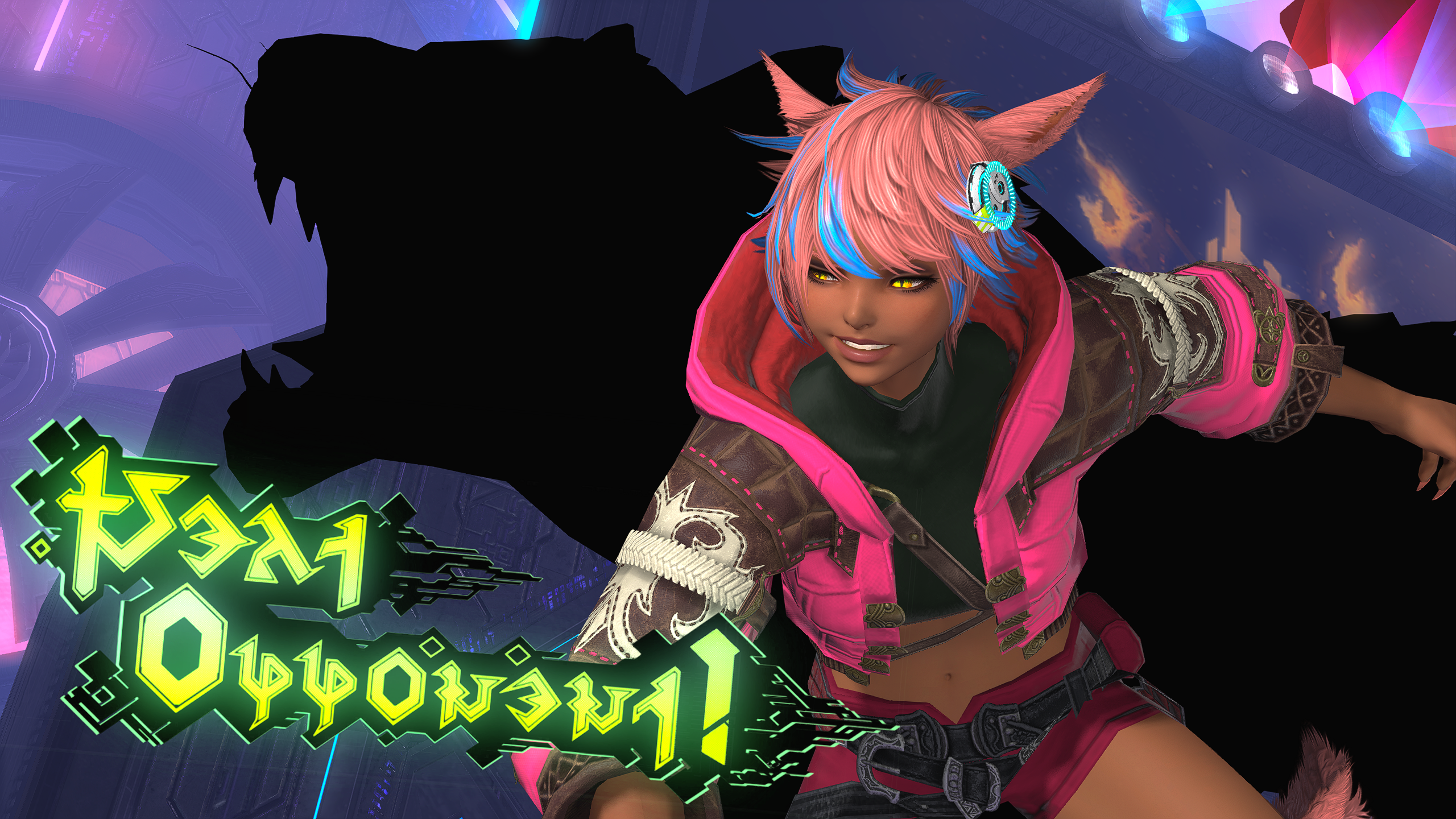
The Black Cat, the first in the current raid series in FFXIV Dawntrail.

I’ve never raided in an MMO before partially because I am not a particularly social creature in MMOs, and partially because the time commitment was not something that interested me. So I figured it would be useful to jot down my progress with this, as it no longer seems daunting to someone who was fairly certain this was content they would just never see beyond watching videos of people playing through them and marveling at the coordination.

There were a few things I did to prepare for this step up in content. My partner and I have been tackling new content near the end of the last expansion and then throughout this one blind, meaning we would not look up boss move sets or strategies when entering new content and just tackle it as it came. While I don’t feel FFXIV is very good at explicitly telling you how its systems or visual language works, there are certain patterns, tells, and configurations that just become standard as you fight your way through 100 levels of content. For Savage we looked up strategies, since it was a step beyond anything we tried.

Second was learning the ins and outs of my class that I would be playing (Warrior). There are the three typical type of classes for an MMO/group fantasy game: tank, healer, and DPS, with me taking on a tank role. In the meta of the game, everything has started revolving around what’s called the 2-minute meta. Various classes have buffs that fit perfectly within a two minute window, so you shift the skills you use into this very set pattern and then perform it while keeping an eye out for mechanics that will kill you. Easy in theory, requires a lot of practice to feel comfortable. I will note that FFXIV doesn’t do the best job of teaching you this meta, partially because it doesn’t seem to have a system in place for expression via builds, and seems to fight on what it wants to be, with classes seemingly constantly adjusting to various cheers and jeers of the player base.

So Ming’s group got together and we entered M1S (the first of this raid series, and the savage variety). What followed was quickly finding out how panicked folks can get when confronted with new information. Despite having watched videos and making my way through new content with barely a scratch (or sometimes collecting vulnerability stacks while playing tank that I only survived by virtue of innate damage reduction), Savage was a lesson that mistakes can be far more deadly. What then happened is that for three weeks we met up, progressed in the fight, learned the various dance steps to a fairly standardly telegraphed set of attacks, and whittled down the Black Cat (the boss of this particular raid) until we killed her within seconds of dying ourselves.

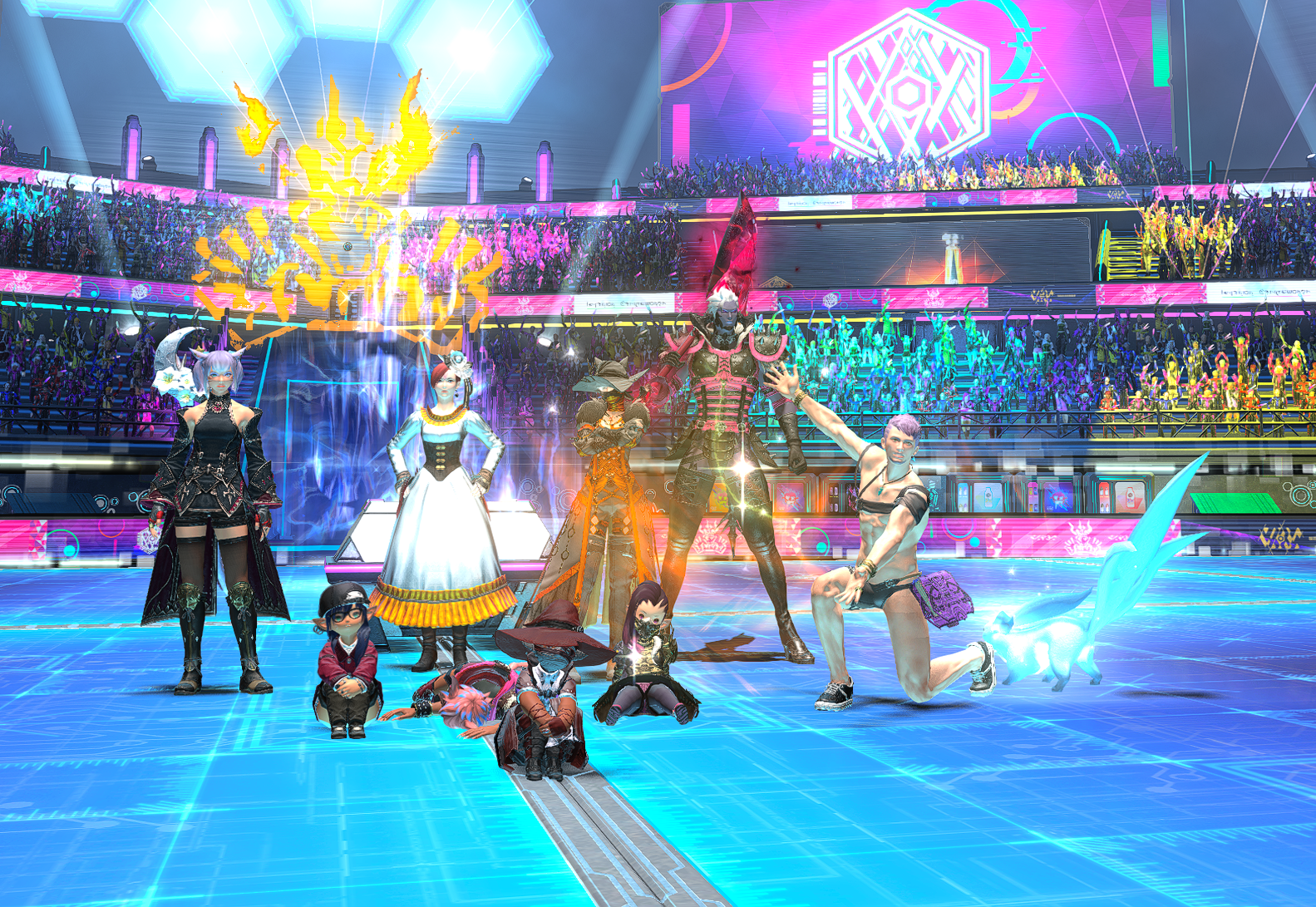
After our first successful pull of Black Cat. I’m the tall Au Ra in pink leather armor in the back row.

What I’m happy to report is that we’ve met for two weeks after our first successful clear and managed to defeat Black Cat within two tries, before moving on to M2S, where we are making progress but finding ourselves slowly learning those dance steps. M2S has us fight a bee lady who speaks in a Southern drawl for no particularly discernible reason (Dawntrail did give us Fantasy Texas, but the voices there don’t even seem to speak in a drawl).

What happened next was mostly expected: dying early to some mechanics we just didn’t understand yet. Then learning those steps and progressing to die to the next mechanic we had not yet practiced and were figuring out as we managed to share damage incorrectly, kill ourselves, and just generally laugh at the shenanigans that ensued. What really helps here is having a group that isn’t prone to passing the blame and instead patiently explaining missed mechanics. Mistakes happen! Folks can easily misread something or have so much going on that they miss an important cue that is the difference between being at full health and taking slight damage or suddenly finding your character face planted with 0 HP. On our Discord voice channel it is common to hear, “Wait, what does she have stored?” as she telegraphed a move several seconds ago while you were engaging with entirely different mechanics.

We’ve not yet finished the Bee Lady and her infectious song, but there’s hope! As someone who remembers running the very first dungeon in FFXIV without their tank stance and having a patient fourth player guide our initial group of three through the ins and outs of the duty, a casual running through of this content is perfectly manageable! We’re only meeting for two hours on a weekly basis, but it’s amusing learning where we need assistance, who is best at spotting mechanics and calling them out, and understanding better how to do things we’d not ever encountered in more normal content.

So if you are on the fence about ever trying Savage, I think it’s entirely possible to learn with a patient enough group. However, it will require practice and leaning on outside resources (a complaint I frequently have about FFXIV). Here’s to hoping we see the end of M4S (the currently available content for this raid series) and get to try the others as they release.

Posted in Uncategorized | Tagged , , , , , | Comments Off on Savagely Raging

Thedas (THE Dragon Age Simp)

Once upon a time (read: 1998) there was a nerdy teen who was obsessed with the game series Quest for Glory. The fifth game in that series was coming out that December, and this series had the ability to import your character from the previous games so that you had a leg up. This mostly mattered in terms of stats (both your character sheet stats as well as spells), with decisions you previously made not really a factor since the games didn’t offer much in the way of deciding how an outcome took shape. You were the big damn hero, which meant heroic conclusions to quests (though you might be more sneaky in how you got there). This nerdy teen proceeded to make import files for each of the games’ four classes, spending hours grinding out the stats and spells (which improved with use).

Adult me sees this behavior and recognizes a similar excitement in the lead up to Dragon Age: The Veilguard, but with neither the inclination nor time to spend quite so much time in creating various world states for the series. Partially because I have wider access to a number of different media, and partially because world state decisions are not to have such an outsize impact in this new entry in the series. The boyfriend can also only handle so much excited gushing on my part as I explain theories and the lore.

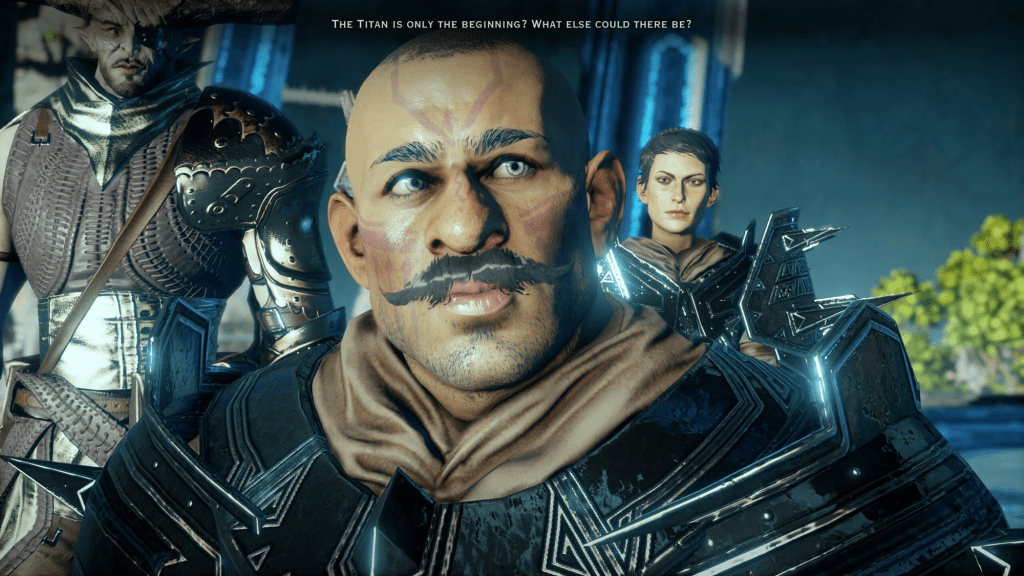
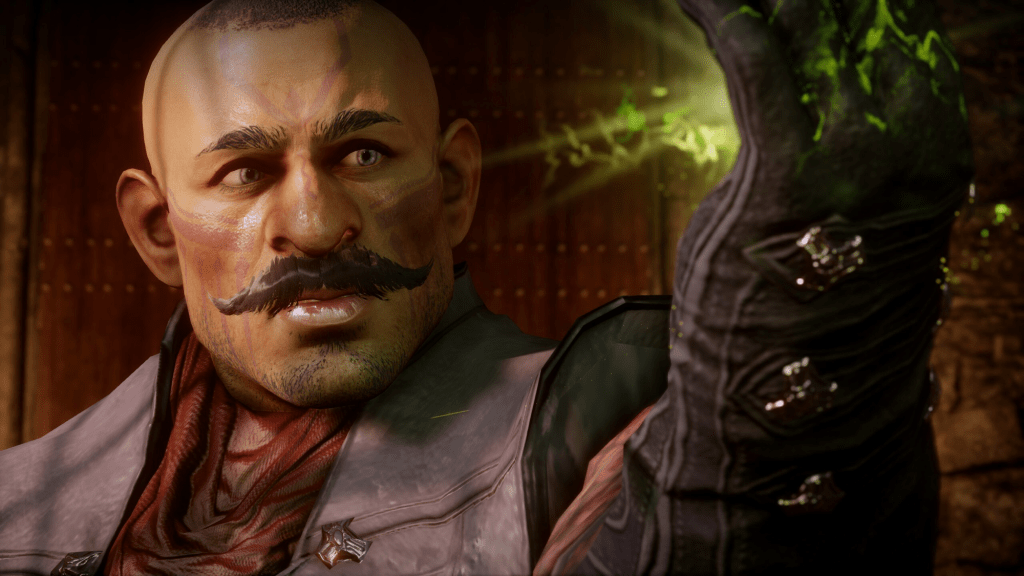
My dwarven Inquisitor with the Iron Bull over his right shoulder, Cassandra over his left. Text reads, “The titan is only the beginning? What else could there be?” Plz to giving more dwarven lore, BioWare.

Thanks to similarly excited Dragon Age nerds, I have had the pleasure of playing the Dragon Age TTRPG. It has taught me very quickly that there are lots of things I consider in creating tabletop characters that isn’t quite wholly addressed in the videogames themselves (or might be a passing note in the codices or some overheard banter between either companions or NPCs). What does theater in Thedas look like and at what stage of development is it? What grains and vegetables are available in the varying regions of this continent’s countries? Why does Nevarra not have its own language, and how does its fairly recent clashes with Orlais factor into their national identity? My tabletop character is a Nevarran playwright, skilled in music and rhyme, and traveling about trying to better understand the world so that the Nevarran hero worship pageants are not the only type of play they create. They’re non-binary.

While I may not be playing the entire Dragon Age series from Origins to Inquisition in preparation for Veilguard, I am replaying Inquisition with a new character to both see things I haven’t before, and to bring things to the forefront of my mind that I may well have forgotten (it’s been a decade since that game released, after all). What I’ve found is that it is my personal least favorite of the series. I am neither a fan of of its main villain or how it feels to play. I hate the combat. The exploration of vast, largely empty spaces doesn’t particularly thrill me. There are enough further smaller gripes that make the experience not particularly pleasurable (why is Power even a resource beyond early game gating?). Thankfully I can mod a lot of my gripes away and move on with the story.

Which I do like! Each of Inquisition’s DLC offer self-contained maps with their own story, providing lore nerds like myself tons to geek out about with fellow lore nerds. The companions, as with most BioWare games, are a stand out, and even when I don’t agree with them (Vivienne and Sera, meet Carver), I appreciate their learning about their viewpoints and how they are written. While Power may feel like a useless gating mechanism to me, I like the idea in theory, offering a glimpse into this massive organization my Inquisitor is building and how they are affecting southern Thedosian politics (particularly once you get to the Trespasser DLC).

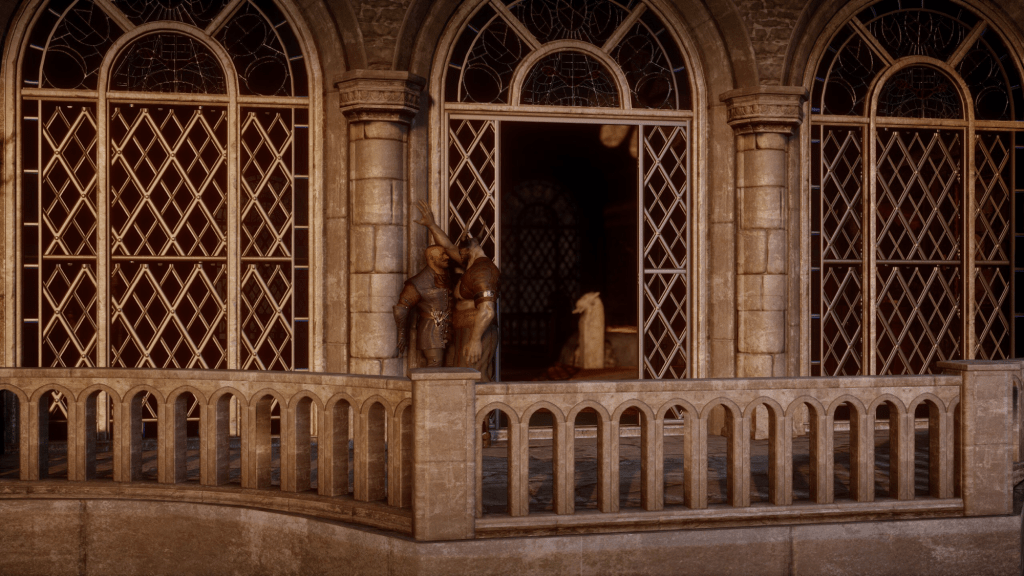
My dwarven Inquisitor stands on his balcony, pinned against a column by the Iron Bull.

My latest Inquisitor is a former member of the Carta who has changed as the game progresses, with decisions I was certain I was going to make changing along the way so that it fit better the person he has become. His romance with the Iron Bull feels very much like an introduction to a safe and respectful relationship founded on BDSM and kink. Where initially this Inquisitor was far more cruel and doled out particularly harsh punishments, as he discovered a wide variety of cultures and a degree of power, he found he wanted to exercise it with a softer hand, giving more thought to Josephine’s lessons on soft power. He came to better understand how to better mesh his own Carta backgroundto work with both Leliana and Iron Bull to play at espionage and intrigue.

For me part of the magic of the Dragon Age setting has been that each game has a new character. While world states certainly inform the world in which those characters are living, breathing, and interacting, they are still responding to the here and now. I can imagine the nightmare that three games’ worth of decisions would be to account for when writing this series, so going into Veilguard’s three decisions to import I know that the world states I do have will still inform my Rook, even if there aren’t callbacks to them in-game. Their examples of heroism in the Heroes of Fereldan (HoF), Hawkes, and Inquisitors will still ring true as stories of which they are aware. But those are decisions I get to make regardless of how the game acknowledges them.

My dwarven Inquisitor in the war room, his left hand pulsing with the anchor, causing his hand to glow green. Having hair options so I don’t default to bald for most characters is hopefully another plus of Veilguard.

So! Going into Veilguard I am no longer that excited teenage self who played an entire four-game series four times over just to have everything prepared. I am instead an adult who is grateful for a game series where I can play multiple times and never have to play a straight person unless I absolutely want to. I can say goodbye to the real-time with pause style of combat that I hated with Baldur’s Gate the first and never particularly grew to like in the decades that followed. I can make non-binary characters who won’t really reflect my own experience with being non- binary, but are characters whose headspace I want to occupy for a bit to see Thedas from their point of view. BioWare games have tended to allow me to feel like I am an actor stepping on to the stage, a metaphor I particularly like for approaching any roleplaying. It’s about collaboration, whether that’s at a table with friends, or with the developers of a more pre-defined story.

Posted in Dragon Age | Tagged , , , , , | Comments Off on Thedas (THE Dragon Age Simp)

Thoughts on Assassin’s Creed: Liberation

N.B. Spoilers for Assassin’s Creed: Liberation, as well as acknowledging that as a white person, my perspective is limited. I’ve linked to an Evan Narcisse post below.

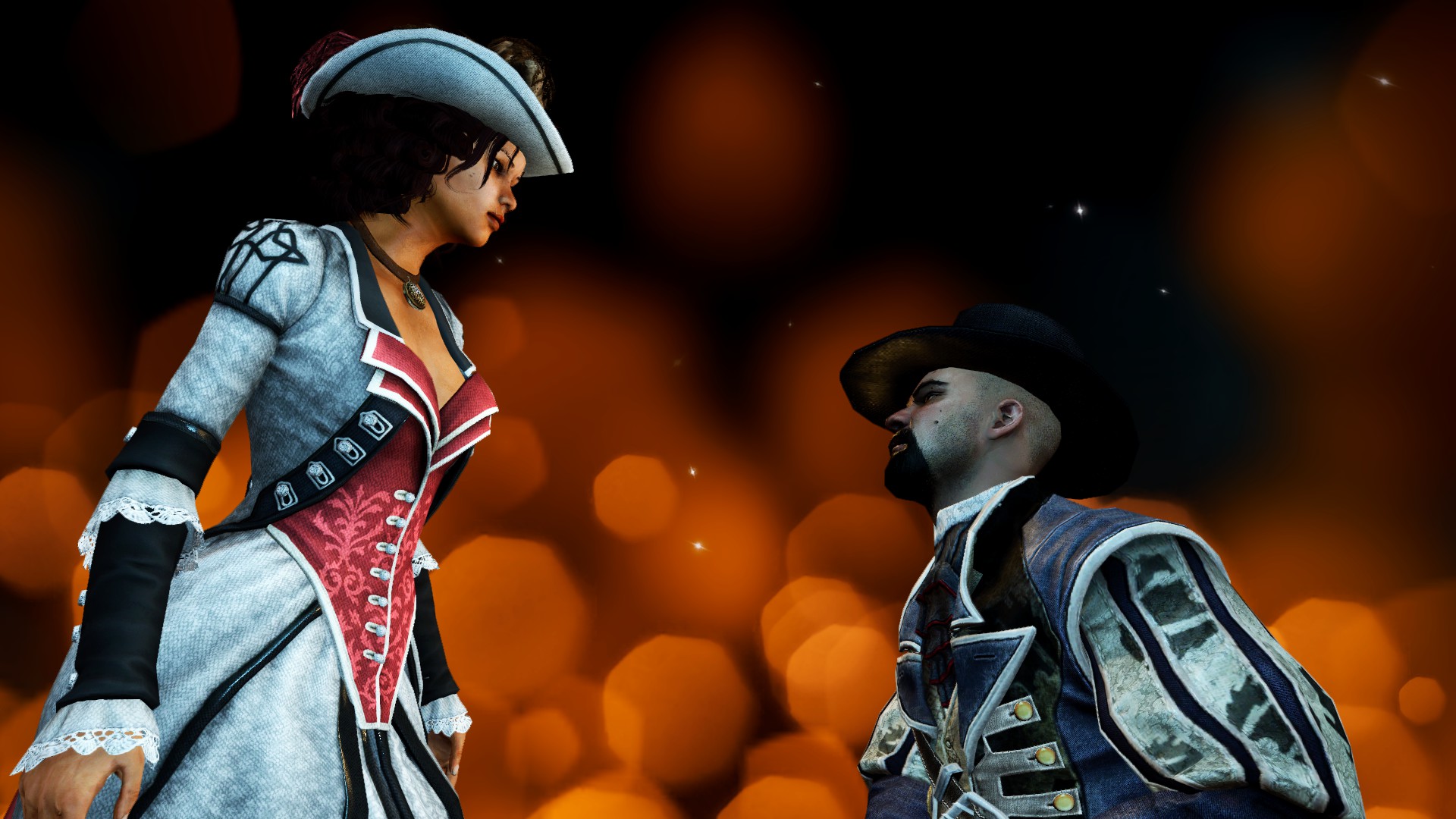
One moment sticks out in my mind in AC: Liberation above others: I was working for Aveline’s mentor, Agaté, to funnel a group of soldiers to a specific spot so I could ambush them. Racing around and breaking water towers so that they would need to navigate certain streets, I ran around in Aveline’s slave guise so that I would attract less attention.

You see, AC:L has a mechanic that is new for the Assassin’s Creed series: Aveline can go to changing rooms and switch between three different personae: the assassin guise that is established in the series, her slave guise, and her lady guise. Each has its own benefits and drawbacks. Assassin has access to all weapons and can freely climb and traverse the city, but is spotted by guards more easily, always having one bar of notoriety. The lady cannot climb and has a very limited arsenal available to her (a parasol that shoots poisoned darts being one). The slave can freely climb about the city (though gains a small amount of notoriety for doing so), and while she has a limited arsenal, it’s not quite as limited as the lady. It was the limited arsenal that struck me as I found myself stuck in the mission above, unable to proceed. The slave persona had no access to firearms.

20170222200155_1

To end the mission, Aveline is tasked with both not being detected by the soldiers standing about like slightly animated mannequins and blowing up a powder keg to destroy their rear flank. In most Assassin’s Creed games, I barely pay attention to most of the tools I have, as they rarely are needed outside of one or two instances; as someone who never uses the pistol in these games, I suddenly found myself ruminating on the fact that of course Aveline would not be carrying about a gun with her as someone who is perceived as a slave around the streets of New Orleans.

Similarly, the notoriety that Aveline is shown to have as an assassin but not a lady seems tied to how she is perceived to wield power. Helping run her father’s business as a lady does not seem uncouth (and one may not even know that, if she is just looked at; her step-mother seems to be at pains to get her to marry so that she can actually fit into society). However, a black woman with obvious weapons hanging about her person, and dressed in garb that would read as masculine while not being a slave? She seems to stick out in what our understanding of that time would be.

Further, it caused me to reflect on the full use of the dressing stations in place of just stepping into an alley to change. Aveline is not just changing her costuming, but what tools she has access to in a particular guise can be incredibly expansive or limiting. Suddenly having access to tools you did not before could only be explained by stepping into a place where they’d be available, instead of just changing into the spare costume you may have had while wandering the streets and stepping out of sight.

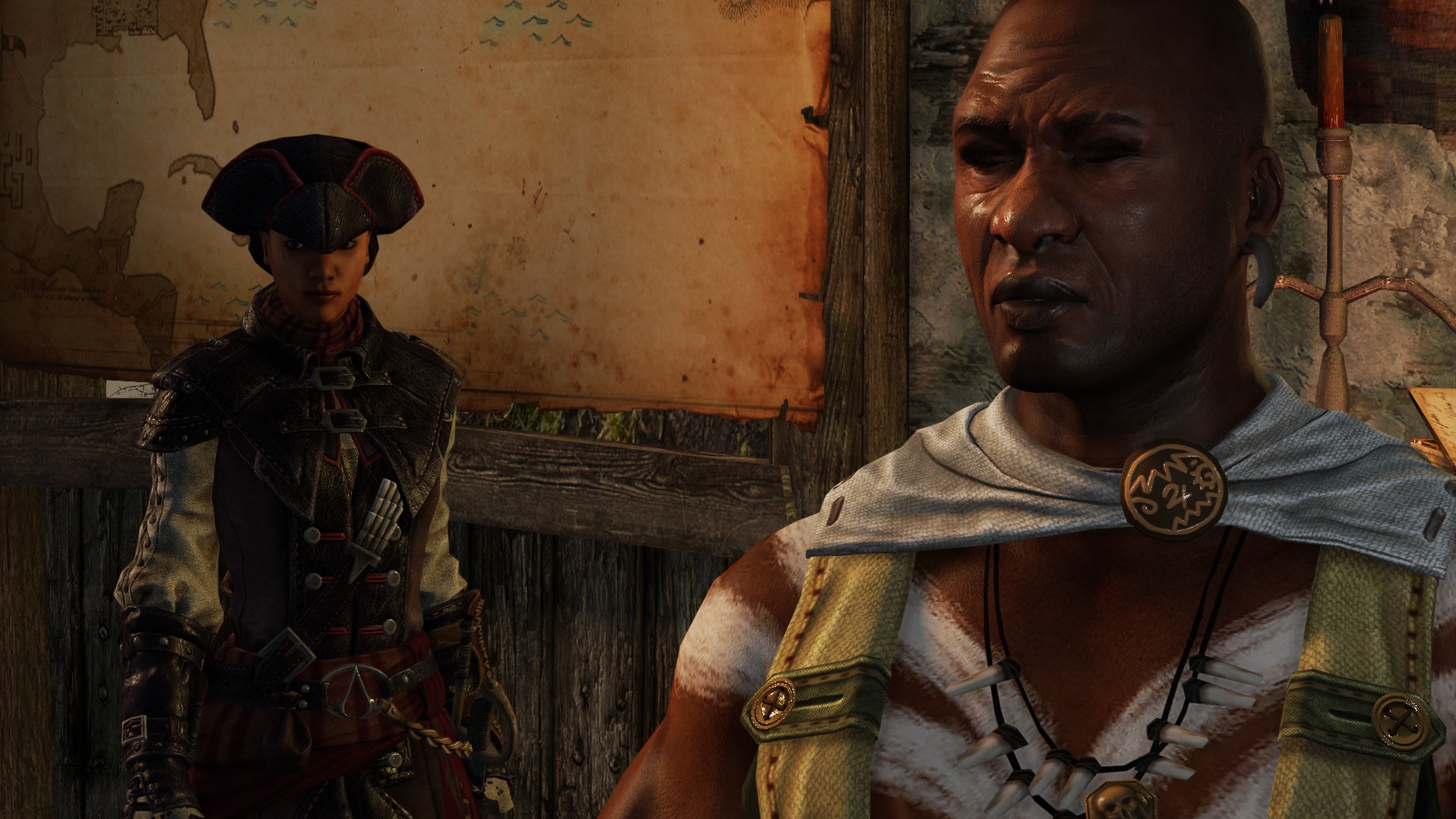
There are many different moments of reflection that the game invites the player to make about Aveline and her place in this society as a liminal figure: a biracial woman with access to being a lady but being able to pass as a slave caught in a city being fought over by the Spanish and French. For more of a look at how specifically her being black influences this, I’d recommend Evan Narcisse’s thoughts on the matter.

20170218230047_1

However, Aveline is not the only character that struck me. Since the first Assassin’s Creed, I have had a tendency to gloss over any collectible that offered no in-game story benefit. In AC:L you are given the opportunity to learn more about Aveline’s mother, Jeanne, through her diary entries. In a literary tradition that reminded me a bit of The Color Purple, her earlier entries tend to be rather simple, and explore her getting a feel for her voice. As her writing continues, she is more loquacious, and outlines the story of being a slave who has to downplay her intelligence and skills in writing, her brief affair with the assassins, and how tenuous her life was as a slave to a man to whom she was romantically entangled. Rather than just placing her in the binary of Templar vs. Assassin, this is a bit of ‘world-building’ (considering it takes place in our own world…) that grounds the AC universe into a place people inhabit where they do not necessarily wish to be subject to these orders when exposed to them.

Therefore the meta-narrative around the game (that this is a memory of an assassin released by Abstergo, who is tied with the Templar order) seems to want to make an example of Aveline. In the ‘fake’ ending of the game, Aveline has turned her back on the assassin order, working instead with her step-mother, Madeleine de L’Isle, who is the Master Templar in this region. This is the narrative that Abstergo wants you to believe, that Aveline is respectable to their standards. It seems all the more sinister that the first access to a minority narrative we have is one where that minority’s story is warped to fit the narrative of the ‘respectability politics’ of the Templar order.

If the player finds and tracks Citizen E through the game (three naturally occurring, whereas another handful need to be found separately), they are given longer narratives around something in the moment: cutscenes with certain key exchanges omitted. Find all three of these glitches that give you access to the more full story, and the ending sees Aveline instead taking her own power and going for her own aims (which theoretically align with the assassins). The only way to gain access to the true story is to circumvent the system, which does seem to track with how mainstream attention toward figures like Malcolm X and Martin Luther King Jr. seem to be wiped clean or simplified into a simple Magneto vs. Charles Xavier narrative.

Posted in Assassin's Creed, Character Analysis, Impressions | Tagged , , , , | Comments Off on Thoughts on Assassin’s Creed: Liberation

Queer Characters: Zevran Arainai

N.B. I originally wrote this for GayGamer on March 7, 2011. GayGamer has since ceased to exist, so I am republishing this here, and will also do so with a few other pieces over the next few months. Of late I am replaying Dragon Age: Inquisition, so this series of posts about Dragon Age before the release of Dragon Age 2 has played through my head.

Zevran Arainai is a bit of a touchy subject around many forum threads that discuss him, both regarding his sexuality and not. His hedonism tends to rub many the wrong way, in much the same way that Morrigan’s cool, selfish, and pragmatic demeanor does. The counts against him in our community tend to go along the lines of: he’s an elf, he’s a rogue (albeit, specced to be dual-wielding and in the thick of it), he’s promiscuous, he sounds like Puss in Boots Lothario type (though only if you stick to the Shrek version of such), and the most pressing one being that he’s not Alistair.

Taken from a distance, Zevran seems a walking stereotype, though one with a few complications. In some ways, he does fit the depraved bisexual trope; at the same time, his story has an arc that can move him beyond such, though if you don’t like him initially, and thereby don’t approach him looking to gain his trust, the opportunity likely won’t present itself.

However, my first Warden happened to be a power-hungry mage who started off believing that both the ends justify the means and that might makes right.

The first time my mage found pause was during the Anvil of the Void quest. Having Shale, whom he respected, voice such an opposition to the use of the Anvil meant he could not actually follow through with such. Similarly, when headed to the Alienage in Denerim, Aeazel found himself ready to take the Tevinter mage’s offer of power in exchange for turning a blind eye to the elves being sold into slavery. At that moment Zevran stepped up and called my Warden out on his behavior, which resulted in saving those elves.

I do love the face tattoo.This changed the way I saw Zevran: a lot of his braggadocio and devil-may-care attitude was a mask. What became apparent was that he is a character at the intersection of a lot of problems, including those of class and race. His talk of being an elf is not as overt as that of Velanna in the expansion, for instance, so it often becomes easy to overlook it as anything more than (as others are quick to label him), “That gay elf.”

Therefore, Zevran suddenly became someone who had adopted his attitude largely to throw off anyone who might otherwise look down on him. Born to a mother who was a prostitute, sold as a child to the Antivan Crows, and belonging to an order that values flaunting its might to scare off entire nations. Antiva has no standing army of which to boast, so the fact that the Crows hold off nations says something about both its reputation and willingness to be flashy.

When you encounter Zevran, he has been hired to kill you. It doesn’t take long before he hits on your character, male or female. As a woman, this comes quite readily. As a male, he comes to it in a slightly more roundabout way. He compliments you, and blatantly pays you a compliment on your appearance. There are three ways to respond: turning him down, telling him that you are likewise interested, or stating that you are a man.

It’s the last that intrigues me, as it leads him to mention that he will stop if it bothers you. There is only one response that does not result in negative approval, and that’s to admit you were just surprised. He’ll also expand on his sexuality, admitting he prefers women. The last seems noteworthy because it both illustrates that he was written with an actual knowledge of bisexuality (where people don’t have to be split 50/50 in their attraction) and that many saw this as a way to make him appear less ‘gay.’

The fact that he is easily invited to your tent to do some ‘assassinating’ (his innuendo–I’m not sure I’ve ever called it that with bed mates) has also left a sour taste in many peoples’ mouths. Unlike either Alistair, or even Leliana, he sees sex as something that does not require strings–again, in this he’s closer to Morrigan. At the same time, he also struggles with such. If your Warden sleeps with any other companions, he’ll suggest you go to others. He claims that they will be jealous, and he doesn’t want to deal with such, and that they are more likely to give you a relationship, as he views it as a fling.

Zevran's concept art.Zevran’s particular brand of honesty could probably be described as flippant, again lending his personality to the devil-may-care view. That’s why his suggestion to find solace in other companions somewhat rings false. However, if one keeps pressing him, he will eventually try to cool things down, admitting he does have further feelings for the Warden.

It is these feelings which will prevent his betraying the Warden when they rush through the streets of Denerim and encounter the Antivan assassin Taliesin. This requires either his trust (a +33 approval rating), or his interest in the Warden romantically–otherwise he will turn and attack the Warden, being offered a way back into the Crows. Asking him about this later will reveal Taliesin was part of the reason Zevran took the mission to kill the Warden, all the way in Fereldan. It seems likely that he and Taliesin may have had a fling or romance of some sort, though that’s primarily conjecture; nothing firmly states such.

Being in love will leave the Warden with an epilogue where Zevran will either stay with you for a while if you decide to stay to train Wardens, or where you two go off an have grand adventures (in Awakening, this can include taking over the Crows together–or having a grand duel in public fashion). In particular, this demonstrates his fiercely loyalty. There are more endings, including that if Zevran happens to be in love with your Warden, and the Warden sacrifices himself, he will stay to help the throne regain stability in Fereldan before heading back to become the leader of the Crows. It specifically points out that he never takes another lover again.

The difficulty with that loyalty is that it starts off to the Crows. While he admits that they will send assassins to finish the job he failed (and would not look kindly on his failure were he to return), he still talks longingly of Antiva, and often shares wry and somewhat lewd stories about his time with the Crows. As time passes and he stays away from the Crows, and as he spends time with you, it becomes apparent that he is largely without aim unless provided one. Your death means he returns to the only other thing he knows.

The only other question would be that of his being an elf, which seems to be equated with being less masculine in some way. The way I read him at first was that sleazy guy who thinks he is the Maker’s gift to anyone he comes across, and has this machismo smack to it. His choice of fighting style being dual-wielding, I also didn’t really feel his role as a rogue, particularly an assassin, felt like he was being kept out of the frontlines. Even his particular like for leather and jewelry depends on how one looks at it; neither seems to lend itself to either a more masculine or feminine trait.

Zevran and Aeazel standing in the camp, K-I-S-S-I-N-G.Aeazel and Zevran making out in camp.I enjoyed Zevran’s romance to put it simply (that may be the tl;dr version). As I wrote about my romance with him in December of 2009, he evoked a particular type of pathos in me, and fleshed out a scripted romance I felt was meaningful to me. Much like the other examples I’ve written about the Dragon Age series thus far, he has a bit of depth to him, to the point that my primary complaint would be that the dialog does eventually run out and leaves you with the same options over and over again (a problem with all the romances, unfortunately). Ultimately, Zevran is complicated beyond any one trope (initially fitting into a handful), and he is written in a way that means not everyone can like him. He lacks the goofy charm of the templar that is Alistair, perhaps, but he was much more appropriate for my type of character–particularly as they both grew out of their predefined shells.

Posted in BioWare, Character Analysis, Dragon Age: Origins, LGBT | Tagged , , , | Comments Off on Queer Characters: Zevran Arainai

Queer Characters: BioShock

N.B. I originally wrote this for GayGamer on March 24, 2011. GayGamer has since ceased to exist, so I am republishing this here, and will also do so with a few other pieces over the next few months.

bioshocklogo

Rapture is a failed dream–an attempt at utopia. Such political and philosophical ideals intrinsically have high aims, and when remaining in the realm of dreams and words on pages, often seem as if they are an ideal that will solve peoples’ problems. Unfortunately, a utopia starts falling apart as soon as human beings enter. Rapture then becomes a funhouse mirror, distorting an individual’s image by building on what was fundamentally there.

Which is to say, everyone in Rapture has their own insecurities and identity problems. For me, however, that came into sharp focus with the character of Sander Cohen. Much as with any character in BioShock, what can be gleaned from his character is not told to us outright. I had the good fortune to speak with Ken Levine about Cohen recently, and as he stated about the game in general, “You have to trust your audience.”

In this case, trusting one’s audience means not treating them as if they need everything spelled out in exact terms. Much of the named cast is Jewish, for instance, but outside of their names, it is only remarked upon in the case of a few (Tenenbaum in particular). In Cohen’s case, that means the game never explicitly says Sander Cohen is someone who likes members of his own sex. Of course, as Levine confided, “If you asked Sander Cohen if he was gay, he’d probably say no.” It’s in the details.
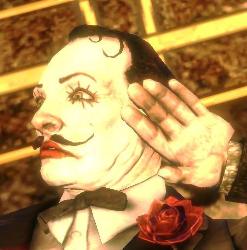
BioShockCohenClose.jpgCohen is a tragic figure. A man who was known for heights of artistic achievements in poetry, music, plays, and sculpture. Most of his character is explored in Fort Frolic, though you can find references throughout the game (and even some in BioShock 2). He was part of an intellectual elite that sought to elevate Rapture and extol its virtues through creative expression. There was always a hint of trouble, however. As Leigh Alexander explores, his struggle with his Muse speaks to the larger struggle and obsessions that Rapture would later face.

His inspirations are drawn from many different sources. His Wikia article mentions George M. Cohan, a man who was known for his prolific work with Broadway and the U.S. musical. In an interview with Edge, Ken Levine revealed how he is a Noël Coward figure gone horribly awry. Then looking at his in-game design, he reminds me of Salvador Dali, with his quirky mustache. One can also easily explore references to Cole Porter and other artistic giants. These men represent quite a variety of sexuality, both firmly in place and ambiguous. Clearly, Cohen is a man drawn together of many parts, and not constrained to a single image.

Cohen, like many artists, is seeking approval. In the context of his work, that means praising his writing, singing his songs, and providing lovely critiques of his work. In the context of his life, it speaks to deeper-seated issues at which he only hints. One such instance is an audio diary that includes a poem called “The Wild Bunny:”

I want to take the ears off, but I can’t.
I hop, and when I hop, I never get off the ground.
It’s my curse, my eternal curse!
I want to take the ears off but I can’t!
It’s my curse! It’s my fucking curse!
I want to take the ears off!
Please!
Take them off!
Please!
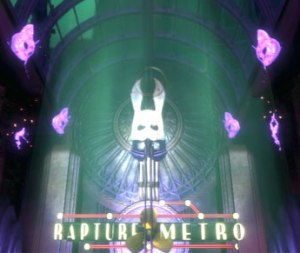
BioShockBunny.jpgThe image of the bunny mask is one that serves as very integral to Cohen’s work. It’s incorporated into his sculptures, seen around Fort Frolic, and even has place in his bedroom. The fact that it is a literal mask serves as a reminder that most people in Rapture do wear masks of some sort–compare audio diaries by people and about them, for instance. Cohen in particular? Levine expands upon an issue many people probably feel, “Cohen is wearing a mask because he’s not comfortable with himself.”

In comparison to the other elite players in Rapture’s power structures, Cohen is among the most visible to a public eye. As an artist, his work depends on him releasing bits of himself for the public to consume. He offers a service like many of the others, but his is one which begs for public scrutiny, adulation, and patronage. Scrutiny has the tendency to bring to light characteristics about one’s self that might not be comfortable to hear, however.

As “The Wild Bunny” illustrates, the mask he wears has allowed for certain actions. He can hop, but it is in vain. It never actually gets him anywhere. The reference to the ears is curious when I consider that Levine mentioned among the reasons that particular mask was chosen was for convenience, as it served as visually distinctive in a scene where a sculpture of himself is staring in a mirror. The game does have other masks, ones of cats and bird (the latter somehow recalling plague doctor masks that would infiltrate the Commedia Dell’arte scene), but in terms of seeing an image from all angles, the ears serve as a much more distinctive feature.

Of course, while Levine and his fellow designers may not have deliberately intended the meaning, the use of the rabbit is particularly striking when one considers the issue of Cohen’s sexuality. Rabbits have long been known as tricksters, and in how Cohen uses the player, as well as how he is using a mask to deflect close scrutiny of himself, it serves as a very apt choice of animal. Furthermore, rabbits are known as symbols for fertility (if you ever wondered why both eggs and rabbits are used as symbols of Easter), and in the case of Cohen, putting on such a mask can be seen as a further indication of his desire to project an image of a particular type of sexuality to distract from further scrutiny.

How do we even know Cohen is homosexual? Considering the time period, and the eras of nostalgia BioShock evokes, it is useful to keep in mind the Hays Code that was at one time enforced in the United States. Homosexuality was forbidden to be discussed outwardly in films, though this did not prevent the inclusion of topics broaching such. Instead, ‘coding’ became a way of recognizing when people were discussing a man or woman who may not be of the heterosexual sort.

While the censorship was deplorable, it did cause people to play with those boundaries and create their own set of symbols and meanings. Which is something we’re seeing here. Cohen is never labeled as just gay. What we have are audio files calling him an old fruit, for instance. Atlas discusses his insanity and talks about how he’s a Section Eight, which stood for someone unfit to serve in the military for mental reasons, or for reasons of sexual perversion. Atlas clearly means the former, though the hints of the latter do not seem far from the mark.

All of this is particularly poignant considering a line from Andrew Ryan’s opening speech as we descend to Rapture:

A city where the artist would not fear the censor.

Was Rapture as free as it claimed, or was Cohen censoring himself?
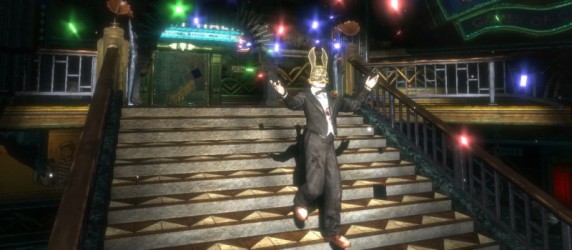
BioShockCohenEntrance.jpg

In exploring Cohen’s relationship with Silas Cobb, one of his disciples you are sent to kill, Cobb discusses the mentor situation he shared with Cohen directly, but also hints at something else: “I used to love you, I used to think you were a musical genius. You know why? Because you paid my rent, you ancient hack!” Love here could well hint at something sexual, but not necessarily. Emotions run high in Rapture, and among artists, the stereotype is that emotions are allowed to explode all over the place. However, the specific use of the word, in a world which doesn’t seem to flippantly use it, automatically made me examine the relationship and further words spoken.

When fighting Cobb’s minions, he further states, “It’s all a game, errand boy! Cohen, Ryan! Two old birds pullin’ on each other’s milk sticks!” The innuendo there is pretty straight forward, and in consideration with what else has been said, seems to paint a picture further insinuating at Cohen’s interests. Of course, this led me to wondering what, if anything, happened between Ryan and Cohen.

Cohen ends up hating Ryan. In one of his audio diaries he states very clearly:

I could have been the toast of Broadway, the talk of Hollywood. But, instead, I followed you to this soggy bucket. When you needed my star light, I illuminated you. But now I rot, waiting for an audience that doesn’t… ever… come… I’m writing something for you, Andrew Ryan… it’s a requiem.

As Levine opined, real hate is very difficult to come by without love. Therefore, the relationship they shared obviously ran high on passion, particularly in building Rapture. In the case of Cohen, it led to resentment of what could have been, the opportunities he squandered. Considering the hints at this sexuality, it’s difficult not to read into it some unrequited feelings.

Did he ever approach Ryan? Did Ryan ever reciprocate if so? The game never tells us, and Levine stated that if it isn’t in the game, the designers and writers don’t fully flesh it out as it would be pointless. As regards love, he stated, “Even if there is no sexual component, there is romantic component in a lot of peoples’ love for each other.” In my mind, this means we are encouraged to wonder, even if we cannot prove it. Either way, Ryan did end up in another relationship, and had his focus shifted by a civil war.
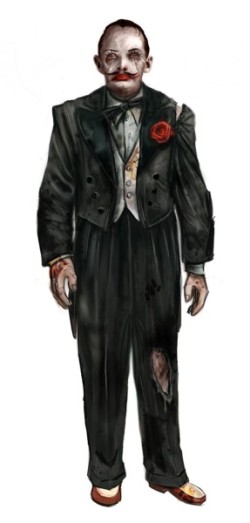
BioShockCohenConcept.jpgThe fact that Cohen ends up murderous means he is in no way different than the vast majority of Rapture citizens. Levine mentioned that among his team’s goals were to create human beings, which meant that everyone was treated equally. Everyone also had the same capacity to fall and become depraved killers. What’s curious about him is what he decides to do with that urge: make art.

Jack, as the player, interacts with Cohen outside of just these audio diaries, after all. He wants us to kill his disciples, artists he locked in with him in Fort Frolic, and has turned against. They have in varying ways betrayed him. The betrayal is focused largely on the fact that they wish to outgrow him and become their own artists, as seen with how each one we fight is a different type of splicer. One is nitro, one has the ice plasmid, and one is Houdini. They each have their own disciplines of art, their own persons, and it is clear that in Cohen’s rise to fame he became very much of a tyrant.

Cohen could not control his own urges, and the oppression of such seems to have pushed out a desire to be controlling of everything else. When Anna Culpepper is critical of him, he has her killed, with the help of Ryan. Due to his lack of control over himself, he attempts to exert that control over others. He is the prototypical Republican bathroom scandal.

As ever, he pushes that one step further by having the player not only kill his disciples, but photograph them in their death poses for his Quadtych, a piece whereby people can remember him when he’s gone. It is twisted on many levels, beyond just the grotesque quality his work now displays. The use of the word Quadtych is odd in itself, as it brings to mind the often religious triptych. The proper term for a four-paneled polyptych would be tetraptych, however. This both distances itself from the actual artistic conventions of that type of work, as well as calling upon the reverence that particular medium brings to mind.

The work is also disturbingly sensual in some regards. He requires visual proof of the dead forms of his former students for his work of art. The reverence for their death serves as a warning to others of what could happen if they cross him, as well as showing his power over them. The mixture of the ability to wield power over their lives after they have rebuffed his tutelage, as well as to deliberate over their corpses so long speaks to a man who sees beauty in what the player has done, regardless of whether or not the player does.

How one decides to deal with Cohen could theoretically be said to reflect how one feels towards Cohen himself. Unfortunately, it would be more apt to say it reflects the player’s feelings toward achievements. Three achievements are associated with whether or not you attack Cohen: Irony encourages you to take a picture of his corpse; to get all the Power to the People stations, you must coax him out of his bedroom in Olympus Heights to attack you; and Found Cohen’s Room is requisite on the same as the previous. The message the achievements get across is that Cohen is an obstacle to remove, even if you can leave him alone. For me, playing on a PC where achievements did not matter, it was reminiscent of the decision to save or harvest the Little Sisters.

Which fits in with the BioShock team’s vision of everyone being on equal footing and treated the same. He is considered a boss character, is no easier than other fights, and warrants his own achievements, similar to Steinman, Wilkins, Ryan, and Atlus. He is reinforced as a major player, which should have already been obvious in how he traps the player in Fort Frolic.

Sander Cohen serves as an example of what repression can do to anyone, though it may strike a particular chord with issues concerning sexuality. It is also heartening to see that BioShock not only captured an era’s politics in the larger sense, but did not shy from exploring how it affected individuals from many different backgrounds. In a world where Cohen was not free to be himself or fully admit to himself who he was, he quickly succumbs to the lure of becoming a powermonger and control-freak. At the same time, his own struggles make it difficult to not have equal measures of empathy as revulsion.

Many thanks to Ken Levine for taking the time to discuss this post and Sander Cohen with me.

Posted in Character Analysis, LGBT, Uncategorized | Tagged , | Comments Off on Queer Characters: BioShock

2016: Persona 4 Thoughts

I recall an IRC exchange with Matthew Gallant when Persona 4 released. This was during perhaps the more prolific part of my writing about games career, and I was covering a lot about sexuality. His excitement was that Kanji seemed to address sexuality at all outside the norm. It was a game I constantly meant to come back to. Approximately two years ago I started an earnest attempt to do so. Of course, it was punctuated with a lot of putting the game down and coming back to it. At the very start of the year I finally finished it! Yay!

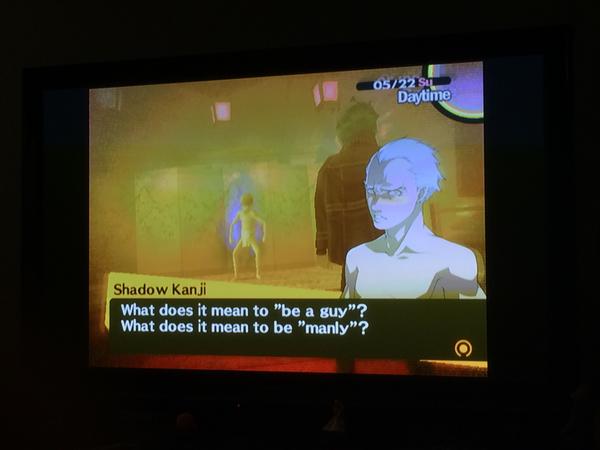
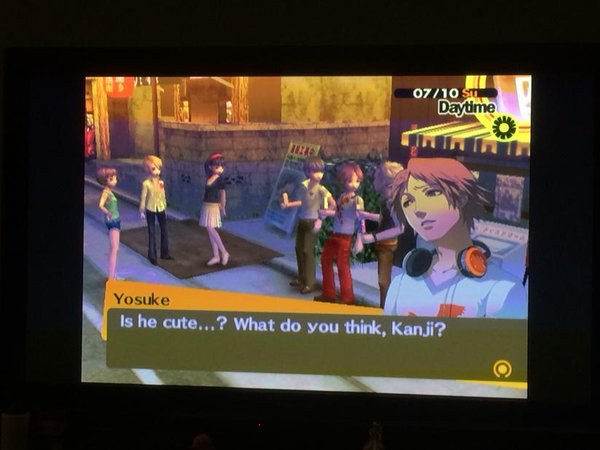
Naturally, I was rather curious as to the depiction of Kanji and how his dungeon is explored. A steamy bathhouse, where he constantly discusses his lust for men, it seemed obvious what his sexuality would be. The answer to whether or not he is interested in men sexually seems rather more ambivalent, though. Having a crush on Naoto, a male-presenting detective who later comes forth as a woman, seems to further confuse him later. Exploring his social link also seems to play with the idea of feminine and masculine.

P4Kanji

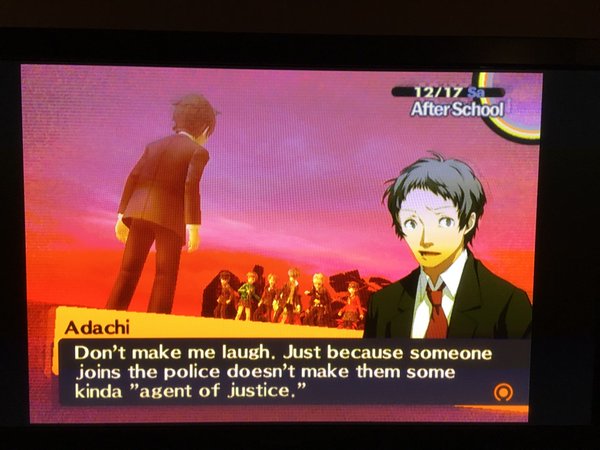
You see, Kanji is more interested in feminine pursuits, such as making dolls. He has a sensitive side that he seems to cover with a brash, rebellious exterior. In many ways, it seems to expound on the ‘we all wear a persona when interacting with people.’ In fact, when dealing with Adachi at the end, I was struck by how one of the messages that I took away is that in a world increasingly connected, it can be easy to slip into having one unified persona across multiple platforms, rather than accepting that we contain multitudes. However, it felt like Persona 4 was very confused as to how to approach gender.

What did not aid this in particular is that Yosuke is constantly teasing and mocking him about it. Asking his opinions on how a guy looks. Making comments about how he’d be uncomfortable with Kanji sharing a tent with him if Kanji did actually, y’know, like the D. Yosuke seems obsessed to a point that were his character given a slightly different glance, one could surmise his own homophobia could well be rooted in issues with his own sexuality.

P4Yosuke

When I started coming out to people in my past, after a full year of having been out, one of my male friends confessed to me that he watched gay porn at times, because he wasn’t quite sure what he liked. There is room to explore such, and I feel like a lot of our media, Persona 4 included, fails to fully explore how confusing sexuality can be as a male teenager. Kanji ultimately feels to me that he is mostly interested in pursuing his traditionally considered more feminine pursuits, and has a thing for more masculine-presenting women. Which would be fine in and of itself to explore, though it is confusing that both his and Naoto’s plotlines start off seeming to explore instead queer plotlines.

Naoto is a character I similarly felt confused by. This is a character who is very obviously presented as male at first, with titles like the Detective Prince, and whose dungeon encounter expressed bodily transformation desires when finding out ‘Naoto is really a woman!’ What this eventually boils down to is that everyone finds out she’s a woman, that she adopted a male persona as a mapping on to her favorite detective novels, and that it was a way for taking her seriously, how she saw the ideal detective (and seemingly saying that she felt it would be easier to be taken seriously as a man in that field).

Again, parts of this actually sound worth exploring: the need for women to adopt more masculine traits to make any headway in certain fields, how feminine aspects are undervalued, and the general professional hazard of being a woman who wants to be taken as exceeding at her job. With Naoto, none of this seems to actually gel, though. Instead, everyone suddenly feminizes her, sometimes to a discomfort that she seems to express. In couching it in the introduction of maybe this character is trans, it seems like the intent was to make this edgier! And then back down and make it all more ‘palatable.’ Again, rather than ambiguity, we seem to be presented with ambivalence about how to present Naoto to the audience.

Which means that in general, I enjoyed the larger strokes that Persona 4 was trying to paint with: we all have varying masks we don dependent on the situations we find ourselves in. Our ‘true selves’ are more complicated than a single vision, and this means we choose what would be more successful. As it regards exploring gender and sexuality, it feels like there could have been a good base to explore what a confusing mess it is to be a teenager, especially when you may feel isolated from everyone else’s experiences, but that is not what the game goes for. While it seems people maintain there is ambiguity in Kanji’s sexuality, it feels like ultimately they might leave it open for him to be bisexual, but do conflate his feminine interests with being responsible for the majority of his confusion (I don’t understand how this conflates into a bathhouse, as I don’t see that as necessarily in the same vein).

P4Adachi

One last thing that did strike me, and seems like it will be a central theme in Persona 5 going forward, is that we have reason to suspect and question our authority figures. Adachi flatly admits his reasons for becoming a police officer have little to do with justice, and more with holding a gun. It is a sober reminder that we can have a tendency to project a persona on a profession, sometimes forgetting the very real, complicated, messy, and flawed (some much more so than others, even murderously so) humans behind the mask of a profession.


Posted in Uncategorized | Tagged , , , , , , | Comments Off on 2016: Persona 4 Thoughts

Queer In Marvel Heroes

My boyfriend and I have found a game into which we can settle for now: Marvel Heroes 2015. For me this is an amusing turn of events: it’s been within the last handful of years that I have become rather enamored with the Marvel Universe (having mostly stuck to indies and DC Vertigo before), and I did not really expect to be sucked into a free-to-play MMO of sorts. Part of how I snagged my boyfriend into the Marvel Universe (fairly easy considering the media saturation currently happening) was by reading Young Avengers and seeing queer representation in Wiccan and Hulkling. It then helped to see comics such as Ms. Marvel starring Kamala Khan, having Captain Marvel round up the wacky space hijinks, and She-Hulk to represent an amusing take on the legal profession (somehow we have found ourselves surrounded by a cabal of nerdy queer lawyer friends).

So, most days we at least log in to Marvel Heroes 2015, and at this point we’ve spent a fair bit of money in the game. In fact, two of the more significant purchases in my memory are for skins of existing characters: Scarlet Witch’s enhanced skin to turn her into Wiccan (a gay Jewish son of hers; it’s more complicated, but that’s comics) and All-New X-Men’s Iceman skin (he was recently outed by Jean Grey in the All-New X-Men run). Were they to release an Ultimate Colossus skin, I would likely also pick him up (he also being of the man-loving-man variety).

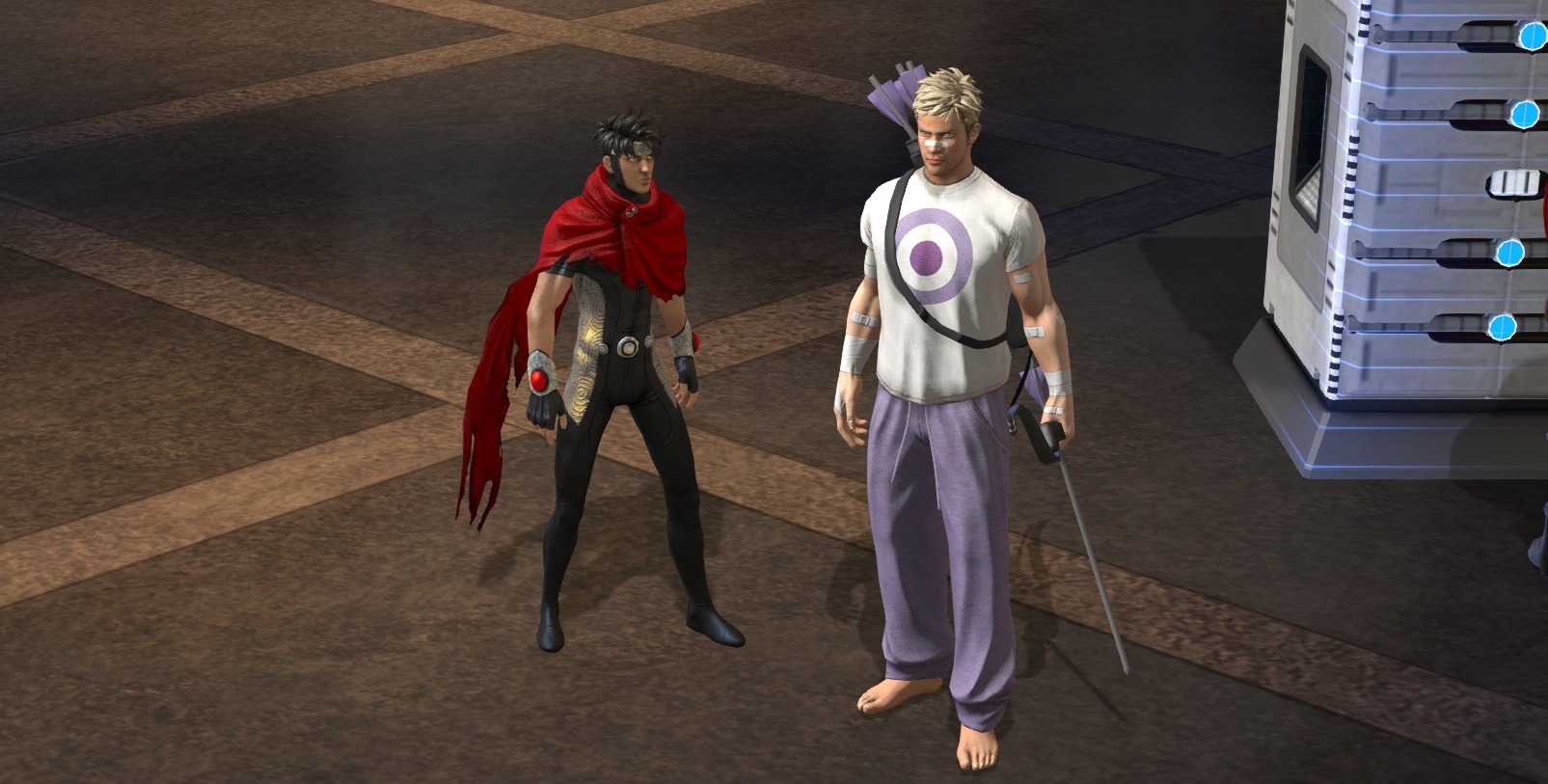
My Wiccan character standing next to the boyfriend's "Hawkguy" character.

My Wiccan character standing next to the boyfriend’s “Hawkguy” character.

Marvel Heroes 2015 is among that line of action RPGs that sticks to an isometric view and is heavy on its loot; these skins I have purchased are cosmetic (and in the case of Wiccan, have a completely different vocal track). Wiccan actually does reference Hulkling, his in-comic boyfriend, exclaiming that Teddy (Hulkling’s actual name) will never believe how easy Wiccan is finding it to fight as a real superhero. Iceman will hit on women, however. This makes sense, as the comics change outing his younger self pulled forward in time (again, comics) only occurred recently. While some would argue there have been hints historically, reading a text as queer is not new, and is not likely to go away any time soon, Supreme Court rulings only carrying so far in how far they can push change.

Today, as I was playing Iceman to farm some daily Shared Quests, Iceman in fact hit on Ms. Marvel, “Hey, is there a Mr. Marvel.” Wearing this young Iceman skin, the one who was recently outed, it struck me as odd to suddenly think of my character: here is someone trying so hard to hit on women that it is a bit overbearing, and probably even more telling considering how his sexuality is currently known to me.

This is odd.

The reason this is odd for myself is because I haven’t done much thinking of who my character inhabits in this universe of Marvel’s where the varying realities and alternate realities can comingle and all exist next to each other (good way to explain how you can have dozens of Scarlet Witches or Doctor Dooms running around on the same screen). This is a game whose primary focus is the game, the story serving seemingly as an also-ran of the typical comic book events. If you’ve played either the X-Men Legends or Marvel Ultimate Alliance games, you can pretty much hash out how that formula goes.

Bobby Drake, aka Iceman, in his All-New X-Men oufit.

Bobby Drake, aka Iceman, in his All-New X-Men oufit.

Which made me think in particular about the mutant metaphor that Marvel relies on: mutants are a minority among minorities (a point Chris Claremont makes in a forward to God Loves, Man Kills, which also made me raise an eyebrow). The idea is that the mutants are loathed and hated across the world: laws are set up to restrict them, they are lynched, and everyone seems invested in somehow controlling, subjugating, or ridding themselves of them as a species.

Games have not communicated this well; if anything, they have proven why people should be frightened of these super-powered heroes who are able to wreak havoc at a whim. Part of what seems to make the mutants, and the X-Men in particular, so appealing is their use of their powers and fighting a struggle that they always seem to surmount (not without casualties). This makes most games about them into a power fantasy, though the minority status is relegated to barks from enemies calling them less than human. Or to quote some Purifiers from Marvel Heroes 2015, “Human rights are for humans!

While at Wabash College, one of my later English courses was on the character of New York and how it not only has been depicted in varying forms of media over the ages, but how that character has shifted with its varying populations. Comics, naturally, became a talking point. The professor, with a mischievous look in his eyes, listened as I explained the mutant metaphor as a parallel to the struggle for queer rights in the 1970s, before he jokingly and tauntingly mentioned that the Jews had claimed the X-Men first.

I’ve met many people who feel like outcast in some regard who identify with the X-Men, and the mutant struggle. The frankly insulting comparison of Professor X and Magneto as analogues for Dr. Martin Luther King Jr. and Malcolm X is frankly so because it tries to simplify into a base comparison what a mutant struggle would be as compared to the black civil rights movements. It is not a good analogue to map it so squarely into real events in our history, even if we can see glimmers of it in varying struggles among different communities.

This makes me wonder what a game that tackles that would be like: it is the struggle of depicting privilege and having a feeling of not being able to control your fate as easily as a more privileged person might. That’s hard to convey in a game where you just beat people, beasts, and demons up while leveling and grabbing loot. Perhaps in a more story-focused game, which theoretically the announcement of the Telltale Games collaboration with Marvel could bring, this could be conveyed. However, the quest to constantly better myself along the exact same track as someone like Tony Stark or Thor (where I am to be an equal in that system in the name of game balance) makes those odd barks about my character’s inhumanity, or my noticing a slight discrepancy with a currently evolving storyline about adopting further minority stories, seem like it’s more of an, “Oh yeah, aren’t I supposed to be prosecuted by the public?” moment than an actual event in the game.

Posted in Uncategorized | Comments Off on Queer In Marvel Heroes

Rewinding My Personality

This post will contain spoilers for the first episode of Dontnod Entertainment’s Life Is Strange. There are content warnings for violence and privacy intrusions.

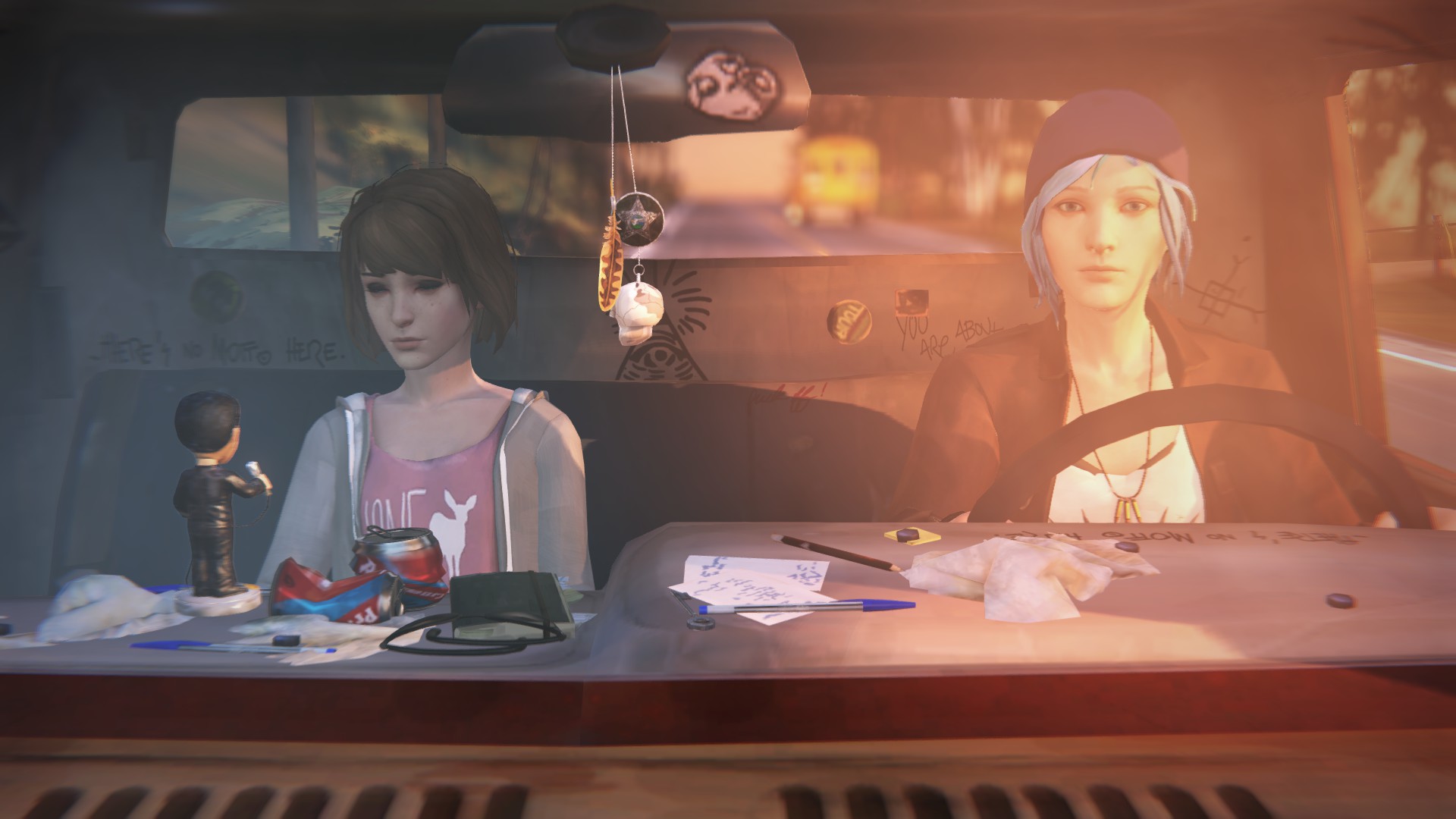
I liked the first episode of Life Is Strange, though for a review I would recommend Maddy Myers over at Paste Magazine. Similarly, I was not surprised to see Todd Harper look at the rewind mechanic of the game. The protagonist, Max, gains the power to rewind time, and over the course of this first episode feels very much like a tutorial for how to use that, providing a sandbox in which to try it in various scenarios. Harper noted an interaction with drones that I completely missed, whereas I noted a few people completely walked by the fact that they could help a young teen woman not be hit by a football later in the episode.

Harper further elaborates on other games that have used the rewind mechanism, but what I find interesting is that in this game, it saves me the time of being a save scummer. Instead of saving right before a decision (not actually possible, as this auto-saves), making both decisions, and then sticking with one, I can easily just start rewinding time after a decision and see how it goes. This actually caused some waffling on my part: wanting to see how both options were presented before making a decision. Max does comment on this, never giving an indication as to which would be better.

LifeIsStrangeEp1

How does the player define better? I began to realize I was slowly learning more about Max the more I played with rewinding time. Here was a character who had just moved to a town in which she had lived before, is attending an elite school, and apparently has a great future as a photographer ahead of her. Oh, and one of her old best friends lives in the town. However, her need to be liked can be reflected in her ability to rewind time, as Harper notes. She doesn’t naturally have the answers to many of the questions her classmates pose her, which puts her in the position of being able to either walk away or use her ability to gain their good graces.

In particular, the achievements in the game seem to try and push for that narrative, as the majority are for taking photographs, a handful of which only occur when getting a certain rewind portion correct and then photographing the result (a football missing a student’s head leads to it hitting a window, which can then be photographed; or a bird whose life is saved by lifting a window allows for the same bird to be photographed again in a later scene).

Which leads to a feeling that to achieve the full intent of the game, and what is expected of Max (at least from the developers’ point of view), one has to use this device to do as much as possible, and to test the extent of these powers. Therefore, better seems to indicate use it whenever possible, but at the crux of important decisions where one has to go one way or another, and can’t rewind to come up with a third option, there is no definitive answer, or even one so basically broken down as paragon/renegade. Gather as much information as possible in order to make the decision you feel would be best.

In particular, in a later scene, Max’s former best friend, Chloe, is being harangued by her father-in-law. I had guided Max to hide in a closet and the decision came up whether or not to interrupt the scene. Having earlier gone to fix Max’s camera, I had snooped around the house, finding evidence that Max’s father-in-law was both the security guard who had been harassing Kate earlier, and that he was creepily surveying the entire campus with cameras. A teacher had earlier asked Max to sign a petition to stop this from occurring, though it appears to already be in effect anyway.

Much of this can actually be skipped, but it meant that in that moment, knowing that this father-in-law was a surveillance fiend, I felt Max, whose questioning if anything she does is correct, would have chosen to remain out of the picture and not focus on her for now. She has an odd power set, is new-again in town, and has very few close friends. Chloe would later bemoan Max not getting involved, which seems out of character for her, considering she expressly stated that Max being caught there would have disastrous consequences for her (then again, we don’t know Chloe’s full story, and she had been getting stoned right before this).

This Telltale games style of adventure game seems to thrive on difficult decisions, and I much appreciate the fact that not only has Dontnod added a mechanic where I don’t feel even the urge to research my options beforehand, or needing to go look up what happens afterward, but embraced it within the framework of Max’s own confusion and willingness to be liked. It does inform about not only her own insecurities, but mimics what I felt my own reaction was in trying to figure out how I would even approach this particular run through the game. As I was getting to learn who Max was, she is learning what her limits are, and together it felt like we were both coming to terms with that before heading further into the story.

Posted in Character Analysis, Criticism, Dontnod Entertainment, Impressions, Life Is Strange | Tagged , , , | Comments Off on Rewinding My Personality

Fumbling Through Wolfenstein

Content warning for discussions of genocide, extreme violence, and other atrocities associated with World War II. Spoiler warnings for Wolfenstein: The New Order.

I am very much a third culture kid. Despite being a dual-citizen of the US and Germany (and spending good portions of my life in both), in the US I am considered a German, and in Germany I am considered an American. And yet, I find both cultures to be fairly alien to me quite regularly (it is not uncommon to have friends express shock that I haven’t experienced this thing or another that everybody else apparently has), but can navigate both with a fair amount of ease (it helps that both of these cultures privilege being white). At the same time, since most of my schooling has been in the US, this means I have had to become very accustomed with World War II.

Being obsessed with wars was something that I saw many teen boys do as I was growing up. Having to listen to details about battles during the Civil War in front of small churches, or something akin, were a grand to-do around lunch time. I found myself interested in the social aspects of war, and because of the atrocities my country had committed against classes of people (Jews, Sinti and Romani, gay men), I had to constantly prove I wasn’t some German who was ignoring the past (because that’s apparently a thing some USians seem to think of Germans).

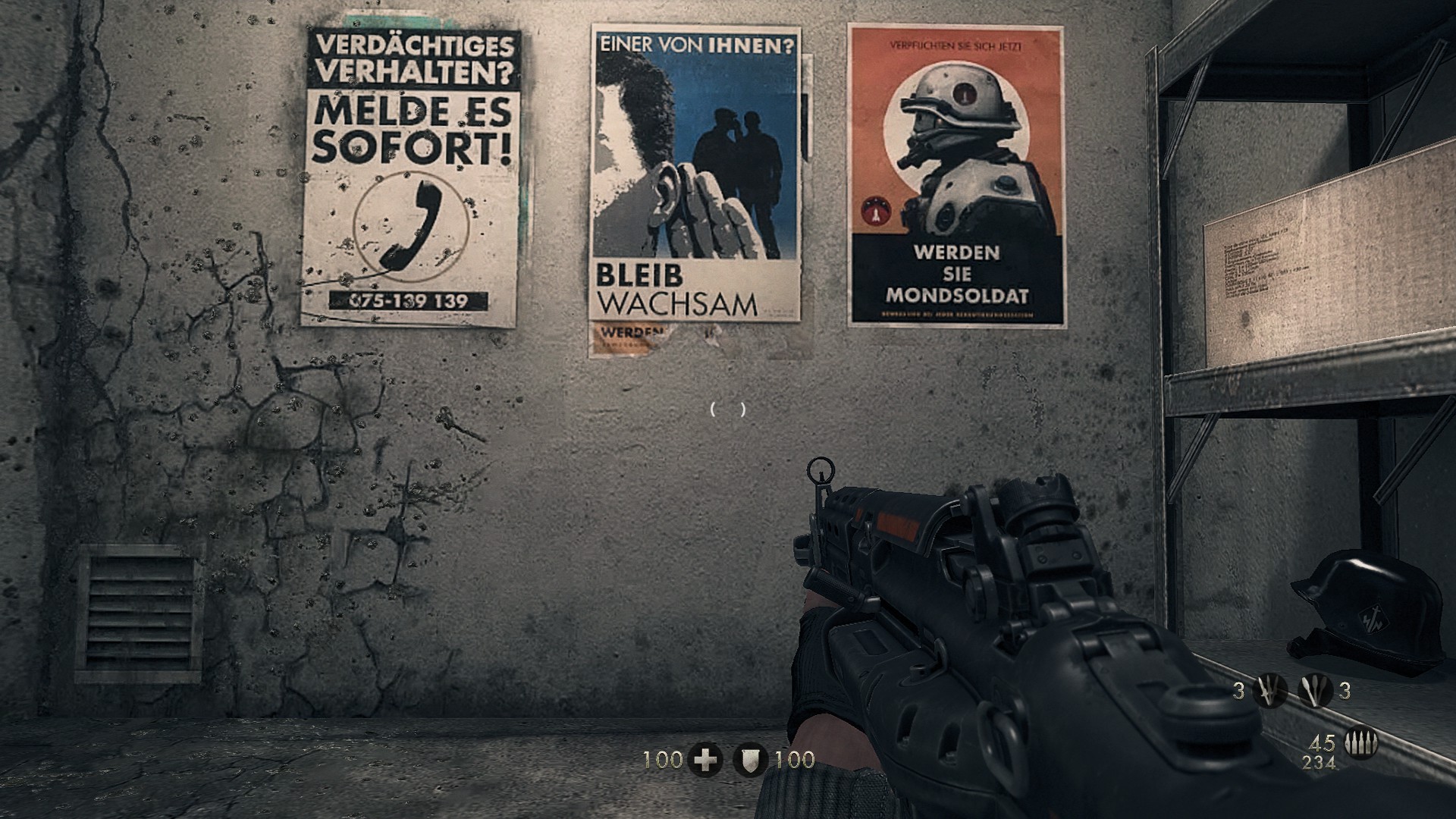
Therefore, I wanted to play through Wolfenstein: The New Order because I had heard it tackled topics like concentration camps and such. Recently, my maternal grandmother, who is German, had also passed, and there is some small amount of guilt there for never learning fully about her experiences growing up as a young girl during the Third Reich.

201810_screenshots_2015-01-05_00043

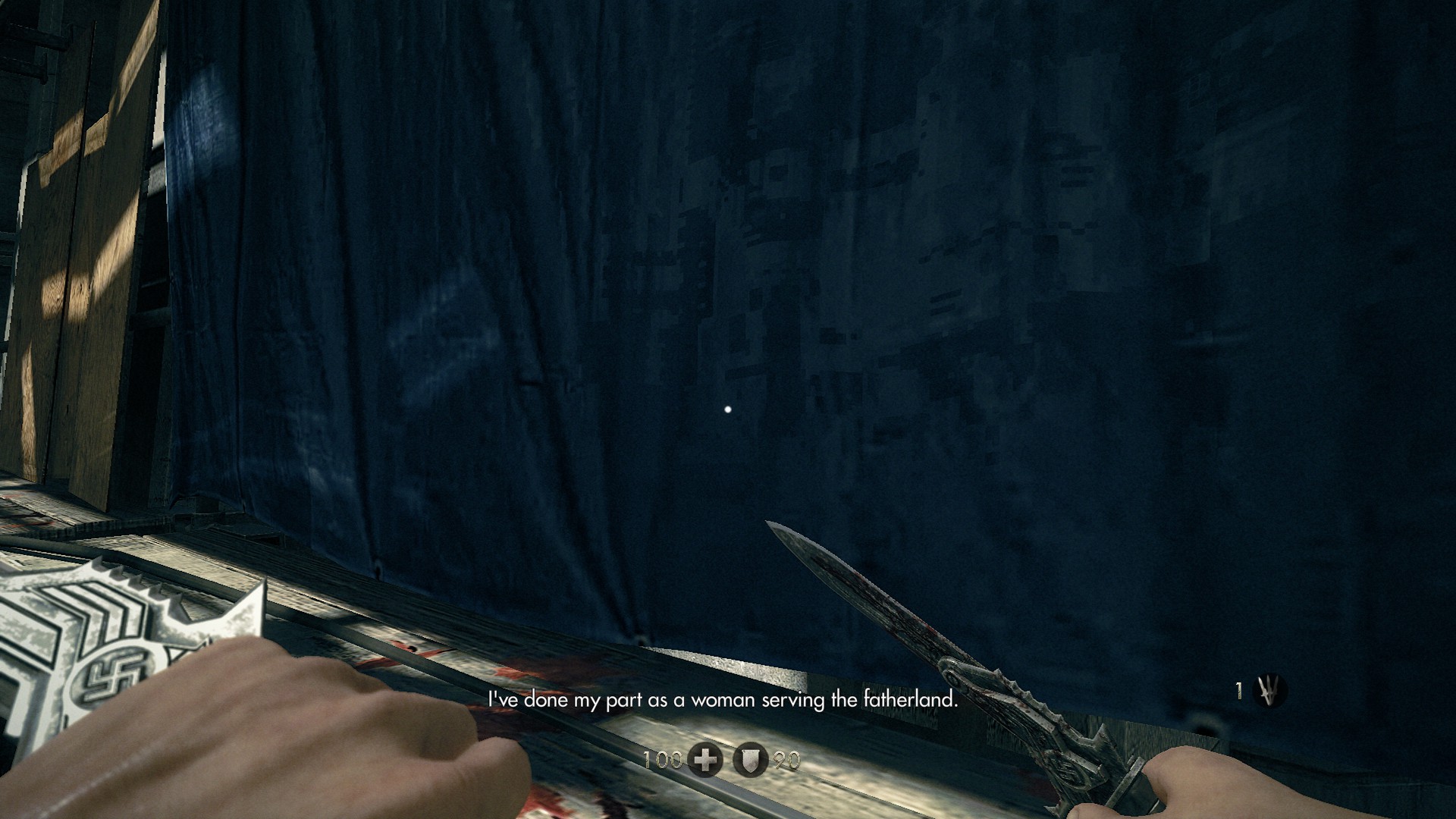
And yet, playing through, I was left with some unease. Sure, there were depictions of horrible things, and there was acknowledgement of the horrors of the Third Reich, but going through the concentration camp felt fairly sparse. It was almost like walking through a village in Skyrim, or Lothering in Dragon Age: Origins. This may partially be because the true atrocities of concentration camps were the experience, which the protagonist, B.J., did not really have to go through. There is a scene where a machine tattoos his identification number on his arm (and a gruesome scene later where he cuts it off), but there was never really any sense that what I was experiencing was that bad.

B.J. is removed from a lot of what has happened. He is a blonde American with a square jaw, blue eyes, and a kick-ass attitude. He is the quintessential action star who is useful for killing Nazis.

I was also rather curious as to what it was like to live in a futuristic 1960 where Germany had won through the use of advanced technology (that they had stolen). Being among the rebels, however, there were only snippets here and there. A mother wanting to report her son for putting on lipstick, a letter detailing the story of a woman whose Sapphic desires would get her into trouble, and some audio files from B.J.’s love interest reading a diary about a woman who was murdering Nazis and had an abortion. Most of the context clues of the world lay in scattered newspapers printed in their original language (with translations available to the player).

There was an attempt at world building, but because of the verbs available to B.J., and the company he keeps, it became rather limited in what it could show me, the player: the German and American who grew up and has read through a culture that had to deal with its guilt following the end of the war, and those that see it as a triumph on the world stage at the exact same time.

One thing I did appreciate is that the Nazis were humanized. It may be strange to wish humanization for Nazis, but I feel it important in the fact that these were humans who committed these horrors and atrocities. We must not forget that all it takes is humans to be so cruel to each other. In fact, with the push into using machines, robots, and enhanced humans, there is the active decision to give part of their humanity up in order to achieve their goals. There is horror to be found in complacency with the status quo that robs others of their humanity.

In particular, the second nemesis B.J. faces is Frau Engel, a woman who runs the concentration camp that B.J. visits. Her first encounter with B.J. is on a train onto which he has smuggled, where she tests whether he is an undesirable by playing a game where the player has to choose a card that best illustrates a word or concept she throws out (sexy, etc.). The trick is that he can’t be an undesirable, because otherwise he would attempt to take the gun that was laying on the table and shoot her (the conceit being that undesirables have no hope, and that they would be pushed to desperation).

201810_screenshots_2015-01-08_00076

Later, in the concentration camp, it is possible to overhear her talking with her effete male lover that she gets to have her fun now: she raised her children for the empire. Her selfishness fits in well with the sadistic character who shows people old vacation and war photos to see if they crack under the strain of her eye that can ferret out impurities. In fact, her lover, Bubi, seems to have a certain effete affectation to contrast with her more domineering attitude. I could never quite tell if the game what the game wanted me to think of him, where his lover, Engel, was clearly supposed to be an antagonist. She is far more present, and far more a danger to B.J., coming back even after having her lower face crushed by one of the robots she uses to control the concentration camp.

Then, in between chapters, B.J. returns to the rebels’ base. For the most part, these characters are distinct for the fact that they are outcasts in some fashion or another, banded against the system that would likely be rid of them anyway. One of these rebels is J, who seems to be this alternate timeline’s Jimi Hendrix: a black man who plays guitar left-handed and infuses the game and B.J’s reality with some psychedelics.

When B.J. asks why J doesn’t fight, J points out that the US was not much better. That the America B.J. fought for, the freedom he thinks he stands for, is all based on his privilege. Were he black, he would not likely have the same views.

This aligns well with the fact that Deathshead, the main antagonist, accuses BJ of just slaughtering Germans indiscriminately, and not being any better than the injustice against which is supposedly fighting. This argument does not work as well for me, as the Germans are not quite characters in and of themselves; the sense of a family life is hinted at, but almost every interaction is with a soldier, who yells out the same barks in German, and who must ultimately be seen as nothing more than an obstacle. Still, it does bring to light the fact that there is no black and white in this particular version of the world either.

It therefore makes sense that B.J. ends up sacrificing himself at the end: given that he is an American who woke up to this world after being stuck in his body for many years, and never truly inhabited this world, he is not one who can affect change in it. He did not live under the yolk of oppression that the Nazis had placed on the world. Plus, as J put its, he is complicit with ‘The Man,’ the big US institution that fought for freedom while not exercising those rights on its own soil. He is a man of action, who is useful during the verbs that require me to kill and destroy. During understanding cultures who have seen horrors he cannot quite fathom, he would be worthless.

However, even though I grew to appreciate the glimpses that were being taken, I realized that this was not a piece of media I would have discussed as a thought exercise with my grandmother. I could gladly discuss Draußen vor der Tür or Die Blechtrommel, this one had more for me to think about as someone who bridges that gap between (and often feels estranged from) both US and German cultures.

Posted in Character Analysis, Criticism, Informal Review | Tagged , , , , , , , | Comments Off on Fumbling Through Wolfenstein

Gaming Made Me: How I Learned to Stop Fearing and Love Decisions

As a child, I was deemed a born diplomat. The easiest anecdote to relate was when my parents would ask whom I loved more, and I would respond both, giving a compliment to each. As is often the case with a certain people, I found my teen years full of throwing everything away and then doing the opposite of what would please everyone. After graduating college? That all became muddled, and only recently have I found myself more confident in my ability to make decisions for myself.

Part of this was due to economic stability, but another was learning who I was outside of the environment provided by school. This is the type of environment where I was always on; I was always playing a role. To varying degrees, I still do this, but I am much more aware of it all and much more in control of that image based on whom I may be around at any given time.

Which is why I found games to be an essential playground for that discovery. Playing games where I could make choices, no matter how superfluous they were to actually changing the plot, made me realize things about myself. It was a chance to be on stage again, essentially. This also meant arguing with myself and considering the decision I had made.

261030_screenshots_2014-08-30_00013

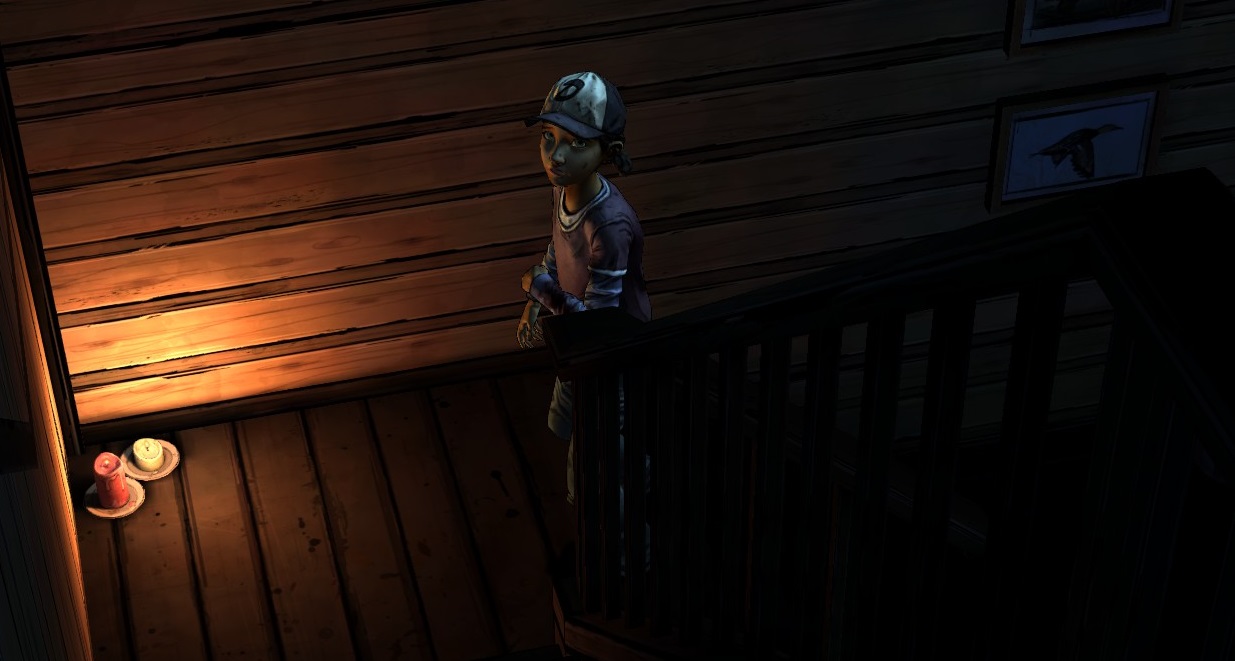
It occurred to me over this past weekend, as I played Walking Dead: Season Two, that I was making decisions with a very firm idea in mind. Part of the impetus was that I only had a limited amount of time to make a decision (not really, since I play in windowed mode, I can click outside the window and stall, but I have been purposely avoiding this tactic). Therefore, I found my Clementine tired of everyone’s immature bullshit. Here I was, a small girl, leading a group because they were too incapable of functioning. Granted, this is largely because everyone has varying degrees of mental health issues, considering the environment in which they find themselves.

Then again, balancing between Clementine and my own projection of her reactions, I just figured as a leader, I had to start making some harsh decisions considering the survival of the group. Sure, this led to some questioning of my motives and tactics as regards other characters in the game, but that’s what makes this more interesting to me than just killing demons over and over again in Diablo 3 (though there is a certain joy in that as well).

This was further reiterated in my recent replay of the Dragon Age series. In Origins I found myself playing a politically machinating noblewoman who married Alistair for the chance to place herself and her line back in good standing, more than actual love of him. Whereas in Dragon Age II, I found myself playing a character who was trying to constantly be the big sister to everyone. This led to good mix of responses that were incredibly brunt, diplomatic, and snarky in good measure. Breaking away from the paragon/renegade system meant I felt more free not to game the system, so to speak.

Which is relatively new to me: not gaming the system. I can spend hours theorycrafting over various card games, RPGs, etc. Yet there is a certain thrill at abandoning this when it comes to storytelling, and that is the chance to become what I believe an actual human being would be in these situations.

So, games have more recently given me a more measured reaction to situations. I feel more confident in my ability to analyse a situation and be okay if I don’t make the 100% perfect decision anymore. Not having to game the system has moved me away from the same analysis paralysis I would often face in real life, worried about how others would perceive my actions. It’s a common lesson to learn, but in my case, games helped me grasp on to that concept once again after a tumultuous past few years.

Posted in BioWare, Design, Dragon Age: Origins, Impressions, Mass Effect | Tagged , , , , | Leave a comment