You’re brilliant, gorgeous, and ampersand after ampersand

Here there be spoilers.

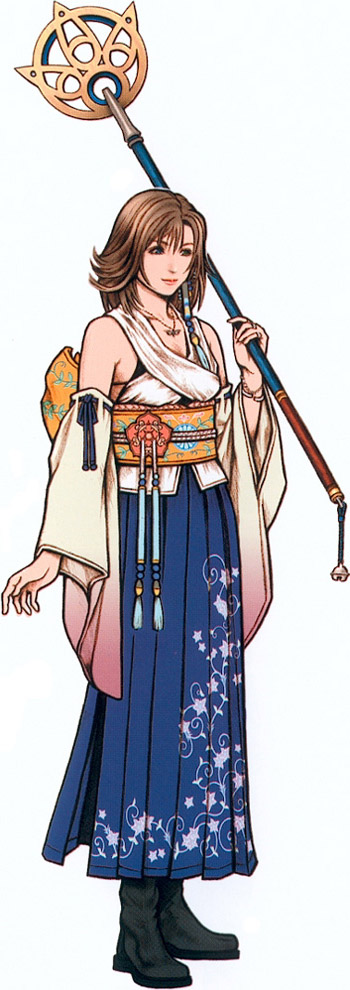
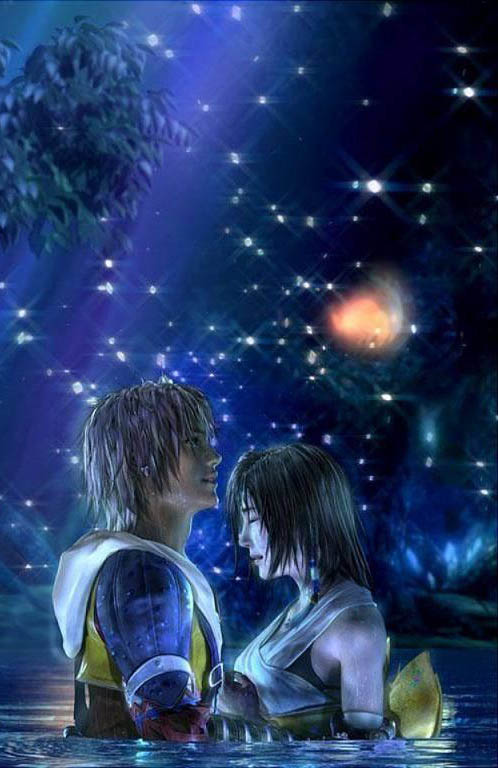
Star-crossed lovers are a pretty common and popular motif. From Romeo and Juliet to Ennis del Mar and Jack Twist, we human beings seem to be moved by tragedy when it comes to lovers who are fated to never actually be. Final Fantasy is no exception to this, and particularly Final Fantasy X, where it’s clearly spelled out from the start that this is not meant to be.

The problem is, it did not work for me, and I contemplated why.

Quite some time ago I took a stab at why romances in games generally fell flat. Too often, romance in games tends to be purely mechanics driven, which leaves a feeling that the art of love is nothing more than a chore that does not offer much in return. A player can put into the relationship, but receiving is normally handed back as items or some manner of stat boost. Sentiment? What’s that?

Final Fantasy X operates on a different level, as does most of the series. In a more linear-driven plot, Tidus can only fall for Yuna. Also typical of the series, the two lovers are still teens who must take on the weight of the world, some manner of love between themselves, and deal with their own issues. Again, this sort of trope is hardly rare, and can be seen across any multitude of media.

The story is rather weakly presented, however. We are told they are in love, therefore it must be so. Somehow some level of attraction exists over which we have no control. In fact, the primary plot points, and any romance that occurs, all happen when the controller is out of my hand. The rest of the time I am engaging in any number of activities: fighting random encounters, playing Blitz Ball, capturing enemies for the monster arena, or racing chocobos.

The story wants me to believe that these two people happen to build a love for each other that results in a cut scene that is beautiful in imagery, but empty in sentiment. As Tidus and Yuna kissed, I just looked at the screen, raised an eyebrow, and mouthed, “Oh, really?”

I understand the reasoning behind the inclusion of a romance in the story. It is supposed to pull on our emotions and give us that bittersweet longing for our own romantic escapades. Tidus’s yearning to save Yuna suddenly has an element to it that seeks to humanize him by giving him purpose in a world to which he has no other significant bonds. For Yuna, it offers a respite and a person who is not wholly enamored with her father and is not in awe of her quest.

That makes sense.

Except the characters themselves are not very well written. Yuna is a one-dimensional archetype whose relationship with her parents is never explored, despite her father’s constant presence in the game. It does not help that her voice actress decides to pause every four or five words to try and add some maturity and weight to otherwise fairly straight-forward lines. Yuna is supposed to be contemplative and mature for her age, but often just comes off as socially awkward and bumbling in sentiment.

Tidus has a host of issues surrounding his father and mother, a very blatant nod to Freud. His Oedipus complex branches out to actually seek the destruction of his father, who has become Sin, to not only redeem his manhood, as he hoped to establish through Blitz Ball, but save Spira and prove himself to the woman he loves. Personally, I found the relationship issues between Tidus and his parents more compelling. Within them lies some form of conflict that hopes to resolve itself.

While it would be interesting to view Tidus’s longing for Yuna in the scope of seeking to replace what was lost to him with the death of his mother, she is barely touched upon beyond knowing that Tidus longed for her love, which was always reserved for his father. In such a light, the romance would make sense, but the story is instead bogged down with the impending doom of Yuna, whose relationships with anyone are never actually explored (even with her supposed childhood companions Wakka and Lulu). This death sentence, by all means, is significant, but it serves as an outside agent, not giving us much of the characters themselves with which to work.

In order for the characters’ relationships to work, we need more fully developed characters. The problem in this particular game is that we’re given hints of many other issues, but then never have them explored. Either those loose ends need be cut so as to make a more concise narrative, or those ends need to go in some direction that does more than make us wonder if we’ll ever reach that cut scene explanation.

The reason stories like Romeo and Juliet, Tristan und Isolde, and Pyramus and Thisbe work is because they very clearly set out the love and the conflict, and work out the fight for love despite the conflict (likewise, it does not end well for any of them). Final Fantasy X seems to throw in the love story as a matter of spice, but does not actually ever seek to resolve it within the framework of its own story beyond a wistful glance at the future. When Tidus suddenly vanishes, I found myself wondering if anything ever really happened after that kiss, or if this was supposed to be meaningful. The fact that none of my own actions ever attributed to this romance meant I quickly dismissed it as not meaningful to my own game. They are star-crossed (overseen by a malign star), but lovers? I remain less than convinced.

Tagged , , | 7 Comments

The Aeris Syndrome

Here there be spoilers.

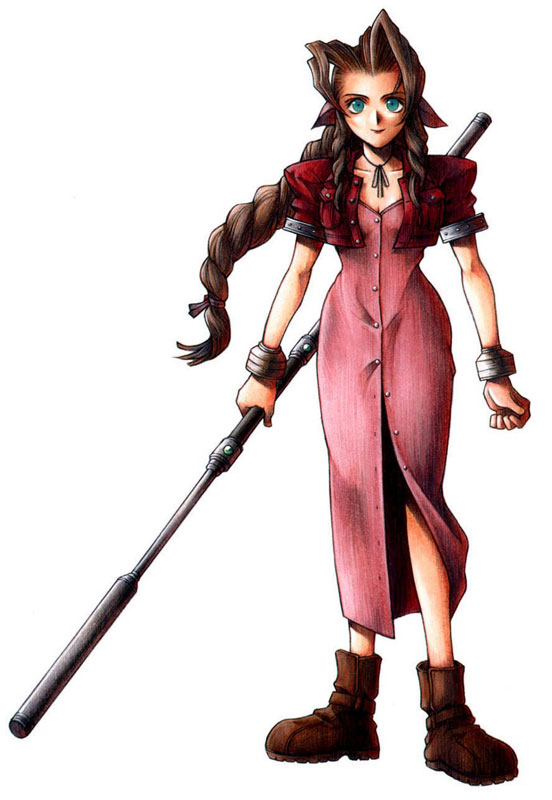
A young woman is in your motley crew. She is descended from a mixed heritage, but one parent belongs to a line that offers hope to the world–a world that has been stricken with hardships. A large organization desires her skills for bringing about this hope, though the organization itself is corrupt and seeks to use her for their own gain. She carries a staff, is fairly demure but strong in conviction, and can be seen in boots and a dress. She is known for her healing ability and magical prowess. You know that her fate is to die.

Did I just describe Yuna from Final Fantasy X or Aeris from Final Fantasy VII? If I subtract two sentences from the above paragraph, I could also use this to describe Terra from VI. Final Fantasy likes giving us archetypal characters, adding quirks as the game progresses, but not really molding a particularly unique framework. For a series that does not have a consistent narrative between the Roman numerals, this becomes a method of making a player feel that they know these characters–they’ve played these archetypes before.

In fact, this is of use to the designers and writers, especially in FFX. It is fairly obvious early on that Yuna’s quest to defeat Sin by summoning the Final Aeon will result in her own death. We are served this piece of irony as Tidus continues on his own quest to help lead her to Zanarkand, somehow oblivious to the hints and silences that follow any talk of Yuna’s pilgrimage among his fellow guardians. We are marching forward a character we know has to die.

Contrast this with the earlier game, FFVII, which managed to create a scene that resides quite resolutely in gaming history. The first time we played this game, unless we’d had it spoiled for us by friends, there was no way of knowing that Aeris, that great healer (with whom I’d spent a considerable amount of time working on gaining her Limit Breaks), would be murdered by Sephiroth and unable to be resurrected by a Phoenix Down, following the great Final Fantasy theory that a character who dies completely out of the battle screen is gone for good. DEVASTATION!

For years, rumors persisted in methods of finding a way to resurrect Aeris. She became a symbol, and many a gamer will whisper in awed tones that he or she let a tear or many flow down the cheeks sometime between Sephiroth’s descending blade and Cloud releasing her corpse into the water. She had become a martyr–a saint, if you will.

Yuna plays on the St. Aeris prototype, except we know what is supposed to happen to her in this game. On their journey, Tidus and Rikku work on trying to find out some method of defeating Sin without requiring Yuna’s sacrifice. The player, in a very linear game, pushes forward, knowing what will happen if Yuna finishes her pilgrimage and confronts Sin. Despite the fact that everybody in Spira knows what sacrifice Yuna is making, they celebrate–she is their hope for a better life personified. She can bring the Calm.

The death of one against that of many becomes a desirable symbol in a world where the threat of obliteration persists. Aeris, using her White Materia before her death, casts the final spell to stop destruction from being visited upon the planet and life to which she dedicated herself. Following in step, Yuna must perform one final summoning, or casting. While she is no Cetra, her own father sacrificed himself in a similar manner ten years prior. It’s in both their heritages to be able to bestow this boon upon the people.

Women as peacemakers. Against the destructive male force, they are to bring forth life and a new future. Females birth new life, males destroy it. In both Yuna and Aeris’s worlds, the way they bring about peace is by no direct violence on their part. They will not bathe their own hands in blood (at least, in the action required to bring said peace).

Except Yuna does not die at the end of FFX; in fact, she goes on to star in the first true Final Fantasy sequel. Upon learning that one of her friends has to make the sacrifice to even become her Final Aeon, she refuses to continue the charade placed forth by the Church of Yevon. She refuses to be a false hope, endeavoring to forge a path not even her father before her could accomplish.

Instead, Tidus is the one whose world is undone as Yu Yevon, the corrupt deity behind Sin, is defeated and the Fayths are released, Dream Zanarkand evaporates, and he himself is the one who vanishes. The character who has been narrating the story to us and has been hinting at some end that spelled a future apart from Yuna, the one who serves as the protagonist, is the one whose story ends. Tidus has been a dream summoned by the Fayths the whole time, meaning he has been striving for his own demise, unwittingly.

For people who had played FFVII, this is quite the switch. Cloud, as the main protagonist, is the one who must continue on to fight Sephiroth and stop Meteor from destroying the planet. Basing a model of Aeris in Yuna allowed the creators to then play with the formula and play up the expectations.

In subsequent play-throughs of FFVII I am of two minds: play Aeris sparingly, because she’ll be gone anyway; or play her while I have her, using her healing Limit Breaks to bolster the party. Either way, I find myself further removed from Aeris’s plight, the shock of the initial play-through no longer able to phase me in quite the same way. Due to our supposed knowledge of what is to happen to Yuna, any guards we may set in place due to this expectation, are fully thwarted in the face of this bait and switch.

The trope that still remains strong is the romantic bond both plots place between this male/female duo, and the expectation that part of what we are mourning is the loss of a future together.

Tagged , , , , | Leave a comment

A softer touch

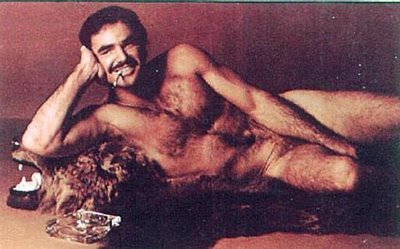
The media has certainly evolved in many ways since the 1970s. 1972 saw Cosmopolitan publish a centerfold of Burt Reynolds with conveniently placed arm. For reasons of decency, the penis was conveniently tucked away.

Then, in 1977 came John Travolta with his black briefs, bopping about in Saturday Night Fever. Add to this milieu the fact that Calvin Klein was starting to make underwear inspired by what he saw in gay clubs, and you have a virtual sex pot a-stewin’!

Except for the fact that this all served to make one thing clear: the soft penis was as mystical as a unicorn, though the latter not nearly so feared. Again, due to decency laws, we don’t see horribly much of any sex’s genitalia, but I’d posit that we’re more comfortable with seeing a vagina or a hard penis. In fact, most depictions of penises by themselves tend to be fetishized as such, made a symbol of power and potency.

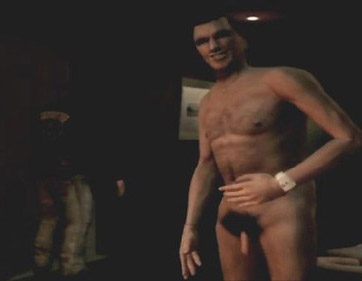
This is where I will state that I have not yet played Grand Theft Auto IV: The Lost and Damned. However, my interest became piqued by the reaction that the gaming community seemed to have toward a flaccid penis presented in their game.

Some questions:

If we see female nipples in a game, from whom do we normally hear outrage? Male gamers? Not typically (though that depends on the context and game, doesn’t it?).

Let us now consider a female vagina presented in a game. Would this make us uncomfortable, or receive an outcry from male gamers?

No, the reaction I’ve seen has been rather curious to observe, and shows how much games can evoke the exact same reactions we can have to other media.

While it is certainly not true of all media everywhere (there exist plenty of more independent films that are willing to show equality in their full-frontal nudity), there still exists some anxiety over the uncovered, non-erect penis. Soft, it does not appear to have much of a function.

A few other complaints I saw were concerning his pubic hair. Really? Pubes? While grimming and trimming are certainly not bad things, I also find it hard to believe that the majority of males spend that much time tending their bushes.

To quote Susan Bordo’s The Male Body (from whom I learned the tidbits in my first two paragraphs): “To be a body with a sex is fine for girls–in fact, it’s what we’re supposed to be. But men are not supposed to be guided by the rhythms of bodily cycles, susceptible to hormonal tides. They are not supposed to be slaves to sexual moods and needs, to physical and emotional dependency” (19). Emphases are mine.

Did Rockstar put much thought into this scene? Considering our own cultural biases and mores, I’d wager there was had to be some manner of consideration over whether or not to include this scene. If not, we’re speaking to game directors who are trying to step more in the direction of foreign and independent films, which are allowed to get away with such risqué material.

At the same time, I can only imagine the outrage that would occur if we were to see an older woman nude. Sad as it may be, a soft male penis is still more acceptable than possibly sagging breasts.

Regardless, I agree with Jorge from Experience Points when he states, “It shouldn’t matter if GTA IV‘s penis is necessary to the story or not, the fact that it exists may push open the door for more tasteful representations of sexuality and nudity.” We will still have to deal with the ESRB, but to have a non-erect penis (sadly) sends out a rather strong message from a series such as Grand Theft Auto, where the expectation might well be to have a forcefully pounding King Kong.

However, throwing them everywhere is not required either. In the gaming industry, sexualization is quite often merely shallow and vapid. Therefore, to be presented with a sexual object which does not try to draw on its possible meaning is a bold step forward.

Where do we go from here, though? Considering how prominent we are already making insipid sexualization of some female gaming figures, could we ever portray them nude and not have it necessarily be in a sexual context? Here are a few other things to consider concerning nudity:

  • Who is nude? Is it the avatar(s) you are controlling?
  • If it is an NPC, is there any interaction with their nude form?
  • Can you present a nude form and then deny interaction with it?
  • What are you saying when you make either choice?
  • If you allow acknowledgment, will this lead to sex?
  • Is the nudity only shown in the context of sexual activity?

And really, what is so threatening or gross about Rockstar’s choice? It’s a body represented through pixels on your screen. Can it really disgust you that much? Remind me not to invite you to my nude party.

Tagged , , | 1 Comment

State of the Denis

There are at least two entries that are kicking about my head concerning Final Fantasy X, which I started in the last month and am near completing.

Gamefly finally sent a (working) copy of Gears of War 2, and I imagine I’ll have something to say about it.

Meanwhile, this past week Matthew Gallant (AKA Gangles) of The Quixotic Engineer asked me to write a guest post for him. Once a month he writes The Musical Box, sharing various bits of music with his readers (from which I’ve gleaned a few acts I’ve thoroughly enjoyed, such as Janelle Monáe).

These were my picks.

Tagged | Leave a comment

Sexually Transmitted Information

One of the charms of The Sims franchise is its ability to allow me to control much of its world and meaning. As I stated in my last post, this all does exist in a boundary and rules must apply, and it’s those that have caught my attention through my last playthrough (even though I was particularly interested in using it as comfort gaming–critical failure or success?). So, what does one do with sexuality in this series, and why has it succeeded where many others are afraid to tread?

Effectively, all Sims are pansexual. You can tell a Sim to make out with another Sim, and if there exists an attraction, a suitable relationship score, and their needs aren’t all in the red, the Sims will proceed to lock lips. Even if my Sim goes through most of his or her Sim life married to the opposite sex, I can tempt said Sim with a member of the same sex and there you go. The opposite is also true.

Does this make the Sim bisexual? Perhaps gay? How are we to tell?

The answer is quite simple, though still confusing in its simplicity in a medium that does not usually have many options as such: it depends on the narrative we, the player, wish to provide. This is an example of game design that puts meaning in the player’s hands, and is not represented fully in the game. If it were to be wholly transcribed by the game, we’d have to examine things much further, and the ability for everyone to be sexually attracted to everybody would likely be a confusing mess. Instead, what might happen is a further customization option that makes us choose sexuality of our Sim, much as we choose their turn-ons and -offs when they become teenagers.

In this capacity, we find a very progressive model of sexuality. We still are not entirely sure of what comprises sexuality, the whole nature vs. nurture argument still raging. There also exists sexuality that is fluid and changes in a lifetime, and The Sims 2 allows for such switching, if I choose to provide this meaning to it. Of course, I also have the option to just say, “Nah, they’re all pansexual–I can’t be arsed to think that hard about it.”

However, notice how I said that the Sims are effectively pansexual, not bisexual, until we provide meaning to their sexual attractions? Sex, that of the male or female variety, has also intrigued me in The Sims (much as ‘race’ did in the first title, for many of the same reasons I’ll be discussing). Sex in the game is extremely functional. Males can urinate standing, women can have children (without the aid of alien abduction), and that is effectively the difference between the two.

Have two Romance Sims who happen to be male and female? Neither one of them is less ‘horny’ than the other, and both will want to Woohoo with increasingly more Sims. Pay and positions in a career are equal, there exists no difference in ability to gain body points, and neither is effectively better than the other in skills. So what grabs my attention?

The clothing and hair options that the default game packages. Beyond pregnancy and the ability to copulate effectively with each other based on having two Sims of opposing sex, there still exists coding to make sure that female and male Sims cannot select each others’ clothes to wear. While it would be amusing to dress up a drag Sim occasionally, the female fashion is what typically annoys me (female fashion in a game I find annoying? How shocking!). Thankfully, the modding community exists, and if I wanted to do so, I could learn the tools myself and make my own clothing.

No, what is noteworthy is that there exists a barrier between males and females purely based on fashion akin to how we typically associate babies with either blue or pink based on their sex (though it isn’t quite as dire in this game). Females are allowed skirts and dresses, men aren’t (though they do have kilts). Otherwise, the Sims are quite egalitarian of their treatment of each other–again, unless stated to act otherwise.

There is also no prescribed behavior for any of The Sims. Males are not all macho, females are not all obsessed with fashion and babies. It varies, and left to their own devices, I find it hard to distinguish their behaviors as attributed to their sex. If they have a gender, it is again up to me to provide that particular function of their personality.

Which makes me ponder again the success of the franchise. Many have just waved it off as a ‘female game’ that appeals to those who played with dolls at an earlier age. Beyond the sexist implications in this assertion, it seems to just write off its success with a simple solution. Considering what I’ve said thus far, I wonder if perhaps some of this success can be attributed to the fact that it is a game where the player, regardless of sex, is fully in the control of the character, and not some script that includes a role for a busty lass.

In other words, you have to tell the story–the game does not provide it for you, nor the baggage that can come with it. After all, by their lonesome, can Sims really said to have a gender or sexuality? Are these concepts purely action driven in our own world? Food for thought.

Tagged , , , | 5 Comments

Simulated History

Through the gender studies portion of my degree I took among my more interesting classes at Wabash College. Three (of the five) that stand out in my mind are an historiography class using sex and fascist Germany as its focal point, a course that examined gender issues in art from the late 19th on until the mid-20th centuries, and one that looked specifically at the media we consume and how it shapes our expectations and understanding of gender. In all of these courses I waded through a lot of source material and had to read between the lines as to what they said about a culture at a given time (literary criticism had that as well, though it didn’t seem as urgent). I want to do that with a game as my first foray into blogging again after almost a month.

In my recent melancholy (hence the lack of posting), I reinstalled Sims 2 and the expansions I have (the last one I bought was Seasons). My normal stance in making my Sims is to take my and my friends’ families and replicate them. This time around, I decided to do something different and took the characters we’ve made for various role-playing games and give them a family. It’s been amusing.

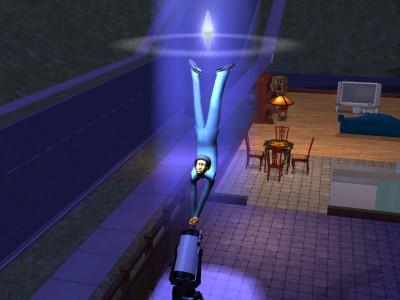
For instance, my friend Janathan would often play a bard/storyteller named Jave the Brave. Jave is personable, likable, and always willing to help in any capacity he can (especially if playing a D&D bard). Unfortunately, Jave is rarely lucky and always finds himself in odd, sometimes horrible, situations. The picture to the left shows this part of Jave’s history: in this case he is being abducted by aliens (who will impregnate him) just after having been elected the mayor of SimCity.

As you can see, I can freely play around with the narrative and create a story. Jave, as a character in our gaming sessions, has been made a Frankenstein experiment, turned into a gnome, and many other less than pleasing events. If I wanted, I can next infect him with lycanthropy, ruin his love webs (he’s a pleaser of the ladies), or take it in the opposite direction and fulfill his lifetime want of owning five top-tier businesses.

As with any game, there exist rules and boundaries. In Sims 2, these rules and boundaries tell me much about our own society. As someone who lives on the edge of it (though not on the edge), I often forget about certain societal expectations or that people may not realize the other side of the polyhedron.

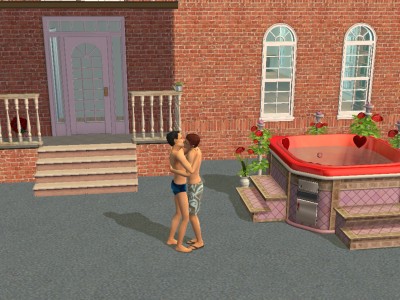
It is impossible to have more than one love on the same lot and interact with them without the other Sim becoming upset. This means no threesomes, no polyamorous relationships, no makeout parties where there is partner swapping, et cetera. The game simply does not support such. In lieu of all that, you can Woohoo! (the Sims equivalent of sex) in many places: bed, hot tub, elevator, car, photobooth, dressing room, and there is even a ‘want’ for the thrill of public woohoo. There is also the aspiration (a selection you make that determines what the Sim wants out of life) called the Romantic Sim, whose goal is not to marry and instead sleep around and fall in love with as many Sims as possible. Just don’t let them find out about it. The Sims world is very obsessed with a culture of monogamy, even when our Sims are being overly sexual and ‘playing the field,’ as it were.

Another aspect of the game is that of gay relationships. One can have them, and you can create any type of gay, bisexual, heteroflexible, et cetera Sim you want. Relationships are tricky, however. It will one day be a sign of the times in which the Sims was released that heterosexual Sims can be engaged and married, but a same-sex couple in the Sims can be engaged and ‘joined.’ Nosirree, Will, there’s no marriage for us queer folk. My Sims can be blood-sucking vampires, turn into werewolves, be poorly resurrected as a zombie, but gay marriage is something beyond the scope of our imaginations. At least they can adopt with no hurdles.

My own sardonic sniping aside, there’s much to be said for what the Sims 2 also says about our own expectations of ourselves.

The rule of thumb is that you can always progress to the top of any skill or career. As long as you keep improving your skills and making more friends, any dish washer can become a celebrity chef. If one keeps improving his or her Sim’s creativity skill, said Sim will produce masterpiece paintings that can sell to make a living.

My mother once confided to me that as a child her expectation of what the United States were was all wrapped up in the old Rock Hudson and Doris Day movies. No one really worked and everybody had a mansion. Sims 2 tries to capture that particular viewpoint of the American Dream: one can start on the lowest wrung and by perseverance and bettering of one’s self, one can reach the very top of one’s own career. Sure, there are chance cards that can get you fired, but these can be ignored, which we can’t say in real life.

Sims 2 can indeed be a virtual dollhouse (though I wonder if it holds up against the Castle Grayskull with non-matching Barbie convertible I had as a child), but it is one that helps feed us what is acceptable and not in our current culture. In a game world where so much is possible, I find it incredibly interesting what gets left out or altered, perhaps expected for the community to mod.

Tagged , , | 4 Comments

Despite all my rage…

Despite some people not liking the term ludonarrative dissonance, as a concept it exists in Gears of War: the game portrays you as a gruff, take-charge ex-prisoner who has to save humankind; problem is that you’re doing all this while taking cover and rescuing your teammates so that you can progress in a stop-go fashion. The game pushes you forward in its tone and then asks you to stop in its mechanics.

While I’d seen this term thrown about, I was curious as to what step we take after identifying the term.

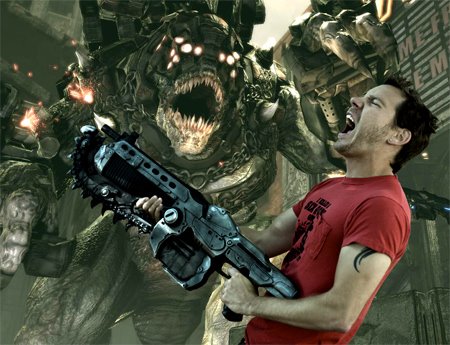
Gears of War is fairly high in its level of testosterone. Chainsaws attached to guns called lancers. Torque bows reminiscent of Rambo’s exploding arrows. Buffed bodies hidden behind ridiculous amounts of armor. Head stomping of a different race that makes me cringe at its implications. While some would argue that the weaponry is pretty phallic, I’d probably quote Saul Williams to counter argue: “Your weapons are phallic–all of them.

At the same time, there are disparities that distract from this testosterone building. Yes, we are at war, but instead of running into the action game that Cliff Bleszinski and his crew attest they have made, we are suddenly given a hint of profundity. The writing in the game is steered by an extremely heavy hand that offers little subtlety, which was the desire of the team. Instead of offering nuance, they wanted to provide concrete archetypes and stories with which we were already familiar. This cooperates with the idea that they wanted to provide a game where you could ignore the story if you wanted, or did not need spend time reflecting on it.

At the same time, in the stead of a raucous soundtrack that is set to get my own adrenaline headbanging, I was suddenly treated to an orchestra that sweeps in to try and tweak with my emotions as if I was watching a riveting war drama. Then, at the very end, Fenix stands there, frozen until the last moment, when he finally jumps off the train set to go off the tracks into a chasm. During those moments suspense is built, but there is a lingering feeling that the game wants you to pause again, even in this cutscene. That paralyzation caught my attention, especially when followed by the voice we’ve heard twice before in both the introduction and as Lieutenant Kim is killed by RAAM–the feminine voice of the opposing leader (at various points you’ll hear RAAM go on about the ‘queen’).

The only two females that I noticed during playing the first title were this unidentified voice of the opposition and Anya Stroud, your own team’s intelligence officer who is seen once and then becomes a similarly disembodied voice. You do not directly engage with females, though they do have a clear hand in shaping your course of action. Both are leaders, Anya’s leadership directing you where to progress in your missions.

This dissonance and tension that I feel is faced in both design and narrative seem to me to speak of the masculinity issues surrounding today’s American male, written in by a team that seems to still be finding its own narrative voice and capability, therefore apt to let a lot of themselves show, whether or not that was the intention. It’s by no means a stretch to see the war story presented in Gears of War as reflective of the same faced by America’s own War on Terrorism. What does not seem to be questioned is the masculinity inherent in the equation, especially with females now in roles that they did not hold during the ‘golden years’ mentality that helps us focus on World War II as a focus of heroism.

In looking back at World War II, it is sometimes bandied about that there was a question of masculinity put in the sons of the fathers who returned to American soil post-war–sons who did not have some great enemy or war through which they could prove themselves. This, alongside the rise of female autonomy and self-realization, led to the split we saw during the Vietnam years–a war that was ambiguous on many different levels and left many scars and atrocities that were fully revealed to the public for the first time. Suddenly there was a question of what exactly composed war, masculinity, and nationalism. The question remains today, especially in a world where gender, sex, war, and violence are all commodities in our daily entertainment and consumption.

Gears of War seems caught in the middle of this zeitgeist. It leads to the hokey attempts of profundity alongside those pauses of Fenix that make me wonder what would actually be going through that man’s head now. It is why it seems important to mark that Fenix can save his teammates, instead of just being faced with their loss. Even though the action is cursory, and there is little interaction, it speaks to reliance on others, even if the words said can sometimes ring harsh. The game starts off in a prison with Wretches shrieking and crawling over Fenix’s cell. Labeled a traitor, he has to prove himself, and even then the experience is caught between adrenaline and pausing to assess. Fenix is constantly caught between two different ideologies, both in controls and in his own narrative.

Did I mention that the soldiers are called COGs? For a game that allows you to ignore the narrative, Bleszinski and crew offered up a pretty sardonic view of involvement in war. Considering how it is often opined that males today (just as easily said about females, though whenever this is reported, it’s usually about body image for them) feel as if they are chewed up and spit back out, used and disillusioned, it seems all too perfect to have these soldiers who are all male, with one exception, have such a name attributed to them.

Ludonarrative dissonance in this instance does not speak only to the team that specifically made this game with this jarring experience, but the culture that influenced even them. Developers do not live in a vacuum. Like us, they see various bits of news, films, and can be caught up in the artistic milieu of the times. Even given the time it takes to develop a game, the culture around us is still reflecting on the ambiguities and lack of easy answers over the last eight years (how else do we describe The Dark Knight?). Take that with the growing interest in masculine studies and looking at our own males from teenagers well on into their twenties, Gears fits right in and reflects what we’re seeing in a far off world called Sera.

Tagged , , , | 3 Comments

Homo say Gears?

N.B. For lack of any confusion, this post is only concerned with, at this time, the first Gears of War. The sequel is another post in the future.

For months I have seen and heard assertions that Gears of War is a pile of homoerotic gonads rubbing against themselves. Before playing the game, I believed much of this and felt that in a story that included a homosocial environment and battlefield with brawny soldiers this had to be the case. Mistake number one; I dare say it’s a mistake into which the gaming community has fallen.

Sure, the achievements have references to a tongue-in-cheek homosexual overtone: when playing co-op with someone as Dom you can earn ‘Dom-curious’ and ‘I can’t quit you, Dom.’ The former seemingly a play on bicurious and the latter alluding to Brokeback Mountain. Even in versus matches there exists an achievement for the first ranked match: ‘Always remember your first.’ Time and again the game pokes fun at its audience and gives a little wink to the assumptions we have of those jocks and homosocial environments–you know: circle jerks, mutual porn watching, et cetera.

The thing is, the rest of the game doesn’t fall through. Many people have bandied about the term ludonarrative dissonance for the fact that the game is constantly on the aggressive, asking you to be macho and push forward while you are instead seeking cover and taking shots from a safe location. You can’t run in guns blazing and hope to survive. Which is the linchpin of the entire game–a conflicted message. The game builds itself out of tension and its execution in many different aspects–but there isn’t really any sexual tension among Delta squad.

At no point while I was playing this supposedly homoerotic game did I ever have that knowing eyebrow raise that denotes I found something scintillating. There was no surreptitious giggle over a puerile fantasy of men in a locker room in nothing but towels. What we’re seeing is a community filling in for something that does not exist in the text or even in between the lines while playing the game itself.

In fact, reading various pieces, forum discussions, and banter on this game, homoeroticism is almost thrown around as a dirty word in some corners. They seem to ask: how can all these (assumed) men players who are seeing this as a pinnacle for masculinity actually like this ‘so obviously’ homoerotic game unless they have possible homoerotic tendencies themselves, in an effort to rile up the core player of this title. It seems to be a path of denigration using homoeroticism as its weapon. Now my eyebrow is raised and my lips pursed in an effort to not say something off-color.

What we’ve managed to do is conflate homosocial and homoerotic, though this is hardly new to videogames, or even this particular videogame. There exists a cultural standard that a single-sex environment is rife with sexual tension in some way that will release itself in homoerotic and lusty propositions of which no one will ever speak. Whenever I, as a gay male, mention I attended an all-male college, people will laugh and say they know why I went there (those four years were perhaps among the loneliest of my openly gay life in terms of sex or romance, actually). That environment did have homoerotic under- and overtones, but the context afforded such.

In the context of Gears of War, we’re barely given fully fleshed personalities that aren’t riddled with stereotype and cliché. Cliff Bleszinski himself admitted in an interview he was not seeking to reinvent characters or push forward a new standard. The focus was on the game, and the plot was to remain ancillary with plenty of one-liners and quips, being more focused on presenting an action game that played on previous sci-fi mainstays or newcomers (ranging from Pitch Black to Alien and Predator). Nowhere in this action or in these one-liners is it implied that this homosocial environment will cross over into any risky business, even as a joke. There wasn’t even anyone in a state of undress.

If anything, the homoeroticism seemingly evident is one on which I didn’t pick up because I never played it with other people. The homoerotic titled achievements all require playing with a buddy, and the design team seems pretty self-assured that this buddy will not be your girlfriend (which made me wonder what the point of the end credits thanking female significant others was–beyond saying one did so). After all, this game fills that niche for a market of men hungry for masculine media made available to the inner-man who does manly things in a manner of man-like activity. In fact, the game seems to push its homoeroticism in a seeming wink at the social aspects of our gaming culture.

The game is not so much homoerotic as our enjoyment of it is. It isn’t even my or your enjoyment, it would be instead dedicated to our shared, collective experience of the title that suggests something illicit. Now, I’m going to disagree with an earlier post (though my recent starting of Devil May Cry 4 assures me that it’s homoerotic within the first half hour), as we’re never even given a body which we can admire in unarmored fashion. So, if I dare say it, Gears of War is not homoerotic.

We are. (Assuming we’re all males and playing an all-male cast.)

Tagged , , | 6 Comments

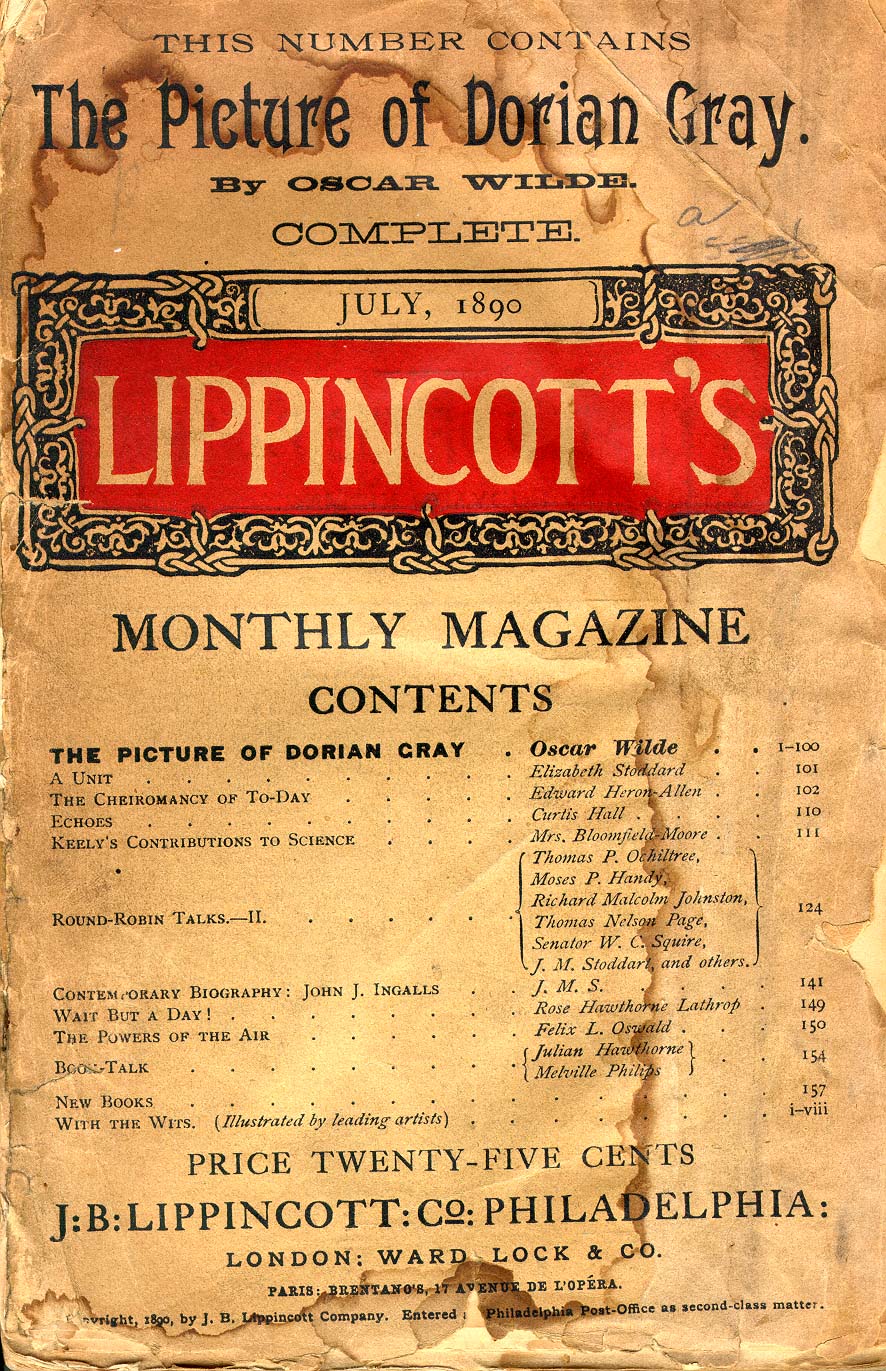
The Picture of Dorian Gray

Putting the Game Before the Book What would your favorite piece of literature look like if it had been created as a game first? In a time when bits of Dante’s Divine Comedy are being carved out and turned into a hack-n-slash game, I find myself longing for intelligently designed games–games with a strong literary component–not merely literary backdrops. So rather than challenge you to imagine the conversion of your favorite literature into games, I challenge you to supersede the source literature and imagine a game that might have tried to communicate the same themes, the same message, to its audience.

Feel free to ignore the technical constraints of the era in which the book was written. In fact, feel free to ignore the technical constraints (within reason) of today and push the envelop a bit.

You see a painting in front of you. It is of a beautiful dandy with blonde hair and blue eyes–a cherub who has an air of innocence and childlike wonder. From this point you have a menu of options: start a new canvas, load your previous progress, or fine tuning the painting (options). I’m going to assume that you have selected to start anew.

Suddenly the text presenting your options melts away and the view zooms out to find this portrait slowly beginning to morph around the lips, a cruel mock forms. As we then zoom in on that perverted smile, we are transported into a world of paint where we are given control of the figure of the portrait as he ends his sentence to a young woman: “I don’t wish to be unkind, but I can’t see you again. You have disappointed me.” From here you are free to control the protagonist, one Dorian Gray–a youth aged twenty in a late 19th century London. The camera follows you from a reasonable distance behind as you move through the city.

From here Dorian may wander the streets as he pleases, though he’ll find many locations closed to him. The streets are lit by gas lamps that flicker with a faint glimmer of the oil from which their paints derive, for it is late in the evening. A hansom stops by and asks if you are looking for a lift, you seeming slightly out of place in this neighborhood; you are a youth of wealth and reputation.

Upon reaching home you find certain doors open with some lights to guide you to your bedroom, but on the way happen across the portrait you happened to see upon loading the game, though it is now set in realistic tones–not the oil-painted world through which you move. The lips are faintly shimmering in a capriciously crimson smile, and no matter where you try to move, the ‘camera’ remains firmly focused on this spot, begging you to examine it closer. The message is clear: this portrait has control over your life.

From here the ‘choices’ are yours. Upon waking the next morning you learn from your friend Lord Henry Wotton that the girl you quarreled with last night, one Sibyl Vane, is dead. He invites you to an opera that evening. Do you go?

One can play this game in a conscientious and ‘good’ manner, but will find that the activities become redundant and frustratingly mundane. It is possible, and there is a game to be played for those who wish such, but there will be no progression–just stagnation in a society that is quite conservative to all appearances. After all, part of the game is living in the society of the times: collecting clothing, gems, art, going to events, socializing, having parties, and many other options available to the upper crust of London at the end of the 19th century.

This becomes a game of building reputation, sparring wits with the likes of the Lord Henry Wottons of society, and showing off your wealth in a tasteful manner. It is at these events that Lord Henry often waxes poetic about how the only thing in life is to enjoy experiences, and how these experiences cannot be hampered by societal expectations.

For the more esoteric player, every so often a person will mention an artifact of old: a tapestry, a gem of emperors, perhaps a book of old. Sometimes these yield you with said artifact, and each one you acquire makes the colors of your oily world that much more vibrant and appealing.

After the first few days (in which the artifacts would not be mentioned), you receive a call from the artist of your painting (one Basil Hallward), a book in the mail, and some regular visits from Lord Henry Wotton (a guide into the social spheres of your world). If you happen to examine the book, a strange effect occurs: you are suddenly transported into a more realistic-appearing world where you are controlling the actions of another young man.

His options are much more linear, and he clearly indicates what he wants to do. These actions start off small, ruining the name of a woman in town. This is a book to which you can return or leave at any time to live through these frowned upon ‘experiences.’ However, the mechanics are no different from the other world, so it becomes clear that Dorian himself can perform these actions. They range from the love that dare not speak its name to ruining young women’s reputations to estranging the boys who adore and emulate you at first. They will grow to fights along the piers, opium dens, and eventually the climax and center point of the game–a murder.
Each day from here will end either after a social event, or engaging in the fantasies the book Dorian has been reading sets forth.

Once you start down this path, however, there will be a faint outline following you every so often if you go too long between these new experiences. It will be a realistic depiction of your avatar on which the camera stays focused, luring you to follow him or stumble around blindly; he will bring you back to your portrait. Here you will see how your actions have changed your visage according to the world in which you actually live, and this will save your game.

Basil pays you a visit once you’ve committed enough of these crimes (if you decide to reach this point) and starts to slowly broach the topic of your reputation. You have the option here of showing him your portrait to explain the truth or ignoring him. Ignoring him just means he’ll come back the next night and start probing you further and more passionately, seeking to find a way to clear your reputation. Or you can show him the portrait, at which he’ll lament and offer to pray with you. Do you follow Basil’s advice and remain haunted by your portrait through the rest of your gameplay? You can certainly try it. That phantom will remain, however, thirsty to try new things and to push the envelope on those you already have.

The act of collection can alleviate these visions for a while, but only so long, and never enough.

The other option is to commit an act with which you have never been presented before: kill Basil and silence him. From here the game will progress and you will step into even more daring acts. Your appearance in society will be expected, but by this time you’ll encounter NPCs with which you’ve interacted before. While they will not make a public scene or start a row with you, they will clearly start avoiding you and there will be whispers around you. If you stay too long from society’s limelight, you will find any other activity in the game but a spiral into crime ever more difficult.

As you hit these milestone events, you will see the NPCs around you age, while your avatar remains the same. Perhaps you’ll change with the fashions of the time, but your innocent-appearing, cherublike face will shimmer its youthful smiles and beauty to any onlookers. Some will make note of it, others won’t.

At random you’ll encounter a strange man who claims to be one James Vane, Sibyl’s brother. He threatens to kill you until he sees that youthful face. It’s been years since his sister died, and the man he seeks would be much older (what you don’t know is that other persons you have slighted will convince him to keep haunting you).

From here the plot details continue, lightly sprinkled here and there while you progress to them at your leisure (or don’t), but will lead to one of two endings:

You can reach the point of disgust, as Dorian’s portrait becomes a nightmare that grows ever more sickening, and grab the faintly highlighted knife next to the portrait to end it all. As your avatar falls to the ground, bleeding, the voice of Lord Henry will run commentary as the world bleeds oil to become more realistic:

“My dear boy, you are really beginning to moralize. You will soon be going about like the converted, and the revivalist, warning people against all the sins of which you have grown tired. You are much too delightful to do that. Besides, it is no use. You and I are what we are, and will be what we will be. As for being poisoned by a book, there is no such thing as that. Art has no influence upon action. It annihilates the desire to act. It is superbly sterile. The books that the world calls immoral are books that show the world its own shame. That is all. But we won’t discuss literature. Come round to-morrow. I am going to ride at eleven. We might go together, and I will take you to lunch afterwards with Lady Branksome. She is a charming woman, and wants to consult you about some tapestries she is thinking of buying. Mind you come. Or shall we lunch with our little duchess? She says she never sees you now. Perhaps you are tired of Gladys? I thought you would be. Her clever tongue gets on one’s nerves. Well, in any case, be here at eleven.”

Or, you can continue until the point where you are forced to leave London, your reputation being pure anathema to a society that may commit crimes, but has nowhere near the backlog leveled against yourself. As you wrap Dorian’s portrait and leave the house, Lord Henry gives a different speech:

“Yes, you are the same. I wonder what the rest of your life will be. Don’t spoil it by renunciations. At present you are a perfect type. Don’t make yourself incomplete. You are quite flawless now. You need not shake your head: you know you are. Besides, Dorian, don’t deceive yourself. Life is not governed by will or intention. Life is a question of nerves, and fibres, and slowly built-up cells in which thought hides itself and passion has its dreams. You may fancy yourself safe and think yourself strong. But a chance tone of colour in a room or a morning sky, a particular perfume that you had once loved and that brings subtle memories with it, a line from a forgotten poem that you had come across again, a cadence from a piece of music that you had ceased to play–I tell you, Dorian, that it is on things like these that our lives depend. Browning writes about that somewhere; but our own senses will imagine them for us. There are moments when the odour of lilas blanc passes suddenly across me, and I have to live the strangest month of my life over again. I wish I could change places with you, Dorian. The world has cried out against us both, but it has always worshipped you. It always will worship you. You are the type of what the age is searching for, and what it is afraid it has found. I am so glad that you have never done anything, never carved a statue, or painted a picture, or produced anything outside of yourself! Life has been your art. You have set yourself to music. Your days are your sonnets.”

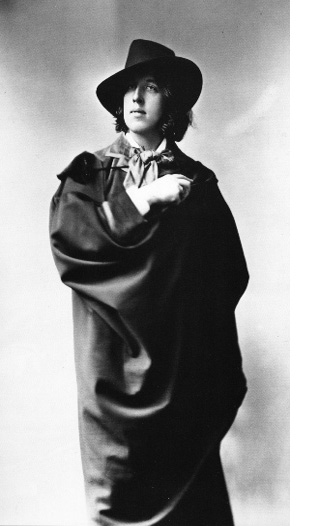
Dorian’s remorse, if there is ever any hint of it, is that of discovery. Either one does not walk that path, and therefore does not allow such exploration, or does and need not worry about proselytizing. Even if you destroy the portrait, it is more in disgust at what you have become than any sorrow for the victims for whom you’ve become a villain. All of this was inspired by Oscar Wilde’s The Picture of Dorian Gray, which clearly has a more specific agenda in mind as to how it ends, and loves detailing the personal treasures he happened to find. Much as in Fallout 3, I’d like to imagine such a game could cause him to wring out these experiences, despite public outcry against them.

Please visit the Round Table’s <a title=”Round Table Main Hall” href=”http://blog.pjsattic.com/corvus/round-table/”>Main Hall</a> for links to all entries.

Tagged | 3 Comments

It’s the context, stupid.

After my post on Shanoa and realizing that her lack of emotion said plenty on the historicism of the time and the hysterics often attributed to women, I began wondering whether or not this was actually in any way researched by the development team when the game was made. It fits in rather nicely into a full argument, but did the game purposefully provide such context? Whether or not it did, the point I made can stand on its own; it does have me pondering what other contexts we place on games in contrast with what they provide us–particularly in games placed in our own world.

There were some complaints over the fact that the latest Prince in the latest installment of Prince of Persia spoke with an American, rather than British, accent. Some even felt it did an injustice to the acknowledgment of Persia in the title (read: racist). For some, it was a slap in the face to break with the tradition of an English narrator. Contrast this with Jake Gyllenhaal being selected to be the Prince in the movie adaptation and the statement over race starts gaining more ground.

Whenever one tells a story, context can be very important. This has an even greater chance of becoming an issue the larger an audience becomes. Suddenly there is no one niche, no one culture to whom you are speaking.

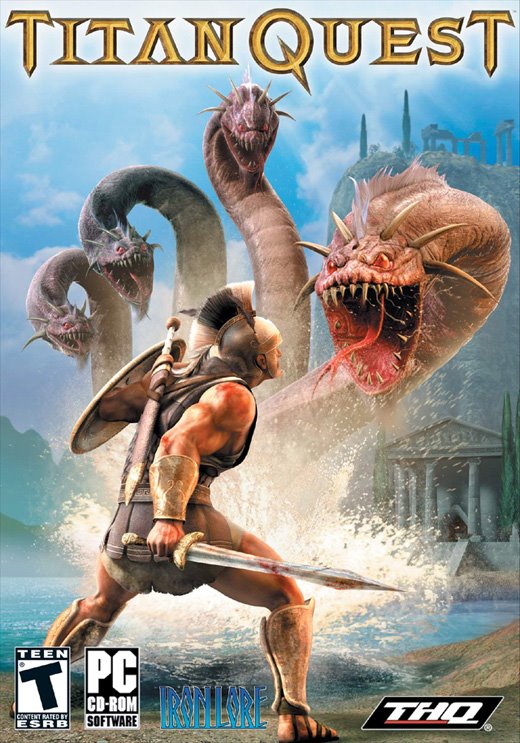
Of late I’ve been replaying Titan Quest and its expansion The Immortal Throne in a need to scratch that Action RPG itch that I satisfied last year with a replay of Diablo II. Three things struck me on my recent playthrough of the game:

The third act of the game takes place in the Orient. Your character will go and meet the Yellow Emperor and walk the Great Wall of China. He or she will also encounter Oriental accents that are a throwback to what I would expect from early cinema. In other words, overly stereotyped accents performed by people who are delivering an expected accent, often for comedic effect. It’s egregious.

The context? Why is this person speaking with such a racist, abysmal accent when your character is Greek? That’s right, you start off in Greece and are a Greek traversing your own country, Egypt, China, and then Hades. Somehow you can speak to all these people. Then they all suddenly have ridiculous accents based on English. I understand why the game is all stated in English, but if communication in a foreign language is one over which we can gloss, can we do the same for hackneyed, insulting accents?

Then there’s sex. You can choose to be male or female. However, this is set in our world. The primary movers and shakers in this game are male. The exceptions occur in Feiyan, part of the Order of Prometheus, and Medea. This makes sense, sure. In antiquity, females were not given the right to own property, vote, make many decisions, and this all in the context of being considered the root of all men’s problems (see: Eve and Pandora).

While it is great to be able to choose to play a female in such a situation, it does seem a bit ridiculous that this is never addressed. If the creators did not wish to address such, it seems it would have been better to remove it from our world directly. Perhaps play only in the lands of myths, rather than set them in corporeal, historical locations. In such an environment, I actually expect the female to face some resistance or have it at least addressed why it’s acceptable for her to go marching about in armor (tailored for her breasts and figure, naturally) and wielding weapons.

The last issue I saw was with the fact that one traverses Egypt and sees not one dark-skinned person. There are plenty of tanned people all along the Gaza and in various locations one visits in Ancient Egypt, but no one has a skin tone darker than a white person who sat out in the sun and worked on a tan. The cultural white-washing is rather disheartening, though not entirely surprising in the popular eye. Ancient Egypt was rather large and comprised of more than just one race, especially considering its location.

There’s another level to this, though. What is the context of the game? The narrative is provided, but it does not seem to be the primary focus of the community still involved in patching the game now that Iron Lore is defunct. This is an Action RPG that does encourage min/maxing and building up a character, where everyone else is seen as merely a prop. While the narrative is not the primary focus, it does appear to still somewhat factor into its appeal.

Does this then excuse the game for cultural oversights? Considering this would all require more work and possibly even putting in controversial or political material in a game focused on myth, does this put too much work on people who are working on a game that follows a model of genre?

Who knows, perhaps these females are our chance to create a myth in a world dominated by mortal male heroes. There is still debate over the issue of black persons being involved in Egypt (this was largely a hot topic when people claimed black persons had never had a civilization of note). We may also expect to go to the Orient and hear that hammed up, annoyingly schtick accent when they utter anything in English. This was not the primary aim of the game, but it has me wondering how much, if any, thought went into these particular areas as well.

Tagged , , , | 3 Comments