Golden Lacks

Last year my Gendered Violence post drew a fair amount of attention, criticism, and suggestions. Among them, Dan Bruno mentioned on Twitter that Golden Axe: Beast Rider may be a game that depicted a violent female character. I’ve started the game, and felt like sharing initial impressions on to whom this game is catering (how that isn’t me), and Tyris’s blood-thirsty violence. As I progress I may add to these thoughts.
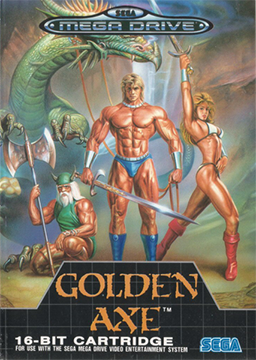
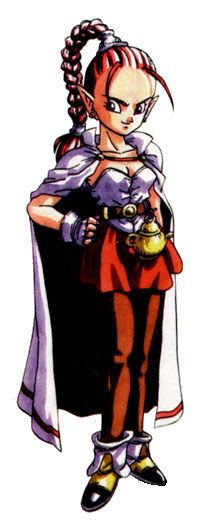
Penny Arcade warned me of this game months ago. From how it was marketed and the focus on Tyris over her other counterparts, this was obviously not the Golden Axe of yore. I can be fine with this, even if it seems odd to remove multiplayer from a franchise that once included it. To start, Tyris was always within that Boris Vallejo style of fantasy art of scantily clad females who wield massive swords. At least the male was in a bikini as well?

Times have changed, and so has Golden Axe.

First, with the more fully realized characters in the game, the fact that Tyris is actually more clothed than her 16-bit counterpart seems to do little to negate the fact that she’s still wearing implausible clothing and eyeshadow. Eyeshadow? Really?

However, what really drew my attention was the first thing I see upon selecting to start the game and seeing things through the lens of a camera. This game is firmly entrenched in cinematic language, and it displays this by having Tyris encounter Death Adder’s enemies and suddenly yell at them. The camera then travels over her shoulder, down her back, and continues down the length of her body and shows the enemies charging from between her legs. My jaw dropped, and neither in appreciation nor to allow salivation to collect in the corner of my mouth.

The story has changed as well. Instead of seeming to come from amazons, Tyris is now the bodyguard of priestesses. These priestesses wear robes that are slit at the sides with nothing else underneath. The first cut scene sees them fluttering about (so you can see the cloth flap about) as Death Adder’s minions run amok. These are no amazons, Tyris is the only one capable of fighting them, and in that first cut scene just so happens to be caught unaware and smacked with the flat of an axe to the face.

The game’s style is reminiscent of the Devil May Cry system of grading a player’s performance based on how the level was executed. There is no easy difficulty: there is normal, hard, and one even more difficult that is grayed out from initial use (the message being that the game isn’t for players who want an easy game). In grading performance, playing normal cuts the player’s score by one-third. Clearly the game wants to tell you that you are a C player if you cannot cut it in higher difficulties. This will not be appealing to any but the ‘hardcore’ audience any time soon.
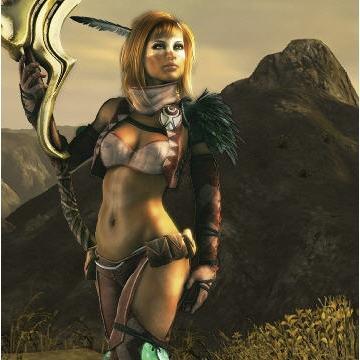
Golden Axe: Beast Rider screams machismo in a throwback to nostalgia. I’m reminded of those days in the 1980s when my parents had many fantasy roleplaying friends who had the Vallejo calendars and prints littering their walls (how glad I am that my mother was an artist who eschewed such). Instead of crowding the market with another chest-baring male, it seemed it wanted to provide another (chest-baring) female who can fight in sexy poses and be offered to masturbation fantasies.

The last clue is the title and what it offers in terms of gameplay. This subtitle is Beast Rider, hence the gameplay has a lot of focus on riding beasts and using them in combat. In fact, the combat is pretty lackluster, and instead of the fluid controls and mechanics that we see with a Dante, we are given very stodgy and block movements that never feel comfortable on the offensive. The beasts themselves are then another weapon (more powerful but just as difficult to actually maneuver), and instead of occasional occurrences as they were in the older games, they serve as a focus of the game alongside Tyris.

Tyris’s bloodshed is hampered in many directions by not as excellent mechanics and even filtered through the beasts she has an option to ride (though must use to progress through certain parts of the game). Instead of focusing on combos, the game puts Tyris on the defensive, heavily encouraging such through a color-coded system of parries, evades, and counterattacks. What this communicates is not as aggressive a warrior, but a tempered swordswoman on the defensive from her enemies barrage of attacks.

What of her enemies, though? Tyris manages to deftly cut them in half, slice off limbs, and summon forth fountains of blood from enemies in sundry ways, which is odd in a game with such a confused intent.

Except the enemies are all dehumanized. The first scene shows one of these peons with filed and sharpened teeth feasting on a corpse. Within the first few seconds of the game, we are assured that what Tyris is fighting are subhumans who are uncivilized and disgusting. On the other hand, she is being gruesomely violent.

Unfortunately, the game itself is rather poorly presented and I’ve already been frustrated more than once with many decisions from how the hints are presented (let’s throw a scroll on screen that halts all action) to the camera, which always manages to obscure one enemy unless I’m constantly rotating it.
Tagged , , | 1 Comment

Albus as the Romantic Hero

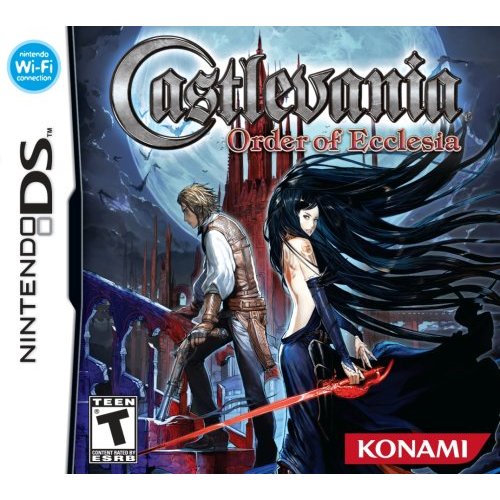
Much like yesterday, this post will contain spoilers for Castlevania: Order of the Ecclesia; again, I offer this as warning.

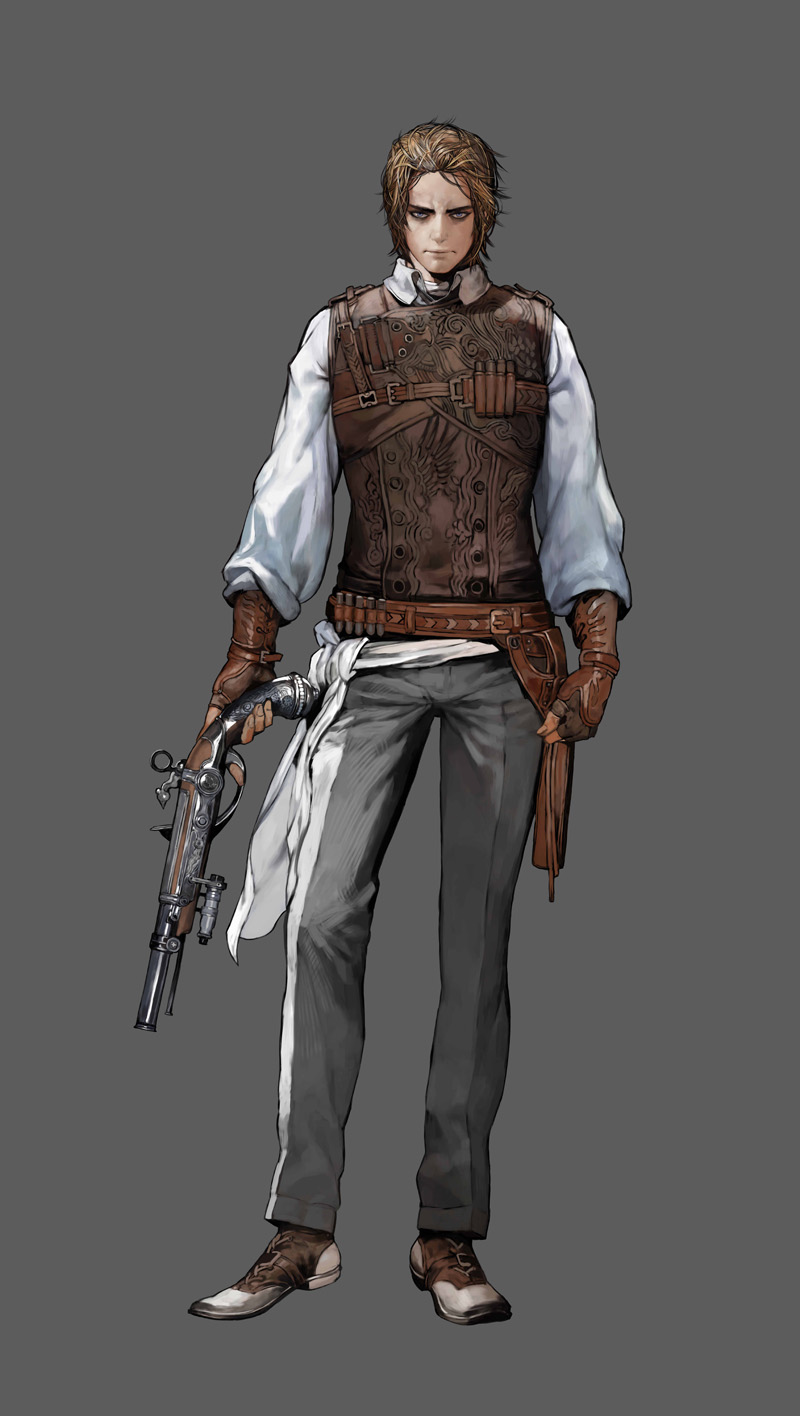
Albus is a roguish rantipole. At first he reminds me of a Balthier: dandy-ish clothing, a penchant for pistols, and lack of physical combat. Our first interaction with him proves him to be a rash individual with issues of insecurity; he will be the one to wield Dominus, not Shanoa.

That is, until you play it again, knowing what Albus understood about Dominus’s role in bringing back Dracula.

Suddenly he is set up, through his dialog and actions, as someone who is telling the truth the entire time. He is the one who can rebel against Barlowe’s lies and see through the deceit. Albus is suddenly transformed from a figure who is impetuous and selfish, seeking to prove his masculinity, to someone who is desperate and heroic.

Which is rather common.

The discussion has already and will continue to occur over how to take the latest Prince of Persia’s protagonist. As Abbott pointed out, we have this hero in spades: the misunderstood rebel or loner who has questionable intents but is drawn into heroic actions. In this respect, Albus is intriguingly constructed, not the least of which is that we have him as the villain for the majority of the game, not just some mercenary or hired gun who happens to tag along for a quick buck.

As I stated, he has a bit of the dandy about him. Rather than fight with any physical implements, his tools are magic and a pistol, which he can combine for attacks. His one physical attack is a flying kick engulfed in flames, an attack bolstered by magic and meant to keep the protagonist dodging. His masculinity is left somewhat questionable through most of the game, as he has neither a muscular physique nor is he direct in anything he does–at least by today’s standards.

In fact, neither Barlowe nor Albus display masculinity in anything but their control over Shanoa; no matter what path the player chooses, she chooses an ending based on one or the other male winning in his goals. By every other standard, Shanoa is the most masculine of the Order of Ecclesia. She is the one going out and engaging in action and until the end is the only one not ruled by her emotions in any regard. She is a Classicist’s ideal.

Albus, in return, is an abomination to Shanoa and the player for the first portion of the game. One cannot understand what he is trying to convey through his words because as Shanoa we have no past recollection ourselves, let alone of Albus. What is his character before this? Instead, he is someone who is trapping villagers and off doing research on Dominus. He is someone whom we simply cannot fathom, nor understand his true nature until we finish and look backward at what occurred.

Which provides an interesting parallel at which to approach the game. Considering the time period in which this game takes place, it occurs somewhere between the battle between the Age of Enlightenment and Romanticism, which leaves Albus in some interesting ground as to what type of male he is. The Order of Ecclesia in some respects seems to be taking the route of the Age of Enlightenment in how to deal with Dracula, by using Dominus (which is made up of Anger, Hatred, and Agony) as a tool in an empirical fashion. Albus then steps in with a rebellion similar to that of the Romantics–one has to appreciate these emotions and stand in awe of them.

Suddenly he becomes emotion. In fact, Albus is the impetus for expression through the entire game. After Dominus steals Shanoa’s emotional capacity and memories, it is only he who can save her from the Classicist ideals of eschewing emotionalism. In fact, Barlowe’s fascination with bringing back Dracula seems to be one built purely on the former, while Romanticism (which would eventually lead to the literature that popularized Dracula) would fight against this emotionless appeal to power.

It is the use of the three emotions of Dominus as a tool that hopes to bring about the rebirth of Dracula, seeking to rationally guide emotions into use. While the sacrifice of Barlowe finally releases Dracula, it then takes the sacrifice of Albus to defeat him. This is a time period in which scientific rationalization and industrialization would elevate the status of the human at the question of humanity, and Barlowe’s disregard is only tempered by the emotional aesthetic of Albus.

Albus becomes the Romantic hero: introspective, rejecting his Order’s edicts, being outcast and alienated, and facing isolation while later showing regret for what he has done and self-criticism which leads to his helping Shanoa. In such regards, his masculinity is fulfilled by another era and movement’s definition.

In regards to Shanoa and the player, he is the one who most pushes for an emotional aesthetic appreciation. Working through the game as Shanoa, the difficulty requires a rational mindset in learning the patterns, gaining the levels, learning the combinations of glyphs to use, and the ludic elements (of which the game is largely comprised–the plot comes in small snippets) work to remove the player from any sense of attachment in an emotional fashion. Albus serves then to not only be the Romantic hero in the plot, but over the game itself.

Posted in Uncategorized | Tagged , , | 2 Comments

Shanoa’s Quest for Hysterics

This post will contain spoilers for Castlevania: Order of the Ecclesia; read at your own risk.

While I was playing OotE, I was wondering about the implications of Shanoa’s sex and her relationship with Albus, who admits feeling like a big brother to her. I’m sure my interest in such serves as a surprise to the readers of this blog.

It takes no stretch of the imagination to see a female protagonist who uses magic, and in fact that’s her only weapon. We’ve already seen her like in Charlotte and the sisters Lecarde in Portrait of Ruin and Maria Renard (who is actually playable in an alternate mode of PoR). This is fairly common in videogames in general. In this capacity, Shanoa is no different nor particularly remarkable.

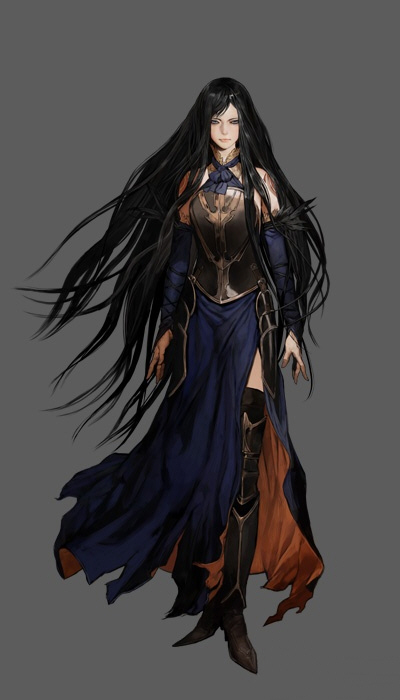
Of interest is how she gains this magic, which may be the most sexy sprite I’ve seen in some time. She obtains her powers through glyphs, which she absorbs through a magic symbol inscribed on her own back. This means whenever she wants to gain new magic she lifts her hair, turns her back to the screen to put on display a very revealing dress, and invokes her own powers. I was fanning myself — it’s quite racy for a woman of the mid-19th century.

This is in contrast, and in fact complements in many fashions, her emotional unavailability. She is part of the Order of the Ecclesia, seeking to keep fighting Dracula in the absence of the Belmont clan and presumably lacking knowledge of Alucard. They were going to use the Dominus glyph to counter Dracula’s next return, but Albus stole it before it could be used, leaving Shanoa emotionless and with amnesia.

Over the course of the game, one finds out that Albus was in fact protecting Shanoa, as the Dominus glyph was actually constructed by Barlowe, the order’s leader, in order to resurrect Dracula. When Shanoa finally kills Albus, she absorbs the last Dominus glyph and with it Albus’s consciousness. This is when he admits a familial devotion to her.

Which is where things start to make me raise an eyebrow. Albus entreats her not to use the Dominus glyph, as it will kill her. However, in her last encounter with Dracula, she has no other choice and chooses to sacrifice her life in order to stop Dracula. But wait! Albus decides to sacrifice himself instead, what with being just a disembodied consciousness now.

Pragmatically, it makes sense. Barring Albus finding a replacement body, Shanoa is the most capable of continuing her work in the world. The matter becomes complicated when he has one last request for her:

Shanoa: …You’re taking my place!? Albus, no! You’ve already done so much, and I haven’t repaid you!

Albus: No arguments, Shanoa. This is my role.

Shanoa: No, I…!

Albus: If you want to repay me, then you can grant one final wish.

Shanoa: …anything.

Albus: Smile for me. That will be enough.

Shanoa: But–

Albus: Please… before I fade away…

Shanoa: O…Okay…

Albus: Beautiful. I… I can finally…

By itself this would be a cause for celebration. She is once again a whole person. Leave it to me to remain skeptical.

As I stated, she’s already been fairly sexualized. This in turn relegates her once again to a status of being fully feminine, emotions and all. It should be of note that during the mid-19th century women (ones of status, read: wealth, I should note) were quite commonly diagnosed with hysteria, a throwback to the Ancient Greek belief that the female uterus was capable of evil to mankind, including an overabundance of emotions in women. While it would reclaim massive popularity when Freud would start theorizing, there exists a whole body of artwork that even shows women in these states of ennui, listlessness, and hysteria. Emotionally, women were not considered the sex capable of emotional expression except in the most obscene sense.

In this context, Shanoa has to be taught by a male how to properly express her emotions again. Except for a brief scene with Albus at the very start of the game, we don’t know anything of Shanoa from her previous life, what with amnesia being visited upon her. Albus is the one who has remained pragmatic and always had logic and reasoning one step ahead of Shanoa, who would have (and it is possible to receive this ‘bad ending’) retrieved Dominus and unwittingly resurrected Dracula.

Don’t leave a woman to do what a man has to do, and if you do, make sure he’s riding along in her subconscious capable of instructing her on how to be and protect herself from her own decisions. This includes her brief breakdown when she no longer knows what to do, having retrieved Dominus and not sure what further purpose she could have. You as the player, regardless of your sex, are controlling a woman; both of your agencies are directed by the male figures in the game–the choice between the good male who was evil or the evil man who was good (more on this tomorrow).

Shanoa seems a self assured woman capable of standing up stalwart in the face of adversity unflinching, but it is prefaced by her being pulled along in the story by one male figure or another. Then again, this is the 1800s, and I’ve been contemplating more and more the role of historical fiction and gender in videogames. What can we expect?

However, while Shanoa is the protagonist and the party required to be capable to progress the story, the plot shows her as inept and foolish, falling into the common female stereotype of the times in which the game takes place. It takes an abnormality in emotions and guiding ‘big brother’ for her to win the day in the name of humanity. While this may have been the expected role of women, she is hardly in the same position as other women of the time.

Tomorrow I wish to take a closer look at Albus.

Posted in Uncategorized | Tagged , | 1 Comment

Glutton for (Gaming) Punishment

After finishing Chrono Trigger, my DS once again nervously placed itself in my hands as I powered on to play Castlevania: Order of the Ecclesia. I’ll make an admission here, the fondest memories I have of early gaming were on the PC; this is why I remain a PC gamer to this day. As such, Mega Man was never played, Battle Toads saw an occasional play with friends, and other such games that required memorizing a boss’s patterns? I’m sure I played them–they just don’t stand out to me.

The reason being that I don’t particularly enjoy it, even though I enjoy many of the other aspects of the game. The past three Castlevania DS titles have intrigued me because they are often enjoyable leveling and collecting while on the go, something that won’t lose me too much in the moment. The boss battles, though? The boss battles were difficult. Hellaciously so.

There’s now talk of the level of difficulty bandying about the gaming blogosphere again (to give you a smattering of my thinking from hereforth, acknowledgments given to N’Gai Croal, Noble Carrots, Groping the Elephant, The Brainy Gamer, and Experience Points).

What occurred to me while playing this game is that we have trained ourselves into expectations of what a videogame should be as much, or moreso, than the outside world has crafted expectations of what art may be, and how videogames fail in that realm currently.

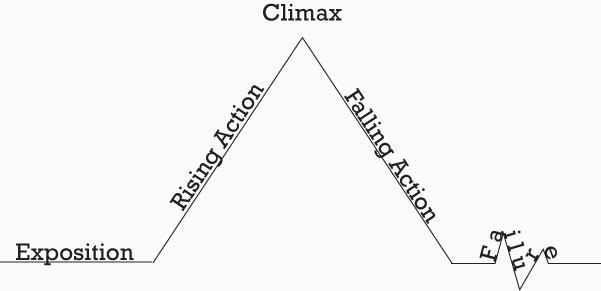
We battle through hordes of minions of some sort in order to fight a boss, while using abilities to get there. We could start mapping out games by a plot diagram. You know: exposition (character and what you do or do not know about abilities), rising action (acquisition of levels or abilities), climax (learning how to use this to your advantage), falling action (use it to progress anew), denoument (defeat a boss with what was acquired). Rinse, repeat.

This diagram is fairly standard because things naturally fall into this pattern. In videogames this means it’s an attention-seeking Chekhov’s gun. For the most part, we’re fine with this pattern.

We also expect death of our protagonist if we fail to use this correctly. We’ve become a strange form of sadomasochism, whereby we request punishment for our failures to be visited upon our avatars and on our time and patience (some of us, at least).

The other game which I recently started again was Bioshock. Another confession, while I was told within the first few seconds of leaving the bathysphere for the first time that a Vita-chamber would revive me if I happened to lose all my health, I promptly forgot about this function and played the game as if these were just a rather pretty tube in an environment of tubes. This meant that instead of knowing what happens when my health falls to nil, I would just hit escape and reload once it was clear I could not leave the fight alive.

This means that when I heard people complaining about the teeth being removed from Bioshock’s difficulty, I was actually confused. What did they mean? It’s a matter of perception.

What does death symbolize in a game? Failure. What does reloading in a Vita-chamber symbolize? Not failure, apparently. Except, you did fail, but the visual is in many ways different. The main difference here seems to be one of what we expect from our failure. Again, sadomasochists.

For me? The failure itself has bred a habit of reloading a game when failure is imminent, not wanting to deal with a death scene which is often uninspired at best and aggravatingly long at worst (unless we’re discussing Sierra adventure games).

In fact, my first discussion with a friend concerning Order of the Ecclesia was how frustratingly hard it could be at certain points. This is why I had no problems leaving it to spend many hours delving into Chrono Trigger. I finished the game, but there were many moments where I’m glad that I have control over my temper, as my poor DS may have been thrown somewhere in absolute frustration.

In fact, this may be one of the best features I have yet to use in Rock Band 2: no fail option. Even I have bought into this idea of punishing myself for incorrectly enjoying the game.

Here’s the thing, and for what N’Gai Croal called, we need these options. I don’t typically play games on any difficulty but normal, Diablo II and Titan Quest being the exceptions among this rule (and I never play hardcore mode in the former). However, toggling what death means and what it can provide us the gamer seems what we may need to explore.

Is there a medium ground between failure-but-not-failure and failure-as-failure? Rather than perhaps just having text pop up on screen telling us how to perform whatever technique or sending us into the game time and time again, is there something more useful that can be provided in game? What do you do with the diagram when it’s broken off at some point?


Here’s a further problem. Failure is a very easy way to give a sense of agency and interaction to a player. If interactivity is what defines games from novels, poems, films, music, and all other art forms, failure can be a quick way to make this knowledgeable. Games are bounded by rules; failing to follow the rules, even the more exacting, detailed ones which we come across in games (reach 0 health and die), is a staple of games in general. We can fail to understand a play, but we can still see it to its conclusion.

Tagged , | 2 Comments

Dork Club

This picture was taken from my freshman year dorm. My roommate was from Texas and this was his first snowfall; his infectious glee (as a card-carrying German, I’m rather used to snow) caused me to take out my camera and take this picture. One may note that the building pictured is the Fine Arts Building. This would prove to be my boon many times when I needed a quick nap between classes and rehearsals.

Duncan Fyfe recently wrote an article on Michael Abbott and his journey of teaching the medium of videogames at Wabash College. It caused some nostalgia. You see, that building had the start of many great memories, including my gaming friends (who lived in the building from which I took this picture).

It started simple enough. My friend Matt had the idea to start a gaming club our senior year. We took over the former Anime Club, who had long been defunct, and proposed an idea to our Student Senate: we want to create an environment of gamers. In this environment, we asked the college to give us money to purchase games (Zombies!!! and Munchkin among the first) for the college to keep and allow future students to partake.

All-male college. I don’t even need bothering to tell you how many game systems were lying about in the dorm rooms and fraternities, do I? They proliferated, as did the variety of games being played. Sports, FPS, RPG, casual, et cetera. My group just so happened to play any and everything on which we could get our hands, and we knew others on campus existed.

There was a slight catch, however. Our newspaper, The Bachelor, allowed many divergent opinions to be released. Our group was quickly the target of an opinion article. Why game? Better yet, why waste the student’s money to allow others to game? The premise was that gaming was a futile effort that produced nothing tangible and gave no real reward to its players. It was a waste of time and effort.

Needless to say, we disagreed. This was around the same time that Professor Abbott started giving talks on narrative in videogames and their rising prominence as an artform. Many things were coming to a head at that liberal arts college. It inspired much of how I think about the medium today.

Our response to this naysayer? One was pointing out how there were many clubs on campus that received funds which might be deemed not-worthy by some, but any were invited to join these groups. We certainly had no pop quiz on gaming knowledge as a barrier. The second was one that particularly intrigued me: what do we say about games such as chess? It is a highly regarded sport among minds, and there even existed a chess club. At its core, is chess not a game?

Is playing chess worthless? If so, how is it any more worthless than any puzzle which we may try to solve?

Thankfully, our funding was never a question. The secretary of the Student Senate was one of our group, and we had many friends on the Student Senate who were excited about such an opportunity. It helps to be sociable theater majors, I suppose.

Our budget for that first semester? $200.

What did we do with the sum? As previously stated, we bought some games for the college to keep and oversee for future students (after all, Matt and I would be graduating and moving away from Crawfordsville) and hosted Dorkapalooza. This was an event in which members were encouraged to bring their games, we brought ours, provided food, and had a few professors give small talks. When I left we had a strong membership of over twenty students (in a college of 900, I didn’t feel we were doing too horribly) and had three professors gaming with us.

Which is where games excel. When we create these communities and have them recognized and accessible, we promote a healthy image.

So why this article? Again, Fyfe made me recall those days with a bit of sentimentality, especially as I’ve recently been in contact with all of the old gang recently. Most of us agree that having that core group of gamers and thespians who were quite tightly knit was the highlight of our college experience. We still play online, but there is something to be said for playing in the same room as one another.

After my family moved back to Germany, they served as my family. It’s certainly the ‘holiday miasma’ in which to appreciate what they gave me, and what we hopefully helped foster alongside Abbott at our alma pater.

Now, what of you? What do you see as helping your community and welcoming others into the fold (not just questioning them or playing defense), and how could you aid such?

Tagged | Leave a comment

Director’s Notes

Dramatis Personae:
Director – Director
Zoey – Rose_Burns
Louis – Danteschmidt73
Bill – ShawnShaunsonMcGee
Francis – 1Mark 9von9 Russo0

Okay, sit down.

Here’s the deal: you people need to get over yourselves. None of you is the star by him or herself. There are four movies in the works, and we’re still not sure which of you will survive–we’ve decided to play this by ear.

Now, to the notes.

Rose, I love how you’re taking charge and running down the stairs, starting to shoot the infected in the kitchen. If you could try crouching next time, Shawn will have better motivation to shoot into the room also. As it is, he’s trying to shoot around you. We’re not filming Wanted here.

Mark, when the Smoker grabs Rose, I know you can’t see the Smoker. The shot we have means the audience also knows you can’t see the Smoker. Don’t shoot, but run up to Rose and bash at the tongue–this is the cue for the Smoker’s tongue to retreat. You do recall what a cue is, right? Let’s work at giving the proper ones.

Dante, hear what I just told Mark? How about you do the same when the Hunter jumps on Mark right behind you. Turn around and shove the fucker off. Mark’s directions clearly say he cannot push him off, so you’re going to have to, heavens forbid, actually work together.

Rose, I realize you want more camera time, but I would prefer you talk to me about this beforehand. Do not wildly go running in front of your teammates that are clearly taking aim. Remember this whole blocking thing that you’ve written down? It may help to reference that once in a while.

Everyone, we had you shoot the first car alarm to let everyone know what happens when you do. However, the extras get confused when you activate a cue that was not supposed to come. Yes, they are told to run after you when the alarm goes off. Yes, this may be haphazard, because you don’t know from which direction they’ll come. How about we just not shoot the car next time?

Dante and Shawn, you’re both taking up the rear, which I told you to do, but do I really need to remind you guys to close the doors behind you? Think zombie apocalypse. Think you’ve never fully cleared the area behind you. Think close the door behind you.

Guys and gal, if you sit around too long, I have the cameras rolling. What this means is I’ll throw more infected after you. If you cannot recall what you need to do next, or are waiting on one of your fellow actors, be prepared to improvise. We’re really trying for long, continuous shots here. We’re not working with the fast, short shots that you see in the 28 Days/Weeks Later films. This is supposed to be intense and exhausting.

Mark, we purposely have the second Boomer hurl all over you so that you can show how to use the pipe bomb. As soon as he does this and you realize what has happened, I need you to throw that bomb. We let the audience know how important these weapons are. This becomes important before the final siege, when you guys don’t have anymore.

I want everyone to practice reloading while pushing the infected away with your weapon. Once you get the hang of it, you’ll really be showing everyone how much you’ve had to learn since the infection spread. When you feel your character has learned this, start doing it. We don’t have room for much character growth, so we need to communicate this in their experience.

Dante, the last Hunter is jumping at you. You see the Hunter. Your character does not panic. By this point, Louis has steeled his nerves, just like the other survivors. What I need you to do is whack your shotgun in front of you. Gene knows that he’s supposed to be hit back, he’s trained in this sort of thing.

Shawn, you’re the older person. We’re playing with the audience’s perception, you have a need to prove your veteran status. When the Tank has Rose down on the ground, your character is supposed to run and and hit him with the butt of his automatic. The Tank will then chase you. Rose does not necessarily want to play dead when she doesn’t have to do so.

Rose, the Smoker grabs Mark right before you get on the helicopter. What I need you to do, is shoot the tongue while the others are providing cover. Stop, aim, and shoot, but don’t take too long.

Above all, no one deviate from the script so much that you go running ahead of the others. We’re creating a film here about working together, not a bunch of solo badasses. Yes, we’re allowing you some freedom, but some parts just don’t work as well if you’re not willing to follow the script.

Get some rest, we’re shooting again tomorrow.

Tagged , , | 2 Comments

Faggot is a dirty word

Welcome to the another edition of Fanny Fridays (shamelessly inspired by Grant Morrison’s Lord Fanny character from The Invisibles). These weekly posts examine the mirror of gender and sex that occurs between our culture and videogames. This time? Attempting to address the discourse we find in game communities.

Let me reiterate, faggot is a dirty word. So is pussy, nigger, bitch, or any of a number of slurs that I’ve heard over the last week of gaming.

Valve put up Team Fortress 2 for sale, and seeing as I did not own it, I purchased, downloaded, and started playing it last weekend. Not knowing what I was doing, I just started by randomly selecting servers with which I had a good connection and started playing.

I’m not sure why I was surprised. Initially I ignored the load screens for said servers, but after a few hours I started paying more close attention. Some banned racism, sexism, and slurs in general (I didn’t come across one that explicitly banned heteronormative insults). Ones that did not? I came to slowly avoid them, quickly disconnecting and going on the hunt for another.

Which makes me wonder, why?

This year marks a decade of my having been ‘out.’ In that time I have lived in states, attended schools, and found myself in company that did not see kindly to my correcting persons when slurs of the aforementioned kind were slung about as if language was just a joke and the people to whom it referred some form of societal inferior. Perhaps it’s because this year saw the first year in which I was physically assaulted for ‘looking like a faggot pussy,’ but I don’t think I can take it anymore, nor do I believe I should stick to places that will coddle me. Confining my habits based on the ignorant or deliberate maliciousness of others is not within my capabilities for a long period of time.

Playstation Home launched recently, and from the reports, playing a female avatar is less than empowering and generally is not a pleasant experience. Harassment isn’t a pleasant experience. It’s created a few posts, Tweets, and general discussion of the atmosphere gamers generate. Anonymous internet theory? In full blast.

Which brings up the internet age-old question of what do we do in such instances? Is it up to the service providers to police their own product, or should we as a community be the ones to push for a less hostile environment?

I tend to go for the latter, supported by the former. What I mean is an environment where I know I could go to the moderators of said product and receive support if need be after my own attempts have failed.

Instead, I’ve been trying a different tactic with mixed results: stay in the game and let it be known that what is being said is not cool.

Why?

If I listen closely, on most of the servers on which I’ve played, it’s usually one or two people who are bandying about the offensive terms. If I speak up, sure I’ll have faggot hurled in my direction. Here’s the catch: what’s new? I, personally, have been insulted any number of times in real life for daring to speak up in hostile environments, or just walking down the sidewalks, minding my own business.

Am I asking for it?

I am asking for acknowledgment and acceptance, yes. Any time a person tells you about his or her wedding, boy- or girlfriend, or recent date, what is being subtly exchanged is an acknowledgment and acceptance of what has been presented. I am not even asking people to accept any of those, I am merely asking for the same in regards to my person. As is someone who is of a different race, sex, gender, or what-have-you.

It seems an uphill battle, but it is one that sees its victories. I have also had people find ways to directly message me and thank me for standing up and saying something. These people may or may not speak up at the time (it varies), but it sets an example of a time someone voice an opinion. People are often quite passive and allow a range of abuses that are hurled until someone stands up against them. Look at it as being a shield that someone can step behind and further support.

Is this the solution to everything? Will this magically cure the effort to bring about civil discourse not laced with hate speech?

No.

But I am asking you to speak up before you just step away and find a more safe server, group, or community. We all need those bastions of support, but it is just as important for us to at least attempt to sway one person; there are no illusions on my end that the person you sway will be the offender (it’s possible, but not probable), but instead someone else who may be listening will get the message–not just the words, but the cause. Much like with champions of equal perception and treatment of people from any of varying backgrounds, it does not gain foot by just those people standing up and making their voices heard, but also enlightening and giving a new voice to the population behind which anyone can stand.

I’m asking a lot: Stand up and likely face abuse? Make an effort that will at times be completely futile? I am asking it regardless. Be a voice, not just angered.

Tagged | 9 Comments

Voluntary Insanity

Alcohol is pretty prevalent around the world. I recall being home during a heat wave in Europe and a German news station interviewing English people who were griping because there was a threat of low beer supply–as the weather grew warmer, people were drinking more beer (which would probably also happen to Germans, so I’m not sure what the news story was attempting to achieve). A hint I might supply people is that alcohol does not really hydrate you, in fact, it is diuretic, so you’re more likely to dehydrate yourself. We, as a culture at large, love our alcohol, though.

Fallout, Deus Ex, MMOs, and a smattering of other games see a plethora of booze. In some cases their presence is far more abundant than that of other consumable resources the game provides. Different categories of wine, beer, harder alcohols, and others we’ve never seen in our own world litter game spaces. If one is to look at art, alcohol is a very prominent entity, whether as an impetus or as a featured guest.

It’s usually amusing to try out the effects of alcohol on our characters, mainly because the effects vary wildly, and everyone has their interpretation of what this can provide: from status boosts and ailments to blurring the screen, causing doubled images, or other effects which don’t immediately come to mind. Here’s the thing though, it’s hard to capture being drunk in a game (or being on any substance, for that matter). But that’s not the point, is it?

Let’s look at this from the point of a player. Our character is drunk. Motor skills may become impaired and directing this character becomes somewhat more difficult. Suddenly the controls become less responsive, we might teeter from side to side, and it would generally be much more frustrating–except we decided to impair our characters, hence our ability to control said character. This is voluntary insanity we inflict upon our characters and upon our play experience.

Cognitively though?

Cognitively, the character may have some setbacks to wisdom or intelligence, as some games suggest, but we the players are not affected in any way. While drunk, our character’s choices are still wholly our own, and while we can hilariously decide to have said character make a less than ideal decision (even drunk, we do have decision making abilities, but sometimes are rather susceptible to not practicing the good ones), it is still completely in our own hands. Hence, the point of drinking in a game is not to actually capture the effects of being drunk–it can’t achieve it unless we, ourselves, decide to pursue the same libations (and since our character is symbolically drinking for us, why risk hangovers?). Instead, alcohol becomes purely a resource in the game world, perhaps even a prop with which we can enact scenarios that we could anyway if our character was sober, but it also signifies something greater–what it says about us.

Discussing his playthrough of Fallout 3 with Cap’n Perkins, he mentioned how the game paints humans as despicable persons. Those given some measure of safety (a la Rivet City) become alcoholic mothers and drug-addicted husbands while the rest of the DC wasteland sees Rivet City as some manner of bastion for mankind, and a paragon for future developments shrouded in mystery. This is hardly new to the series, as a world where Jet is a drug of choice and a primary source of the economy, providing a way to decimate whole towns at the whim of a pusher with an agenda. Given the option of attempting to better the world, these NPCs choose altering their own minds and escaping the reality with which we are willingly participating.

I’ve joked around that the amount of alcohol present in Fallout 3 will cause me to make an alcoholic next game–someone who is constantly swaggering around the wastes, slurring her speech, and being boisterously embarrassing to thankfully no one, as she is a stranger to all and I don’t have the text options of making a complete ass of her. The idea amuses me simply because having played through the game once already, I know there is never a shortage of supply for her rampant alcoholism.

While in the case of the Fallout universe this speaks to how pathetic we as humans can be when faced with an easy escape, it also speaks to the perception of how much of our economy is apparently strung along by its consumption (as are cigarettes, early on I found myself picking up cartons to sell for a relatively steady income). As a culture, we are obsessed with alcohol, and it just so happens to filter down into our games and how much is ready at hand for our ever-willing characters to chug and easily slip into binging. All the while, the choice still remains ours, and the characters in the game have no way to really discern alcohol-related decisions from the ones we make for them.

Tagged , , | 3 Comments

Fleaing the Male Mantle (Donning the Bustier)

Welcome to the another edition of Fanny Fridays (shamelessly inspired by Grant Morrison’s Lord Fanny character from The Invisibles). These weekly posts examine the mirror of gender and sex that occurs between our culture and videogames. This time continuing the Chrono Trigger trend. N.B. I will be using the gender neutral pronoun zie because I’m still not sure how I’d classify Flea, as zie leaves it rather open.

Magus has three generals: Ozzie, Slash, and Flea. One could easily just start calling them Magus and the Fiendlord’s Army and watch as they play Rock Band or Guitar Hero.

This quotation happens to be when one first encounters one the above three: “Male… female… what’s the difference? Power is beautiful, and I’ve got the power!” Flea is a magician, so it’s quite easy to say zie has power. However, upon first encountering zir, the party calls zir a female and it is revealed that Flea is in actuality a male dressed as a female. Suddenly, the fact that power is beautiful can also be reflected to mean beauty is powerful. Or can it?

In my post on Ayla, Scott Juster of the Experience Points blog had this comment to make: “I always looked at her attacks as Ayla’s way of consciously using her sexuality as a tool. Who would guess the same person that could “charm” an enemy could also heave a boulder on their head?” Ayla is already a powerful character, and physically stronger than any other character in the party. She attacks using her bare hands, and charms with her feminine wiles and kisses. Beauty does seem to hold itself up to be a form of power.

Do we see this in male characters, however? While there are many who would point the finger at jRPGs and call them on their pretty boys, this game seems far from that canon. Magus is elfin and pale, but beset with a constantly unhappy or grim face. Frog is… again, a frog. Robo is a male, as I covered, but still a bucket of bolts, so to speak. This would then mean that Crono could be the pretty boy, but watching the movie sequences this time around, he is muscular, determined, and would be far from a feminized male character in any fashion.

So, if power is beautiful, and beautiful is not necessarily male, Flea seems to have translated zir own power into the feminine. Because there are strong males, who can be considered handsome, this means that Flea, at some point, decided that handsome was not attainable in zir quest for power and settled for another option.

This other option is laden with luggage, though, so I’m going to attempt to unpack some of it.

Flea is already othered: zie is part of the monsters, or fiends. The fiends are attempting to take over human land, and this act is seen as evil. They wish to rid themselves of humans. One narrative by which the game seems to stick in every age is the struggle between two groups, and one always trying to be rid of the humans. Humans and fiends, humans and reptites, earthbound (humans) and enlightened ones, robots and humans, and the one age which seems fairly clear of any such conflict is that in which we start: 1000 AD. Flea just so happens to fall into the group of fiends, which automatically places zir on the side that is destined to lose.

Given this, it makes it easier to put forward such a character as nonthreatening. Even if zie defeats us in battle, the narrative of the game only progresses once we defeat zir. At no point is Flea a ‘real’ threat to an established order, as that order will remain in place.

Which is also why zie is sexualized. It seems to be fairly standard to believe that the impetus for wanting to switch genders is sexual (he’s more feminine because he wishes to be passive or homosexual), so this fits into an established cultural narrative. On the second encounter with Flea, zie makes comments about needing to give the protagonists a firm spanking (with a wink, wink, nudge, nudge). Flirtation is a weapon used by females in many games, as we see with Ayla, and considering Flea believes power to be beautiful, there is no reason not to make this display of power also wrapped in some manner of decoration.

However, when one uses Ayla’s ‘Charm’ ability to pilfer items from Slash, Flea, and Ozzie in the final battle with them, we see something curious (though thankfully not too much, in the case of Ozzie). From Slash we receive Slasher II, a sword. Ozzie has his pants charmed off him, which has some curious connotations considering a female purloining them. Flea leaves behind the Flea Bustier. Slash’s item is one with which we act, Ozzie’s confuses a player upon wearing (which speaks to his ineffectual leadership and constant cowardice), and Flea’s is to make one prettier–more beatiful.

It appears that Flea’s assertion of power being beautiful meant that zie also took on the role of the feminine to appear rather than act, thereby allowing that appearance to act in the stead of power. The item gives one magic defense, and an ample amount of it, but is that power? Flea’s notion of power seems based in appearance, which is amusing because zie uses some level of obfuscation to make the player have a good head scratch upon the first encounter.

Oh, Chrono Trigger, how could I forget how riddling you can be? Lord Fanny would be proud.

P.S. I’m glad to be able to name another transgendered character in videogames. Now to find a non-villainous one.

Tagged , | 2 Comments

Lucca; or The Postmodern Prometheus

Chrono Trigger is a game that relies heavily on our own world’s history and expectations, even if set in another timeline that barely resembles ours in actual historical fact. As a teenager playing this game, many of these never occurred to me, and I see nothing wrong with that (or in the direction I am now headed). The game is quite subtle about some of these expectations, placing the years on a line with the demarcations with which we are familiar: BC and AD. This is a world that does have various religions, but I somehow failed to notice the Christlike imagery present (it may be there, I’m often oblivious to the more subtle Christian imagery). It is something we can easily overlook, and something that actually aids our understanding of the game: we understand concepts such as BC and AD and don’t need it necessarily explained how this world obtained its dating system. I have made other assumptions in my go-around this time that caught me even more by surprise.

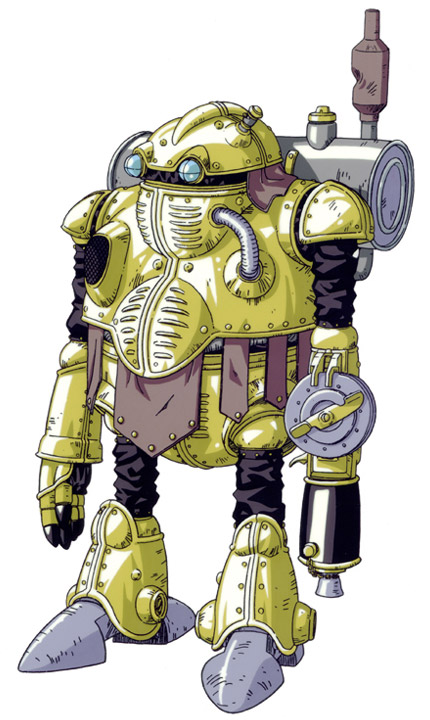
There are many things I forgot about Chrono Trigger that are a delight when I suddenly encounter them again. Among these is the encounter with Atropos in Geno Dome, 2300 AD. What confused me about this particular encounter is somehow I had set it in my head that Robo, the robot character who has a connection to the robots present in this time period, was asexual. It’s a robot, gender is something which we can impart to it, but it does not come equipped with a sex on to which we can map our expectations.

Until this point, the only robot that had oozed some manner of gender in my general direction was Johnny, the biking robot. His cool bravado and machismo brought to my mind A-Ha’s Take on Me video (there are better examples, but this is my favorite), and the name further gendered him to me. A name like Robo was gender neutral, and I am not one to assume the default gender/sex is male (even if I should have realized that this is quite common).

Then enters Atropos to remind me in two ways. “It’s a girl? How do we depict a girl robot?” Pink and equipped with bow. Not only does this display that Robo (and every other R-series and other robot you’ve encountered so far) is decidedly male, but it shows that the female robot is either bedecked in pink or is a shimmering rainbow of a human-eradicating (though human-form assuming) central computer called MotherBrain. The other signifier is the names attributed to each.

The Three Fates were Clotho, Lachesis, and Atropos: those women that spun, measured out, and eventually cut the cloth of one’s life; Prometheus is the Titan who stole fire from the gods of Olympus and gave it to us lowly humans. Between these two robots there is a hint of a love story, and the sudden revelation of their names again plays into our understanding of our own universe and history. Atropos, strangely enough, does not live long. She is introduced and just as quickly killed off, having been corrupted by MotherBrain, and succumbing to Robo’s assault on her to protect his new friends.

Atropos’s own mythos saw her evolve from just the determiner of when to cut the cloth to determining how the death occurred (this was hardly odd, the stories were constantly evolving). This shift is mirrored in the corruption of Atropos, who goes from being the planet’s hope for a future as a robot who was just seeing the end of human fate and continuing on her own species’ survival to a machine seeking to wipe out the warmongering human race. From observer and marker to agent: she is seeking to cut the end of this human tapestry.

Prometheus, or Robo, then becomes mankind’s hope. He is not human, yet will suffer and fight to keep their struggle alive. He is also a combination of creators and different templates, having been constructed as an R-series robot, eventually broke down, and then being fixed by Lucca when you first discover him. Lucca becomes the Dr. Frankenstein to Robo, the Postmodern Prometheus. However, Frankenstein’s monster’s story is altered by seeing Robo learn from his human peers, not being shunned by them (probably helps that he’s not a stitched together corpse), and having him kill off his own female counterpart, instead of begging his Frankenstein for her existence. He kills off the evil she represents to mankind and thereby purchases his humanity, and stops her from cutting off the thread of human history.

As a story, this does not bother me in the slightest. I find it a well-written twist that works well on its own, or with the knowledge of not only the myths of Prometheus and Atropos, but that of Mary Shelley’s Frankenstein; or The Modern Prometheus. Except, it comes wrapped in a marked pink bow (which does create an interesting contrast on her intent to kill). To some extent, it makes sense from a purely visual standpoint. If Robo is to be a heterosexual, the female needs to be show this heteros, or difference in Ancient Greek, and graphically the sprite for a female Robo needs to be altered. However, it now makes me realize that unless this particular game tells me otherwise, all the monsters and creatures I see can probably be safely assumed male.

The only time this backfires is when one first encounters Flea…

Tagged , | Leave a comment