Ayla

I’ve been replaying Chrono Trigger on my DS. The last time I played it I was much, much younger, and to say I’ve read a few things since would be one way of putting it.

Ayla, chieftain of the Ioka tribe, is a character who was almost always in my party (right there with Magus). Replaying the game, a few things have struck me (HERE THERE BE SPOILERS!).

The first two characters one meets after being introduced to the silent male hero Crono are Lucca, Crono’s lifelong brainy scientist friend, and Marle, the tomboy princess of Guardia. Both are better suited to casting magic, and the two serve as the respective brains and heart of the team that finds itself hurtling through time to fight an ancient parasite. While their ages are not revealed, it is pretty safe to assume they’re teenagers.

It is when one travels back to prehistoric times, 65,000,000 BC to be exact, that one encounters Ayla. The initial encounter sees her battling back reptites to give the suprised party time to prepare for battle. Upon the battle’s conclusion, she beckons them to follow her to her village. It is here that we learn the Ayla is a no nonsense type of person who values strength above all else, which works in her favor, as she cannot acquire magic abilities, not being part of the evolved humans who learned to harness such power.

This is where things becoming intriguingly complicated.

To obtain the item the party is seeking, Crono enters a competition against Ayla. Instead of just a direct battle, however, one finds a drinking contest being performed. Skull-smash is the amusingly named concoction, and one repeatedly presses a button to consume more of it than the opponent, thereby winning the Dreamstone necessary to repair Masamune. While I was slightly surprised to see this played out, it is set against other events rather well: Ayla is constantly striving to get the pacifist village to fight against the reptites, she pushes Crono forward and is often telling him to show no fear, and is generally the one raring to fight at every opportunity.

Ayla is chieftain, but upon going to rescue Crono’s Gate Key, she explains that Kino, who precipitated the loss of the Key, has no need to be jealous of Crono. She will bear Kino’s children, who will continue to rule the tribe. This is hardly surprising; it is much more practical (and has historical precedent) to recognize the mother as the direct line of descent in ruling families. Kino is set as the submissive in the relationship, and Ayla’s childbearing intrigues me. This is not a woman who is thinking of much beyond the continuation of her race, having been embroiled in a battle against the Reptites for dominance of the planet.

She’s the only one in the party who can in a game which pushes forward the theme of the survival of the human species and the planet it inhabits.

Crono, Lucca, and Marle are all a bit too young for us to comfortably discuss their having children yet. Frog is… a human-sized frog during the story of the game. Robo is a robot. Magus (an optional character) is a manchild obsessed with revenge and seeing only his sister Schala or Lavos in front of him at all times. He’s never fully matured, and was brought up in a non-human environment, effectively making him an asexual, antisocial megalomaniac bent on Lavos’s destruction. He’s not having children.

Given this cast of characters, Ayla is the one who is already a leader of a group that has not been destroyed. Perpetuation of her race and tribe is of course on her mind, and she sees herself as the cream of the crop. She has to pass on her genes.

And she does. To the royal women of Guardia, including Marle herself.

In fact, early on Marle is kidnapped upon falling into the first time gate encountered that sends her back 400 years, to the Middle Ages. During this time we see many strong women, who keep transitioning and growing up to become proper, prim, and ladylike from seemingly tomboy beginnings (the supposed “feminization of civilization”). Marle’s headstrong conflict with her father the king and unwaivering will can be seen as direct traits that passed on through the years.

One thing that strikes me about Ayla as discongruous is her tech abilities, among them Charm. It’s essentially a ‘steal’ option, but it seems largely out of place with the character. Sure, she is charming in her neanderthal, assertive ways, but she does not strike me as a woman who would seek to charm someone out of his or her items. Especially with hearts, winks, and pink. It seems in direct opposition with the characterization that has built up before this point.

Right behind this ability in puzzling me is Kiss, which effectively heals a party member. Contrast this to Frog’s Slurp ability, whereby he licks someone to heal him, her, or it, and we have a lot less creepy option (I certainly don’t relish being licked by frogs). The two can even combine this to to provide a Slurp Kiss, which is accompanied by a ring of hearts expanding across the screen (I’d argue this should just be slobber dribbling down the screen).

Given these two abilities combined with how she is clothed and her comments on baby-making, Ayla is a sexualized character. This is not necessarily negative. However, this is very confusing, as her sexuality seems to be assertive and direct, as presented through her dialogue, and then cutesy and girly in her abilities (which are still primarily strong, bruising hits, kicks, and charges). Her outfit makes sense as a pragmatic outfit for a rather sweltering prehistoric climate, but also serves to further an image of a sexualized woman. In context, it makes sense, but I can only imagine the reactions people of future ages would have of her walking about clothed as such (especially the men who’d also like to make some babies).

Provided all this, she serves to be a very confusing character in her design choices. On the one hand, she is an immensely hardy, stubborn character (not just female, but character) who is also sexualized, as we often see with strong women–but she is still fully characterized, humanized, and is not a smoldering sex kitten.
Tagged , , | 5 Comments

Vorpal Bunny Ranch Corral: #2

This week sees a double utility post. Fanny Fridays are based on Lord Fanny from Grant Morrison’s The Invisibles, and are when I discuss sex/gender and games. The Vorpal Bunny Ranch Corral is my discussing various gaming topics with people and presenting them to you.


My friend Janathan is going to Japan next year, so I called him up and asked him if he’d like to have a conversation with me. Janathan and I met our freshman year at Wabash and were part of a core group of friends who gamed and were theatrical (for the most part).

The answer was yes:

You can also download and listen. I may look into setting something up via iTunes, especially as I plan on a few more of these with persons such as Cap’n Perkins.

The sound was off sometimes, but hopefully it’s still audible. I know I’m not 100% convinced on our arguments, but I found them useful to tease out and contemplate. Would welcome your thoughts, as, again, I have played perhaps one of the games we discussed (though having seen all but one played).

Tagged , , | Leave a comment

Feminism and Pop Culture

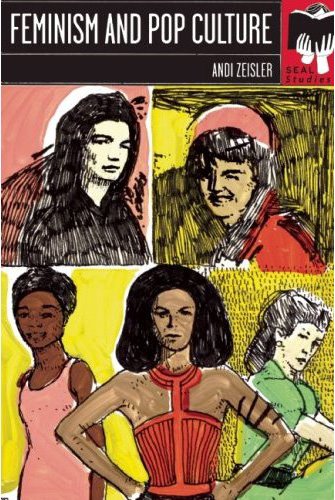
Living down the street from an independently owned feminist bookstore (Women & Children First) means I have come across some rather great books as they are released. This week’s case in point: Feminism and Pop Culture by Andi Zeisler (cofounder and editor of Bitch magazine). Reading the back cover summary, I quickly realized one aspect of pop culture that was not mentioned was one on which this blog concentrates:

“In Feminism and Pop Culture, author and cofounder of Bitch magazine Andi Zeisler traces the impact of feminism on pop culture (and vice versa) from the 1940s to the present. With a comprehensive look at representations of women in film, television, music, advertising, and news media, this book is an ideal introduction to discussing feminism and daily life.”

Initially I raised my brow and contemplated whether this would just be an intro book of little worth to me, but decided the book was worth a chance. I was not mistaken; neither was Zeisler’s aim.

What the book does is exactly what it says: displaying how feminism and pop culture have had an (often contentious) exchange that has shaped both in ways that probably were not expected. Videogames are also not entirely discounted, having three mentions in the book, pointing out that Zeisler is aware of them and the role they may well play in the future, and acknowledging that they are a part of pop culture. Have they added to feminist discourse however?

The one full example of the book dealing with videogames in more than a passing note is illustrating how Lara Croft rose out of a general atmosphere of pop culture’s acquisition of the riot grrrl scene and turning it into girl power through the use of groups like Spice Girls and in advertising through catch phrases coopting and at times even expanding women’s empowerment. “Though Lara Croft, the impossibly buxom heroine of the Tomb Raider video games, was by the late ’90s the most mainstream pretender to a girls-kick-ass throne, she was also the pixelated embodiment of a male gaze-centric fantasy of what a heroic woman looked like” (96). She then goes on to provide examples of women during that time that were more nuanced and fully realized female protagonists in other media: Xena the Warrior Princess, Buffy the Vampire Slayer, and, to some extent, even the Powerpuff Girls.

One question we’re facing here is of scale. Many of the examples Zeisler uses are ones that are viewed and more readily accessible to people: television shows, advertisements, music, and film. Videogames are expanding, and because of their relatively new stature, the effects of what they’ve given to pop culture are still being teased out and examined in even a more general sense. If we are to believe some of the wacko politicians in the other country that holds claim to my supposed loyalty through citizenship, many videogames are merely Killerspiele. Of course, this is hardly the property of any one particular country, but we’re currently the comic books of the 1950s, under careful scrutiny by many parties. Many people play videogames, but have many played the examples which we could discuss from the past? Would they care to go back and take a look?

Another aspect to note is how the media Zeisler discusses all had massive efforts to target and advertise to women (‘chick flicks’, women’s products, girl groups, et cetera). It feels as if videogames have only very recently, within the last ten years, even attempted to realize there exists a whole other sex that might be interested in the games provided. While we could probably argue that they started off in a somewhat sex neutral space (even saying this feels circumspect), there definitely exists a time when the top titles were not aimed at women in the slightest. Now that we have seen it, it’s almost painful to watch how easily it has stepped into the feminist backlash phase of advertising in many regards.

One other point to consider is that Zeisler does examine many of these pop culture phenomena from a personal vantage point. While offering various readers’ responses to prompts in excerpts found throughout the book, her own personal voice makes it very clear that she has been at least somewhat immersed in many of the various media of which she speaks. If videogames are not of interest to her, I could hardly expect her to wring out information on a topic that holds no interest to her. After all, this is a woman who admits that pop culture can often be problematic, but she consumes it all the same. Every one of us does in various manners. We make our decisions based on our interests, and this may mean that some aspects of pop culture may never speak to us directly.

Will videogames affect feminism and proffer a similar exchange that can both be enlightening and frustrating? I believe they already have (or so my blog posts would lead us to believe) on both counts in varying degrees. It certainly is a topic about which I feel passionately, and it was useful reading this book just to refresh and fill in some of the gaps of my education while tracing the second wave of feminism and beyond’s battles and cooperation with various media.

Tagged , | 2 Comments

Gayming Closet

This month’s Blog of the Round Table: The Ghost of Gaming Future What role will gaming play in your familial relationships in 5 years? 10 years? 20 years? Having already explored both the past and the present, this month’s round table asks us to turn our eyes to our future gaming expectations. If you can’t picture how gaming will impact your own family, feel free to explore what game designers could/should/shouldn’t do to make gaming a more family friendly experience, or even to create and explore a fictional world where gaming is (or isn’t) a major part of every family’s life.

When I first read this prompt I sat back and scratched my head. What is family? Do I even know on which continent I’ll be living in five, ten, or twenty years? After the initial confusion I started parsing out my thoughts on the matter and decided a few things: Corvus is not the type to make the question of family so limiting, I was looking at this from the stance of someone who has remained single for some time and did not account that a relationship can be family, and that given my past in gaming, the experience that exists with my family is unlikely to change. Instead, I decided to opt in for some navel gazing and ruminatin’ (and will admit this presupposes that I’ll enter into a future relationship, of which I remain curiously wary).

In the Gaymer community there seems to be a loose consensus that one comes out of the closet twice: once as gay, then as a gamer. As someone who came out at age fourteen and has been gaming unashamedly for many, many seasons, both of these seem far distant memories for me. In the past I have been on dates with a variety of men who’ve had reactions to my gaming habits mirroring my own when they admit their love for the heteronormatively insulting Katy Perry or racist and abashedly homoerotic Abercrombie & Fitch–it usually leaves us with pregnant, awkward pauses. At least, this is what results when I admit to playing something more than just Rock Band or Guitar Hero as a party game (or isn’t that Wii thing like the greatest fad ever?). What has resulted is an acknowledgment that I need more discerning taste in those with whom I go on dates.

While I often hear mixed reports from my heterosexual male friends concerning girlfriends’ and wives’ reaction to their gaming habits, the general consensus is that it is allowed as in the realm of those ‘guy’ things or joined in at some point. In the gay community, the reaction with which I’ve been met has been one of my habit being puerile to the extreme or hopelessly not cool, and, as these are fellow males, they see no excuse of guys will be guys being allowed as a small indulgence. Meeting gaymers seems to be a special occasion which often leaves me and the other party raising an eyebrow and throwing down gauntlets to make sure we’re talking to an actual gamer (imagine me sighing as I type that last sentence).

What does this mean for the future in the world of Denis?

Frankly, the odds of my happening to date and enter a relationship with someone who refuses to game or acknowledge it as a legitimate hobby may well face the fate of those who refuse to read (something I cannot fathom nor really begin to abide). What I see as an ideal proposal involves someone with whom I would actually game and hold discussions. Someone with whom I can debate the merits of dissonance in games, propose theories of queer theory as seen through an interactive lens, contemplate what a Dennis Cooper written game would entail, and other such topics (note, I said ideal–there is wiggle room there). It has reached the point where I have become fairly staunch in my belief that videogames are a medium which has to be acknowledged more universally as we often do with music, film, art, and literature as cultural signifiers and relevant to what entails our pop culture and more ‘high brow’ entertainments.

So, in five, ten, or twenty years, I’ll still be playing with my family via servers in various games ranging from MMOs with my mother to FPSs with my brother, and hopefully be that kick ass uncle for my nephew when he discovers the joys of gaming (I’ll be a kick ass uncle either way, but gaming would make the transition easier). In the meantime, any future familial relationship of my own has come to hinge on the acceptance of gaming, and hence my curious wariness and raised eyebrow as to the future in that realm (after all, I did once briefly date someone who gamed, but refused to talk about it…).

Please visit the Round Table’s <a title=”Round Table Main Hall” href=”http://blog.pjsattic.com/corvus/round-table/”>Main Hall</a> for links to all entries.

Tagged | 13 Comments

He kindly stopped for me

Bloggers Unite

This post is in dedication to the brave and often terrified individuals I have known who are living with or passed on due to AIDS related complications:

My mother had many gay friends. From stories, I have learned many of their names and faces, their stories, their lives, and what German queer life was like in the 70s and 80s. Being the person she is, I don’t think there is a period in my life where I have not known a queer person as a family friend–that’s just how my family worked. During one of the visits to Germany during the summers while I was attending Wabash, my mother and I were walking around in Fulda and ran into one of these old friends. What followed was a recounting of how many of her previous friends had succumbed to AIDS related deaths.

I have known friends to acquire HIV and later develop AIDS. It has even sundered some friendships in places due to misunderstandings during a very trying period.

Can games capture this? Should they even attempt?

It strikes me that almost every example I can think of in terms of an illness presented in a videogame is able to be cured. If the person dies, it is usually due to our own lack of haste, ineptitude, or because we just didn’t care to save said person. How many times is a game’s death inevitable and one which we know has to come, a fate we cannot alter?

It is highly unlikely that any but an art game will take on such a topic in terms of protagonists, but what would we do with a sub-character, or party member being afflicted with a disease, virus, or illness that could not be cured? What would our attitude toward that character be?

In games we often are presented with deaths that are sudden and violent, deliberate and focused, but rarely one that we can see a mile coming and have no control to stop. Of course, it’s also a morose topic. Why present a player with an element over which he or she has no control whatsoever? Are games capable of demanding and asking of us such an emotional commitment?

If the death of Aeris is one over which many mourned, is this something that can be replicated in a different manner? Can we create a character about whom we care and whom we know we cannot save, but knew such from the start or even midway through as we watched them collapse before our eyes? What if no quests in the game at all concerned being able to aid said person, but we had to accept what was occurring because the disease was too new and we didn’t know enough about it?

Or, what if we could prolong the character’s life through treatments, giving them a life. It might only be bearable, but that character can live a while longer.

The complications, of course, are that this would require some method of attachment to the character. If not the protagonist, this would require a compelling relationship between the player’s avatar and the character with whom we interact. If the protagonist him or herself, we suddenly face the question of whether or not people would play a game, knowing that no matter how fantastic the journey, it must end–probably not in a pleasant manner. Maybe the next generation we can save, but we’d still have that memory of the one who didn’t make it.

Maybe this game even exists and I am not aware yet of its presence, or have forgotten. Thoughts?

Tagged | 11 Comments

Body Image

This post is inspired once again by the ever lovely and brilliant Amanda Palmer (whose song Guitar Hero I have discussed previously–actually, twice). It appears she’s having a falling out with her record label, Roadrunner, over her latest video, Leeds United. Apparently she is showing too much belly fat, which she refused to remove from the video. From the words of Palmer herself, she hardly saw herself as fat in the video and refused. This has seen quite the reaction from her fans. Here’s the video of which I speak:

If I dare speak my non-heterosexual piece of mind, Amanda Palmer is rather gorgeous and hardly fat. This is a move I would expect from the music industry, however (or with most industries, sadly). Considering how much ‘fat’ her belly is showing, we’re seeing an impossible standard once again being applied. But what if she was packing a few more pounds? Back in July my mother asked me about Fat Princess and the controversy which it inspired. I would wager to put forth that negative representations of people with ‘bellies’ are hardly sex exclusive to females, however (at least in terms of representations of people with more pounds–we still see less fatter females than males overall).

Fatter people of both sexes are generally not people we see in games as protagonists. This is for a variety of reasons of course: who wants to play fat? sex sells! we’re certainly not putting more fully figured people in skimpy clothing unless we’re going for a laugh. They exist as NPCs, merchants, and possibly a member of the party who probably obsesses over food all the time.

As it stands, those that fall outside of the culture’s weight expectations are often used as a prop for laughs. These are the people that play comedic relief and occasionally make us endear our hearts to them because of the prejudice they face (particularly in romantic aspirations). They will run and occasionally put their hands on their knees, gasping for breath, sorely out of shape, behind the chuckling protagonist who has remained a lifelong friend. It is hardly news that our expectations of beauty have changed in the past decade–for men and women both.

On another level, we’re also under the assumption that all people who may be overweight are out of shape, sloths, and incapable of the feats required in a physically active game. Those are the games we mostly play in fact, those that require our protagonists to perform awe-inspiring feats of physical strength, agility, and various other activities in which I may likely never engage. This would create a dissonance in playing against our expectations and the realm of the plausible. Expecting Lara Croft to perform acrobatics with an overly-abundant bra size is all right, but don’t add to her belly.

Iunno, food for thought at least.

Oh, and I support Amanda Palmer–going to see her this Wednesday here in Chicago, in fact. The writing is an allusion to her album, Who Killed Amanda Palmer?:

(Writing on one’s belly backwards does funny things to handwriting.)
Tagged , | Leave a comment

My So Called Sims’ Life

The Sims 2 came out my sophomore year at Wabash, and would be the game on which I would spend the most time (second place may go to World of Warcraft) during my matriculation. The reason this game worked so well into my schedule was that I could leave it running, come back to it, play a little, and never feel as if I wasn’t progressing.

Everything in the game is progress, in a very Zen way of looking at the game.

If I had not uninstalled the game in a fit of disgust after it deleted all my saved files, I probably would have intermittently logged more hours in the past few months and never thought much about the whole process.

Is this a game? A glorified doll house? Playing a god?

I’ve tried in various ways to understand what it is that appeals to me about this game over the years. My Sims tend to be people I know, and the stories in which I wrap myself only make me appreciate the stories all the more. There was the time when my friend Janathan’s mother came over to my and my partner’s house, stepped into our hot tub, and would have caught herself on fire if we had not quickly come to her rescue. When children would come along and then grandchildren, suddenly the personalities I had brought to the game were abandoned and new entities would arise.

A large part of my disconnect from the Spore universe is not being able to really connect with my creatures after the Creature phase. Personality was no longer a factor, as they all dressed the same, there was no variance, and as I entered Space, I suddenly was treated as an individual of my race in the first person. The game’s perspective shifts from a third person view similar to The Sims to an overview expected in an RTS to one that is more focused on myself as an individual of my race, except I no longer really see myself–instead seeing my leader who looks exactly as I left him at the end of the Civilization stage. It’s as if I, as God, stepped down to become an avatar, and have a very curious stake in my world these days.

While I may have made Denis Sims, I never felt like I was inhabiting the body of said Sim, so this stage in Spore strikes me as particularly odd, and probably speaks closest to my disconnect from my race. Perhaps that is the desired effect, but after nurturing my concern and eliciting small chuckles from me while in the first two stages, I no longer knew what to make of the race that I had created. In other words, I was no longer invested in the smaller progressions and only cared about ‘achieving.’

This may partly be expectation again. Once I reached this stage, my mindset shifted to one that I would normally adopt in a game more similar to the genres that had been represented more recently. When I play a game like Master of Orion, Civilization, et cetera I have no personal investment in the empire I am building, much more focused instead on the elements to progress, achieve the next goal, unlock more tidbits, and eventually win the game.

I don’t play The Sims to win.

One aspect of the game I have not tried is just playing the discrete portions and creating a different race. However, I cannot divorce myself from those fond memories of playing my first three creatures and seeing them nurture and grow. Perhaps the solution is to never move beyond the Creature stage–but the stages by themselves seem largely simple to me. The charm of the whole package was how this all connected, and I find myself almost regretting getting into this whole mindset.

The unfortunate aspect of playing these discrete portions is that they all seem small enough that I could finish them in one session. There is not enough content in any but the Space stage to actually entice me to play beyond reaching the goal marker to progress to the next phase of evolution. The game itself is encouraging and pressing me to go to the Space stage, where I am finally free to explore, do as I please, and have a more open-ended game. That was not what I was expecting from the promise of being able to play in any stage and ignore all others–but I did not carefully read between the lines.

This is the allure of The Sims 2, finally. It took Will Wright’s next installment to make me realize why I picked up the game so often. There is no expectation, no stages, and the game seems more like one seamless experience (albeit, one that has odd time warp issues which are apparently addressed in The Sims 3). While it does not allow the versatility of quickly starting a new game at the exact stage without cheats, it does allow me to actually stay invested in what I’ve created at all times. In retrospect, this is what I should have foreseen coming with the shift of the micro to macro level of experience for which Wright and his crew were aiming.

Tagged , | 1 Comment

Endospore

I keep hoping that Spore is just in a gestation period in terms of my own interest. One day I’ll suddenly be struck with a ravening desire to load up its application, download a few patches, and tear into it again with a gusto that makes my initial playthrough seem paltry by comparison.

The dreamy part of me eventually meets the pragmatic side and what ensues is wondering how I can be possessed with such an odd, deluded daemon.

I don’t dislike Spore, but after reaching Space, I was somewhat disappointed. Instead of being able to explore and marvel at all I could find, I was suddenly engaged in one spaceship battle after another, trying to save my planets. This invariably led me back to my homeworld to defend it against a warmongering race, which in turn led my game to crash. It left a sour taste in my mouth, but I figured I’d be able to come back when the appropriate patch came along (I did not relish deleting my turrets and all decorative items every time I returned) and just breeze along dreamily, eventually putting the other race out of its misery.

Wait a minute.

Had I not started an herbivorous race that had loved singing and teaching other races to dance and have fun? I realize conflict exists in many videogames because it is the easiest way to progress a competitive story, but in choosing a peaceful race, I find it odd that most of my time in Space has thus far been ruled by blasting other ships to smithereens in order to preserve my own hide.

The hints of this dissatisfaction started early on in the Civilization stage actually. To conquer other cities, which I had to do, I had to blare an image of what I presume to be my race’s leader proselytizing as beams of light were shot into the city. My religion is better than yours!

Herein I find two problems. Religion is nonviolent? Really? Perhaps I’m reading too much of our own history into this game, but most religions are anything but nonviolent. I think my annoyance with the selection of the themes of a race choosing among War, Religion, or Trade is that the three are inseparable for the most part. To say that my race is a pure theocracy who does not use trade or war is very simplistic, and while I know that this was the aim of Spore (to not be entrenched in complicating details), I somehow feel that some other metric might have been used to allow our races to continue.

Unfortunately, in the way the game is built, I cannot say what this would be, as the game misses one element I feel is quite sorely missed: diplomacy. Is your race one that tries to solve its problems with words? I do not buy the principle that streaming yellow beams of my religion are the words that equal diplomacy. The difference between it and the War path are only that they shoot missiles from their vehicles that are much more damaging. After all, if I was throwing my ‘conversion’ religious beams at another vehicle, why does it not actually convert said vehicle instead of destroying it?

My path was not really nonviolent, it was just violence painted in another palette with different words, and I was supposed to be pleased that my vegetarian, pacifist race was still spreading happiness and cheer. As an atheist, I think you can read the frown dripping from my fingers right now.

So, by the time I reached the Space stage and was constantly embroiled in space battles, I grew rather disheartened; the bug that caused me to crash when leaving my home planet if there were some turrets or decorative items on it only exasperated these feelings.

My problem with Spore was that I wanted a more open ended game. There is an impressive tool set, definitely. However, in actual gameplay, I find myself yawning now. The Space stage has left a very poor impression that won’t remove itself until I know that I could, for instance, use diplomacy in a method other than wandering in to another solar system. You mean to tell me that we can travel through the galaxy, terraform planets, and can’t communicate via remote means?

Really?

This is not all Spore’s fault, though. I was expecting something else. In all actual truth, I was hoping for something that pushed the limits of The Sims franchise and re-envisioned it. The two games are wholly different with little I see actually linking them. This is, of course, a good thing. Considering The Sims franchise will continue, I’ll likely stick around to play its next incarnation.

Perhaps most disappointing was that after all was said and done, the further removed I became from my creatures, the less personality they actually had that seemed distinguishable from any other race.

Verdict? I’ll have to return to Spore at another point, but I doubt I’ll buy any of its expansions or sets.

Tagged , | Leave a comment

Seven for a secret never to be told.

In the past month I have invested over eighty hours in two games: Fallout 3 and Left 4 Dead (the ratio is currently 3:1). While both certainly have their qualities that draw me in and make me enjoy playing the games, this is not what this post will discuss. What I’m interested in for this post is not the narrative told by gameplay, optional quests, or personal investment; what I am interested in is the story told in the nooks, crannies, and little details. Those moments that I just pause and think about what was or could have been, particularly in a post-apocalyptic world.


Call this reading the story between the lines, or creating it myself. What’s great about this element in games is that it can be ignored by any who so choose, and offers a minefield full of possibilities to those who are interesting in pushing their own narratives and interacting with the story a step further by creating even more stories. What am I talking about exactly?

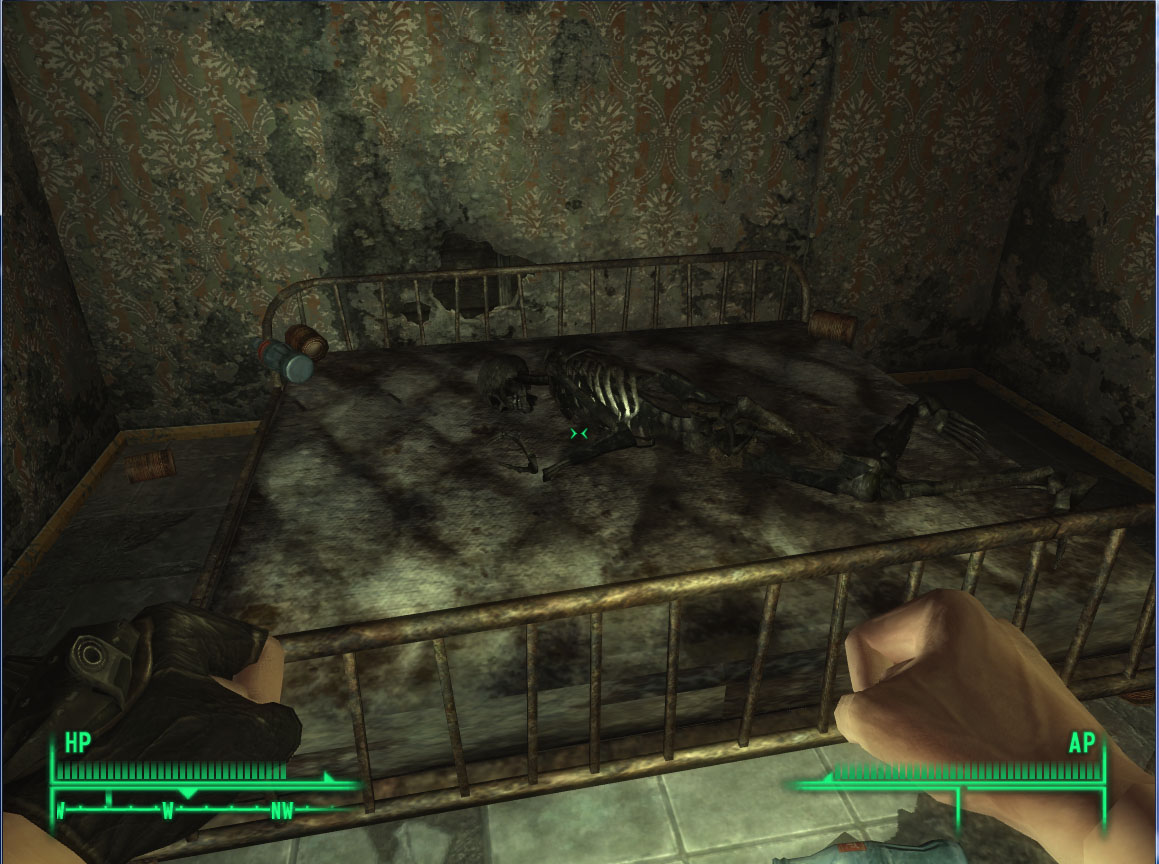
This scene from above is rather familiar in Fallout 3: a skeleton on a bed. The variance comes in whether or not there is more than one skeleton, what items are strewn on the bed with him or her, and where this location is. Just as likely for the player to find is a skeleton in a bathroom, sunk down in the tub; while the skeleton who is surrounded by empty bottles of whiskey in the bathtub offers a morose sense of humor, it makes me wonder what happened to those skeletons who don’t have that sense of liquid courage. Were they peacefully taking baths when the nuke hit, cowering in fear because they couldn’t get into a vault?

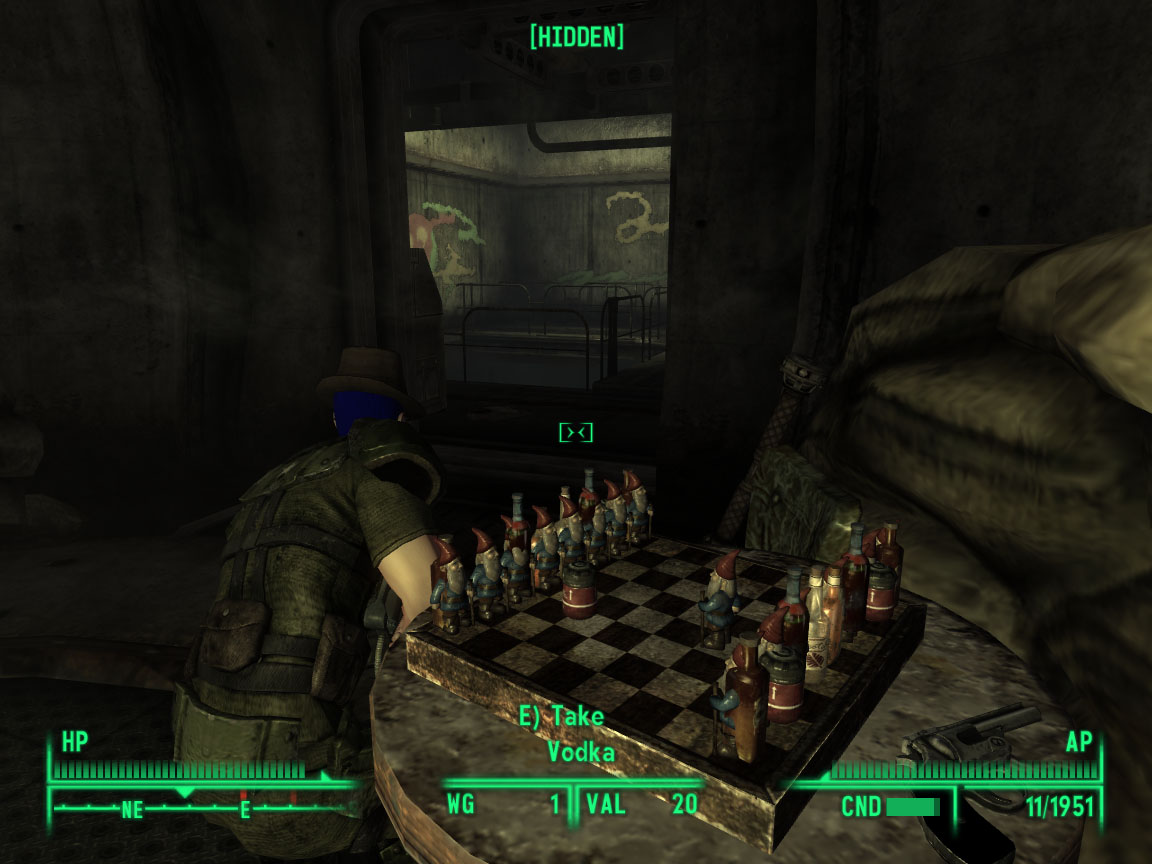
One of the portions of the game that just had me stop and laugh for a good while (then take a screenshot) was in a later communications tower, where I came across a makeshift game of chess played out with garden gnomes and bottles of alcohol (the variety of alcohol in the game is true to gaming form). Did someone find a pre-war book on chess and put together this rather odd game? Perhaps it was put together by a survivor who kept the tradition alive via introduction of the board to new people. Chessboards are one item that proliferates the world, but what context does it offer the player, who may have never encountered it, or at the very least, the pieces with which to play it?

I have yet to write out an actual story based on these secret stories which are never really told, but add them up over the course of a game and I’ve created my own world based on the story I placed into these images. Fallout 3‘s humor is not often to be found in its dialogue, but in the small idiosyncracies that populate its world–or perhaps I just have a very comical way of looking at the world. I’m certainly never bored, even while waiting.

Waiting happens from time to time in Left 4 Dead, or so I’ve found if I’m on a good team. We take a moment to discuss the strategy of a known horde that will rush at us. On our way to Mercy Hospital, a teammate remarked on how he just now noticed the spinning Tank Burger sign across from the gas station. His words, paraphrased, were to point out how this game’s polish comes from the little details while you have a moment to breathe.

In my day to day life it is quite common for me to look at grafitti and what people have written on walls, bathroom stalls, or any other locale. I’m attracted to the written word. The walls in Left 4 Dead are strewn with such distractions. Walking into a safe room, I get the feeling that the level designers listened in on teamspeak servers, polished it, and gave us what they imagined survivors would write to each other.

“We’re the real monsters,” is followed by a person pointing out that the above has not seen the infected, obviously. “I hope I die in my sleep,” is rudely followed by an arrow commenting, “I hope he does too.” There is a church in working your way through the Death Toll campaign which has a list of deceased, scrawled in passing, marking on those who failed as survivors. The idea of needing to communicate and commemorate persists, even if the means to which we have become used are no longer apparent.

There is a moment at the end of the Dead Air campaign where I always pause. Each time so far has netted a different story: who was on that plane? What happened while I was fighting my way to get to this point? The game provides an excellent distraction from anything but the here and listening for the telltale signs of the next special infected. Speaking via microphone, I am much more interested in talking and communicating effectively with my teammates than worrying about the few other survivors that exist in the world.

Living in this world, I don’t have time for those who cannot aid me in some fashion (read: teammates who go running off and getting us nearly killed). I dread the world in which I’d become a survivor.

After realizing that I was doing this for these two games, especially considering the loose connecting thematic genre, I began to wonder if other games do this more often and I just space out (though it also caught my attention in Portal), only recently having rediscovered some of my analysis skills after working in a detailed design department for a full year. Does this happen in other media? Yes. Whole critical essays and works have spawned from the minute details of a Shakespearean drama to George Bellows‘s paintings depicting amateur boxing around the turn of the 20th century. Videogames just happen to have an element whereby I am creating the story myself, in some fashion or another.

This seems to occur (based on recent games I have played) more frequently in a game where the surrounding plot is either merely passable with a few great moments tossed about (e.g. Fallout 3) or virtually handed to the player to construct (e.g. Left 4 Dead, Portal). It is by no means a requirement for everyone, diminishing dependent on one’s enjoyment of the title and what one’s aim is (for a person enjoying the ludic elements of L4D, it plays hardly a role). Hopefully this will not result with my writing copious amounts of fan fiction.

Tagged , , , , | Leave a comment

Not gaming?

For a myriad of reasons, I have not gamed in the last two days. Nor have I written here, obviously. I’ve started a new job which is quite draining (but more rewarding on an ‘ideals’ level) and I entered into a valley of the doldrums. Whenever I say that word I recall the first time I read The Phantom Tollbooth, and that gray, desperate ennui would be an apt way to describe what had occurred.

I could go into a longer treatise on why this occurred, but I’ve already purged that out of my system. Instead, I was reminded of one segment in particular that caught my attention during the last Brainy Gamer Gamer’s Confab: gaming is an expensive habit.

Part of the reason there is a chunk of missing data in my own gaming history is that I lived for a year without electricity in high school. To say that the surrounding years afforded no new videogames unless my parents pirated them would be quite apt. This is among the reasons I don’t personally believe in pirating games: it leaves me with a feeling of desperation and reminds me of worse times (further complicated by my father’s videogame addiction–yes, I believe in such). Thankfully, my family has since rebounded and is firmly on its feet, and I’m thankful that such was the worst I ever faced.

While we can talk ’til the cows come home about gaming being a recession-proof industry, I think we’re only looking at the industry itself. Most people I know who game may buy up to three games a year, not really wanting to keep up with all the latest releases. The other reason being that three games in a year can cost one anywhere from $150-200 easily. While we’re now presented with games that can be downloaded at much more manageable prices, this is by and large not that which with the public is aware. I’ve met many Wii owners who were not even aware that they had access to the WiiWare channel–confusing my talk of it with the Virtual Console.

Recession proof? I believe we’ve seen evidence in the contrary. However, while I may cringe oftentimes when I see discussion of how people are entitled to certain things from a game because of the money they spent, I understand from where they come–to an extent. On the other hand, sometimes I wonder if we let an inner spoiled brat start complaining at the drop of a hat.

Then I see organizations like Penny Arcade’s Child’s Play and the efforts by GenCon Indianapolis (even if their initial donations were spurned, but which led to some confusion), and I realize that there are those gamers out there that do realize what they have and what others do not. While I try to not be sappy as often as possible, with the American Thanksgiving coming around the bend, I think we gamers should be thankful we even have the money to purchase our systems, games, and the space in which we’re voicing our opinions.

P.S. In the near future I will probably be striving for only three posts a week until I get the hang of my new job/schedule.

Tagged | 4 Comments