I largely feel that when adding a female protagonist into a mostly linearly plotted game (read: no emergent gameplay; nor creation of your own character or characters that aren’t fully developed, instead being ciphers to ludic pleasure), the whole tone of the game changes. Not because I want it to do so, but because whoever may be designing the game designs it with different expectations, and brings their own societal biases (don’t worry, we all have them). In the past, I’ve already discussed how we perceive females as the weaker sex in terms of physical activities, and this means we normally give them a more full range of emotions and make them less blood hungry. Due to my previous post and then reading Brinstar’s review of Star Wars: The Force Unleashed and her comments of the sex selection of the game, I want to now explore the exploration of how violence is shaped by the sex at hand–particularly that of the few female icons we do have in games.
I don’t know about you, but even growing up with a very pro-feminist mother, I was raised in a world that told me I was more predispositioned to violence than my female counterparts. Somehow that magical Y chromosome donated by my father meant I could at any instant turn into a bloodthirsty killer; it was up to me to determine whether this was as a soldier for a proper cause or as a madman who’d just gone off his rocker. Males are told that as XY bearers we have the inherent ability to carry out a battle, to wage war, to shoot a gun, and to take another human life–in the proper context.
Contrast this with the way I saw many of my female peers raised: they were caregivers, morale boosters, supporters, pleasers, and had the ability to create a new life. We are not comfortable with the idea that a female who is capable of producing life also has the ability to take away said life. In a world that often is painted in stark binary terms, it does not offer a cohesion of principle and clearly categorized worlds. This is why we have problems justifying and accepting bisexuality and intersexuals as a society at large.
When either sex adopts the supposed incongruities of the opposite gender, comedy frequently follows. Here is the norm, here is the norm subverted. Isn’t that a barrel of non-intersexed monkeys!
This, then, gets into the question of one’s belief on how gender is created in a particular sex. Do you believe that this is because of the chemical workings of the chromosomes that dictate how we react and our particular behaviors? Or, perhaps you believe that we are placed in an environment that fosters these behaviors and reinforces them so that when we rebel against them, we show equality of the sexes is actually possible? Nature versus nurture, folks. Essentialism versus construction.
While I am a large believer in Judith Butler’s assertions that gender is a role we adopt, a mask in which we feel comfortable presenting ourselves as the appropriate sex to our society, I do not believe in pure binaries, and believe the truth may be closer to a point somewhere in the middle. This does not shake the fact that if you ask the average person the difference between gender and sex, many will believe the two largely interchangeable. It certainly is in videogames so far.
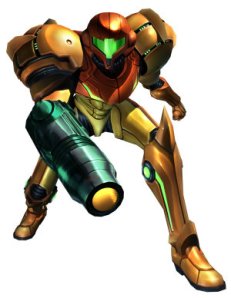 When we are given a female protagonist such as Jade or Faith, the game becomes less violent. Suddenly gone are headshots, gore splattering all over the place, the walls dripping with the blood we forcibly ejected from our opponents. Putting a female face on a videogame spells out the fact that this game is less violent, gory, and more palatable for the female sex (unless survival horror). Even the violence performed by Samus Aran falls into Nintendo’s realm of not being gratuitous or gristly (however, so does Link’s). Survival horror sees its fair share of female protagonists, fighting supernatural or scientifically altered non-human beings. This fits into what I see as females being okayed to fight against less-than or not-quite humans.
As I stated yesterday, we don’t often see the emotional reactions of our protagonists to the violence they inflict, and when we do, it’s usually from female quarters. Yet, we’re to believe that suddenly a violent act inflicted on someone with whom we are familiar in the game world should tug at our heart strings, be it Jenny from The Darkness or Aeris from the oft maligned Final Fantasy VII. Violence against females is supposed to bring a reaction from us, which plays on our society’s need to protect its mothers, sisters, and daughters. In The Darkness we come a step closer by portraying Jackie’s response to his changing humanity, but violence is the solvent to almost everything, with one important exception through which he is guided by Jenny’s voice. His reaction is more focused on the symbol of his violence through the Darkness, however–not directly to his acts.
Contrast this with Lara Croft, who has a very strong reaction when she kills her first fellow human. Again, violence against non-humans is seen as fine, but if a female suddenly fights her own species we’re told to pause. Something important happened here! We don’t give this pause to our male protagonists. Killing is an everyday occurrence for the most part. Normally we have to dehumanize the foes for our females in some manner, and even then, the deaths are quite frequently not visceral. Why?
The answer, I believe, is two-fold. We want to believe females not capable of such acts. We do the same with serial killers as I’m seeing occurring with our females’ foes, often painting them in mystic tones and making them less than human–no human could do this, erego inhuman. At the same time, the draw of a female protagonist is also to play the market in a heteronormative fashion: appeal to the male libido and assure females they can play as someone of their own sex. The female gaming market is growing, especially in the cases of The Sims, Harvest Moon, and other such titles. These are generally non-violent games (give a tool to anyone and they’ll manage to play around its original intent), which grows the expectation we’ve been given in general society: females are not violent.
Which is a lie. Reading bell hooks’s Feminism is for Everybody: Passionate Politics, I was reminded of a fact we often overlook: just as many cases of domestic violence are perpetrated by women against their own children. These are often either ignored or not reported, so it becomes difficult to navigate that terrain, especially when children are not given the tools or rights to speak up on their own behalf; to believe females are generally pacifist and have little capability of violence or prefer such is very likely just a fallacy in which we like to believe. We just prefer the idea of a father who is abusive physically and a mother who may be more critical with her words–this makes sense to us.
Therefore, to just place a female in a game is not to provide equality, as it quite frequently comes with a caveat. We should not ignore the society that shapes us as human beings, including our diversity. We do need to step beyond the boundaries which we place on ourselves, however. It is one thing to acknowledge and make us aware of what may have shaped a female in attaining the skills she has, but it is another to say that she is not as capable as a male at certain tasks, or has to be sexualized to achieve the same goals. That does not mean I wish to see G.I. Jane the licensed game, but it means that it may be time to be more creative and acknowledge truths with which we may not be comfortable. How about more games where the male is the non- or less violent entity, as I’m sure many of us see Faith; alongside this, provide females who can give us grisly deaths and are not the villainess?
Would we accept such? (Thanks to Groping the Elephant for the link.) Should that stop us?
Edit: Many examples have since been brought to my attention, which I explain (slightly) further in depth here.





 Vorpal Bunny Ranch