Punk is commercialized

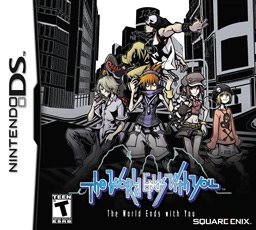
When The World Ends With You was released I paid attention to the various reviews and thoughts being bandied about over it. This seemed like an intriguing game that presented a new type of challenge in its combat system. When it arrived in a GameFly package, my only worry was that the combat system might prove to be too much, too distracting, and that I would eventually put split screen battle system to auto so as not to distract me from Neku.

I was mistaken.

There’s a lot to enjoy about this DS title. The fashion system is fun, but entirely able to be ignored. If you happen to want to stick to the pins and clothing you have on, just fight a few battles, and the popular fashions of the area will shift toward what you are using. However, I’ll keep the game away from my mother, who complains every time she sees punk clothing on sale, bemoaning the days when she and her friends made their own.

The pins offer the usual culprits in damage types, but provide a great way to battle. The DS doesn’t have many games out that use the stylus in actually intriguing ways that work well. This game does that in droves. Drag Neku across the screen, tap at your enemy, slash to create a line barrier, et cetera. It made playing on the El a little more interesting, but the expressions on peoples’ faces were rather priceless. Yes, this business casual attired chap was gleefully tapping his stylus away, bobbing his head, and enjoying himself.

Then there’s the dual screen combat, with what’s happening on the top screen. I took control of the characters in turns by shifting my focus: mashing away the direction pad when concentrating on Neku, dragging the stylus to have Neku perform dodgey dashes while concentrating on pressing the directional buttons in the proper sequence. Slowly, I began realizing I could shift my focus dependent on where the ‘puck’ that provides extra damage was, and thus make my combat more effective. This was really fun, and I enjoyed battles because of this mechanic.

What I found myself yawning at was the story. Perhaps the game is trying to be too hip, or perhaps I’m just too jaded, but after the second week (in terms of the game, which is set up by days, then weeks), I found myself putting the game away and not caring. This will likely be a purchase in the future, but for right now, the story does not grab me. It seems like a mystery novel written so as to not give any clues, and has all these discrete moments of storytelling that probably sum up to a grand total, but which does not grab me enough to string me along to the end.

In fact, the game feels slightly esoteric to me, and I can only make some educated guesses as to why this may have occurred. Fashion interests me, but I find popular fashion to grate on my nerves. The music was fun and I was pleasantly surprised to hear my DS being able to play it back, but none of it really appealed to me, brought me closer to the game, or made me feel I was part of the environment (it served to remind me why I stay away from shopping centers with music). This game felt like a reminder that I felt alienated from this youth culture. Which may be the problem–I am no longer a young boy or teenager playing these JRPGs with very young protagonists. I grow weary of most coming of age literature as well, which is not to say that such does not have its own place; I’ve already muddled through my teenaged confusion and don’t need to revisit it unless the work at hand is well crafted or picaresque in nature (e.g. Huckleberry Finn).

The game fires a desire in what I want from DS games, though. I want to use my stylus in ways that are not frustratingly inaccurate or pointless (this can also be said of the Wii). When playing Castlevania: Order of the Ecclesia or Final Fantasy Tactis A2, I never have to use it, which makes me wonder why it’s even there. What I’m largely left with is a handheld system from which I crave more. TWEWY had me excited because I enjoyed the battles and the ways to use my pins in conjunction with each other (so much so that I absorbed myself in them versus the plot). It was a promise on which it delivered.

Overall, it’s a game I will have to get back to, through which I cannot push myself when I have other selections to try. While I am happily taking my time with Fallout 3 (close to thirty hours logged) and will start tomorrow with Oddworld: Abe’s Odyssee, this title will require a time when I’m less apt to yawn every time Neku has one of those ‘Man, people are such sheep, they need to be individuals and do what they want’ tropes (which is amusing considering he does what I say for the most part).
Tagged , , | 3 Comments

Birth of a role

This will likely be my last Fallout 3 post for a while. I want to share a series of impressions, then enjoy and chew on the game, to return when a more fruitful discussion can develop. Spoilers are not really existent.

White light glaring at you, harsh and clinical. Pieces of fleshly blood spattered in your vision. A strange man in a mask comes up to you while you stare, disoriented and having no idea where you are, what is happening, and can barely understand who you are. While this could easily describe the scene of an interrogation of a less than kind nature, for anyone who has followed Fallout 3 for the last few months, it’s the start of the game.


Instead of playing an assumed sheltered adult thrust out in the harsh, destroyed landscape of the DC wasteland, this is a character you build from cradle on to many graves. Without having to deal with what life has gone before you, you are given glimpses of that life, influencing it, and determining how you will emerge and grow as a human. No amnesia allowed. No shady past on your part. Nothing. A blank slate, perhaps?

Actually, if anything, this character is not a perfect exemplar of tabula rasa, but a window of your own gaming habits. You are controlling this person’s actions, and that guides what knowledge the character has. In metagame terms, you know that pressing the WASD keys will move you, the mouse will change where you look (though the game is sure to remind you, in case you have forgotten, or this is your first game), and the click of the mouse button will have an appreciable effect in reacting to your world. The moment you make your first decision, selecting male or female as your sex, you are basing it on your own desires and expectations.

How will this game play if I have a vagina versus a penis? With whom can I have sex? Will there be sexist attitudes? Then you choose a name, and since it is purely cosmetic, it can range from Aeazel to Denis to Nutella. Though, perhaps you actually aspire to infuse the name with meaning–is it the name of a friend, a character you know, a relative, someone completely new? There are no guidelines and restricted names, no moderators to kindly suggest an alternative or banning. Next, choose what you will look like, selecting first from a template of four races who are all human, and then choosing certain templates within that frame. This is purely cosmetic, as you can select Hispanic and still make an albino, or someone of African descent and there is no bonus to skills or attributes. Race is truly just a construction of words. This continues and you start growing up, which is where I will stop pushing forward with the character creation stage of this game.

I think it bears repeating that there is no amnesia allowed. The game is set up quite well so that even the first time Fallout player is not expected to know everything the moment the game begins. Don’t know who the Enclave is in the face of an American jingoist (like cockroaches, they can survive even nuclear devastation, though they don’t grow in size and ferocity)? Fine. Ask about it. You’ve been secluded your entire life, how could you possibly know? Your ignorance is not because you forgot something, or need to inform someone else who may not know, but because you simply were never made aware of this fact.

Currently, I’m also playing The World Ends With You. While there is a subtle shift from the hero who was bumped on the head or had a traumatic experience and cannot remember, the trope remains. This was also curious when playing any of the Elder Scrolls games. Who was I beforehand? Why am I always a prisoner or slave escaping? If I’m supposedly good, does this mean that I was framed? If I’m evil, am I really stupid or unlucky enough to get caught? Time to find out.

This is something Fallout 3 does not ask as much, though I find myself asking questions anyway. Why is this character so rude to her peers? Does she not connect with her gently toned father? Does the tone of the Overseer provide that stifling an environment in which children grow up? Considering there is a gang called the Tunnelsnakes, everything can’t be peachy keen down here, can it? Then the reverse, why is my character so optimistic? Can he not see the corruption and tyrannical ways of the Overseer that have led to an answering rebellious faction in the youth? Instead of asking what occurred in my past, I am asking what happened in my past that has shaped my actions.

One last occurrence that struck me in this creation phase was the ability to see myself. With the gene projector, I was able to determine how I would look as an adult, but I never saw myself as a baby. Likewise, when I was taking my first steps in game as a toddler, there was no mirror, no scrolling out with the mouse wheel to see myself. Instead, when I’m ten I can finally wheel about, examining the character I created, scrutinizing what child Redgren looks like. Reading perhaps too much into it, it introduces thinking back on philosophy and child development in terms of when we learn that the reflection in the mirror is actually ourselves. If our characters cannot visualize themselves, can we? Should we? Also, rather important is to note my shift in about whom I was speaking in this paragraph: from myself to the character as I was finally shifted out of the perspective of first person.

Whether we can or should feeds into what the design and intent of the game is meant to be. Is this character I am creating supposed to be an extension of myself, or an element in the world over whom I have direct control? The way the game is feeding itself to me, I feel somewhat at odds. I don’t empathize with my character, looking at him from a distance (yes, playing in third person), so this then makes me question the camera. For me, the camera in this game is functioning as a physical camera, following the story of this character in this world. Blood splatters on it, lens flare blinds me momentarily when cresting that hill with the sun on the other side, and when I score those killing blows in VATS, there is a slow motion effect and I see the bullet travel into the target.

This may require much more experimentation in the form of playing the game. Good thing I enjoy it.

Tagged , , , , , , | Leave a comment

The Repair Bill

The first game I can recall playing that had equipment with durability is Diablo. At the time, it annoyed me more often than not and I did not see it as trying to immerse me in the world by putting real life mechanics in the game. When someone made such an argument, I usually liked to point out that our characters in games often eat and drink, but we never require them to go to the bathroom.

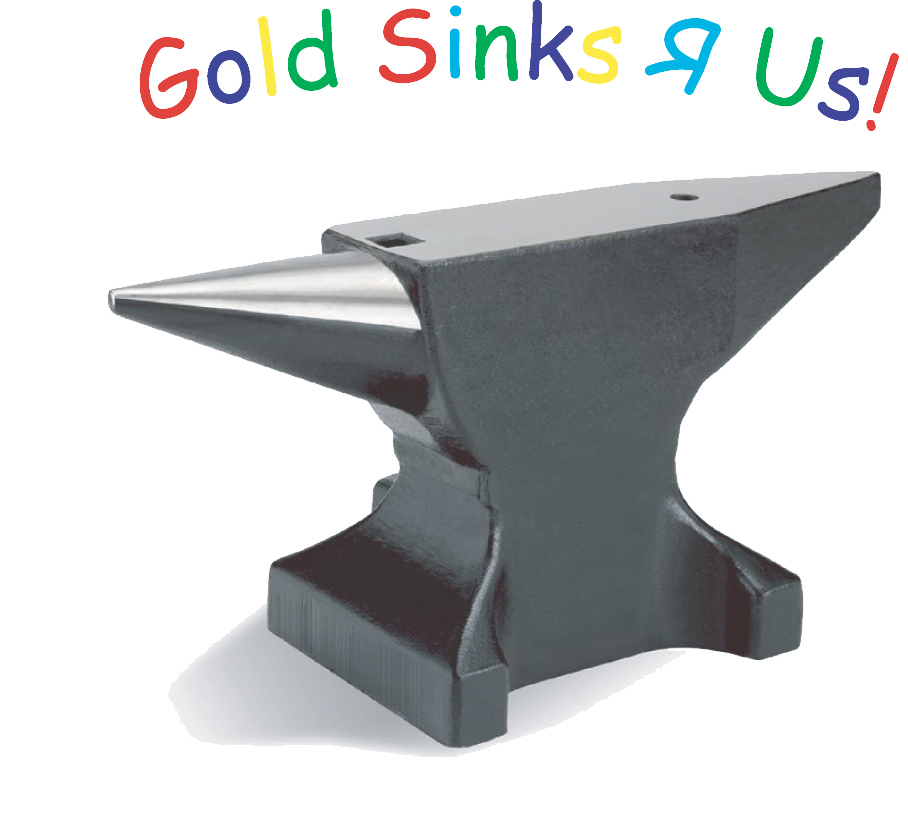
However, I was a wee lad at the time and did not appreciate the overall effect of that game, which did a very wonderful job in setting tone and mood through art direction and gameplay. The deterioration of my equipment early on, while I was fighting plain skeletons and zombies, gave me a contrast to when I would find indestructible gear later, while I was ripping through succubi and demons. Since then, I’ve paid much more attention when my equipment starts degrading and accepted that some games wish to implement this for varying reasons, and in a game like World of Warcraft, I saw it as two things: a chance to take a breath so you don’t go into instance after instance and are required to go to town and a gold sink.

So, enter Fallout 3, with which I spent a good amount of time yesterday. While I could easily go into many different subject areas, the one I felt like actually exploring was the equipment and the effect it had on me. In this game, Bethesda did something that makes so much sense, I wonder why it wasn’t in the original Fallout games (while somewhat being thankful, as the games are difficult enough as is). In this game, your equipment degrades with usage–something to be expected, especially in the Gamebryo engine. While there are usually merchants in town that can repair your gear for you, you also have a skill called, simply enough, repair.

Not surprisingly, this skill allows you to repair your own gear (whereas in previous games it allowed you to repair faulty equipment in the game world). How, you may ask? Simple. If you have a similar item, you salvage pieces from it and bolster the desired equipment. With armor, you gain more damage resistance; with weapons, you gain more damage up to 100%. I have not progressed past Megaton (and Super-Duper Mart) yet, but I’m already noting how it has changed my behavior in gaming. I’m a hoarder (as evidenced by completing Fallout 2 with $40,000 on hand), and this rewards me for such.

Because you come out of Vault 101 a poor, destitute outcast who has no idea what he or she is getting him or herself into, you are suddenly presented with the problem of how to survive and advance yourself. So, picking up gear and then piecing it together provides a neat gameplay issue that makes me really appreciate how this world is constructed so far. I keep all the armor and weapons I pick up, repair them together, and then have more valuable equipment that weighs less. This makes sense, but you need a high enough repair skill to do so. If you don’t want to bring up this skill, again, you have the option of doing so in town.

While I do not profess to have the most extensive gaming knowledge ever, I cannot recall a system in which this has occurred before in my own gaming history. Hellgate: London had a salvage system, but its use was not immediate in aiding you. When I very briefly discussed my initial impressions with Cap’n Perkins last evening, he mentioned that it seems a more advanced version of a common occurrence in FPS games. When you walk across a gun someone else has dropped, you chuck the gun and keep the ammo. While I can understand why not every game would do this (maybe you don’t have characters with an interest in smithing or crafting), it is a system by which I am very intrigued.

Now, I understand why this differs in an MMO landscape. It serves as a way to make sure the economy isn’t constantly inflating, as it introduces a system of fixed price to repair your gear. Yes, you may be able to get more money in the next section of the game you enter, but you’ll likely also need new, better gear, and when that gear is damaged, you’ll be paying a larger portion of your gold again. It’s a tiered system that doesn’t quite cripple the player, but also makes sure that a dynamic economy is not periled by introducing money into the system out of nowhere. Just because you can print more money and throw it into the market, that doesn’t mean you’re actually helping anyone (an issue most games face to some degree).

With Fallout 3, my initial impression is, “Why wouldn’t I pump points into the repair skill?” Again, while I have not progressed very far (aided by the fact that I’ve made three different characters in the one day I’ve played so far), the world seems both more expansively barren and populated than the previous games in the series. This is for a number of reasons: with every person having a face and voice, their impact is much more apparent and cannot be avoided (even if the models don’t act, so to speak); walking around in this world and seeing the horizon is very imposing, a ruined DC skyline is very devastating; it’s been two hundred some years since the war, the world has had time to settle itself more than previously possible. The last point makes me want to eventually create a character who has a different sensibility than the self-sufficiency I normally imbue in my characters’ personalities.

My goal is to make a character who, because he or she grew up in the Vault, craves community and codependency. This, of course, will be a ‘good’ character, but I wonder how that character will fit into this world. Instead of ignoring the barter skill as I have in the previous games, I want this character to depend on a trading of goods to get what he or she desires, and exchange goods as such. Have I mentioned I love a barter economy where I don’t just need money to purchase things?

You know what, the fact that I can create this type of character has me extremely excited. Unlike Oblivion, where I would make up my past in much the same way that I would write a character bio for any role I took on various stages, the introductory section of this game gives me a small taste of what has existed in this person’s life, and the grand scale of the world makes me wonder about the place my character can hold in it. That’s what I would call powerful–the ability to evoke thought on that level.

Tagged , , , , , | 2 Comments

Miasma of Excellence


I’ve been hearing a lot about Mad Men, and as a person who doesn’t watch television, I’m finding it surprising that I’m so intrigued. Most of the talking I’ve read or heard about this title concerns feminism and how it portrays an intriguing, well detailed examination of gender politics of the time, even if it’s infuriating (I’m assured there’s much more to the show, but this subject caught my particular interest). However, with all the talk I’ve heard about it, I was rather surprised to learn it doesn’t appear to be doing the best in ratings. This particular article points out that while other shows may have a higher rating, this more popularly has become a zeitgeist:

It’s a recurring phenomenon, said Robert Thompson, director of the Bleier Center for Television and Popular Culture at Syracuse University.

“It happens in literature all the time,” Thompson said. “Everyone knows about Herman Melville’s Moby-Dick, but a tiny percentage of the population has read it. But we all know about it and it’s highly influential in American literature.”

As someone who goes on dates and often finds himself at a loss for conversation because he doesn’t watch television and most dates don’t seem to play videogames to the same extent or read anything beyond magazines, this struck me and got me a-thinkin’. I feel we’re approaching this with videogames as well. I certainly feel guilty when I admit to dozens of games I’ve never played or have played but not completed, of which I’m still aware because of their influences and hearing/reading the conversations concerning them. These titles include the Halo, Metal Gear Solid, Grand Theft Auto, and, for the most part, Silent Hill series. Sure, I could talk about them and probably theorize about what I’ve seen of them, but I have no actual experience with them; any conversations that occur with me on these subjects are ones I expect my statements to be challenged, provided with examples, and then have me provide more questions or hypotheses.

I should feel no guilt over titles I haven’t played, though. Just as I should feel no guilt for the half-finished Don Quixote currently sitting right beside my bed, or the Moby Dick still staring at me from my bookshelf. My mother has confided in me that her greatest fear in death is not being able to read all the literature in the world and that which has yet to be produced. I want to play as many games as possible, but I realize I am a human being that requires at least four hours of sleep a night (this led my colleagues in college to call me an elf who merely went into reverie), needs to work to earn money, eat, and then experience all these extraneous but essential activities to set my mind to work.

This is why I enjoy the concept behind the Vintage Game Club and the encouragement from the blogosphere to try older games I dismissed or had forgotten in the rush of new titles. There are a number of games out there to try, but there are just as many that I can accept I may never actually play, or play and never finish. While I have yet to read Moby Dick, I have enough of a knowledge to talk about the symbolism apparent, as well as discuss it in a myriad of literary criticisms from Historicism to Queer Theory. It may not be the most well-informed theory by itself, but I would normally reserve such observations to chime in on a conversation that is already occurring.

“You get one of those programs that grip the elite intellectual minority, the people that are writing and about talking about culture, and the influence extends a lot further than the actual audience would indicate,” he [Thompson] said.

There are a few issues with this quote, notably the connotations of the word ‘elite,’ but I feel it speaks to the current situation in which we find ourselves. There are certain games like Eternal Darkness, Bioshock, Braid, and No More Heroes (just to arbitrarily list a few that garner much discussion and critical thought in the blogs I read and with friends whom I have discussions) that definitely excite conversations, whether or not people have played them. If you are a person to frequent gaming sites, you probably have an opinion on Braid, whether or not you’ve played it or intend to do so. It’s hard to miss on these gems that offer something beyond their intrinsic value as games–they offer new approaches, new discussions, and a glimpse into what we want from the future. The most amusing part is, that you don’t even have to be aware that you didn’t miss out on it.

Fast forward to what I expect to be doing with the rest of my day: I feel that there will be many people who pick up Fallout 3 and have never played its predecessors. While I could likely be crucified for the following statement by some groups, I’m fine with this fact. If nothing else, it brings to light a portion of our gaming history and the marvels we’ve already had which we can take for granted. You don’t have to read all previous iterations of the old tropes to understand the basis of the story, though it can enrich the experience. Suddenly retrospectives of the series are popping up all over the internet, and we either remember what it is we loved (or hated) about this series or are given the tools to make some informed decisions and at least not feel lost in the ensuing conversation.

Perhaps even more telling is whom these games reach. In case we forget, people made these games. These people have their own influences from our culture, which includes books, films, television, and even videogames they have both experienced themselves and are only aware of in a cultural lexicon that we all build to understand the references that whiz by our ears and eyes every day. Fallout had subtle influences on Bioshock which in turn may well have been an influence on the latest Fallout. What we’re seeing here is a form of intertextuality where our sources are feeding into and off each other in an intriguing element so that we could even go back to the original Fallout series and not just compare it to its latest installment, but look at it through the lens of Bioshock and compare/contrast at our leisure.

Needless to say, this means that despite Ebert’s protestations against it, this is a medium that has art, literature, and theory smacked all over it like cheap lipsticked kisses with a bright, lush candy apple red color.

Tagged , , , | 4 Comments

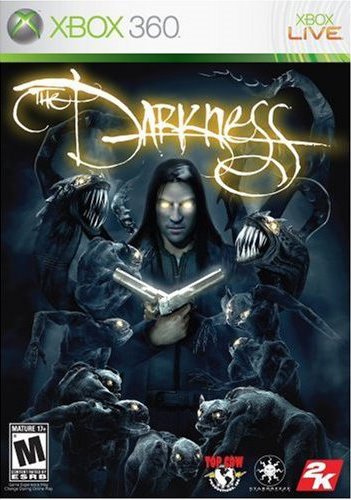
Post Mortem: The Darkness

There will be no specific bent to this entry, be warned. Instead, consider this my ‘review’ of The Darkness, which I completed early last week; you might also consider it a ‘debriefing.’ I’ve now had time to sit back, read my notes (I’m taking notes while playing games now, which is another point over which I need to ruminate), and just sit back and think on the experience. Since many other sites and critics have given an appropriate review for the title, this will not cover most of the same issues.

The first few minutes of playing The Darkness were completely jarring. First, I’m waking up in the back seat of a car with two mobsters talking at me. It took me a moment to realize I could look around, and as soon as I did I realized the problems that would be arising as I saw us careen past police cars. My unease was equal parts learning a new controller and jumping into the first person perspective again, which always scratches at an uncomfortable feeling for me when starting a game. Quickly adapting to the view, I muttered a few choice words when I kept having to retry the beginning sequence in the cemetery, after your uncle Paulie has tried to blow you up in a trap. Fortunately, the difficulty curve was fairly simple, and this presented the largest obstacle.

This was not a game about testing the player, or at least I didn’t feel the game was constantly throwing new tools at me to present one-time challenges. Instead, every time I received a new Darkness power, I just viewed it as a way to use a different set of tools to progress the game and generally be a living terror. This is a horror game, though I was never the one frightened. Instead, it was constantly the shouting of my enemies, screaming, “Did you see that thing?” and generally decrying my lack of humanity. I am the terrifying element, and these guys are scared out of their wits. Thinking back, I can’t recall many games in which an armed enemy has had this reaction to me.

Even in games where I have the choice to be evil, townfolk and regular citizens are the ones who may be terrified, but my enemy will not shout and present me with fear driven shooting. What is most amusing is the irony that I know that my protagonist has a good heart, albeit one mired in mob dealings. These same enemies did not see the loading screens between maps, where I would be speaking to my now dead girlfriend, explaining the part of my life with which she only became aware as she was being pistol whipped and eventually shot.

Which was a brilliant moment in gaming history, brought to my attention by Mitch Krpata. My desire to play this game was spurred on when Mitch Krpata posted a small list of game cinematics a while ago, showing the YouTube video above. Despite the fact that I had seen this particular moment before, being wrapped up in watching it with controller in hand, it still struck me with a powerful jab. He is perfectly apt in the observation that this scene is juxtaposed quite well in the only really long-term interaction you have with your girlfriend. Sitting on a couch while watching To Kill a Mockingbird with her felt weird at first, but that probably has to do with my own romantic failings. Instead, I kept being tempted to see how long this game would let me sit there, and it did not disappoint, as I sat there for half an hour before deciding I’d had enough (even my patience has its limits, and I was not interested in the film).

In both situations, the sitting on the couch and watching her being killed, you are stuck in the same perspective. Instead of watching the couple snuggling on a couch, you have to look around and see Jenny on your shoulder, reaching up at one point to give you a kiss. Then, instead of watching the protagonist’s face (Jenny meant much more to him, as I was still barely familiar with her), you watch as the Darkness holds you back and mocks you. There you sit, controller poised to intervene at any time, and watch as your girlfriend is killed in front of your eyes. The difference is that I could not stop the latter at any point I chose.

This scene also proved to cement my actions henceforth. I was furious for a multitude of reasons. Unlike Final Fantasy VII’s fabled Aeris moment, here I was given a reason for not having control (or being able to use a Phoenix Down). I was partly furious because I watched an innocent die because of my own actions, but mainly pissed at the Darkness for the control it had over me. When the game shifted to gaining power in the Darkness’s own domain, I was gleefully attendant to the task.

Which would lead to one of my gripes, an extremely personal one, of the game: in a game set in modern times without the sensibilities of a Third Reich that somehow survived, suddenly I was facing German soldiers in a World War setting. I would like to play more ‘realistic’ (I use the term loosely, but it references the setting) shooters that don’t feature the same ad nauseam adversary. You see, having family that died in World War II casts a curious perspective on it for me, as my relatives who died were on the front, forcefully conscripted teenagers and retirees. My great-grandfather would survive, which is more than I can say for the rest. I was not surprised to find that the game had been edited for Germany (including elements of violence, which is yet another post in the wings). For me, whenever I see these references, I think back to the family stories about my relatives, who were not some mindless automatons with intent of evil, but men caught up in an inescapable situation.

The one thing that gave me pause was the fact that these soldiers fighting in the trenches were animated corpses. In the case of the German soldiers, fully resurrected husks of bodies, akin to zombies. This creates an intriguing question of the command these soldiers have over their own actions. On the English front, they were Frankenstein’s monster conglomerations of skin stitched together, one notable memory in my mind being the soldier whose face had been stitched together from two separate halves, creating differing eye colors and skin pallors. These soldiers were locked in a seemingly neverending struggle, as neither could kill the other. It serves as a useful metaphor (as well as being literal) for the Darkness which you are fighting. Yes, for a rails driven plot shooter with some side missions, this game has layers.

The game had its frustrations, but it also did some things extremely well. Because of the lack of a really difficult game (Castlevania: Order of the Ecclesia is providing that in droves), you spend the game feeling like what you are–a human with extraordinary powers on a mission of vengeance. Which is unfortunate when you reach the end of the game and watch your powers being used in ways the game’s engine does not support, merely pausing to move places and perhaps off the few stragglers that survive your onslaught. While it would frustrate me, this was the point at which I realized that I was a living terror. What these men saw was a force of death visited upon their heads, whom I saw as a man who had a reason. The game stops at a moment when Jackie is in flux, again on many levels, the ending giving a bittersweet moment of contemplation.

Tagged , , , | 7 Comments

Who you callin’ macaroni?

Welcome to the another edition of Fanny Fridays (shamelessly inspired by Grant Morrison’s Lord Fanny character from The Invisibles). These weekly posts examine the mirror of gender and sex that occurs between our culture and videogames.

When first attending school in the United States I came across a curious phrase in a song, “…stuck a feather in his hat and called it macaroni.” It made no sense. Why would he call putting a feather in his hat after a pasta? Wha–

Wait a minute. Perhaps macaroni had other uses in our language? Could the Oxford English Dictionary aid me in my search? Indeed! A macaroni (alt. maccaroni) was another word for a fashionable gent. You should go ahead and read that as dandy. Therefore, the Yankee that stuck a feather in his hat and called it macaroni is the epitome of a buffoon who does not know true fashion. The name of the song, not surprisingly, is called Yankee Doodle Dandy.

The dandy is a curious creature, most notably known for a few traits: his impeccable sense of fashion, his wit, and his distaste for rough physical activity. That is why a metrosexual is not quite a dandy: a metrosexual is allowed to be sporty, active, and fit. When one thinks of dandy, other common words are fop and someone of that Wildean sort. A poet, a noble, perhaps an artiste–someone who does not toil with his hands for his supper. This also means that person is usually considered queer or something just as troublesome.

There do exist exceptions where dandies are not necessarily queer; they’re just not really trustworthy. They are quite common in JRPGs: bards, thieves, pirates, nobles, and other such scoundrels. People who look out for their own best interest, and while they may be very fine and pretty, they are not men to be trusted quite fully (though of course you can, because they do exist on your team, silly). It is a common stereotype that we have come to expect–if a man is not muscular and cannot save the day through his forceful body or strength, then he has to be crafty, making him either a man of questionable morals or a villain himself.

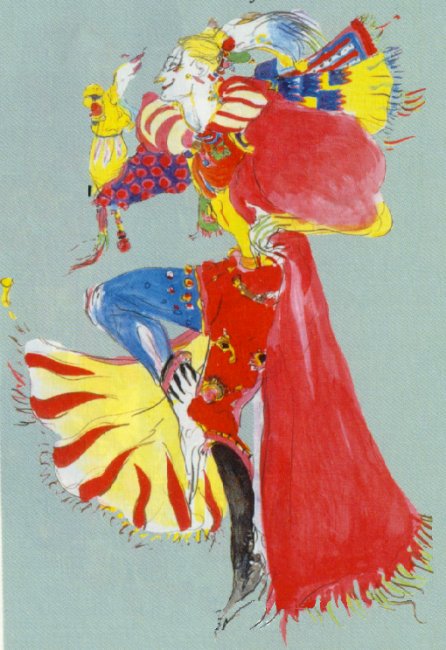
After all, the greatest dandy of the Final Fantasy universe? Kefka. A despicable human being who poisons an entire castle, runs through an honorable general, and destroys the whole world. At least he looks fabulous doing it, though. You cannot trust the man who does not use his hands for physical labor and counts on magic and deceit to achieve his goals–how loathsome.

Is it that surprising that this happens in videogames? Not at all. Consider that, in general, the dandy is a male who is considered feminized by his opposition to the male principle of power through strength. The world of fashion in which a macaroni may find himself is one we see relegated to the interests of women (though many designers are men–once again displaying the hierarchy of male dominance), and no self-respecting man should be bothering with such. If one is a marine, tough guy, or solemn hero, one does not have time for such frivolous pursuits. Heavens forbid he should be smart with his words as well (if he talks at all)!

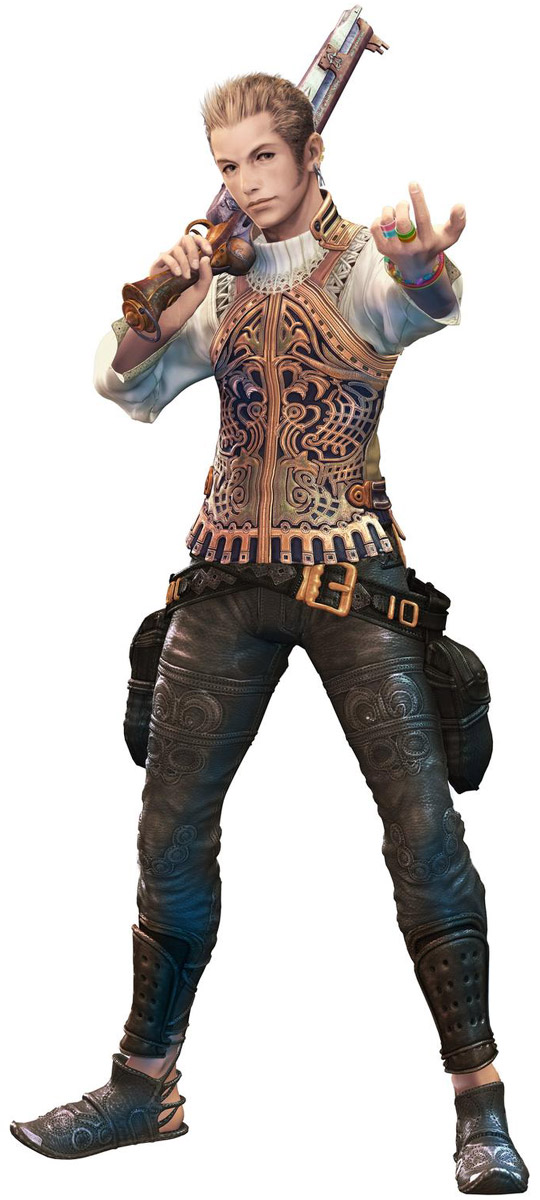
It is curious how this occurs, though. Balthier in Final Fantasy XII is a pirate who is self-serving, and will work with the group for his fair share of the treasure. Setzer in Final Fantasy VI is a dashing airship pilot who kidnaps daring opera divas and will help the party if they happen to win in a gamble. Dante from the Devil May Cry series is an anti-hero with a devilish side. The feminization these men face sets to give them a bit of danger and makes them all slightly less than good–the rebel. They could also be labeled with the term lady-killer because he knows how to appeal to women. However, real, good men cannot have a strong feminine-presenting personality in any degree; the woman is expected to flock to them because of their strong masculine presence.

Therefore, the man whose foil the dandy plays is the stoic, quiet, restrained, and/or muscular type. So, with the two polar opposites being the effete dandy and tough, muscular guy, the metrosexual makes perfect sense as someone who toes this line, which is where I would argue a character like Dante actually fits. He resembles more a James Dean or Han Solo than an Oscar Wilde or Jareth, the Goblin King. It is even more curious to note how these dandies do fight, as they are bound to be included in some brawl.

They sing, use tools, prefer using guns, and cast spells (the notable exception to this is the venerable old sage, who has earned his right to cast). Occasionally they may engage with a sword, but these are the fencers, not the brawlers (see: Raphael Sorel of Soul Caliber). Finesse, not strength defines their character–which lends itself to us distrusting them. Would you trust a man who would not engage you in direct combat? In a “man’s world,” this is seen as an affront to honor. Those silly effete duelers, chatty and unwilling to muscle through a problem. You certainly wouldn’t want to wrestle with them!

Which creates one more disparity. While we’ve seen more beautiful or handsome men with the advent of the metrosexual, the dandy was, for the longest time, the primary source of male beauty in the same fashion as we expect from women. The muscular man can be admired for his body and strength, but is rarely considered generally beautiful (though the word handsome could be thrown in his direction). It is his body we drool over, the body that becomes the aesthetic principle by which we judge him. The body is the exact opposite of how we regard the dandy. By these definitions, the female form is defined as okay to ogle, but to do so with the feminized male form is considered problematic and misleading–also notably queer. Instead, the admiration either comes from his clothing or his face–two avenues which do not really aid to his use in combat at all and hide away his shamefully inadequate body.

Again, none of this is surprising, but it is very amusing to note how well videogames reflect our culture even down to our depictions of gender–even across the culture divide we consider in place between the West and Japan. While their males are more effeminate with which to begin (at least on the surface), it is curious that they still place this line on which we can plot the exact same characteristics, albeit all shifted a bit toward the dandy side of things.

Posted in Uncategorized | Tagged | 8 Comments

Survival of the Grotesque

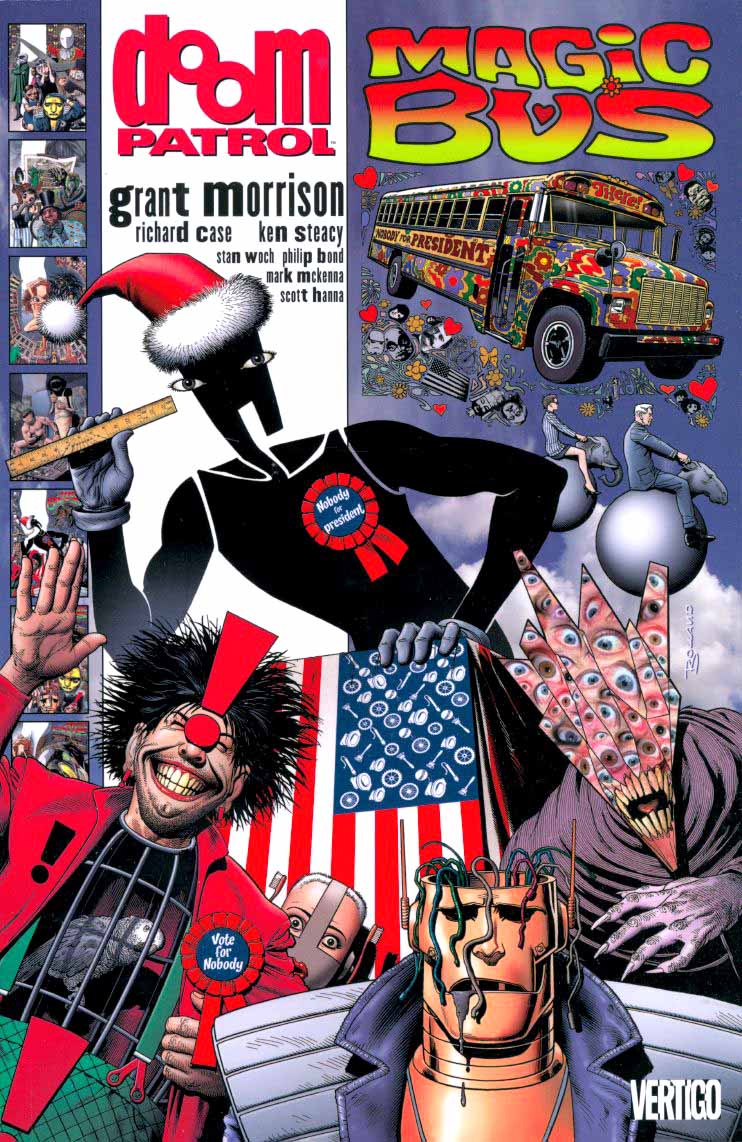
What do you get when you combine the following elements: Cliff Steele, a man who had a race car accident and woke up with his brain transplanted into a metal body; Crazy Jane, a woman suffering from sixty-four multiple personalities, each of which has her own superpowers; Dorothy Spinner, a teenaged girl whose face is that of an ape and can materialize her imaginary friends and foes, but has yet to control said power; Rebis (AKA Negative Spirit), who comes into being when a negative energy combines both Larry Trainor, a pilot, and his physician, a black woman named Dr. Eleanor Poole, in the form of a divine hermaphrodite wrapped in bandages; and Danny, the sentient, transvestite street who can change his location? Yes, you get Grant Morrison’s run on Doom Patrol. With appropriate villains, such as the Candlemaker, Scissormen, The Brotherhood of Dada (whose leader, Mr. Nobody, uses the stolen bicycle of Albert Hofman to power the Brotherhood’s U.S. presidential campaign), and ventures into Jane’s own mind, which is akin to a subway system, the ride is amusing, brim with brilliance, and utterly horrific.

Cap’n Perkins and I discussed in a phone call the other week how to classify this body of work. He had gone to Goodreads and labeled them all under this tag: horror. In much the same vein, titles such as Hellboy fell under the same gaze. These are titles which offer grotesque environments, characters, and situations, but do not necessarily proffer a fright. I know that I for one cannot recall the last time I was frightened by any media, be it book, film, comic, or videogame. It doesn’t happen; I have to scare myself, which I do with a certain aplomb, if I do say so myself.

There’s been a bit of discussion of late on whether or not Survival Horror still exists as a genre. Curiously enough, it was one of the few ‘genres’ we have in videogame culture that is not solely contingent on mechanics, offering some amount of theme that had to be followed as well–though mechanics are a rather large portion of its definition. Most of the games do have in common a certain level of capability to offer frightening situations with the role of one person trying to survive with limited resources, however. Whether this be by zombies, frightening psychological trauma, or other externalized fears, the supernatural was almost always involved in some way.

Recent reviews on Dead Space mostly seem to point out that the game is not very frightening. The monsters may jump out at you, but that’s the extent of the horror. Ammo may not come in droves, but is still plentiful enough to gleefully rip apart your opponents, and you get the feel that survival is not a large portion of the game. Which makes me wonder if we’re done with the survival element of games because, let’s be frank, a large portion of the videogame audience does not wish to be frustrated by poor combat mechanics and frustrating (albeit rewarding) gameplay just for the sake of a good horror story. Don’t get me wrong, I love those games, but I know a fair amount of people to whom such does not appeal. If you wish to expand your franchise in terms of consumers, these elements come into play.

I do believe that we can find another way to have interactive story elements give us a good scare (well, some of us not including myself), but perhaps we need to find new methods of such. For now, what I might suggest is not to throw survival on every game that happens to be horrific. Horror can exist without the need to frighten you beyond a few anxious, palm-sweating and making the controller slip moments when a monster may jump out at you, or is heard clanking about in the background when you expect something that never comes. That is to say, we may be moving into using horror elements in action settings, and the survival horror game may not be as front and center as we expected from Resident Evil and Silent Hill.

Because this is a still rapidly evolving medium, including in its mechanics and technical specifications, we’re still not defining genres by their themes–so I believe we may still see the term survival horror bandied about by a game that just offers the horrific, supernatural, and grotesque. We also seem to be stuck in the mindset that anything including the title horror has to titillate to the point of fright. I have yet to play Dead Space (it’s in the rather long queue that will only fall behind as the weeks progress), but I do not expect to play it and have it frighten me. I’m not sure if that was ever part of my expectation–much as I wasn’t frightened by Alien the first time I saw it, but grew rather enamored with H.R. Giger’s artwork (it helped that my mother had the Dark Seed games).

Am I calling the end of survival horror? Heavens to Pamela, no. Given the various methods of distribution, an emergingly visible independent scene, and different price points, I believe survival horror will probably exist in some frame or another for years to come. However, as with any medium, we should expect changes and exploration of the territory. By many accounts, The Man Who Laughs is a horror film (which I watched with Cap’n Perkins when he visited), but certainly one which does not frighten today’s audiences, whose expectation of the scare has changed. The film is certainly grotesque and morbid in theme, however. Horror films have progressed in many ways, trying different tactics, and that is what I expect of the next horror games that seek to actually proffer fright instead of just the grotesque (but I’ll gladly take the grotesque). As it stood, the survival horror genre had to change anyway–we can only be scared so many times by the same elements before we expect it.

Tagged , , | 2 Comments

Hush, little baby


It may be hard to believe, but I’m an opinionated person. Something with which I’ve always had difficulty is not saying certain things that come to my head–a trait I learned fairly early on when I first lived in the United States.

Therefore, I’ve come to appreciate games that offer me this choice. Yes, I do appreciate the whole text adventure games where I can explore every option, but I’ve come to grow wary when it is done just because it’s been done before and worked in a different setting. Hence my qualms with it in The Darkness. Contrast that with another game I’ve been playing concurrently, Fallout 2.

As was pointed out over at Versus Cluclu Land, one can say the wrong thing in these games. It is entirely possible to make a comment that will have you finding yourself in a bout of fisticuffs (or a shoot out, as the case may be); both of the first two Fallouts give you options to say snarky, sometimes rude things–and while it may be amusing, you have to weigh against whom you say these things. Of course, these games being the way they are, and it being somewhat difficult to stop progress to the end goal completely, I’m finding myself saying certain lines without trepidation. In the second game there is even a perk to be able to have good dialogue options highlighted in green, and poor ones blaring dangerous red. This is a world where your choices have the option of mattering–somewhat.

In the end, it might not even matter. While I’m playing Fallout 2 fairly straight forward, with no end goal in sight beyond finding the mythical GECK, I do realize there may be an effect of which I’m not entirely aware, but which will be divulged in time. For instance, my option to not wipe out the ghouls of Gecko to obtain my Vault City citizenship will probably have longer term effects, even if I don’t see them until the ending of the game. If I accidentally say something wrong and end up in a fight, I go along with it and see where it will take me. I am not deciding whether or not my character will end up ‘good’ or ‘evil,’ but playing it as I would expect this personality to do so. I am, quote unquote, roleplaying and acting.

Which is the problem. I’m not entirely sure how much this exists for other gamers, or why it would. I appreciate these dialogue options, ones where I can burn a bridge unless I reload, because it gives me the illusion of making choices that matter. However, for all the praise I may lavish on Fallout for its drawing me into the world, I don’t really care about the characters one way or another. This is probably largely due to the time separating me from that era, but I’ve had much more meaningful relationships with characters in games now. The followers I have are just props I use to win a battle, but my interaction with them beyond that leaves me yawning and wondering when they’ll shut up about needing Stimpaks or wanting a drink. They work well in setting a backdrop and setting, but as for feeling any empathy? My roleplaying stops at that moment.

While I do not like the way dialogue is handled in The Darkness (or the other game I’m playing, The World Ends With You) because it may as well have been relevated to a cutscene for the amount of input I actually put in to the conversations, there is a small portion of me that cringed in the beginning of the game as Jackie Estacado finishes the first part of his tale, the build up of the tale on his first time dying–you are proven powerless. Which may be the point of the ‘choice’ of dialogue, but I feel there were better ways of giving that illusion. There is good dialogue that occurs (alongside the bad), but it is usually when I’m not given even the smallest sense of empowerment over these choices. When given the option of loading if I don’t like the outcome, as with Fallout, I’m left with the feeling that my choice has no real consequence unless I imbue it with that meaning. Contrasted with with The Darkness, I cannot avoid certain parts of that game, and I am on the railroad to this point, numbly selecting the dialogue options as they occur, until they lead me to these events.

I do, by the way, imbue Fallout with that meaning. While I often appreciate new gameplay techniques, I’m often more drawn in by the power of the story that can be told. Instead of being one who held his finger in place and looked through all the options of the choose-your-own adventure book as he came upon them, I would happily go trodding along and then just restart when I wanted a different series of events. Both of these games have their strengths and weaknesses, and I’m appreciating them both for different reasons (rest assured, both have their pulpy roots firmly in place); whereas Fallout 2 has me caring about the world and this future (hopefully) alternate timeline, I don’t care for The Darkness‘s locale of New York, for example. Much like with Hellgate: London, the setting offers me something in terms of accents and setting, but it is just a backdrop to the story that is told. It may be because I’m limited to such small sections of it, but it ultimately doesn’t matter to me that this is New York–it could be any metropolis.

This all leaves me wondering what the next step in interactivity with dialogue options will be, and how many games will jump on the bandwagon just because it’s there. Fallout‘s dialogue system would not work in The Darkness–I don’t want it there. When was the last time you felt something your character said in a game actually mattered, though? It’s something I’m not sure we’ve quite captured fully, or possibly can.

Tagged , , , | Leave a comment

Between You and I

What is the purpose of dialogue?

Generally, we use it to convey information on some level, to exchange ideas and advance one topic or a range of topics. Of course, this does not happen all the time; any time two (or more) people are speaking, misunderstandings, poor word choice, or a murky idea can get in the way of such information being batted back and forth between a speaker/listener.

In storytelling mediums, that information becomes the focus whenever agents of the story are talking. It provides not only information that is being discussed, but also colors the indirect characterization of the speakers. You’ll hear accents, background hints, opinions, and many other small indicators that clue you in to who these speakers are and color the personality being presented. If you’ve ever read or watched Waiting for Godot, you’re well aware that sometimes the words don’t have to make sense in order for you to understand the emotion and drives of Vladimir and Estragon.

With art, there is one more dialogue occurring: that between the art and its consumer. We color our perceptions of any art with which we come in contact with our own histories, understandings, and views. Thank whatever powers may or may not be, too; it is because of this that we have dissenting opinions on what constitutes ‘good’ and ‘bad’ music, art, theater, et cetera. Otherwise we may well be stuck all lauding everything that’s created and stagnating in a bath of our own tepid creative juices. In games, however, that dialogue is even more present, you are usually controlling some element/s and/or characters.

While I’m enjoying my first Xbox 360 experience, this is the element that confuses me about The Darkness, and I’m not even sure why this particular title made me ponder this question. During the game, one sometimes runs up to NPCs and certain conversation topics show up in the lower left of the screen. One can scroll through these options with the arrow keys, but it isn’t really necessary. You just walk up, press ‘A’ (had to run and double-check to make sure that was the correct button), and then just press down and continue doing so until the conversation topics are exhausted.

After a while I was wondering why I was even being bothered to press these button configurations–I was not being presented with dialogue trees where I could go out on a limb and possibly affect a different outcome. While we could posit that I’m merely being lazy, I’m really not seeing how this constitutes the supposed dialogue that is supposed to be occurring on screen. I get a gist of what I’m proposing or asking, select it, and then the person at whom it is being directed responds. After his or her initial response I may add a few words, and the charade begins anew.

This is not interaction, though the game is providing me the illusion that I’m making ‘choices.’ While I realize not every team wants to give more options than those scripted, and that some do not have the resources to write more to then have it voiced, I do wish that if I am to be having this dialogue with the game already, it does not press tedium on me by having me make choices which have no bearing whatsoever. I do not wish to play games to be some automaton just pressing buttons to get the next bit of information.

In The Darkness, this is even further confusing as I make these choices from a first person perspective, with no HUD to really provide me any information that I’m not actively using, and at this point I have a chance to be thrust into viewing a third person perspective which I can navigate with my right analog stick. At the same time, this is at the point that the game signals to me that I’ve made a ‘choice’ and am now being presented with the ‘consequences’ of that choice, removing my ability to directly involve myself. I am suddenly thrust into an observer mode.

In one way, I can see this as the game’s turn at speaking and conveying information to me, but it becomes jarring when the agent I am supposed to be controlling is suddenly taken out of my hands and becomes someone else’s puppet. Does this mean that the information being conveyed and passed back and forth between the game and I is the protagonist? We are pressing forward and advancing our communication, but I still somehow feel cheated by a promise that the game makes from the moment I started, waking up in the backseat of a car that is hurtling through a tunnel in New York. Because the game is presenting me with so much other information, it feels as if its taking my one leveraging point and input into the game as its own. At what point do I become useless?

It is at this point that I realize the videos I’ve been watching of Diablo 3 are what I would prefer in this scenario; I walk up to an NPC, choose to engage, and the information that needs to be conveyed is, without needing to request that I continue needlessly providing input. That would still present the problem of switching perspectives on me, but alleviate my concern that I am somehow an agent in this particular dialogue–because let’s face it, this is providing the game a soapbox from which to disseminate information on which I can then act. My communication then becomes the act of choosing to talk. If the game made no qualms about that being what I was about to do, I’d feel much more comfortable–as of right now it’s a minor annoyance that made me reflect on how often this occurs in games. Jealous of its sibling, the dialogue tree, it seems all ‘dialogue’ aspires to be something more than it is.

Next, I’ll explore the dialogue tree and its cousin, the archipelago with bridges we burn as we cross them. These offer different narrative options and challenges for the designers and writers, as well as providing us with our own dialogue options with the game itself.

Tagged , , , | Leave a comment

Fallout Boy

Welcome to another entry of Fanny Fridays (shamelessly inspired by Grant Morrison’s Lord Fanny character from The Invisibles). These weekly posts examine the mirror of gender and sex that occurs between our culture and videogames.

In Fallout, there exists a curious tab on one’s character sheet. This tab is labeled ‘Kills,’ and it tells you the number of enemies you’ve killed, split into categories such as rats, radscorpions, men, women, mut… Wait. Men, women?

I did not mention it in my post-play analysis, but this struck me rather early on in the game. I saved Tandi from the raiders by bluffing that I represented a larger force, and then went back and killed the raiders for their loot; wanted to make sure there were no casualties.

Pulling up one of my old saves (I keep most of them stored in various places when I switch computers), I loaded up the end game of a character who killed her way through most of the game. The reported kills were intriguing: Men, 98; Women, 16. This was my bloodthirsty character who just killed instead of bothering to even negotiate, and she only had killed sixteen women as opposed to almost 100 men?

I’ve previously made the point that women protagonists are often less violent than their male counterparts when we’re given a character. The exceptions we do have are usually not killing other humans, feel remorse if they do, or fall into the archetype of the femme fatale (killin’s sexy). It did not occur to me to look over the divide and see if this held true for antagonists. Of course, antagonistic females are a whole other category.

Witch. Manipulator. Sexual. Unwitting pawn. Foreign assassin. Insane. A monster or demon (then usually very scantily clad and a succubus).

While games in general are still a maturing medium in terms of the narratives and plots they tell, we rarely have horribly nuanced female villains–when we have them.

This was something I noticed in Deus Ex, where there weren’t any female NSF agents. When I brought this point up, the counterargument was resources for creating a female model. I suppose I could see that to a point. However, in games where we already have those models, such as Fallout, why are they not used more?

A while ago, when I brought up the issue of race from the preliminary look at Diablo 3, Chris brought up the following point:

Expressive art reveals to us that we are racist, that we do hold stereotypes, that we do tacitly believe insane things about other people. This is going to sound very radical and not very PC, but here it is: bring it on. Bring on the deeply racist depictions of other cultures. Bring on the subtle stereotypes we carry along with us as societal baggage. But, bring it on artistically – actually SHOW us what we secretly believe in an expressive form. That’s what moves people. That’s how we come to see ourselves in a bas-relief.

Fallout does have a slight glimmer of this, actually. The question of children and how the family functions never is really brought up. Children exist, you shouldn’t kill them, but they are never seen around parents, which makes one wonder if the ‘takes a village to raise a child’ mentality has been adopted. One notable exception is Tandi, who is already a teenager (in fact, being the chief’s daughter, I wryly told myself, “The princess is in another raider camp,” when going to rescue her). The antagonist leaders with whom you speak are male; when you enter Junktown, you learn of Gizmo’s ruthless grip on the town through his casino, including the local prostitute, Sinthia.

If you go to the local hotel and speak to the prostitute, you learn how she is being exploited by Gizmo. He is her pimp, she makes him money, and she sees herself as having no other real options in this world, other than selling her body as a service. However, these conversations only come up if you save her from a deranged man who threatens to kill her because he perceives her laughing at him.

Given that we are presented with 1950s images of families entering vaults, with mom in her mid-length dress and pop being the cheerful middle-class family man, the game seems to present us with the fact that given an apocalypse, if women are not on equal footing, they will be in a worse situation than with what they started. If one selects playing a female character, some male NPCs are typically chauvinistic toward you, making it harder to get along with them unless sex is offered, which is an option.

However, outside of antagonists, in the latter half of the game, specifically the LA Boneyards, the player is presented with two female leaders. There is Razor, of the Blades, and Nicole, of the Followers of the Apocalypse (an awareness group of the dangers of how the apocalypse occurred). Razor becomes a target and is considered a threat. If one hears her out, the Blades have been framed as a child-killing organization. In this instance, the female who grew close to the child leads in decisive action while the father is impotent and usually gets killed; Razor can end up taking over Adytum. Nicole makes it easier for you to take an alternate route into a later part of the game, enabling the less or non-violent solution. Both of these women prove that women can take charge and lead forward into the new world.

While I’m only hazarding a guess, I’d wager that the Fallout team did think about the implications of sex in a destroyed world. However, instead of falling into an all out battle of the sexes (which, truthfully, could quickly be overdone in such a setting), they subtly implemented it. Did the audience perceive? Go check out any character creation FAQ online and you will have many that clearly outline the differences that one will face between the selection of ‘Male’ and ‘Female.’ The game falls short many times, but it does present a compelling, thought-provoking ‘what if.’

Tagged | 1 Comment