What be this bait? Please, you teach me.

My experience with the Xbox as a console would leave me as a Level 1 Gamer. No prestige (class) for me yet, I suppose.
When I was applying to colleges, the one to which I eventually matriculated offered to fly me up as a finalist for the Fine Arts Fellowship in Creative Writing (the ultimate deciding factor in my attendance). Accepting (well, they were paying for everything), they lodged me in a fraternity with a chap who was perhaps the hippiest person I ever knew on that campus (that first night he recited Ginsberg’s Howl apropos nothing). It being a fraternity, there was an Xbox, and Halo was being played. I was invited to join in, so I did, and was horrible.

Upon first moving into my current apartment, I met with my future roommates, one of whom, Steve, was playing on his Xbox 360. We discussed some games and comics and it was decided that I was quite acceptable as a roommate (it also helped that I have the ability to pay rent). When he bought Rock Band, I watched as he, his girlfriend, and some friends sat down and started playing. The girlfriend, Kit, was taking care of vocals, until a Garbage song appeared on the screen, with which she was not familiar. Shirley Manson always holds a special place in my heart, and Garbage was my high school listen-to-every-day band, so I took the mic and sang along. That was experience two with Microsoft’s consoles, experience one with the Xbox 360, and also experience one with Rock Band.

Until recently, my attitude was generally that if there was a game I really wanted to play on Microsoft’s venture into console gaming, I’d eventually get it on PC. I am no longer so innocent.

Last night I sat down and conquered the largest hurdle to my issue with the Xbox; I can no longer claim ignorance of such an odd controller. Loading in my latest Gamefly rental, I went through the game and confused myself for the first fifteen minutes. This was partly alleviated when I made sure that the right analog stick was actually reversing the input I gave it to look around. Boy, that was frustrating for the few minutes it lasted.
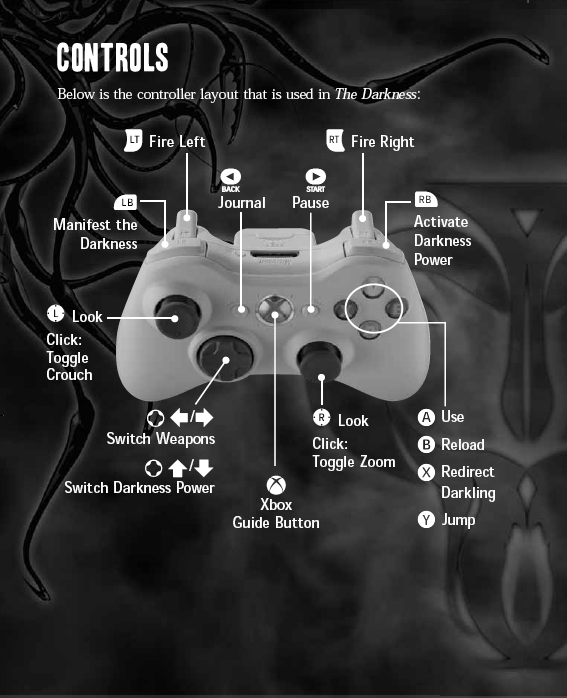
The control schematics to my left are what I was muddling through (from the PDF manual, and the left analog stick is mislabeled–it controls movement). Yes, the game is Top Cow’s The Darkness in game form. I became familiar with the franchise through the Indie HeroClix Cap’n Perkins presented me on a past birthday, and have since rather enjoyed them in comic form as well. So, since this game was not available on PC and I had recently started a Gamefly account, I figured why not try it out?

Therefore, it was rather serendipitous when I read Ben Abraham’s entry to the Round Table this month. I identify with his mother quite a bit; even my own mother is rather intimidated by the controllers we face these days.

In all, much like I’ve read many times in various formats over the past year, we gamers are presenting some interesting hurdles to enjoying this medium. Thankfully, I consider myself rather game savvy, and was able to finally start getting through the game without dying every five minutes, but for someone who has never played a game, or taken a decade or longer break, this could potentially be extremely frustrating.

I’m not sure if it was the expectations I held for myself or if it was a general frustration, but seeing a cutscene to tell me I had once again been shot to death made me purse my mouth, raise an eyebrow, and stare down the controller in my hands. Had I convinced myself it held sentience, I probably would have quipped, “I’ve survived heterosexist behavior in the South; I will overcome you, silly controller.” At least the cutscenes varied and I became intrigued enough by how they captured a feel in the game (which I’ll discuss in another post, I’m sure).

However, the game intrigued and pleased me enough that I kept at it (with a break held to watch the presidential debates), and by my second hour of playing, I was leaning back on the couch and playing without a bit of mind to how awkward the controller felt in my hand at first, though I was still very cognizant that it existed and we had not yet ‘bonded,’ so to speak. The controller does fit well into my rather spidery hands (I’ve been told many times I have the perfect hands for piano), and after my initial discomfort, it reminded me of the problems I had with the PlayStation 2.

That is, whenever I played a game with a Quick Time Event, I would more often than not die. You see, even though I’ve spent a ginormous amount of time on that particular console with its controller in my hands, I still cannot tell you how the buttons on the right hand side of the controller are configured. I learn what button I have to press by location, not by the arbitrary symbols that exist on their face. Therefore, whenever a button would flash on screen and I had to press its real life sibling, I would have to look at the controller and would often be too slow to satisfy the gaming gods; in this case, the sacrifice would be my virtual life.

It is no wonder the Wii and DS are so popular. Picking up the Wiimote was intuitive to me. Using the stylus on my DS is so easy to understand, that I’m happily tap-tap-tapping my way through The World Ends With You right now (though this game is more demanding than any other game I’ve played on it in terms of control schemes in battle). Again, for someone new or a long-time absentee, I have no clue how they get back into the swing of these things. The first thing I do when I receive a game is to either read the manual or go to options to see what the control schematic is–this game’s was daunting to me. I’m glad I have overcome my hesitations, but it presents to me a problem with expanding the market beyond younger, more adaptable minds.

What this primarily illustrates about me is that while I can and will often play console games, my preferred platform is still the PC. This means I’m still awaiting the release of Dead Space (next week!), and it’ll be a long time coming until I play Mirror’s Edge (whose PC release is next year). Ah well, at least I’ll be able to space out my videogame purchases. In the meantime, chalk another controller under my experience belt. Though I think I’ll skip the E-athlete prestige class.
Tagged , | 5 Comments

So much depends on a red wheelbarrow

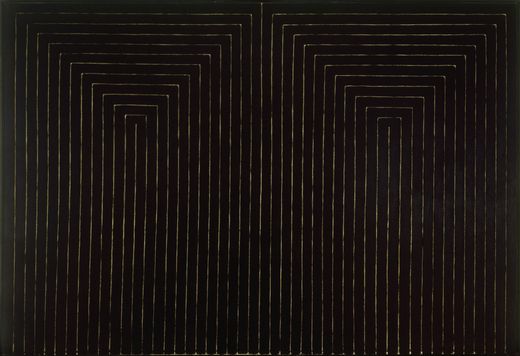
(Frank Stella’s Marriage of Reason)

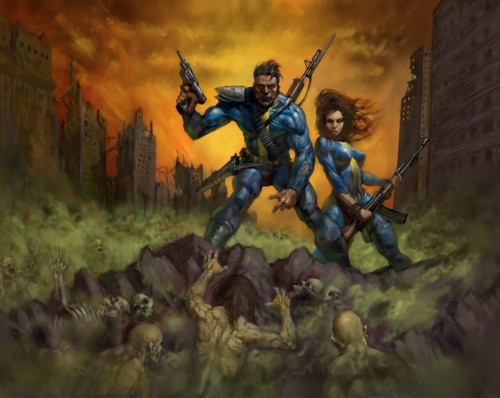
As I’ve mentioned, I’m replaying the Fallout series in anticipation of the third title, which (Amazon willing) will be on my doorstep the day it releases. It’s been at least six years since I last played the first title; eleven since the local sysop of the BBS my family and I most frequented brought over the title. My initial impression of the game back then was: “This feels like Diablo!” I was fourteen at the time, and still to this day it gives that feeling when I first enter the game, to quickly be replaced by a difference in tone, thematic content, and style of play.


This game made me fall in love with the Ink Spots.
It is very quickly apparent that Fallout is dark, but well buttressed with comedic moments that feed on our knowledge of pop culture. If you’re familiar with the Mad Max series, you’ll get a chuckle when you visit Junktown, for instance. Instead of being whisked away into a world of fantasy, Fallout plays on the fears of the Cold War generations, keeping the kitschy tone of that era (though the game’s events start with a nuclear war in 2077). This takes place in a destroyed California, you emerging from a vault, to which your family fled before the nukes dropped, in order to obtain a water chip to replace the one that has failed. You just happen to be the unfortunate person selected to leave the vault’s safety.

Fallout is both a more mature and thought-provoking game than Diablo (I love both games for very different reasons–they’re also in wholly different genres, even if both affix an RPG to it). This is in part because fantasy is not as visceral as seeing your own world in ruins, but also because Fallout feels much more minimal, allowing me plenty of room to fill in the gaps of my own horrific experience (horrific in terms of what my imagination does with it). Through music, presentation, and guidance, the game has a very light touch. When I first entered The Glow, a nuked research vault that is still irradiated, a shiver went down my spine as I listened to the music and saw the graininess that presented itself on screen. Fallout is a game whose older graphics add to the feel of the game–this is a world stuck on nostalgia that has not progressed in its images.

One will walk by dilapidated buildings that hang old advertisements; when one is still learning to survive, why worry about the aesthetics of your environs, after all? The world is populated very sparsely, and even the largest towns feel woefully underpopulated. Even though the game actually starts in 2161, eighty-four years after the nuclear attacks ravaged the world, mankind has only begun to rebuild. When traveling the overhead map, I often stared at the vast distances between spaces and gawked at the fact that my character was walking across those mountains and deserts. Even with the NPC followers I had, it made me feel very abandoned and alone (a critique on their usefulness beyond gameplay, actually).

Yesterday, I finished the game. Playing a character who used diplomacy more often than not (but specialized in Energy Weapons), I managed to get a ‘good’ ending, where I was able to see what happened to all the communities across which I came. I started the game on Sunday and finished on a Tuesday. As soon as I Tweeted about the fact, Daniel Purvis of Graffiti Gamer replied with this: “I love that Fallout 1 is such a reasonable size. You can really bite into it, yet you don’t feel like you’re stuffing yourself.”

Again, the game is very well designed in that I did not feel I was playing some epic RPG that could last me until the end times. There were certainly options, and I imagine I’ll replay the series again in the future as a more war-mongering, ‘evil’ type (playing the second with a varied build of my first character), but even completing all the side missions and talking to everybody, it is not a game that bogged me down with meaningless options. Even talking to the ghoul in the Followers of the Apocalypse building saw me taking a sharp intake of breath when he mentioned he was once a resident of Vault 13, sent by the same overseer that pushed me out into this forsaken wasteland. The game may be minimal in many aspects, but it provoked a rich emotional response from me; this world has a story, and it does well in presenting it to me through small snippets.

What aided was the fact that I played a character of my own choosing. Being given many different options of what I had to do versus how I could do them made me contemplate my choices quite often. Michael Abbott mentioned through both VGC and Twitter that his students were having a rough time of the game–it does not hold your hands. There is no tutorial, no guidance, and almost everything in the game is purely optional. You only have a few goals: first, locate a water chip; second, destroy the mutant menace; oh, and can you do it all within this set time frame before your vault either dies of dehydration or the mutants find them? That’s it. Everything else in the game can aid you, but you can take a completely non-linear approach to how to go about interacting with this world. In many ways, this game was a sand box before that phrase became a buzzword.

Even the options given: you can kill the townsfolk if you so wish. When going to Junktown, you have the option of either aiding the town in ridding itself of a crooked gambling establishment and its town, or killing off the law. One can even kill children, though don’t expect people to treat you very nicely thereafter. The karma system is one I have to more fully explore, but it seems an intriguing element that set many a standard. You have the choice, will you become a hero, perhaps an anti-hero, or will you be villainous to the extreme. You do not have to kill off the mutants, by the way–you can in fact join them. This may not be seen as ‘winning’ the game by some, but it is an ending option with movie scene to its credit.

This makes me want to say there is a vast difference between nostalgia and a well designed game: Fallout falls into the latter category, thankfully. It is actually quite easy to see why this game has such a strong fan base, and why it is considered a canon RPG.

Now, while I made allusions to minimalist and pre-minimalist literature and art in this post, please do not consider me saying this is actually minimalist game design. First, there are more contemporary games that better illustrate actual minimalism (you won’t find them in the stores). Second, this was also probably largely due to technical limitations at the time. Is this a bad thing? While with many games we can look back and wish for an upgrade, I don’t think Fallout would benefit from such. The game isn’t perfect, but it does fit in with its technical limitations quite well. To me, this illustrates quite well what creativity can be spurred by placing boundaries on artists. Third, and last, my assertions were primarily based on comparison. Compared to the games I play today and was playing at the time, this game seems so deceptively simple that it stands quite well as a rather (thematically heavy) palate cleanser.

I’ll probably be posting my thoughts on its sequel as I progress. Already, the game feels much less sparse; with eighty years transpiring between the two, this is easily explained, though.

Tagged , , | Leave a comment

Smashy Smashy

It was the end of my high school career. I had just completed an original one man show, directed another two act play, and was finishing all the remaining duties that remained as a member of the International Thespian Society when all the theater people decided to have a party. At that party there was a game introduced that I had not seen before (not surprising as I had no Gamecube): Super Smash Brothers Melee.

I just happened to be fortunate that when I went off to college, I ended up in the dorm that had a disproportionate number of theater folk who were all gamers. It was quite common that midnight or one AM would roll around and we’d all take a break for some Smashy, as we enjoyed calling it. At first I was at a clear disadvantage, having once played the game at a party where my focus was distracted with farewells and good cheer in a party setting.

Super Smash Brothers Brawl is the first game for which I’ve attended a midnight release (in rather cold weather). I invited friends over for when I arrived home and we ended up playing well into the next day. However, when Cap’n Perkins came to visit, I hadn’t touched the game in months.

Why?

The very simple answer is that while I still have all of my college friends with whom I played on my friend list, we’re all on different schedules (one grad school, another soon off to Japan, and one other who is dealing with some major life changes), so getting online and playing doesn’t happen very often. I also don’t enjoy the taunting texts as much as the talk that would occur in person. Those people have visited me in Chicago and we did play some Smash (and Mario Kart), and that’s the environment I want. I’m still not sure how well I’ll react to playing either an MMO or Diablo 3 with my family without being able to yell into the server room.

Reading Experience Points’ entry for this month’s Blogs of the Round Table, I think I may have finally found that source of slight ennui when it comes to playing some more Smash. First, let me clarify a few points that Cap’n Perkins and I discussed, however.

The game may seem generic to some, but it is the charm and nostalgia that grabs us. I tell other gamers who are not familiar with the franchise about Peach being able to smash her crown into Bowser’s corpulent frame and a gleam enters their eyes. As a fighter, the game doesn’t offer much wholly new from its predecessor (refinement versus revolution). What it does offer is entropy. With items on, smash balls zipping across the screen, and simple moves, the game can quickly be won by the person who is the fastest reactor in an equally skilled match. This is not a bad thing, but not a system to which most of us are experienced when it comes to the term ‘fighter.’ In opposition to the second law of thermodynamics, we are constantly trying to impose order on our experiences–this is nothing new.

This is primarily a party game in my eyes. While I’m sure there are people who relish the single player and don’t mind playing with anonymous faces online, this is a game that invites trash talk, is a source for aggression release, and is cute. It is a game that fully benefits from a party environment, with people exchanging controllers as they place fourth. Many an hour was spent after rehearsals just unwinding with the second in the series, and the third offers no less in that regard. It is also aided in the fact that it is quite easy to just pick up and play.

Which is the problem, at which I’ve already hinted. I knew my friends’ characters, strategies, and could surmise what moves they’d make if we were down to the last two contenders. Sometimes chance would play into the game, but after a certain level of expertise, one learns how to dodge and outmaneuver in even the most seemingly hopeless situation to provide some sliver of a chance. It is that level of familiarity that I enjoy about the game–it’s a bonding exercise of sort, as many a good game can (perhaps arguably, should) be.

I could pick up new friends with whom I play, and that is a distinct possibility. As of yet, however, the game has not provided that for me.

In summation? The game is fun, but it greatly benefits from people being in the same room and playing against each other. While it is an easy game to pick up, it does take considerably more effort to master–though the lack of having to learn an archaic system of button combinations for every move is a boon. This all comes from someone for whom fighters are not among his first go-to games, however. The last one I truly enjoyed before this series was Killer Instinct (how enamored I became with that little black SNES cartridge). Oh, and it also serves as an excellent Nintendo library.

Tagged , , , , , | 1 Comment

A New Age of Gaming

When young, one is confident to be able to build palaces for mankind, but when the time comes one has one’s hands full just to be able to remove their trash.

–Johann Wolfgang von Goethe


I never completed Fallout 2. So, in preparation for my copy of Fallout 3 that I preordered back in May, I started replaying the first in the series and will hopefully finish both games before I can fiddle around with the latest’s customizations and different camera.

Loading the game, the first thing I noticed when creating a new character was that the default age happened to be twenty-five (which one can alter). I was fourteen when I first played this game; at that time, the age of twenty-five was some mythical far off adult land of which I had no real concept. Now that I am twenty-five, I look at the age and recall trying to make the age as young as possible. I could not think in terms of a twenty-five year old, and wished to make no attempt at such back then (I still have a hard time conceptualizing myself as an adult due to lack of markers such as marriage or children as goals).

I used to have different expectations of games. No matter how many times I was proven wrong, I kept hoping that I would play these RPGs and possibly be represented with an ending based on the little quests I performed or ignored during my play. Over time it became evident that I was striving toward one goal, possibly a handful of different endings, but that I was much more pleased with the endings I often rewrote for myself. I’m not sure when the shift occurred that I realized this and started removing myself from games as such, but it also meant I stopped naming my characters after myself and my friends, and started creating personae. In fact, I think it was around the time of Fallout that I began such (and little surprise, it’s when I began involving myself in theater).

So what, you may be asking yourself right now. Well, one temptation (undoubtedly bred by Diablo II and its unforgiving stat/skill attribution system) is to go find some FAQs and find out what the best configuration of skills/attributes are to make sure I have the Ultimate Character! Except, I realized I don’t care and this game is not so difficult that I need worry about making too many mistakes in character creation. Fourteen year old Denis played Fallout and had very few issues when Vault 13 citizen Denis was bumbling about the world, more often talking his way out of situations then engaging in wholesale slaughter.

This means that I came to an ugly realization today. Somehow I’ve become engaged in having the best possible ending/character available to me as I play through the game. This makes little actual sense, as I have yet to encounter many games where I am prohibited from completing everything available outside of harder difficulties. So, yes, I’ll continue making Diablo II characters that get the minimum possible STR required for equipment and then pump everything into VIT (unless I need a shield and then put some in DEX). When I boot up Fallout 3 I will not be making this mistake, however.

When I was a younger gamer, I was much more enamored with the possibilities of an endless game. Endings were something far off and I did not measure my game by the amount of time I spent in the world constructed for me. In other words, the end was not the goal, the experience of getting there was the whole point. If I made mistakes along the way, that was all right, I make them in real life. However, this same Denis also put himself in these games, living these games.

I don’t wish to return to that. Instead, the actor in me is much more enamored in taking on these roles, which means not seeing things from my eyes, and not playing myself. Sure, my responses will be grounded in my own experiences, but most actors will agree, the only difference between two actors’ take on Hamlet will fall in what they bring to the role from their own lives (N.B. this assumes they are of equal proficiency to take on the role).

Therefore, since I am not about min/maxing in real life, it’s high time I stopped allowing it to rule my ways of play. What I care about is the story and how I interact with and perform it. I do wonder if I’m the only one who fell into such a trap, however? Is this a result of competition, or did I just fall into a desire of perfection bordering on OCD?

Tagged , , , | 2 Comments

Night of the Living Gamer

The first evening Cap’n Perkins stayed with me, my friend Josh also came over and we all played Zombies!!! It was Perkins’s first time playing it with more than two players, and it had been so long since I played, that I needed a refresher course with other novice zombie slayers.

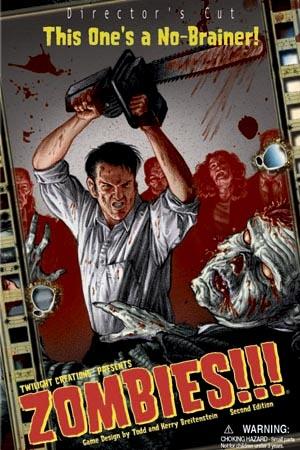
The premise is rather simple: you, the players, are facing a town that has succumb to the zombie apocalypse. You must either kill twenty-five zombies or find the helipad to escape . Complications occur as the city is built by the players, turn by turn, and killing zombies is purely dedicated to the chance of a die roll (one through three, die; four through six, win). It also doesn’t help that at the end of each turn, you must move a d6 worth of zombies one space, toward the players. You, the player, are also the zombies. To aid the decapitations, one has bullets to add a number to the roll, hearts to allow a reroll, and cards that have various effects.

Death is not the end of the game, however. Oh no. You just start back at town center with your zombie kills halved, any weapons gained being discarded, and the beginning amount of bullets and health.

Much like with Once Upon a Time, the game mechanics on this one rapidly change when more players are involved (this leads me to wonder how multiplayer in card/board games changes as opposed to videogames). Because tiles are placed on each turn, more and more zombies appear before any one player gets his or her next turn. Also, because zombies become less plentiful when all the map tiles have been placed, the opportunities to win by zombie head count decrease.

Because of the mechanics, this quickly becomes a game whose focus is not solely on the Zombies!!! the cover reports. Instead, placing map tiles becomes a strategy and aggressive stance against other players, while the opportunity cards become a way to leverage one’s self. Curiously enough, there is no opportunity to turn against your fellow player (which makes sense in a way–would you turn on your fellow man while escaping zombification?), yet this is not a cooperative game in the slightest. One is solely concerned about rescuing one’s self–no aspirations of teamwork exist.

In fact, Perkins and I contemplated what would become of the game if all the map tiles were to start out in play. The objective of reaching the helipad would become immediately apparent, as opposed to the fact that in normal gameplay it is usually the last tile to be played. It is possible, though seemingly rare, to place tiles so that the helipad never arrives as well. Also, because of the mechanics behind their placement, this means that for the first portion of the game, the goal is merely survival. An interesting way to make evident the feeling through design.

Another boon of the game, though it does not seem so while playing, is that the opportunity cards are quite often very circumstantial. There are only a handful which are always useful, most being one’s that only activate in certain buildings, require a specific turn of events, or are so seldom useful that they often become discarded. It helps to keep the game interesting and requires some forethought, but not so much that one is constantly stalling and card counting (one could if such was desired, though).

We being the people we are, also questioned why twenty-five zombies? Does this make one the undisputed leader of the group? Does this portray a certain amount of experience that means one is capable of survival? The latter does not make much sense, as there are no stats, and beyond acquiring weapons, one never gets better at killing zombies. The former would perhaps makes sense if there was any cooperation. Instead, it seems a way of providing a secondary way of winning the game, and possibly just means one has cleared out enough of the city (but why does this cause just one player to win?).

All in all, it’s an amusing game that doesn’t require too much thought, and rarely plays the same way twice.

Tagged , , | 6 Comments

I’m so pretty!

Welcome to another entry of Fanny Fridays (shamelessly inspired by Grant Morrison’s Lord Fanny character from The Invisibles). These weekly posts examine the mirror of gender and sex that occurs between our culture and videogames.

The Minx series of comics has been recently canceled. I would seriously recommend you read Living Between Wednesdays’s take on the matter. Sound familiar? Now, this particular problem is a bit more specific than we find in games:

A new product line aimed at a new audience needs to experiment with new channels. You cannot put these books in comic shops and in the graphic novel section of Barnes & Noble and expect teen girls to find them. You need to get creative. You need to AT LEAST make and distribute display units. To promote something this different, you need to go balls out on it.

Finding videogames is pretty easy, and their selling points are much more prolific than comic books. So they may be in a different section, but at least they’re very visible (most comic sections of a Barnes & Noble make me weep, which is why I stick to my comic book store). We in games face this challenge as well, albeit in a slightly different manner. Among the problems are that some females are self conscious of going into these sections of the store–remember, girls don’t game nor are they tech-savvy. If they do, it’s that wimpy, non-hardcore Wii or DS that has piqued their interest.

Unfortunately, this problem, as with any of the gender/sex related issues I bring up here, is not something unique to videogames; instead, we see a larger trend in our society.

First, I will state I am not a gender essentialist (in case it has not been apparent before this). For those that may not be familiar with the phrase, I do not believe that women are endowed with inherent feminine qualities, nor men with essential masculine ones. This means I largely see gender as a performance (with which I gladly take on personae), something we are taught in society and we emulate to varying degrees depending on how we wish to fit into said society.

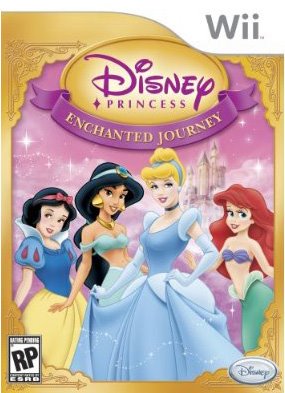
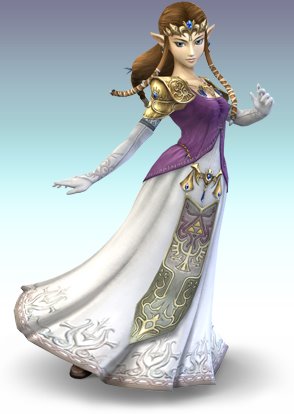
That being said, I look at the image to the left and shake my head. “But girls love Disney and being princesses!” They also love pink, playing with babies, and don’t like violence. At least, that’s what we, as a society tell them. So the marketing of games to appeal to women and girls makes me scratch my head. It’s a cyclical prophecy: girls want these games because they’re girly, these games are girly because girls like them. Really, it’s a quick buck.

My favorite color when I was five was pink; I attribute this to my love of bubblegum ice cream, which I’d first discovered at a Baskin Robbins upon my first visit to the States. Thankfully I was never told this was inappropriate. I eventually grew out of my like of the color pink (and now despise it), but I also wasn’t being presented with it very often in clothing options or interests I had. There was the journal I received for my ninth birthday that had a unicorn and was a pastel pink, but these were items that were not considered appropriate by society at large. While it never bothered me in particular, once I hit my grunge stage, pink was a no-go until I would take on the trappings of glam rock.

What I’m getting at is that we are stuck in a vicious marketing cycle that tells us what we can like based on how we identify. To appeal to young girls, videogames have largely pushed forward typical ‘girl’ interests: take care of a puppy; dress up this woman in gowns and makeup; oh em jee Snow White, Jasmine, Sleeping Beauty, and Ariel! Don’t think boys aren’t targeted either: from appealing to raging hormones to a supposed desire to kill and maim, males are fed a different marketing tactic. Unlike many cosmetic products, however, these games are usually not just the same product in different packaging.

Now, what I am not saying is that we need to cut out the sims (not just the title, but also the take care of animal, et cetera) games. They have their place. What I’d like to eventually see is a movement away from such blatant gender pandering. Of course, we’re still facing this problem in every day ads. Levi’s 501 encourages us males to Unbutton our Beast, we’re encouraging baby girls to don heels (they’re booties with the fashion consciousness of a runway model!), and do I even need to point out any Axe commercial?

So, what am I saying then? Honestly, I’m not entirely sure. Much like Derrida, I can deconstruct this problem, but such theories are not great at proffering any reconstruction. The problem is that the type of people to read this blog are not the ones who will normally purchase such titles. Parents, peers, and lazy marketing executives are the ones perpetuating this gap in gender advertising. The thing is that there are a large number of younger girls playing videogames, and more and more older ones joining the array–I find it insulting that we throw these titles at them. However, this is probably seen as the easiest way to catch their eyes and reassure them that the videogame industry is not just one large sausage fest. Who knows, maybe some of them are decent. If so, let me know.

Now, there do exist games that are gender neutral, but they are normally given a child-like sheen, which creates problems for many males to then admit they enjoy these titles (see: Pokèmon and Animal Crossing). Basically, what I’m pointing out is that gaming is still very self-conscious. We’re very aware of what, when, and where we are seen playing (or so I read–I don’t much pay attention anymore). Much like some people blushing or being embarrassed by buying condoms, lube, tampons, and the like, we as gamers seem to be extremely aware of the packaging we bring to the check-out counters, which in turn means we have to be given gender appropriate packaging and games. I’m not crazy enough to call for a complete deconstruction of gender (at least, publically), but I do think we need to destigmatize ourselves at large.

Own your games: own your image.

Tagged | Leave a comment

Sail the moon

In one manner or another, I’ve been reading comics since I learned to read. The confession part comes in the fact that I don’t feel I started reading really good comics until Advanced English II, my sophomore year in high school. My friend Stephanie brought in Neil Gaiman’s Sandman, Volume I: Preludes & Nocturnes; my mind was appropriately blown. In college, Cap’n Perkins introduced me to Morrison’s The Invisibles. Upon reaching Chicago, I took it upon myself to take a crash course in comic book history and the greats of the last few decades.

There now sits an entire bookshelf full of comic trades next to another bookshelf full of more ‘lofty’ titles, plays, and children’s literature.

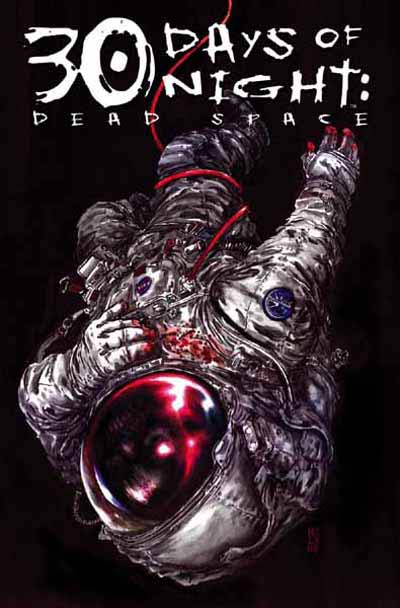
Dead Space has been on my radar for any number of reasons. Its seemingly cunning use of a HUD that builds itself seamlessly into the world I’m seeing, zero gravity puzzles, and taking the concept of zombies and doing something intriguing with it. I’m a horror junkie, especially when it’s done well. This does not mean that horror needs to scare me (I’m much better at scaring myself than any outside source can ever be), but I do expect it to hinder the protagonist in some manner. We’re rapidly moving away from horror just occurring and being played by common, every day folk–but I believe any good genre can expand itself and try out new things.

So, when I found out that Ben Templesmith was involved in a comic of Dead Space, I was intrigued, to put it mildly. I believe I’ve read something of Antony Johnston’s, perhaps a tribute to Alan Moore, but I cannot recall any great body of work of his I’ve read. I’ve observed Templesmith’s artwork in the 30 Days of Night series and have started his collaboration with Warren Ellis (who also wrote some material for the game, though he’s not sure how much of it survives in the game itself) on Fell, so my attention was primarily directed toward that aspect. The man’s artwork lends itself to the horror genre extremely well. His purposeful use of broader depictions and hazy lines draw one’s eyes to the pure grotesqueness of the world one observes.

While Cap’n Perkins was here we visited GameTrailers.com and watched the animated comic through episode five (six having released just this Tuesday). While the voice acting was particularly less than stellar, I enjoyed the story. Much like with Deus Ex, Bioshock, and other titles who provide optional plot, this was an intriguing take on providing information to those who desire it, while allowing those who care just about blasting apart Necromorphs. There’s a small catch, however. Just because I like this idea and the plot presented, does not guarantee I’ll enjoy the game:

Here are the problems Cap’n Perkins and I potentially saw: the art direction of the game does not follow the comic. The events of the game are even further removed from the game by an animated movie, Dead Space: Downfall, when the Necromorphs move from the colony to the USG Ishimura, where Isaac, the protagonist, encounters them. This poses an intriguing question concerning the colony and whether there will be sequels. Presumably, I’m not really going to see any of the characters from the animated comic, as they’re on the planet’s colony and the events of the game are on the Ishimura; even if I do, their attachment to Isaac remains dubious at best.

However, I can easily say I like it (and having no idea how the game concludes, I may well have my questions answered yet). In an era of gaming where I have to order Collector’s Editions of games to get little goodies that make me thrill to open a game box (or lunch box, as the case may be with Fallout 3), this serves as a welcome substitute. It also shows there is some thought into the plot and world beyond just the scope of the game. While I am sure there are other games which build such worlds, it is refreshing to actually experience it. This is also a story that is fully fleshed, not just a shambling skeleton in someone’s design closet.

Would I buy this comic by itself? As long as the voice acting didn’t come with it, that would be a resounding yes (granted it came in trade form). Will it add to my enjoyment of the game? I’ll get back to you on that one. The marketing behind this does excite me, though. Rather than just releasing trailers of rendered images, I actually enjoy looking at Templesmith’s take on Dead Space; I can watch game footage whenever I please, separately.

Tagged , , , , | 11 Comments

Think before you speak

I think that’s an adage many of us could get behind: Think before you speak. It’s not that surprising, sadly, that the term, “That’s so gay,” can be found in most spaces both on and offline; this includes videogames (oh boy, does it include them). In fact, it’s one of those warnings that I’ll leave a pick-up-group in rather quick order. Yes, some people may use it without thought and are just perpetuating something they don’t understand, but that tells me enough right there about how much I want to interact with said person.

So, color me surprised when I saw what the Gay, Straight, and Lesbian Education Network (GLSEN) were teaming with the Ad Council to release: anti-gay language advertisements. On the right sidebar of the provided link you’ll find videos and images connected with the ads. I’ll bring three to your attention right now, the first featuring Wanda Sykes:

I laughed. It’s definitely a message I support and fully endorse.

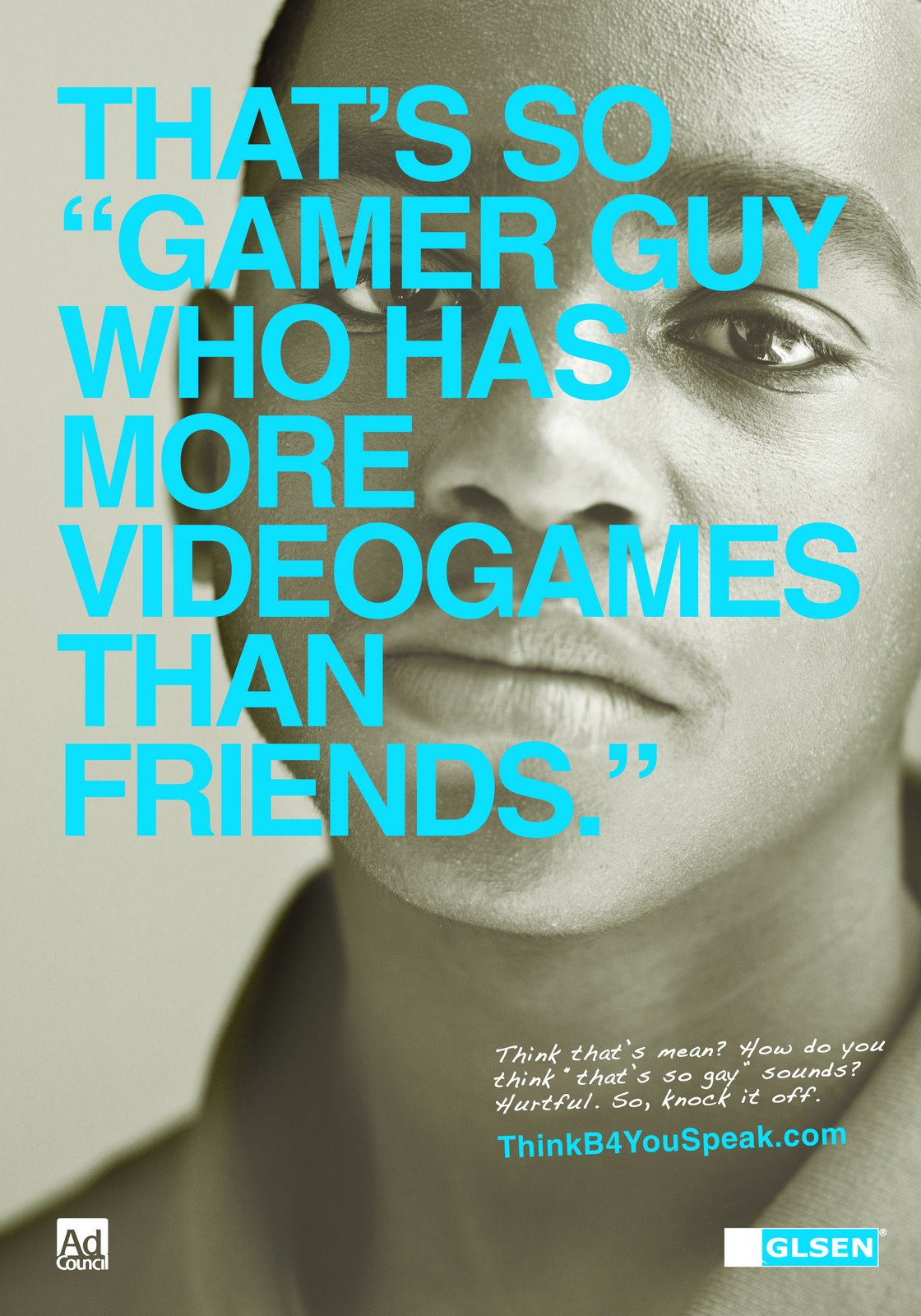
Then I came to the print advertisements, which is where this ties back in to this particular blog (with one extra to show the bent of these ads):

Keeping it pointed and direct was one thing; perpetuating stereotypes is another. Sure, the smaller text reads, “Think that’s mean? How do you think ‘that’s so gay’ sounds? Hurtful. So, knock it off.” Except, saying ‘That’s so gay’ does not perpetuate a stereotype, it’s just asinine and derogatory. The explanation text is also quite small and assumes the reader will next draw his or her attention to that particular spot. You do not make such assumptions; it undercuts much of what you say, because I can read the larger text and just turn my head.

The target audience is younger than I. People who are apt to associate more readily into cliques, rather than denying the truth. People for whom these stereotypes are something much more real and palpable (what isn’t to a teenager?). So, these are people who will read the stereotype and already be warned off about some sappy message concerning loving each other and not using stereotypes.

And boy, do I grow tired of stereotypes. I’m German, so I’m punctual and have been called a Nazi. I’m gay and enjoy theater, I must loooove musicals and swish my hands around while having to know everything about the latest fashion designers. I’m a gamer, so I am some lonely, introverted nerd with glasses who sits in a dark room whose only illumination is a television or computer screen, also being overweight, and limiting my social interactions to people online–if that.

I realize the line they were trying to walk with these advertisements, I just feel they fell off the mark. Yes, gamers have serious issues with heterosexist language, but I somehow doubt this will actually speak to them in any fashion–especially to the age group these ads are so painfully targeting. Most gamers I know these days are not lonely, friendless dorks, and the one mistake many ads make is attempting to appropriate the language of youth in odd ways.

The gamer ad also assumes gamers are guys.

Seriously?

One does not seem informed when one makes statements like this. In contrast, the Wanda Sykes commercial showed an immediate, personal connection. There are two other television spots, one with Hillary Duff catching two teenaged girls trying on clothing and intoning the line, and another with a customer coming up to two clerks complaining and using the phrase. The latter even goes so far as to say the clerks’ names behind, “That’s so…” to illustrate her point.

That’s what I’d like to see.

P.S. Tomorrow I’ll continue recounting what Cap’n Perkins and I discovered and discussed.

Tagged , | 1 Comment

Once upon a time, in a city that was labeled with the number 2

Imagination, story, writing, narrating: these are all words that describe my earliest loves. My aspirations as a child were three-fold. I wanted to be a father, contortionist, and writer. I’ve abandoned any progress on the first two, but the last one still piques my interest and has seen me pursue interests from creative writing to theater to gaming.

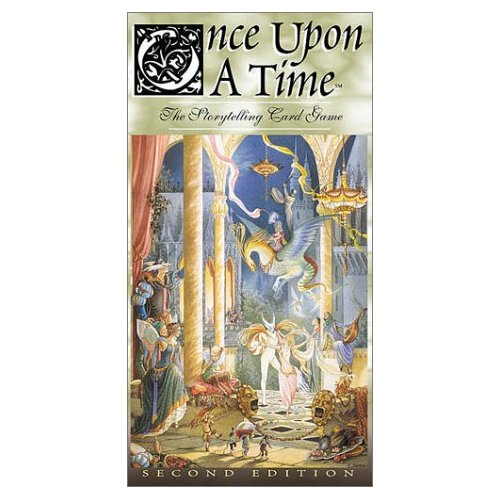
This weekend my collegiate friend, Cap’n Perkins, flew to Chicago and stayed with me. The impetus for his flying up here was a concert by Robert Pollard’s side project Boston Spaceships, but we spent the rest of the three days together gaming and talking about gaming. One game I had purchased some time ago but never actually played (they litter my shelves with their piteous mewing) was a card game by the name Once Upon a Time. It labels itself as a storytelling card game.

Reading over the rules, Perkins and I set to playing, drawing the appropriate number of cards. Our first game had an ogre who captured a troupe of children seeking to lead a rebellion against his tyrannous ways. A beggar, intrigued by the food that was used to lure these children, followed them and saw heaps of treasure lost in a moat of crocodiles; his new goal was to save the children so they could steal the treasure for him. We introduced some more secondary characters and the story progressed, eventually ending with order being restored and an errant ogre mage roaming the world at large.

Our second play was… weird. Somehow, both Perkins and I neglected our Happy Ever After (and with the introduction of the darker expansion pack, some not so happy ever after) cards, the card you have to play to win the game after ridding yourself of all the other cards. These other cards are your locations, characters, items, aspects, and events. One is not restricted to these cards to tell the narrative, but mentioning them allows their ridding from one’s hand.

So, our second play had the Cap’n and I telling a narrative and forgetting our individual goals toward which we should have been steering the story. Both being fans of works by such esoteric minds as Moore and Morrison, our story steered quickly into the surreal and we found ourselves lost in a story with some Cthulian elements alongside a treatment of the perception of time and dreams. We eventually stopped for our own sanity’s sake, because the only way to win at that point would have required hours of play or a cheap deus ex machina, with which neither of us would have been satisfied.

The game works, and brilliantly. It encourages cooperation rather than just competition. Sure, there is a goal and someone has to win, but the rules clearly state out one important principal: don’t be an ass for the sake of being an ass. It also points out some of the rules are merely suggestions, mix and match to your personal tastes.

The Cap’n and I tell stories very well together. Our collective knowledge of pulp, humor, and character development in stories alongside critical theory means we often catch up on each others’ points and just feed the fuel of creativity. We’ve played Dungeons and Dragons campaigns where our characters spent the majority of the time just playing a role and being themselves. No dice rolling, no looking at our character sheets; we just enjoyed the thought of bringing forward a story to entertain ourselves and our fellow players and friends.

This game feeds that desire that we felt with our D&D gaming group. There is no need to keep score, no peripherals, no sheets over which one needs to fret (as someone who plays mages, I usually have the most pieces of paper in front of me). Because it uses the title Once Upon a Time, it is very much taking from the tradition of faery tales and fantasy settings. There are broad archetypes which one can easily use in any way one sees fit (such as the class conscious, aspiring, and devious beggar I concocted). The strategy to telling the story begs other players to become a communal story telling font and interrupt or pass on the torch when the realization strikes that one simply has to pause and regroup.

There is no age recommendation for this game, and it’s easy to see why. As long as one can string together coherent sentences extemporaneously (this is a game I won’t be playing with Governor Palin) and can tell a story that is consistent with what has passed before, with the cards as a guidance, there is a game to be had. We only played between ourselves, but it also is a game that would vastly change with more agents. The core mechanic changes when adding more players; suddenly more cards are introduced, the story becomes more complex as it doesn’t just bat back and forth, and there is more time to contemplate with fewer cards in one’s hands.

As for the stories one can produce? Our second play did reveal one component that we did not realize initially, both being prone to lots of abstract thought. The game encourages very concrete, event oriented storytelling. This reminds me very much of a videogame. Our second dream had a farmhand who shucked his duties, fell asleep beside a river, and was lost in his own dreams, being sent on a quest by an elderly man there to travel up to the future or down to the past on a particular staircase. Playing our cards became an interesting challenge, but more importantly, we did not introduce as many concrete elements, meaning both our Happy Ever Afters became far distant goals.

In other words, this could be turned into an interesting theater game.

I’ll revisit this game once more upon further experimentation. However, I’ll spend the rest of the week discussing other events of the week, including: Zombies!!!, Super Smash Brothers Brawl (Cap’n Perkins’s first interaction with the Wii), and impressions of the media surrounding Dead Space.

Tagged , , , , , , | 3 Comments

Cultural Layering

Welcome to another entry of Fanny Fridays (shamelessly inspired by Grant Morrison’s Lord Fanny character from The Invisibles). These weekly posts examine the mirror of gender and sex that occurs between our culture and videogames.

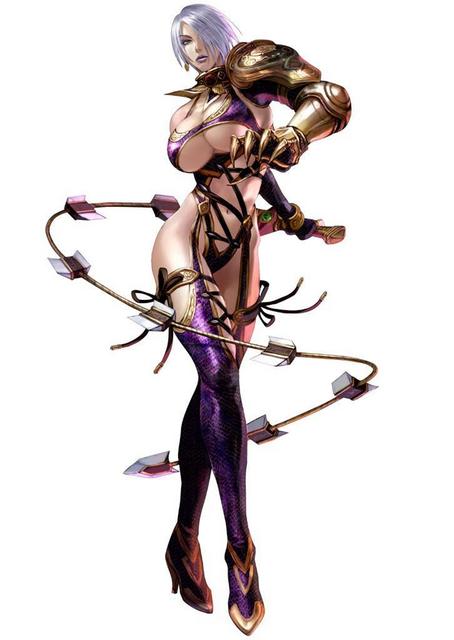
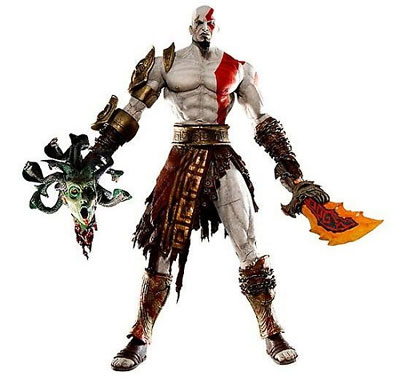
The last Fanny Friday, I alluded to the fact that Ivy and Kratos are wearing pretty much the same amount of clothing (we can argue about a few scraps of cloth here or there, if you desire), but that does not mean they are equally clothed. I’d like to repost those pictures:

Culturally, if we see a male willingly dressed in fairly skimpy clothing, it can mean one of a few things: he’s been wounded and is in battle, is engaged in sport of some kind, or is showing off his muscled body (which usually relates back to sports). Females? Not so much. If we show a female showing off her physique, it’s not for her physical prowess (in fact, female body builders are usually pointed at and laughed), it’s for titillation. That picture of Ivy makes her no more deadly seeming than Kratos in the slightest.

So, even if they are in equal states of (un)dress, they are not on equal footing when it comes to actual body representation. In fact, I cannot think of any females who are known for their physical prowess; perhaps their skill level or aptitude, but not pure physical prowess. We have a couple of things working against us here, including the fact that we still like to operate under the impression that females just aren’t as strong as males from a physiological standpoint; as stated before, we also don’t like the idea of female body builders, who are quite frequently derided for their less than attractive presentation. It’s a cultural joke.

Why?

Because it’s a woman attempting to take on the role of a man. Therein lies the difference in supposedly equal presentations of characters: females are feminine, males are masculine.

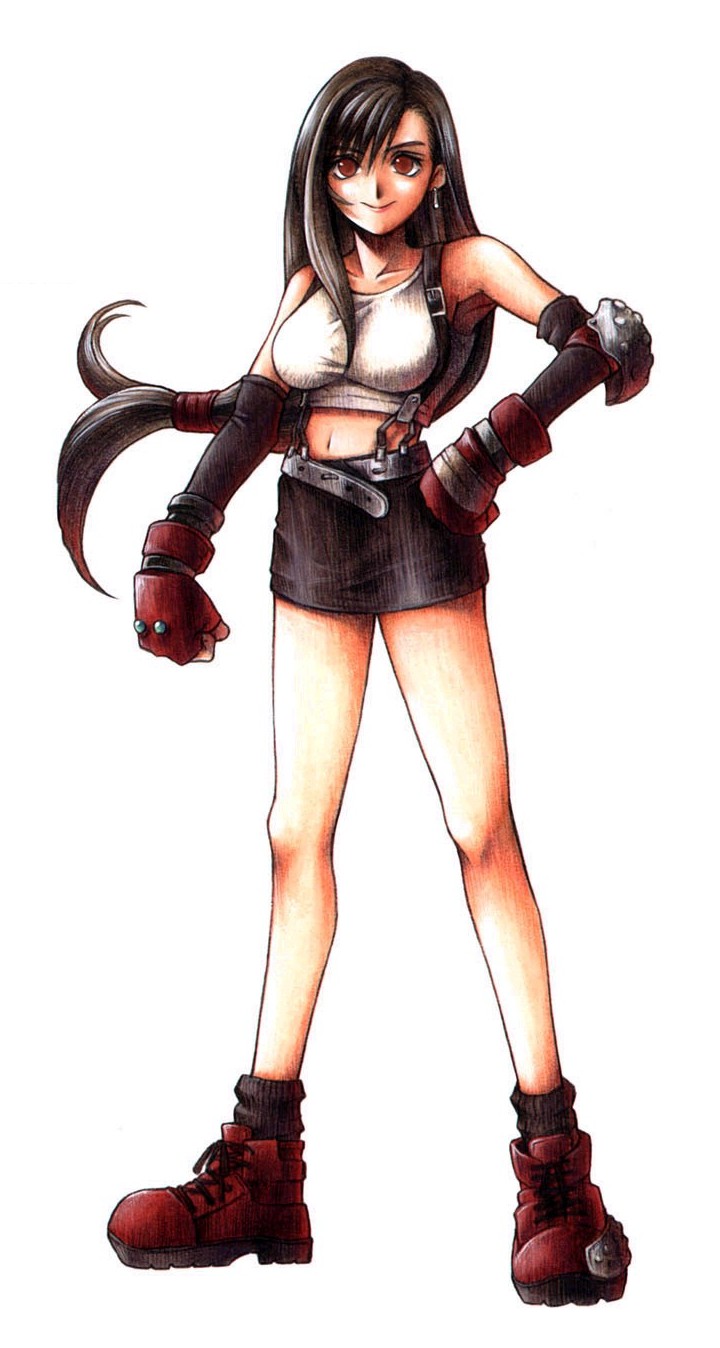
Let’s take a look at Tifa and Yuffie of Final Fantasy VII fame (I’ve excluded Aeris/th because she plays another role entirely, which her clothing also aids). Tifa is a martial artist–she cannot be fettered by too many clothes. Unlike male counterparts who usually take off their shirts, she does still remain with a top, and thank whatever gods to whom you may pray. The game does a fairly interesting job of portraying her as gruff and a leader when she needs to be, but also as weak and emotionally distraught at other times. Oh, and did I mention her breasts are akin to Barbie’s in their seeming impossibility?

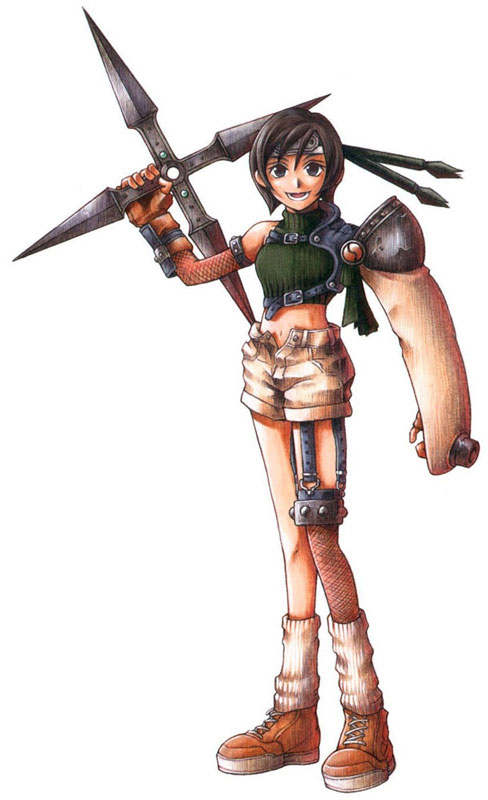
Juxtapose that with Yuffie, whose clothing is also rather skimpy (also, the button on her shorts is undone? I just noticed this), but for a different effect. Yuffie is often hated upon in various Final Fantasy fandoms, largely because she’s portrayed as an annoying teenager–she, like Cait Sith, is serves as a comedic double against the austere, more serious portions of the game. She gets to play the confused young girl who hasn’t quite learned what is fashionable, and is allowed some tomboy freedom.

These are both tomboy characters, but for Tifa this means that she has to show, as an adult woman, that she is still feminine.

Clothing is one part pragmatic and the other part signifier. In colder temperatures (which we’re finally seeing here in Chicago), we prefer to be layered to protect from the cold. From a development standpoint, I can understand why Tifa is running around in snow-capped mountains in that outfit, even if it does create some interesting disparities from a metagaming standpoint. The other portion is to display what gender you are.

Notice that I used the word gender there, not sex. As babies we are often clothed in the appropriate color (often blue or pink) based on our sex. Then, as we grow up, we portray our gender identity through our clothing; this creates some interesting ‘anamolies’ (to a gender binary) around the world. Therefore, Tifa is portraying a more masculine identity, but cannot hide the effects of her sex. Yuffie is portraying a similar gender identity, but is still a teenaged girl, so we can see her from a lens of still growing into her body (and comedic relief founded in females is not supposed to be sultry–except in rare cases when airhead is funny).

Whereas we’re becoming a culture where we are uncovering both the male and female body, we also are dealing with the fact that in the last fifty years, females were much more quickly stripped than males. We have producers of consumable goods to look at for that one: the ones who assumed that the spending power lies in the hands of only males. The equality (not really all so equal) we’re suddenly seeing takes into account the disposable income (maybe not at the moment) of females and gay males.

As I’ve pointed out in previous entries concerning the uncovering of the male body, this is done completely differently, though. Strip a female and you need not worry about it impugning her femininity (we just question if this makes her ‘easy’ or saleable). Stripping a male can make him less masculine if he is not properly guarded against such (e.g. by being placed in a situation where competition or sex is promised).

Males who are stripped need to show their masculinity in much the same way that an adult Tifa needs to show that she’s still female despite her tomboyish attitude and clothing. If, as I’ve also stated before, they are presented in a nude form, and are the object of the gaze of an audience, they also need to guard against the passivity such allows. They must prove they are heterosexual (or at least not the one buggered) and could assert themselves if need be. Which is why we largely see muscled nude or semi-nude males (or ones that are assassins–I’m looking at you, Mr. Touchdown).

Females? We normally don’t worry as much against their sexuality. The idea of a woman’s heterosexuality is usually a moot point: she just needs to be able to be enjoyed by men (whether or not she may enjoy it). Which creates the crux of the problem I’m seeing presented in the cultural microcosm of videogames: females are still largely presented to be enjoyed by men, whereas males are presented to give a different role for men to play.

Tagged | Leave a comment