Argh!

In March of 2004, fourteen other theater students, two professors, and I took a trip to London paid by my college. Because our intent on going was to enrich our knowledge of theater, six out of the seven nights we spent there saw us in theaters, watching plays. Our days were left largely to ourselves, except for some visits to theaters and museums. Those included the new Globe Theater, Drury Lane Theater, National Theater of Great Britian (the Laurence Olivier stage has purple-covered seating because it was his favorite color), and the London Theater Museum.
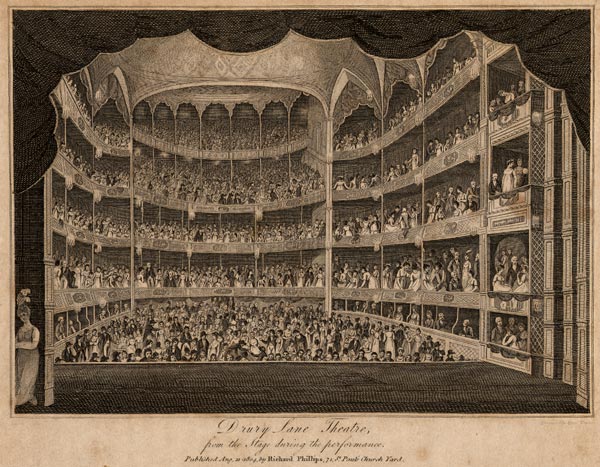

The most educational of the four was probably the Theater Museum. All of these trips had guided tours, but this one was just chock full of various tidbits that would make any theater historian drool. We saw drawings of the youngest actor to portray Hamlet, heard about the passing on of the Shakespearean actor from the greats (we’re on to Kenneth Branagh now), and the lead-based makeup that proliferated the fashion and devastated the face of the Victorian lady.

During this tour we also learned of the old rehearsal process. Growing up in contemporary theater, and having been involved with it for ten years now, I can’t say I’ve ever been through a rehearsal process where I did not know the entire script–where the story was something I only knew through my lines. There are many things about previous ages of theater that are easy to overlook, including the fact that directors were not always a staple and that people who rehearsed had the entire script in hand.

Therefore, while walking along with our tour guide we were told of one actress who held her script, which only had the lines for her part, who decided to sit in on the other rehearsals to learn exactly what she was playing. That way she would be better able to understand what was going on, what her character may have known, and generally have a better idea of the themes and plot of the entire production. Seems to make sense.

Acting is not something I’ve done professionally or in a theater since moving to Chicago. It takes a lot of time and I’m already stretching my limits oftentimes. Instead, I’ve contemplated the profession of voice acting and wondered about how I would get into the field. Particularly for videogames. There is some painful voice acting out there.

Take, for instance, Deus Ex, which I am currently playing. Curious, I decided to head to Google and do some searching on what others thought. This review seems to think it is phenomenal, with which I would heartily disagree. Honestly, it often sounds as if people with very little idea of what is going on in the scene are doing a cold reading, having seen the lines for the first time before the recording I’m hearing. This isn’t the case for the entire production, but, much like with The Dark Knight’s distortion of Christian Bale’s voice while Batman, even the lines said by JC Denton have me rolling my eyes with how ridiculous they sound (I get it, you’re gruff and in charge…).

One of the non-essential dialogs I heard was between a soldier and Shannon in the UNATCO headquarters on my return trip from a mission. They were sitting on a sofa in front of the restroom when both were engaging in flirting (the soldier was giving a danger fraught retelling of his part in the last mission and Shannon was less than enthusedly flirting with him) that stopped me in my tracks as I tilted my head and furrowed my brows in consternation.

Don’t just take my word for it, though:

Not all voice acting in all games is horrendous, though, and some voice actors and actresses are actually amazing. Therefore, while thinking about this issue, I did some research and came across a wealth of information on Gamasutra. The first was an interview with Sony’s Dialog Manager, Greg deBeer, who confirmed a lot of what I suspected was happening.

The actors are often not given the script beforehand. Their first encounter with the script may be the first time they walk into the recording studio. From an interview with Wendee Lee, a voice actress and director, it appears that sometimes these projects don’t even have a director, they merely have the creative team working on the project. And, for my own personal interest, I read industry advice from David Sobolov. Now, the set of scenarios I’ve illustrated may not be a challenge for the greater actors and actresses, but we cannot all be Jennifer Hale.

Not all acting is the same. Therefore, please feel free to completely disregard my introductory story and the faults I lay out as I (a person with no industry experience) see it. My junior and senior years in high school saw me taking Theaters III and IV, where my time was split between film and theater. Acting for the camera is wholly different than being on stage. I can only imagine it’s all the more different from being in a studio with no other actors most of the time. According to Wendee Lee, it’s even different than working on animation or anything of that nature.

In my first post about Deus Ex, Michael Abbott left the following comment, concerning a throw away line I made about my frustration with the voice acting:

I’m also curious about our responses to the acting (voice-acting and in-game character performances) in video games like this. Even among some of the very best games, to a real actor with training these performances usually range from poor to abysmal. Do we overlook them? Do they diminish our experience? Ahh, there’s yet another post! ;-)

Well, here’s the other post. As to the questions asked? I obviously don’t overlook them. When the Marquis in Final Fantasy XII is named and talked about and the s is pronounced, I cringed. My fellow thespian Dickie and I visibly cringed and it had us going around putting on airs and calling everything a Marquis with an s. Otherwise, the voice acting in the game is passable, though not great.

However, do they diminish my experience? It depends on what other elements are in the game, but it does in varying degrees. My current experience with Deus Ex has me frustrated with the game. The focus of the game has shifted from the moral ambiguity of class disparity in treatment of an engineered disease to my own survival. Not really feeling any empathy for JC, I don’t care. The plot has also spiraled into a conspiracy theory which has little or no explanation right now, which further divorces my empathy with the characters.

Therefore, if the game were feeding my other needs and expectations (it may well shift there again, and this is a personal problem with the game), it could be something I note with passing and then go on. It would diminish my experience, because it grates on my nerves, but it would not be a deal breaker. Right now it’s just the icing on the cake I don’t want to eat. Yet, as was noted by Abbott, and I acknowledge, this may well just be because I have higher expectations from the voice acting (there may yet be another post on in-game character performance) due to my own experiences with a very similar art.

The goods news is that it’s something of which these companies and teams are aware and the quality is slowly improving. The other industries certainly have their fair share of clunkers, too. Don’t worry, we’re not the only ones.
Tagged , , , | 3 Comments

Let’s talk about sex, baby. Let’s talk about you and the avatar you control who may or may not share your sexuality, prowess, libido, or taste.

When the name of your blog has an allusion to the Moonlite Bunny Ranch in Nevada, the key terms people use to come across it are pretty entertaining. One rather frequent hit (beyond searching for a gay version of the famed Bunny Ranch) concerns sex and games. So, without further ado, call this a post for the masses. Since I’m also a person who has an extremely low TMI (Too Much Information) filter on my brain, I figured I had no qualms talking about the subject (completely work safe, by the way).

Back in April, when Grand Theft Auto IV released, I grew rather irritated over a few things. One was how IGN posted a rather immature video concerning hiring prostitutes and then killing them. For a major game site to do such seemed crass and stepping beyond an acceptable decorum.

Whatever.

My other issue at the time was how people with no idea about gaming history seem to be shocked that sex is in games. The major reason for this being that games are grabbing a larger audience now than they were, say, twenty years ago.


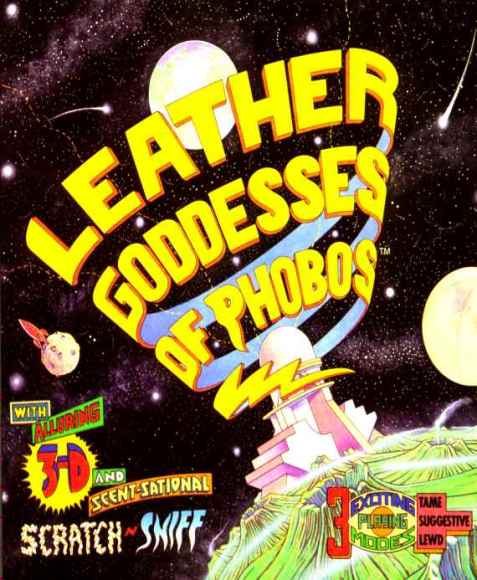
I seem to recall a lot of games tinged with sex around my household while I was a child. Steve Meretzky’s Leather Goddesses of Phobos (1986), Megatech’s hentai hit Cobra Mission: Panic in Cobra City (1992), and even Al Lowe’s Leisure Suit Larry series (1987-being milked into horrible minigames) were games I knew my parents were playing and had started playing myself around the mid-1990s (putting me somewhere around the age of ten to thirteen). These games normally made me laugh; not being confused about the topic of sex, I was more queasy over the 16-bit surgery simulation/doctor game my parents had (edit: as Chris pointed out in the comments, this game was Software Toolworks’s Life & Death). That flesh really did look ghoulish.

Call me silly, but sex is a pretty natural thing that humans explore. The fact that games include the option to simulate the experience hardly seems earth shattering. One natural problem that becomes evident is providing for everybody’s sexuality in games where emergent gameplay has become the norm. I’m sure someone somewhere would gladly do some research on how males feel about playing a female simulating sex with a male (oh Passionate Patti, you vixen, you).

For example, back when I played Sierra’s The Realm Online, I was part of a guild called the Schattenjägers (I’m German and I had a crush on Gabriel Knight, especially when voiced by Tim Curry, so sue me). One of my guildmates and I were talking about Phantasmagoria: A Puzzle of Flesh when he mentioned that he was fine with the game until the end. Being thirteen at the time and not having quite come out as queer, I feared what was coming next: “I couldn’t really identify with a dude kissing another guy.”

Of course, given the recent annoyance over the lesbian scene in Mass Effect (or the controversy over the Hot Coffee mod in Grand Theft Auto: San Andreas), the topic of sexuality in videogames is one that will be coming up more often, and I’m frankly surprised it hasn’t made more appearances in games. This is an issue that will cause major headaches, though. In the days of Sierra, Infocom, and Megatech’s sex games, I was not the intended audience. The first Leisure Suit Larry even had a pretty tough (for someone born in 1983) quiz beforehand to prove your age and what you should know (this was before Wikipedia and the internet in homes). People begrudgingly accept that adults have sex (though they’re not happy about how some go about it), but do not even consider teaching them, in the United States, about how to have it safely.

Given the interactive element of videogames, the only thing worse to some parents could be catching his or her child having sex with a same-sexed dog orgy, thus fulfilling the dangers of allowing gay marriage (we’ve got the gays, the bestiality, and the polyamory goin’ on).

Either way, it’s useful to remember, sex and videogames are not new to each other. Sex and humans are not new to each other. Videogames and humans are relatively newly acquainted, however. We just have to be ready for the media attention that will accompany us now, and hope people like IGN don’t add fuel to the fire.

Tagged , , , | 7 Comments

(Walking) Idea Man

I have tons of ideas in my head for posts. In fact, I always carry around at least three notepads in my messenger bag; one of these notepads is dedicated to ideas for this blog (however, as this post shows, I have no schedule for these and will post something as soon as it enters my sights). Last week, via Facebook, I asked my previous professor of theater history to suggest a book to which he had alluded during one of my many courses with him. Lo and behold, ask and you shall receive. It concerns one of the future posts of Fanny Fridays. Performing a quick online search of the Chicago Public Library’s catalog, I found we had the book! At the main branch!

So, last night after work I headed to the downtown area to procure this book. However, instead of using the CTA’s lovely El stop that advertises itself as the Library stop, I wanted to meander and intuit the direction to the library itself. This is a bad idea when you are used to going to your neighborhoods’ libraries and have only visited the main branch to procure your library card and return the books you took out that one time.

Oops.

By happenstance (and boy, was that a long introduction), I came across something I would not have had I just made my trip and headed home as I originally intended.

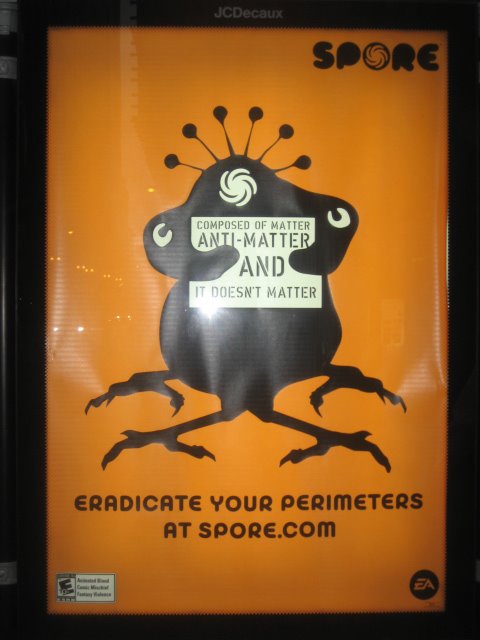
So, I was walking down the street and saw this advertisement. At first I completely missed the obvious Spore logo and read the text. “Curious,” thought I, “how this travel ad is targeting my planet, not my country.” I looked at the creature and then realized, “Oh, duh.”

The ad is fairly straight forward and while it hints at the gameplay for anyone who follows games and has known about Spore, I’m not entirely sure the average passerby would know what to make of this. The only real indicators that this is a game are the small EA logo and ESRB rating in the lower right and left hand corners, respectively. In fact, the lack of any gaming indicators in the main image is what caught me by surprise and had me thinking it was just an advertisement for a travel agency of some sort (those types of advertisements proliferate Chicago).

Curious, I gave up my poorly planned trip to the library and began looking to see if any variations on this advertisement showed their faces. Lo and behold!


This time I knew for what I was looking and it stood out to me, even though I passed it as it faced my back in front of the Oriental Theater in Chicago’s ‘Theatre District’ (where I find the least interesting theater in Chicago being performed). Again, if I had no idea what Spore is, I could easily remain ignorant of the logo and ESRB rating and just be curious as to what is staring at me. This one’s text had me in even further thought.

“Composed of matter, anti-matter, and it doesn’t matter.” Huh. I very seriously doubt many are up to the conversation that would occur about the implications and theories behind anti-matter and its purported existence, so I’m assuming they’re going for a typical sci-fi hook here. As for the ‘doesn’t matter, ‘ honestly, I don’t know quite what to make of it, and could throw many theories out there (and shall proceed to pitch two at you).

One school of thought could be that it applies to the scientific principles. After playing Spore, evolution and things of that nature don’t really matter. You don’t have to be a scientist to appreciate Spore, and as a scientist, you may not really agree with how it arrives at some of its conclusions and pushes forward the idea of evolution/intelligent design. It also may not matter that matter is involved at all. Relax, enjoy, play a game. It is a game, it is there for your enjoyment, what does it matter what engine is running behind it and of what it may be composed?

But more importantly, the phrase, “Eradicate your perimeters,” seems odd tied to a game made by Will Wright. Now, playing a species that has decided to be religious, I do find it amusing that I essentially proselytize my enemies with magical streams of words and propaganda. There is definitely a war-like path to be had if one desires (and even economic, to which I’ve switched in the Space stage). In fact, it seems that this choice of word wants to capitalize on the possibility of this military violence in the game. Otherwise, it could be transcend, outgrow, cross, or step out of your perimeters. Eradicate is a very weighty, violent word in its connotations.

Given the eradication, perhaps what does not matter is the matter or anti-matter that is not useful to you. Disturbing if that’s true.

Reading these images, though, I’m wondering if they’re advertising the same game I’m playing? Perhaps I’ve just fallen into the deadly trap of overanalyzing advertisements because of my Weltanschauung.

However, Spore is not the only thing that my camera saw fit to capture.

Tagged | 3 Comments

Disparities in image

Human Rights Campaign news via GamePolitics.com: Game publisher Electronic Arts, Xbox maker Microsoft and leading retailer GameStop are among 259 corporations that have been awarded perfect scores for their treatment of gay, lesbian, bisexual and transgender employees, consumers and investors.

I have very, very mixed feelings about the HRC concerning its treatment of class, race, and the not-too-distant ENDA spat while using the term human rights. While I understand they are paving the road, I wonder at what cost, and if the ends justify the means. That’s my own personal battle, however. I encourage anyone to do their own research and come to their own conclusions (really, don’t just take my word for it–not everyone will agree with me).


Consumers? Really? I’ve previously discussed the dangers of identifying one’s self as queer in an online space, particularly the gaming community, but Microsoft was given a perfect score with consideration toward its consumers? Are our memories so short?

If a person can be banned or have their name required to be changed due to the sexuality statement, I would like to see more gamer tags cleaned up, because it’s ridiculous out there.

Also, if the LGBT consumers are so well treated, why do I scramble for a representation of a queer character that does not make me uneasy? For that matter, if we’re discussing diverse workplaces, why are sex and race something that I also rarely see very diversified in the games I play?

The consumers bit just rubs me the wrong way, even if I do commend these places for including sexual orientation (now to get gender expression) in the Equal Opportunity statements. I suppose my problem is that I’m constantly looking at the larger goal and expecting more.

So, once again I’m left scratching my head when looking at the HRC. At least they’re getting me to think about what is important to me.

P.S. In less grumpy news, Joey Comeau posted this quick, flash fiction titled Mario of the living dead. For all us grim, dark-themed-loving folk out there, it’s a necessary, fast read.

Tagged , , | Leave a comment

Where I End and You Begin


It’s been a rather wet week in Chicago. When I first started this blog, I was intent on playing and finishing Oblivion. That didn’t happen. Once again, the game lost its interest for me, and I spoke with Cap’n Perkins how I think I like making characters in the game more than I actually like progressing. I enjoy proving their mettle in the beginning, but lose interest as things become too easily obtained. Especially since the plot does not ever grab my attention and I lose focus quite quickly–it’s my world to explore, and I love dungeoneering.

Oblivion is quite beautiful in many regards (with a few issues), yet whenever it rains in the game I wonder what the point is. The same can be said for many games that come to my mind. In particular I recall my mother constantly turning off the weather in Diablo II. Beyond its power of graphically making us go oooh and ahhhh, does it serve any purpose? I don’t know about you, but walking around in metal armor while it’s pouring rain does not seem like it would be conducive to my good spirits or health. Just saying…

Yet, do games need that manner of realism? The closer we get to imitating human faces, the further away our empathy seems pushed. Common complaints include the fact that the faces are creepy and surreal. It’s like watching some twisted puppet (whose description is particularly apt whenever someone watches these character models ‘speak’). A somewhat touchy subject is also water effects. Watching the Fallout 3 (I can’t be the only one glad they didn’t add a subtitle, can I?) gameplay videos, the one for the Wasteland struck me as particularly odd.

Now, this is Bethesda, so it’s the same company that produced Oblivion. However, around 1:55 in the linked video, while talking about how water is essential to keeping your character alive, and that one has to balance one’s radiation from drinking it, the person controlling the game decides to shoot the water to show the physics behind the engine.

Okay. But to what point? Perhaps I’m being too harsh from a theatrical point of view, but it reminds me slightly of Chekhov’s gun principle: “One must not put a loaded rifle on the stage if no one is thinking of firing it.” I don’t believe in the extremity of this example (I also enjoy Oscar Wilde’s theories behind Aestheticism), but one thing from which videogame design could benefit is taking stock of what is being placed in games and whether or not it adds to a sense of immersion–or purposely tries to remove us from that feeling. These days it appears that we’re seeing more and more ‘random’ weather effects that don’t necessarily add particularly to a title. However, at our current state, the majority of games either don’t care or are trying to immerse us in their worlds, not disconnect us.


So, what am I trying to say? No, I do not necessarily believe all weather in all games should somehow act as an impediment (and one can argue its use on the psyche of the player), but it appears to be one of those elements of game design which we take for granted. Hey, it’s a real world, it should have real weather. I would probably add that they should also have realistic voice acting, but at least they can get the weather to look correct for the most part (oh the gift of illusion). What I am saying is that we could perhaps benefit from stepping back and deciding what is and is not necessary, how we connect, and what actually causes us to immerse ourselves in the worlds that these designers have built.

Tagged , , , | 8 Comments

Touchdown!

This will be the start of what I will call Fanny Fridays (shamelessly inspired by Grant Morrison’s Lord Fanny character from The Invisibles). During these weekly posts I will be examining the mirror of gender and sex that occurs between our culture and videogames.

I thoroughly enjoyed No More Heroes. The game’s satire had me laughing often enough that my roommate’s interest was piqued as to what game I was playing. I was playing this at the same time that I was reading David Coad’s The Metrosexual. To say that Travis Touchdown’s masculinity interested me would be understating it a bit.

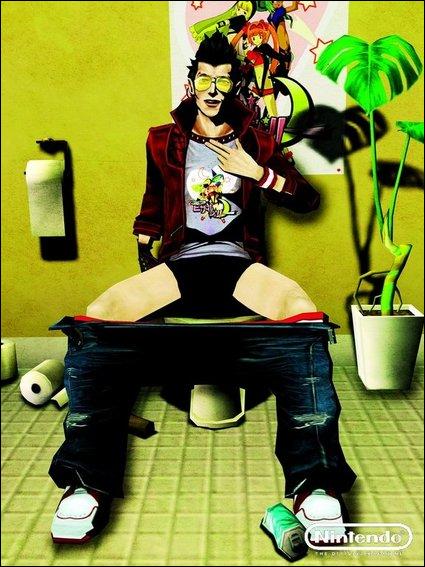
In a recent interview with Suda51, a few new screens came to the fore, mostly concept art. What also appeared is the picture above, with Travis sitting on a toilet, trou dropped, staring at the audience. This is hardly a new pose for males, and it automatically brought to my mind a few other books I’d read and classes I’d taken.

Susan Bordo’s The Male Body does a rather thorough job of looking at how the male body’s presentation in present day media has evolved. In the first chapter, entitled In Hiding and On Display, she presents the reader with two Jockey ads. One has five males presented in various medical greens, their trousers dropped to reveal five different styles of underwear. Its sister ad has five females in cowgirl gear, trousers also dropped to reveal pretty tame and non-varied looking underwear.

While on initial glance they appear the same, there is a vast difference in the language and context. The females are smiling, their bodies are flirtatiously curved and bent, while the males have their arms crossed, do not look particularly amused, and there is also the fact that every one is facing forward, where as some of the females are facing to their sides or looking over their shoulders. The males have a very aggressive stance, and considering society’s shying away from the male body’s penis, the fact that it is barely hidden presents a dare of sorts. In no way does this state of undress make the males vulnerable, whereas the females seem to be much more exposed and lacking any autonomy.

The picture of Travis above juxtaposed with a Calvin Klein model is quite intentional. Both have aspects of their masculinity that are somewhat questionable in today’s society. For the Calvin Klein model, he has longer hair, a slightly boyish (read: young) face, and unlike the males in the Jockey ad, he leans back, seemingly more inviting. Yet, he too has no trace of a smile and his gaze is slightly challenging. The way his arms are posed, he shows off his muscles, and while his face and hair might seem slightly effete by most male standards in the United States, he is not really feminized or vulnerable.

Travis is much the same, though his questionable qualities vary slightly. Instead of a boyish face, he wears his otaku pride in an anime t-shirt and poster behind him. He’s a bit less challenging in his pose, but he is also staring at the audience without any particular flirtation or guile. If one has played the game, one also knows he’s an assassin with a rather foul mouth and penchant for witty comeback.

In fact, the other part of Travis’s masculinity that comes into question (masculinity as defined by mainstream society), is the fact that one of the collectable items for him is clothing. His sartorial penchant offers no bonus to the character, so in case of pure gain to the player, there is none. It is all an aesthetic choice for the player, and for Travis himself. He blends his otaku love with a care for his fashion that borders on being a dandy, if he were not so interested in physical sport through assassination. Yet, does he cross into the realm of metrosexual?

The original definition of metrosexual was to include all sexualities of men. However, over time it quickly became a buzzword hanging around heterosexual males who were particularly keen on their style. Travis clearly illustrates his heterosexuality and failed attempts to bed Silvia Christel. The dynamic between the two of them further plays with Travis’s sense of traditional masculinity, in that she is, in effect, his boss and is chiding to him in various phone calls, reminding him to go to the bathroom, take care of his oral hygiene, and such tasks–in essence, feeding him opportunities to either become or indulge a metrosexual lifestyle.

Travis’s portrayal is quite nuanced, and oftentimes, as with much of the game, I wondered how much of his gender portrayal was purposely designed. Suda51 admitted that he modeled Travis after Johnny Knoxville. Still, there exist moments when Suda51 clearly seems to be playing with the player’s expectations, such as any time the player enters Thunder Ryu’s gym and is taunted with demands for Travis to take off his clothes and bend over for Ryu’s training. Even I was taken aback when I first entered that particular building.

Despite all questioning of his masculinity, Travis continually proves himself in opposition of being labeled a true sissy or even queer. At the same time, he does not quite cross the realm of the sports playing metrosexuals or urban men so self-assured that they can dabble in more ‘queer’ affairs. His masculinity teeters in a rather comfortable range that is further exasperated by the purposefully over the top script. Instead, he seems a foil to examine both the follies of machismo and of a man too soft too kill his women adversaries in the beginning. Which is something else of note, worthy of a whole other post (maybe next Friday?).

So, while Travis has a troublesome masculinity, it is a masculinity that is still in place and within a certain acceptable norm. That does not mean it does not flirt with concepts, much as Calvin Klein’s ads unabashedly appropriating gay culture to sell male bodies (and underwear), however.

Tagged | 2 Comments

Why Y: The Last Man?

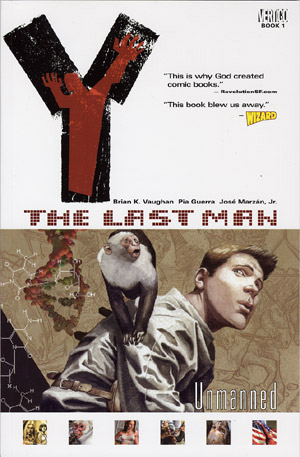
I rather enjoyed Brian K. Vaughan and Pia Guerra’s Y: The Last Man comic series. Currently I’m reading (and finishing) bell hooks’s Feminism is for Everybody: Passionate Politics. This idea came from watching the following video (I swear, my life is not normally this synchronous):


It seems to me we could give players a lot more ways to examine the world concerning gender, sex, and the current state of the world.

In Y: The Last Man, every male on Earth save Yorick and his Capuchin monkey Ampersand die off due to an unknown illness. The series sees all manner of females emerge from the ruins in which this leaves the world, and illustrates a lot of the problems inherent in today’s still gender and sex restrictive society. Consider how many females are pilots, running utilities, in the seat of government, et cetera (here’s a hint, not many). Along with that fact that nearly half of the world’s population (according to the CIA’s estimates, the total population sees 0.92 males per every female) is suddenly dead, this creates for a very different look at a post-apocalyptic world.

While the comic series is being made into a film, I can’t help but wonder what a game universe as such would look like. Especially as, to me, the really interesting part of the story is that which we don’t see every panel. Militant groups labeling themselves Amazons derisively sneer at anyone who still buys into the patriarchal structure, the fight for whom will be president of the United States, the rumors of one last male left on the planet, et cetera. These women are learning to readapt and rebuild their world.

What if one were to be given the task to play as these females? Imagine a Sims-like experience where one has limits on one’s Godlike power that very clearly illustrates our current position. Or, what if this were from a perspective of an engine like Oblivion, where one has to carve some manner of niche from the ruins? One of the first females Yorick meets is an ex-model who just had a breast enhancement before the catastrophe hit. When she meets Yorick she’s working with the CDC to clean the corpses off the street by driving a garbage truck. This led me to think of ways to illustrate actual feminism (not just the myth of the bra burning, man-hating lesbian) into videogames: subtly, directly, tangentially, and various other methods. This was just one idea (it should be noted I have no experience in the games development industry, so this is all purely theoretical).

However, as Brecht states, “Art is not a mirror held up to reality, but a hammer with which to shape it.” For many reasons, feminism is seen by many as revolting and is clearly misunderstood. As hooks states, “Feminism is a movement to end sexism, sexist exploitation, and oppression.” Amusingly enough, there is no real mention of which sex this helps more. Yet, there is no denying, every source of media can be quite guilty of all three.

From what I’ve read of bell hooks’s writing, she is not a particular fan of videogames, falling into that group of people who see them as violence trainers and providing the wrong values to our youth–particularly males (I have the unfortunate tendency to roll my eyes whenever anyone brings up ‘values’ as if there is one definition of the term). I would probably counter her by showing her the early history of film, novels, comic books, and even point out their current state to show videogames are no worse than any other medium. But, is that really any excuse?

Tomorrow I believe I shall start a weekly tradition (we’ll see how I fare dealing with it) of examining the use of masculinity and femininity in games from a gender studies background. I’ve loosely done it before in some posts, but I believe it is something which could benefit from a more thorough analysis, and I certainly have the library of books to help me along the way. While I could just focus on females/feminist ideals in videogames, I believe there is a rather large gap in masculine studies with which to begin, and want to round out the discussion on both ends. As hooks’s statement illustrates, we all seek to gain from feminist ideals.

Tagged , , | Leave a comment

Twin Peaks of Excellence

Despite the problems we may have adapting forms of media amongst themselves, music and videos are something that are generally accepted, and are an artform in and of themselves.

One month ago, to the day, I posted about Amanda Palmer’s Guitar Hero. Since that time she’s released two new videos in her ongoing series, and her album (Who Killed Amanda Palmer?–the allusion in my title reflecting that of the album name) has gone up for presale. When I saw her live she mentioned this video series, where she had two choices, use her budget for one or two videos to promote singles, or create a series of videos instead. She opted for the latter.

The least two videos have been concerning the two songs I mentioned previously, Strength Through Music and Guitar Hero. Since I’ve already delved into the lyrics somewhat, this post will look at the videos released for them. They are also the only two in the video that are directly following one another (though they all are linked). First, Strength Through Music:


As Palmer explained before performing it at the Lakeshore Theater, she had written this song about Columbine, but as she was recording it in Ben Folds’s studio in Nashville, the Virginia Tech shootings occurred. The message seems to be pretty clear. Again, the line that sticks out to me, at least when writing about it for this blog, is “don’t bother blaming his games and guns–he’s only playing, and boys just want to have fun.” There’s a lot going on in those few lines. From the indication that both of these shootings had a media furor around the causes, including videogames, to the similar sounding lyric to Cyndi Lauper’s Girls Just Want to Have Fun. These travesties are every bit a part of our culture as anything else packed in these words.

They resonate with us.

This video sets itself up well for the following:


I’ve already made a small attempt to explicate the lyrics, as provided in the link at the start of the post, so I shan’t focus on it fully again (though, as any densely packed poem, it would be quite easy to type out a five page or more explication of it).

To start, this video has a clever way of introducing the title of the artist and title of the previous song via iPod, implicating Palmer herself as a musician to whom the shooter was listening. As the video continues, there are many allusions to our current culture’s use of the peripherals with which we commonly come equipped (e.g. cell phones, with their texting, and even guitars in some form or another). For better or worse, we in the United States and many other countries in the ‘West’ are very tied into our electronics and media.

As the song indicates, there are many lives. As such, all the victims we saw piled in the beginning are alive again, with the notable exception being the shooter himself.

The guitars are of course a focus in a song entitled Guitar Hero. While not using the game controller peripheral, all of the guitars are the same, and if you watch them being played, until Amanda Palmer’s solo, they’re being held and played the exact same way by everyone. Even more importantly, none of them outside of Palmer have any expressions or are even engaged in playing. Contrast it to this commercial:


However, when Palmer does start her solo around the 2.30 area, all manner of cultural signifiers are occurring. Suddenly Palmer’s hair has a life of its own, mimicking the windblown look that seems a standard in today’s music and fashion industry. Her finger placement on the guitar during the closeups also becomes extremely exaggerated while her imitating guitarists turn into clapping support. This is showmanship. In fact, while there are a few chords to be heard from the guitars themselves, the keyboard, drums, and clapping are the mainstay of the music.

Along with the shift in the lyrics to a more sinister turn, suddenly the scene changes from a classroom to a stage. While Palmer intones, “Shut up about all of that negative shit. You wanted to make it and now that you’re in… you’re obviously not gonna die, so why not take your chances and try?” the stage becomes slightly livelier; after the sardonic verse that follows into the chorus, the stage jumps alive with action. Remove consequence and the feeling of real failure, and what do you get?

Perhaps the most dramatic and symbolic portion of the video comes at the very end. Suddenly the shooter, who has remained dead the entire video (and whose iPod displayed the title–intoning the intro of Strength Through Music‘s discussion of the symbols F and S, ‘fool’s gold,’ or a false goal), opens his eyes as the camera starts to pull back and focuses on a little plastic cowboy. While I’m rather bored with Marilyn Manson these days, during the release of Holy Wood, he had a phrase that I feel poignant: Is adult entertainment killing our children, or is killing our children entertaining adults?

What is our mandate and when are we responsible? I don’t believe in the idea that violent videogames beget violent acts, those who would be violent would find some means of doing so (and being inspired) anyway. However, I feel the larger point is that we tend to go into polarizing opposites (which can also be seen in the government/factional mandated violence–did Al-Qaeda or Georgie Bush play videogames?) and don’t even really address the issue at hand. We’re seeking to cure the symptoms.

Tagged , , , | Leave a comment

Ambisexual Androgynes

This post is inspired by an hour long conversation with Cap’n Perkins (this was among one of many topics broached, one of which will hopefully see a dual-front post from the both of us within the next month), recently having finished Ursula K Le Guin’s Left Hand of Darkness, picking up yet another bell hooks book, and playing Spore.


The two pictures above are my creature halfway through the Creature phase, and then again after Civilization was reached. You can see my steampunkish leanings through what I’ve decided the creature is wearing (tux front, frills in the groin region, wheels on the knee above bowties on the shins, a curly wig, and a tophat). Here’s the problem, I was almost going to type a pronoun in that last sentence, except I could not decide whether or not I was going to use he or she.

Ursula K Le Guin’s Left Hand of Darkness follows the plot of an emissary from the Ekumen, a confederation of over eighty planets, contacting another race to join. This race has no knowledge of space travel, and as we find out through the course of the novel, these different humanoid species seem to be an experiment landed on different planet environments with different abilities by a progenitor race. So, what is these Gethens’ ability which sets them apart? They’re androgynes, switching from one cycle to the next whether he, the novel assumes this as the neutral pronoun, becomes male or female, and therefore can be father and mother in one lifetime. Sex becomes a tool in bearing children, but otherwise gender plays no role in this society.

For those who’ve played Spore, I think you see where this is going. What sex are my creatures? Do they have a sex? After being frustrated by civil partnerships in the place of marriages in Sims 2, I was rather taken aback when I realized that there is no real assigned sex to my creatures. Only assumptions.

Which is not to say there is not implied gender. Most of the clothing options, for instance, are pretty asexual, in that I could see either gendered perception wearing them with ease, with a few exceptions. Tophats and curled wigs are typically masculine fare–in our world. Which is where implied gender comes into play, based on those viewing the creature as it interacts with one’s own world and the person playing the creature.

For myself, this creates an interesting choice. It may well have been a choice of not wanting to be bothered with different character models and behaviors. We have a few allusions to more feminine fare in having an eye option with long, lustrous eyelashes. However, I can tell you from personal life experience that my eye lashes in no way make me more feminine, though they can be an asset when taking on those qualities in this society. They can help me play a ‘role,’ which is one thing I do not feel myself doing with my Terimes. I’m not playing the role of a Terime, I am merely seeing them through their life stages.

Whatever the conscious choice of going into the game with this, the implications are even more astounding. I am even more curious as to how male and female players will differ in how they perceive their created races. Being somewhat non-cisgendered, I assumed my creature an androgyne. For all I know, the Terimes are a race where homosexuality is the only existence, because heterosexuality is a moot point. Now there’s an interesting thought.

Since I am also writing my civilization’s history as I play, it creates an interesting model for me to try and understand how such a society would function. Of course, it falls purely into theory land, and won’t let me get to the deeper details, but it became an epiphany moment when I was describing the game to Cap’n Perkins and realized how this gender confusion lent itself to a novel I just recently read and the book I just picked up concerning feminism’s role in breaking down the oppression of one sex over another.

This means that as a base, Spore allows us to create ambisexual (androgynous being somewhat misleading, because what if there are more sexes?) beings. It is only our own projection on to their character, appearance, and behavior that modifies its gendered leanings, which will naturally be limited by what we perceive and enforce based on our own understanding. It also clearly points out that a game makes no real distinction between sex and gender of its inhabitants–to create the option of sex and gender is to be given more work. It is something designers put into a game. What really is the difference between my female and male Sim beyond a skin paint and certain boundaries on who wears what and who can marry whom (instead of a civil partnership)?

I hope this isn’t too far out there to grok. Either way, it has me very excited.

Tagged , , , , | Leave a comment

Virally Loading

Spore will likely do very, very well (even despite the DRM/Amazon review fiasco). At this point, I really cannot see it being a massive failure. It’s easy to get into, none of the stages are overly difficult, and it supports researching evolution as well as intelligent design. It’s inoffensive on many levels.

Knowing that I liked the Sims, and had stopped playing Sims 2 after loading the game one time caused it to wipe all of my neighborhoods, I was rather excited to give it a go. Even though my degree has four parts that are all focused in the humanities, I am rather engaged in science and biology (especially concerning genetics) often held my interest alongside the theater courses. I’d even downloaded the Creature Creator and given it a whirl a few months ago:

So, here are my initial impressions of Spore:

I enjoy the gameplay. In essence, the first two stages of Spore are an RPG that sees major cosmetic changes as you progress. The Cell stage does not take long and the Creature stage can be as quick or long as you wish it to be. On my first go, being the collector I am, I gathered all the body parts I could in both sections. While not one for achievements that brag about what I’ve accomplished, I like unlocking parts of games that are usable in some manner. In fact, I’m an anal retentive completionist–why I avoid an RPG unless I know I’ll want to finish it.

Playing an herbivore (I wanted to see whether or not us pacifist vegetarians can conquer the world), I found the social bits during the creature stage amusing, and the challenges were definitely there. There were some creatures with whom I could not negotiate, others who were much better performers in some fashion whom I could not woo, and I had very few weapon capabilities.

However, as soon as I hit the Tribal stage I was just trying to move on as quickly as possible. Both it and the Civilization stage were rather weak as Real Time Strategy games. The only point of interest I actually had was in the fact that I could design my buildings, aircraft, and the dress of my now ‘fully evolved’ creature. Being the theater person I am, the entertainment building saw a large portion of my time and energy expended on its structure alone.

Unfortunately, upon reaching the Space stage, I could not save nor heal my spaceship. At that point I decided to have dinner, and sure enough, upon returning, it set me all the way back at the beginning of the Civilization stage. My mother and I have a running joke between us (though the joke is more on us): never buy an EA game when it first launches. As the Sims expansion packs have shown, something will go horribly wrong. So geht’s.

One aspect of interest to me about this game is the fact that I can pick and choose. I do not have to play the Tribal or Civilization stages ever again if I don’t want to do so. However, I have a problem with this. I’m sure it will be a feature that saves the game in many peoples’ eyes, but I cannot break my own habit of seeing something through from beginning to end. This probably stems from the fact that I have a somewhat more rigidly defined sense of what a game constitutes and don’t wish to skip about from section to section–I want to see the evolution of each creature I create.

In a grander scheme, I see the entirety of Spore as an RPG whose focus shifts. It is acquisition, refining of your avatar (and consequently the civilization), managing stats, and the only thing it lacks is a written plot (this can be argued, but I’m thinking in the larger scheme of narratives, not goal posts hidden in tutorials). Considering I find many J/RPGs to be a bit too convoluted and trite these days, I’m actually glad to provide my own stories, which I will gladly take upon myself given the right tools. I might even make the argument that this is the ludite’s RPG–it provides the basic tools and you do with it what you will.

Then again, considering one can play this game any which way one wants and some people will likely be taken to only creating creatures, buildings, vehicles, planets, and YouTube videos, it is also not an RPG at all. Which brings me to the one feature I hope to further explore, interaction with friends’ creations. So, if you have Spore and need a buddy, add Aeazel to your list and feel free to e-mail me your own Spore screenname.

Tagged , | Leave a comment