Glitching the System


(This YouTube video was posted for the song more than the visuals.)

Videogame music has its niche. With bands like The Advantage and The Minibosses (along with a slew of others) we have a new form of cover band–those that cover 8-bit NES songs in these two bands’ cases. The above video clip is a curious step beyond such, not being wholly chip tune (I’d never even heard this term before I saw it posted by Michal) in nature, nor fitting purely into the glitch format of music. Crystal Castles (both from the She-Ra franchise and an old Atari game) is utilizing videogame music, but not being defined by it.

Doing searches on Amazon.com, Last.fm, and various other sites on which I can quickly look at data, Crystal Castles is by far more lucrative and popular a band than the other examples I mentioned (though still far from ‘mainstream’). They’re not playing to nostalgia alone (which has a tendency to stagnate progression), mixing the tunes we recognize with a high energy delivery and giving us an expertly honed, if not quite unique, performance. Having seen them twice, I’ve noted a few things that made my experience pleasurable.

The stage is set up with flashing strobes that run the entire show. Alice Glass, the vocalist, jumps around on stage, screaming and crooning into the mic, in a curious form of dance. Due to the flashing lights, her movements are disjointed and she ends up looking like she’s missing frames of action. It’s akin to watching an older videogame with amazingly realistic visuals but a horrible frame rate.

The lyrics to most of the songs are not narrative in any format (ranging from sampling Death From Above 1979 to quoting James Joyce’s Ulysses). In fact, Glass has a tendency to scream the vocals so that they aren’t quite discernible in the wall of sound that is assaulting one’s ears. Yet, the song does create a curious spectacle. As I said, this show is high energy and moshing most certainly occurs throughout a major portion of the audience. Instead of the extreme examples that popular culture expects from crusty punk shows, this is a milder form: people are pressed against each other, jumping, dancing, slightly jostling each other and all the while watching Alice toe the edge of the stage, hurl herself into the audience’s expecting arms, and snarl while crouching at the very lip of her performance space.

Videogames are infiltrating every part of our artistic culture and it’s curious to note that passage. My generation is one that grew up in a videogame culture and now that I find myself in my mid-twenties, I can easily spot the culture that has formed. We’re not the only ones noticing. Despite gripes about Nintendo abandoning their ‘core’ audience, when I last visited New York City’s Nintendo World, they had apparel and accessories obviously geared toward those entering the professional work force. I bought (and have since lost in one of my sleep deprived jaunts through airports) a very elegant, simple watch whose Nintendo logo was not instantly visible on the watchface from a distance of more than a few feet. Videogames are not only progressing themselves, but the very world around us.
Tagged , , | 2 Comments

Presidential Race 2008

This is the first U.S. Presidential race which I’ve closely followed. I just as easily grew tired of the rhetoric and now look at all the candidates with a very skeptical eye (the FISA bill, Obama? Really?).

Something that caught my eye today, however:

A snippet from Presidential candidate John McCain’s website: It may be typical of the pro-Obama Dungeons & Dragons crowd to disparage a fellow countryman’s memory of war from the comfort of mom’s basement, but most Americans have the humility and gratitude to respect and learn from the memories of men who suffered on behalf of others. Yes, I do realize the irony of promoting traffic in some small manner to that blog.

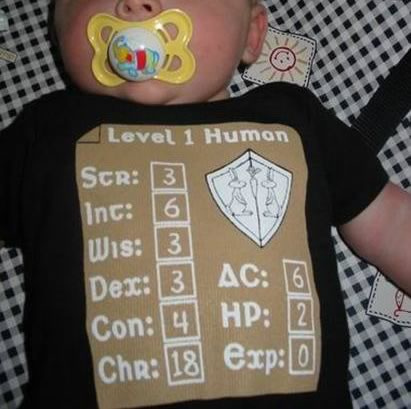
(Is any baby’s Charisma score really 18?)

Dork that I am, I’ve been playing Dungeons and Dragons for twenty years (with my entire family, no less). I’ve come across a wide swath of dice rollers, and cannot say any particular attribute sticks to the group en masse–including political affiliation and chosen place of residence.

From where does this idea stem that gamers are all liberals? Or socially awkward grown men who live with their parents? I’ve known just as many military servicemen who tried to imagine a scenario in which they could roll the fabled d12 as I have liberal arts students. As many males who rolled that sultry female elf character in tight leather as the females who made a brutish, testosterone-addled male orc. I’ve played with socially awkward communicators alongside people who were very confident and extroverted. It’s an odd assumption, but one which I, sadly, expect from politicians.

At least John Kovalic was reminded of a cartoon he drew back in May.

Tagged | 3 Comments

WTB: Straight Sexuality

The problem with the above video (beyond the response to the name) is the name itself. The player advertised himself as gay. In almost any online space, this can be a headache. One does not have to display their sexuality in their handle in order to receive this treatment though.

When I last took up World of Warcraft, I recall an instance when I was playing my Blood Elf Paladin. Unfortunately, at certain points while grinding through the levels, one comes across some armor for the legs that act as short shorts, which look less than ‘masculine’ on a Blood Elf (who already isn’t winning many points on traditional masculinity).

On the goblin blimp from Undercity to Orgrimmar I had another male Blood Elf toon accost me, starting to call me a faggot and less kind terms. Sighing in real life, I pointed out the logic that his toon was no more masculine seeming than mine.

Appealing to such logic with these people rarely works, however.

When playing an MMO I do not advertise my sexuality. Frankly, it doesn’t concern anyone playing the game. Yet, invariably it comes up in some manner or other, either in an overt discussion or subtle hints that I do not drop.

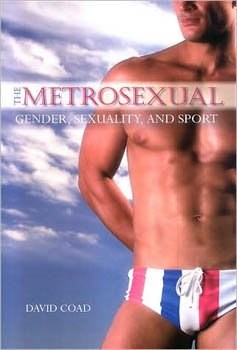
Yesterday I had one of those ‘Oh, duh’ moments while reading David Coad’s The Metrosexual: Gender, Sexuality, and Sport (due to its cover, I’m very self conscious while reading this in public–though largely because his nipple seems so obscene and photoshopped). I picked it up from the feminist book store up the street from my apartment because I thought I would see if: I could find any parallels to either game characters we see and how we sexualize them and/or explanations for how males react to the competitive aspects of gaming. I have yet to read past the first chapter (I cracked its spine yesterday), but within his introduction Coad makes a statement that is very simple and has always been at the back of my mind, yet which I never vocalized.

One of the reasons I out myself when I play in an online space is because I do not assert my heterosexuality. There are no comments about a girlfriend or which females I may find sexually desirable. There are no cues in which I assert that yes, I am a straight male not associated with homosexuality at all. Coad’s particular argument is on the sexualization of our athletes and how to not have a girlfriend, wife, female lover or not to brag about one’s prowess in some manner is to open up the problem of a homosocial environment–here there be queers.

It’s quite a leap to assume that a homosocial bond will always produce homosexual acts. However, hardcore gaming (including the realm of MMOs) is still considered a ‘man’s’ sport. Despite the fact that I probably know more females playing the big MMOs than I do males (personal anecdotes do not a statistic make), perception is one of those things that can be difficult to change.

The other way in which I out myself in online spaces is a refusal to ‘correct the insult’ that I am queer. Yes, it would save me a lot of headache. Yes, I am asking for further idiotic comments when I defend myself. No, I do not see compromising for the sake of it.

I do enjoy my mother’s response to the ‘that’s so gay’ comments she comes across in MMOs (yet another way in which I happen to illustrate my not-so-straight tendencies), “My son is gay and I would appreciate if you didn’t make such idiotic statements.”

Tagged , , | 8 Comments

Problems in Translation

A short introduction. Cap’n Perkins came by his name from my college gaming group. We played a plethora of games: Dungeons and Dragons, Kobolds Ate My Baby, Munchkin, HeroClix, videogames, et cetera. At one point we commandeered a ship and our rogues aboard said ship called themselves To the Pain. We went through a sea-faring phase and Cap’n Perkins was considered the figurehead of our group (though he had graduated a year earlier). While I had talked about starting this blog for months, he was the one who spurred me into action. Along with discussion fodder for this blog, he and I have exchanged thoughts on the possibility of his writing something for this space.

He sent me this link via e-mail last night. While I believe we can all agree that the critical language of films (or comic books, literature, music, et cetera) hardly does the best job of giving us a plane in which we can work, comparisons will be drawn. After all, we still do this with adaptations, even if they are two separate mediums which should attempt building their own separate strengths (I stand guilty of that one far too often).

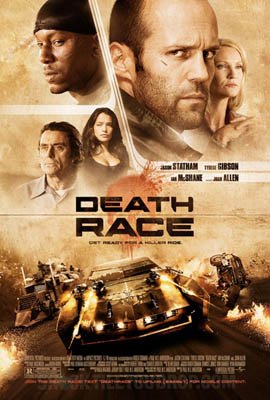
Tasha Robinson is not alone. While watching one of the plethora of comic book adaptation films this summer, I saw a trailer for the film Death Race. Looking over at the friend who accompanied me into the theater, I commented that I would likely pass this film up, but would be interested in playing a videogame as such (though not an adaptation of this particular film). He wryly remarked that we already had such in titles such as Carmageddon.

What does it mean when we want that interactivity, however? Despite my bemoaning the lack of romantic relationships between characters (I do believe they exist between character and player due to attachment), videogames do offer us a lot. Interactive stories draw us in and keep us tapping those keys, pressing those buttons, and watching the screen in front of us. It also seems to speak to the ability of gamers to make up for barebones storylines.

Yet, in her review of Star Wars: The Clone Wars, Tasha points out, “And with its simple-goal-driven plot, its wordy, cutscene-like interludes, and its stiffly modeled characters, it wouldn’t even make for a particularly high-end videogame.” It’s nice to see someone acknowledging that some things are simply not desirable in any particular medium.

Though, I suppose we’ll always have those moments of imagining what it will be like: the book into film, film into game, game into film, comic book into film into game (I worry for Watchmen, the episodic brawler).

And while videogames don’t need to be on big screens, I still recall the amusement that came from loading up the Gamecube and projecting Super Smash Brothers Melee in our small presentation hall in the Fine Arts building of my college.

Tagged , , , | 1 Comment

Arteroids

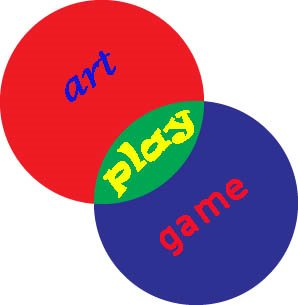
“The middle ground between art and game is play.”
– Jim Andrews

On the sales bookshelf at Quimby’s quite some time ago I picked up Gamers: Writers, Artists & Programmers on the Pleasures of Pixels as edited by Shanna Compton. Today I decided to relax a bit and took it with me as I went to lunch, first searching through the titles and seeing if any caught my immediate attention based on the discussions that have been happening around the blogs.

The quotation you see above is from Jim Andrews’s Arteroids game, a pithy sentence that greeted me when I had to start a level anew. While you could buy this collection of essays (I’ve yet to read all of them, so I cannot tell you its worth), his essay is readily available on his site as well. I won’t rehash the entire article, but wish to get to the parts that particularly interested me, which are the later portions of his essay in the book, under the headings Game Mode & Play Mode and The Conflict of Art & Entertainment (his conclusion).

Game Mode & Play Mode

The game exists in two primary modes, that of the game and one of play. Game mode gives you a score and has you progressing in levels. In game mode you are given one life and asked to play the game. Play mode allows you to tweak the controls; you control the velocity (through level) and mortality of your avatar, a word. One cannot save one’s score in play mode, as there is no progression in terms of the game.

After all, as Andrews put it, “Arteroids is the battle of poetry against itself and the forces of dullness.” Literally. You will have the option, as the word poetry, to shoot your doppelgänger, the word poetry.

In my first play through of the game I was very cognizant of the words I was ‘shooting.’ As a sometimes dabbler in poetry (it paid itself in scholarships), I was mentally keeping track of the words that exploded on screen and seeing what manner of syntax was being formed. Alongside the noises that were made upon ‘shooting’ these words, I began to wonder how I would even bother reading this aloud if I could recall it for later writing.

This was during game mode. As I progressed through the levels, the velocity of the words meant I quickly paid more attention to my survivability and it became an impossible task to keep all the words in my head. Perhaps had I a watcher who could write down the words, it might have yielded results. However, this seems the design of the game.

The Conflict of Art and Entertainment

“I’m hoping my continuing ambivalence about the piece indicates that Arteroids does have an unresolvable dynamic that is a source of continuing energy: the conflict between game and art, entertainment and art, popular culture and art.” His use of the word ambivalence immediately caught my eye and I thought to myself that much like the artist, I hadn’t fully settled on my own definition of his title. The game seems to still be going through various versions, which offer different capabilities. As these capabilities, high scores are the latest addition with hopes for a future multiplayer component, become available it does seem our own awareness of this game will shift as well.

The game is very basically modeled after Asteroids but also implements a certain metagaming quality in the term of how we approach it. Most of us know Asteroids, whether or not we have played it. Poetry is something with which I would imagine all of us, who are reading this at the very least, are aware. Essentially, one is a game and one is a piece of art. The play I garnered from my interaction was changed during the course of my play. What started as art morphed into a game where I paid less attention to my former aspirations. Whenever I would be forced to start new, I would contemplate what had happened and seek to restructure my next play of the game.

I am a proponent of some games having the ability to be art, and this creates some interesting questions as to what that means and where it intersects. There exist art games, there exist games for gaming pleasure, and there does seem to be an intersection where the two can meet. Can an art game cross into losing its ‘art’ if the player refuses to interact with it as such? For all intents and purposes, one can ignore Andrews’s artistic goal of the game completely–he even suggests it is the goal in game mode. How do we decide when a game crosses over from one to the other and whether or not it lies in the middle, however?

Well, that’s a question that still puzzles students of art as well. Perhaps it’s time I went to see the Jeff Koons exhibit at the MCA.

Tagged , | Leave a comment

Ewigkeit

Corvus Elrod’s Blogs of the Round Table proposed the following question this month: Do video games teach socially responsible lessons? Thinking about it, I immediately started grinding the gears in my head to try and think of concrete examples of what I’ve learned from video games. The problem became that my childhood was filled with literature, video games, pen and paper roleplaying, and a freedom to explore any curiosities I might have in any art form (the one exception being Marquis de Sade). My mother was directly involved in anything I did: playing the games, reading the books, watching the films, et cetera. She made sure I had a healthy mix of everything and wasn’t too overly reliant on any one.

The problem then is trying to extricate specific lessons that would be hinged solely on games. Instead, there was a miasma of knowledge into which I felt I stepped in and absorbed what was at hand.

As I thought further on the topic, I did realize one starting point, however–one game that still informs my quest for knowledge.

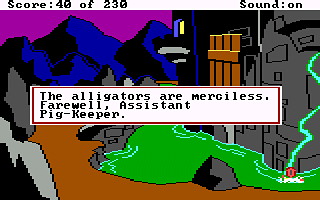
Sierra’s adaptation of Walt Disney’s take on The Black Cauldron.

Playing this game filled me with delicious dread. I was living in Heidelberg and my family had two computers. My brother and I inherited the Tandy and my parents duly bought the more kid-oriented titles alongside their own interests.

What about this game grabbed me?Mortality. The game was ruthless. One had to make sure that Taran was fed, hydrated, and then kept him alive. It was my second introduction to the adventure game genre (Mixed-Up Mother Goose being the first). Given how I never successfully navigated very far into the game’s storyline (oh but I tried!), it’s a wonder I stuck with the genre at all.

However, I saw Taran die in a number of ways. Along with the darker tones of the environment when one neared the castle and the malicious intent of most NPCs I recall encountering, the game caused my seven year old self to confront head on the concept of mortality and what that meant to myself. Thankfully, as I stated, my mother was there when I woke one night crying to her about a nightmare in which I imagined the terrifying and yearning maw of an eternity of senselessness (the nightmare was more concerned with the afterlife than any actual physical harm or the act of dying itself).

My family was not very religious, going through the motions of baptism in order to please my grandparents. After this incident, I requested permission to attend church. Because my intention was to learn and discuss theology and the mortal coil, I was rather disappointed in my experience (it seems most people are not comfortable with children asking pointed questions about mortality and how it concerns faith–I wasn’t satisfied with a mere heaven, purgatory, and hell) and found myself seeking answers in mythology and it was around the time my mother also suggested The Little Prince. It managed to open up a whole other world to sate my questions I had concerning that troubling dream. I also picked up Lloyd Alexander’s Chronicles of Prydain.

Which is the one theme I kept thinking on when considering what games have taught me. Most of all, they taught me aspects of myself. From my gaming style and how it differed among my family members, to what personalities I felt drawn, and what expectations I had of connections with my stories. But the question this particular game drew to my mind still has me questing and searching for the answers.

Coming from a liberal arts background, I can think of very few greater socially responsible lessons than the encouragement to satisfy a basic question that still lingers over humanity.

Please visit the Round Table's <a title="Round Table Main Hall" href="http://blog.pjsattic.com/corvus/round-table/">Main Hall</a> for links to all entries.


Tagged | 6 Comments

"It is well that war is so terrible — otherwise we should grow too fond of it." -Robert E. Lee


During my college years, my videogaming habits were rather lacking. While I’m sure my professors appreciated this effort, it meant that I was out of the loop for what was happening. Abbott’s Brainy Gamer brought me into the fold of videogame discussion in an online space, and this means I’m still learning and catching up with what I missed during those four years in Podunk, Indiana.

My friend Josh keeps up on my blog and after a delicious lunch, we sat in my room and were discussing the problem presented by Leigh Alexander. He mentioned the project by artist Joseph DeLappe in the embedded video above. Performance art is a tricky enough gig as it is, but its presence in videogames is one that has me thinking.

It is obvious why DeLappe chose this particular FPS to broadcast his message when one realizes the U.S. military is funding it. It is also not surprising to see the gamers’ response to his broadcasting the dead soldiers’ names.

Perhaps my examination of Amanda Palmer’s Guitar Hero still hasn’t fully satisfied my urge to examine the song (thankfully I can listen to it over and over when the CD releases next month), but it seems that what is being tapped into here is an intriguing notion. With MMOs like Second Life, the possibility of expressing one’s self in an online space that has a set of rules, whether loose or rigid, is a performance I can well imagine we will be seeing more often. But how many will take this to a political level? Is it productive or does it just get in the way?

There are a plethora of YouTube videos concerning themselves with setting music to various games, such as World of Warcraft, Guild Wars, and whatever else have you. Entire web series using these games have seen life and are watched by guffawing fans. The human desire to create and express exists in many fashions, and this just seems one more field in which I can envision seeing some intriguing innovations in the coming years. But will we receive them well?

Maybe the next MMO I play will see me trying to add some queer activism via performance art (because I see that going over well…). Food for thought.

Tagged | Leave a comment

Amanda Palmer’s Guitar Hero

A while ago Leigh Alexander’s Sexy Videogameland asked the question, What’s Our Mandate? The post concerned itself with a gamer’s sense of reality, the world around her, and how the two did or did not connect.

Tonight, I recalled this post for a particular reason.

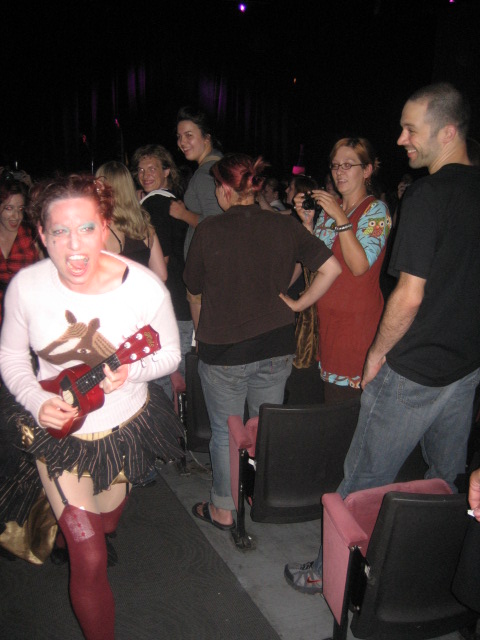
I went to the Lakeshore Theater in Chicago’s Lakeview neighborhood (commonly known as Boystown for its large gay population) to see Amanda Palmer touring her new album, Who Killed Amanda Palmer?, which is produced by Ben Folds. She is one half of the Boston based duo The Dresden Dolls. The gushing already happened all over my personal blog. Here’s where I get serious.

In 2003 my college’s radio station received a promo CD from a band called the Dresden Dolls. I was good friends with the station manager (say hello, Cap’n Perkins) who insisted I listen to this band. This ended up being rather fortuitous, as they became the topic of my Gender Studies thesis paper (I decided to use all my disciplines of study: English for explicating song lyrics, Theater for analyzing performances, German for examining the cultural mileau from which they formed, and Gender Studies to tie it all together). So, bear with me as I delve back into it again–it really does have to do with gaming.


What you just heard/saw was a song from Amanda Palmer’s forthcoming solo album. The name of the song is quite simply Guitar Hero (the link leads to the lyrics). Upon learning of this song, I knew I wished to dissect it for this blog. The problem was that I looked at it, and as is quite common with the lyrics Palmer writes, I could see it from a few different angles (in this case I was trying to see whether or not it condemned videogames, and could come up with cases for both).

So, after the show I walked up to her and quite bluntly asked her, “Where’s the connection? Where’s the shift from gamer to war?”

What she saw was the similarities in the manner of disengagement with surroundings. Gamers and soldiers are in different situations, but there is a certain disconnect from reality for them. There is a need to lose one’s self in what exists around them by divorcing from reality. The manner of this divorce is different, but the concept is the same. Find some way to remove one’s self temporarily.

Perhaps most poignant is the point where the song does shift:

It’s a hit but are you actually sure?
The targets in the crowd are a blur.
The people screaming just like they should,
but you don’t even know if you’re good.

This stanza illustrates both the gamer’s level of skill, the lack of an audience who gives feedback on actual guitar playing skills and then further illustrates the soldier’s fight in a heat soaked desert, where one has room to question the morality of war. Is what I am doing good?

What made me further disconnect these two portions of the song was the fact that the game that was chosen (possibly due to popularity and the relation to her field) is one that is not really all that violent. Instead of an FPS, we are presented with the relatively innocuous music game. There is no direct translation from gamer playing with guns to soldier utilizing guns in reality, though there is a metamorphosis of the plastic guitar into dad’s semi-automatic and the first reference to the gamer being ‘killer king.’

The narrator does not exempt herself from the culture that feeds these war-laden images. I’d rather pick up right where we left, makin’ out to faces of death. What I forgot to ask her was whether this referred to the film or the name of Bone Thugs-n-Harmony’s first album. Either one instills in itself some rather curious evidence as to the atmospheres in which we decide to put ourselves.

What made me perk my ears up even more this evening (beyond anticipating that song) was the song preceding Guitar Hero called Strength Through Music (a song about the shootings at Columbine and Virginia Tech). One particular stanza that struck me there was the following:

Don’t bother blaming his games and guns,
he’s only playing, and boys just want to have fun.

Considering what I asked her this evening about Guitar Hero, it seems that she is of the opinion that we do lose ourselves in games and a variety of other activities, hobbies, what have you. Games are just one venue on which they can focus, and one that is coming under more and more scrutiny by the media. These shooters, unfortunately, were lost in their own realities, taking it out on those around them. Amanda Palmer seems to be reflecting our society back at us, but I would not go so far as to see her actually placing the blame.

We all have moments in which we escape or become engaged with videogames. It is the Holy Grail of the gaming experience for many of us–that game that kept you up until the early hours of the morning (see, concerts can do it too!).

Yet, as Leigh Alexander put it in her post I linked at the start of this article, there is also a whole other world out there. Without having games preach at me, I would find it interesting to have a game at which I could puzzle and look as I did with the song Guitar Hero; I want to make a connection that gives me that epiphany sometimes. However, I am not calling for all games to be as such. Right now I am reading schlock fiction right next to Don Quixote, so I perfectly understand the benefits of not having to think too deeply all the time. Overall, it does seems a goal from which I believe we could all benefit.

Tagged , , | 7 Comments

Choose Your Own Lover

This is a post that has been brewing about in my head for some time, and thanks to Michael Abbott’s Narrative Manifesto and Chris’s Narratives and Interactivity Misunderstood coupled with various discussions I’ve had with friends in the past week, I believe I am willing to try and further vivisect this topic.


On Wednesday I watched Wong Kar-Wai’s Happy Together (I might note that the film plays with the title, rather than endorsing it). It led me to question whether any romantic relationships or, as Chris puts it, engagements available in videogames to date actually convinced me. Jein (German for yes and no), but only to a certain degree.

Final Fantasy VI still holds a mystical awe over my gameplaying youth. The complicated relationships that developed among the cast of characters actually had me believing there was something at stake and that decisions were being made (though the last time I played it I was in the fourth grade, so my nostalgia may be influencing this recollection). The relationships seemed fluid the first time around, and it was as if I actually were reading a story and watching this authorial pull on my sensibilities.

In the end, the game’s romantic relationships were a sidenote that were never fully developed due to other, more pressing concerns for each of the characters (and the sheer amount of characters probably diluted some of the connection, as emotional investment for each and every one became cumbersome and taxing). Games have offered a relationship mechanic in games since, but I stress the word mechanics. Or, if we are discussing a narrative game, the romantic development exists as a minigame or series of quests that seems wholly disingenuous because it becomes a reward of some sort (much as Pliskin observes) instead of actually working on engaging me in the story. As a player, I am asked to fill in the gaps.

The most poignant example for myself relates to this blog’s title. A rather large fan of the Quest for Glory series, I recall salivating over the little details I garnered from my dial-up internet connection concerning the release of the fifth game. Quest for Glory V gave the hero the option of marrying one of four females that had been present in the storyline of past games (most of whom only appeared in one prior game). These options came down to which would make most sense for my character, but the problem existed that the emotional attachment to these four women was not really developed very well and it really became a choice of aesthetics (and whether I wished to learn the Dragonfire or First Aid spell by choosing to rescue Katrina or Erana from Hades).

To return to Chris’s point, while I enjoy the emergent gameplay style that has developed, I often feel this leaves gaps where designers are afraid to offer too much structure into the game’s narrative. In a recent discussion with my mother (with whom I plan on eventually conducting an interview for this blog), she lamented the loss of Sierra’s adventure games. A woman who reads almost a book a day, she enjoyed the stories, which engaged her in a faux choose your own adventure gameplay. We have finally moved into a territory where we are offered more and more options, but it has yet to fully and successfully make me care about both the narrative and the options offered me. There is a disconnect between the two functions.

While my friend Cap’n Perkins became fully immersed in Oblivion, it does seem that the story did not really offer him much. Of our many discussions concerning the game, the plot has never really come up as something we want to discuss. Both having been English majors, this points out something about the script’s engagement of our attentions. It simply isn’t that novel or important as the rest of the game.

However, while I may not be able to believe the romantic relationships presented to me in Quest for Glory V or Baldur’s Gate II, there are relationships about which I do care: Pey’j and Jade from Beyond Good and Evil are a prime example. There are many engagements in which I do believe, but these are usually of a familial or platonic relevance. The complications of romance have yet to be, in my opinion, successfully written into games as yet.

The major problem I saw with this particular issue was the fact that a relationship in a game is either thrown in and expected to work because it was written in and assumes we believe the relationship exists or used as a gameplay gimmick. Give the NPC of desire certain items, perform quests, or compete in a trial of minigames. There usually isn’t some manner of both give and take until the NPC has been wooed and expressed a sudden love. The last time I checked, genuine relationships really don’t work that well in this model. If a prior relationship exists, we again fall into the assumption category, and very little comes forth to make us ever question this premise–meaning it becomes something in which I do not engage.

Since this is still a developing medium, I do feel it will eventually become something we will see. The balancing act becomes keeping the unique interaction that games offer while giving the players another form of interaction on a deeper emotional level (which seems a tricky problem overall–this is just one example I have noticed). There is also the possibility that I have missed some grand game, but this still speaks to the overall medium lacking this element.

N.B. While at first I thought perhaps this disconnect might exist because I am a queer male who was inspired to write this by a queer film, I quickly dismissed this idea in remembering how I have engaged in other art forms which have depicted heterosexual relationships.

Tagged , , , | 9 Comments

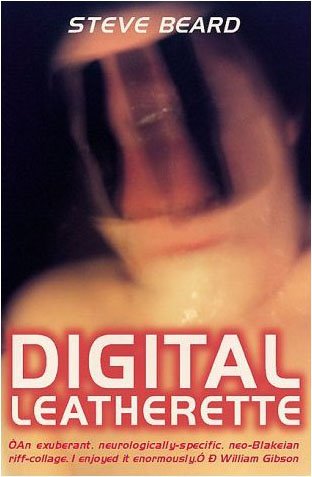
Digital Leatherette

Steve Beard’s Digital Leatherette describes itself as an ambient novel. Set in a cyberpunk world where there is no easily followed plot diagram or narrative, the ambiance is what encourages the reader to progress through the pages. Dealing with all manner of mysticisms, technology, and narrative structures, the novel pushes forward many concepts that only now seem a bit dated considering it was written in 1999. However, it dealt with a few interesting concepts, especially considering the way the novel was written.

Each chapter is a separate e-mail to a secret agent identity, ansa/angel. These e-mails make it so that no linear plot develops, but instead encourages the reader to puzzle together the pieces of narrative to gain an understanding of the world–though it is entirely optional as you can just enjoy the ride. Due to the lack of background knowledge of this futuristic world and the manner in which it very slowly makes things aware of how things run, but not how they reached this point, ambient novel is quite possibly the best way to describe this manner of storytelling. Instead, the reader is presented small vignettes from a movie about John Dee, Edward Kelley (who also later controls Ariel and becomes an allusion to Prospero), and Queen Elizabeth I in a techno-magical world to an interview with Morrissey after he has become an estranged artist who sneers quite readily at his interviewer.

In such a backdrop, Beard easily drops a reference to a virtual art event and the discussion surrounding its inception. This event actually ends up becoming an interactive event, where the ‘players’ are encouraged to compete against Mithras in a race to control the economy and resurrect one’s self as a god in the future. Amusingly enough, Beard points out the similarity wanted from a game like Sid Meier’s Sim City, but concentrating the marketplace rather than metropolises.

It’s the wording around this that is most curious. “All we have to do is make up an allegorical narrative and wrap some cool graphics around it.” Essentially, this game is about the draw, the ludic elements, and the display of the virtual art event. Everything else is an afterthought easily couched in mythology and fantasy.

However, even more wry is the Update on the effect of the game: “Well, the game came out November 5 and it was a smash. Some people wondered whether the combined effect of thousands of networked players having a go at Mithras added up to some kind of psychic attack on the Chamber of London.”

MMO’s are popular. Especially ones that were meant as dadaist pranks and became officially accepted in a literal manner. Considering again the time of publication, this acceptance of the fringe into the corporate entity seems quite prophetic.

The second such instance of a reference to games comes later when an e-mail asks ansa/angel to consider an interaction with Atlantis/MUSH (MultiUserSharedHallucination). The prose is set up exactly as one would expect from a MUSH. Character creation in bio, logging in, checking /who status, and so forth. It continues on to give descriptions of the room, exits, and then proceeds to have the ‘player’ execute certain commands.

This blending of ‘gaming’ and narrative becomes particularly interesting in the trouble spots. Sometimes certain interactions do not work. In switching narrative view, the player is required to log out and into a new identity. It brings to light that switching perspectives in games does not come easily. One must break from one personality in order to inhabit that of another, much as one would do in acting. Instead of a chapter or line break, Beard uses this to illustrate the end of one particular portion of the game and segue into the next. However, each character encounters the next character the player will log, and all these characters were created by the user before stepping into the game itself.

Another particularly catching moment is when the extra-terrestrial hermaphrodite, Nameless, is going through a tower to rescue one portion of this identity’s ‘princess,’ Virginia. While it may sound strange, I could not find myself really thinking it was any stranger than some of the premises old adventure games would have placed a character who happened in on the later portion of the narrative. While going to each of these towers and encountering Virginia, Nameless goes through the same narrative.

The door has four options: Press bell, Push gate, Bang door, Pick lock. Going through the same motions each time, Nameless illustrates just how redundant certain games can be. While it is something we can seemingly accept in games, it made me realize how my speed reading skills immediately kicked in and I began noticing when the pattern would diverge, and paid little attention to this repetitive structure that manifested itself. Afterward I even reread the passages to see if Beard perhaps managed to sneak in some tidbits to purposefully reward the stalwart.

No. The connection seems to be recognizing the grind we go through in games. We will happily go through the same narrative multiple times if it means we progress the plot or somehow aid our own avatar. This creates a conundrum. It certainly was not fun to read. What makes it fun to experience?

Do our minds similarly ‘skim’ these portions of games in an effort to move on to the next time we may encounter the divergent path in the narrative?

If you can manage to find a copy and are not afraid of stream of consciousness novels told via e-mails that depict an ethno-technical cyberpunk world which revels in mythology, theater, and mysticism along technology, user interfaces, and raves, I would recommend you give this one a go. Personally, I gave it 4/5 stars.

Many thanks to my friend Josh, who encouraged me to read it by lending his copy.

Tagged , | Leave a comment