Wii Play the Game

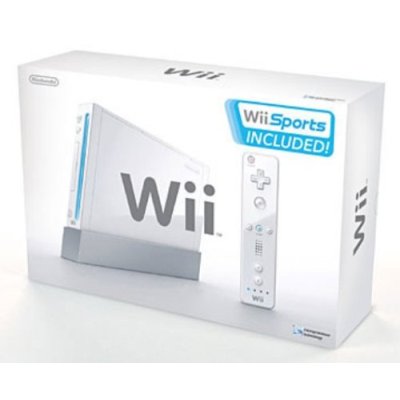
According to sales figures and word of mouth, one could estimate that the Nintendo Wii is popular. It can also still be rather difficult to locate in some regions. Chicago is one of these areas.

Color me surprised when I walked about my office today and saw a Wii on an absent intern’s desk. Looking at my boss for an explanation, she let me know that this was to be the center of attention at the next trade show booth we would be attending. Considering I work for a human resources firm, a look of confusion quickly set itself on my face.

Seeing my furrowed brow, my boss tried to explain further.

All I really heard, and she agreed, was that the Wii is popular: it will draw attention to our booth and engage any passers by.

Again, I tried to think of how my human resources company in any way relates to the Wii. I failed. The premise is supposedly to push that the Wii is the new way to game, and we’re the new way to recruit… I wasn’t sold. It seems a very tenuous connection at best. However, it will probably succeed in its execution.

Now, I do not work in a gamer hostile environment. My boss and I frequently discuss the Wii, her son’s gaming habits, and I frequently field questions about this particular hobby all around my building. From middle-aged women to twenty-something males, I discuss videogames a lot at work.

I enjoy my Wii. Granted, I only purchased mine this past year, and I have a whole back catalog of games for both it and the Gamecube to experience. However, it’s curious to see the ways in which it is muscling its way into the broader marketplace and earning cultural cachet.

Many were disappointed with E3 this year, in particular one could hear many a moaning of Nintendo fanboys. Supposedly the hardcore gamer is being neglected in favor of the casual gamer, and I look at it all with a sense of, And…? Don’t you believe you’re overreacting just a little?

There will be the ‘hardcore’ games alongside the ‘casual’ ones, but I find the terms to be wholly inappropriate as to how much I may enjoy a particular game. It only speaks to what parts of my gaming appetite it may satisfy, and even those particular terms seem woefully inadequate.

So, while I may not be particularly impressed with my company’s use of the Wii at the trade shows, rest assured, I find it to be such because of not seeing exactly how it ties in with my company in particular. It is not within my plans to be in any way dismissive of those it might snare into actually trying out the system.


Tagged | Leave a comment

Gender Policies


Growing up a dual citizen who constantly moved, thereby allowing his family to make up all manner of personal holidays and traditions, who just so happened to realize he was queer pretty early on in his teens–all while being raised by a mother who firmly believed in many feminist principles without necessarily subscribing to their club–identity politics are nothing new to me. Add to that the realization that while I am firmly rooted in being male in sex and will not be seeking to change that fact (considering my alma mater, this may be for the best), I find nothing about me cisgendered. Naturally, part of my degree involved Gender Studies.

Preface what I am about to say with the realization that it is merely an annoyance rather than something over which I am ready to take arms against a sea of troubles. I would like to see the options of character creation actually ask my character’s sex, rather than the gender.

While I would love the inclusion of gender in games, I somehow seriously doubt we will see any consideration of this topic in terms of choosing characters with a sex and gender that do not match (let alone genders beyond just masculine and feminine).

In fact, in a discussion with a friend who loves his ‘trannies,’ we could not recall a transgendered game character. While I realize the gaming culture we may face, I also realize there are some interesting gems, and am merely hoping I’m overlooking something or have just missed an opportunity–y’know, beyond Birdo (who does bring a smile to my face, admittedly). However, her history is a confused one, made doubly so by Nintendo’s not knowing what to do with her for a number of years.


(How can you not smile at a face like that?)

However, considering the number of actual gay or lesbian characters we see in videogames (and what their depictions may be), I somehow imagine that transgendered characters will not be a priority. Especially as we still have some problems with depictions of females in them as well (though I do love me some Samus and Jade). Frankly, it’s an issue that unless it can be done well, I would also rather see steer clear of games, as it could create all sorts of headaches.

This is a topic to which I will return.

Tagged , | 4 Comments

Imagine a game with no rules

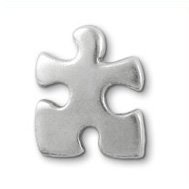
If you look at that image to the left, I would hope you can follow my train of thought in imagining that puzzle piece as a human being, requisite with four limbs and a head.

Even though I spent a lot of my youth playing both computer and console games, reading, and playing outside, one of my favorite activities was to take one of my puzzles (another hobby of young Denis) and assign each piece a set of statistics I kept in a notebook by my side. What would then occur depended on my mood that day. Some days large scale battles would take place, with turned over puzzle pieces indicating a unit that had been slain. Other days I would just use them as props to tell a story of exploration and adventure without any need for combat.

My younger brother, Dane, recently picked up World of Warcraft again. He and his family moved to a small village outside my hometown of Fulda. Therefore he has plenty of free time on his hand not socializing with said village-folk. He’s living the life many of my college friends desired–stay at home dad who gets to play video games all day while taking care of his son. Beyond his pleas to have me play again (I refuse), he has been regaling me with his efforts to gain his second level 70 character, earn his epic flying mount, and all manner of stories.

This past Friday he was being his usual self and antagonizing the GM’s. He was playing his level 70 gnome mage and because he was on a roleplaying server, he was requesting that he be allowed to switch his Alliance-loyal gnome to the side of the Horde. This was how he wished to roleplay his character, he would tell them. He knew going in that he would not be granted his request.

The GM’s actually surprised me by telling him they would forward his complaint of not being able to enact this change to the design team, to be dicussed for a future expansion and/or patch. Whether or not they actually follow through on this, I cannot say.

While he was waiting on that response, my brother and I engaged in one of our usual pasttimes: debate. As soon as he pointed out that he was on a roleplaying server, I pointed out to him that when he was playing Final Fantasy, Diablo, or any of a number of games, he was being told he was playing a roleplaying game. This did not automatically grant the title the benefit of roleplaying, though.

In fact, he argued that he just wanted to play how he wanted to play.

It’s something gamers are increasingly promised. You can do whatever you want.

Ending my debate with my brother, I pointed out that if he wanted a game without restriction, he might as well just use his imagination. Growing up in the same household as myself and knowing about my games with puzzle pieces, he let the matter drop with a winking face on our AIM clients and that was that.

Imagine a game without rules, however. Would it be fun? Would there be any point in playing it? The fact that there are rules seems to beg that we further examine the games and wonder why these rules were implemented. Someone made a choice to not allow my two male Sims in Sims 2 to marry but enter a civil partnership. Considering the fact that Everquest 2 allows crossing of factions, the various teams at Blizzard made a choice on whether or not to allow the crossing of Alliance and Horde allegiances.

Once designers and programmers make these decisions, it appears inevitable that one may question or try to break the rules. This in itself becomes a game. Just like a director (in film, stage, television, or whatever have you) dictates where your eye is focused, or what you can see if you decide to break that focus, games focus our attentions to certain criteria. Sure, you may not wish to progress the main plot, but in games without a modding tool, you are given limited options of where you can focus your energies. Then, of course, you can completely ignore it all together.

Truly being able to do everything you want in a videogame is a promise that will be made oft in the coming years, but I cannot help but feel we are far away from that point, if we will reach it at all. Honestly, I’d rather there be rules, as it allows me to think within the frame of the game and try to interpret the point of it all. If you believe the premise that a videogame can be art, this is just another tool in which to interpret and understand said piece of art. Of course, it’s also perfectly fine to look past that or not to aspire to make such a game.

After all, who’s to say that a puzzle has to be put together to make a picture?

Tagged , | 4 Comments

Reading Quest

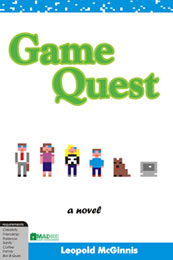
Here in Chicago there is a lovely independent bookstore by the name of Quimby’s in my old neighborhood, Wicker Park. While I was living there and searching for a gift for my mother I came across the cover for Leopold McGinnis’s Game Quest.

I grew up in a family of gamers. Both my parents were primarily computer gamers, and in the 80’s, this meant there were a plethora of Sierra titles in our household–more specifically, the Quest titles. From being a police officer, a custodian in space, king of Daventry, or exploring the worlds of Glorianna, I spent a lot of my time working through these series. There was also a lot of time spent watching my mother play these titles.

It seemed the perfect gift to give my 40-something year old, still hardcore gaming mother. Given that my mother lives in Germany, I had time to actually read my own copy before my next visit, in which I presented it to her.

McGinnis’s novel is a thinly veiled look at what he imagines was happening to Ken and Roberta Williams’s household and company right before its acquisition. However, he also focuses on two other phenomenas of the time: the rise of corporations and growing popularity of the First Person Shooter. The former has him making up a company by the name of Che’s Coffee Revolution, a company that is being hip and bringing gourmet coffee to the masses–its allusion to Starbucks is hard to miss. The latter is done in both the sense that the company itself refuses to capitulate and produce such a game, and then having the daughter betray her father with her own love of the genre.

In a recent post entitled “Ready to Surrender My Gun” at the Brainy Gamer, Michael Abbott laments the flooding of the gaming market with a plethora of titles that are all based off the FPS model. It made me think back on this book and its overall message.

Not only does McGinnis display a love for the old days of adventure games and track the changing landscape of gaming (conventions, an online community, and the rise of the FPS and smaller business models alongside the beginnings of shovelware and larger corporations), but he parallels it to the changing economy of the United States with corporations like Che’s Coffee Revolution threatening smaller cafes, such as Naughte Latte. While the novel definitely speaks to those of us who will quickly recognize what Madre really is, it also takes a rather scathing glare at the corporations who would gobble up these properties, turning them into money-making machines instead of the idea makers they had been (though, to be fair, Sierra had also been stagnating to some extent).

I am generally anti-corporation, but I do recognize the ever growing game industry. The desire for lucre has formed a lot of what we see today, from the plethora of Ubisoft’s ‘Z’ titles to series that have ever growing numbers (Sierra was just as guilty of this, but I’m still having a hard time digesting that I may see a Mortal Kombat 9) and the adaptations of movies that are adaptations of comics.

What we see is exactly that at which McGinnis points: brand loyalty. In his recent review of Consumed by Benjamin R. Barber, Iroquois Pliskin further examines Barber’s explanation of how companies’ can cultivate desire in a consumer: create a better product or gain their loyalty through branding. The problem lies in that fact that while the former allows for an expansion of the industry and usually results in innovation, the latter means you are creating an identity. His example includes Starbucks, which again led me to think on this book.

Branding and advertising are hard to avoid, though it affects us all in varying degrees. Upon my purchase of Final Fantasy XII I was rather amused as I stared at the package. Here I held a title that I guessed I would like (I was meh about it) purely because of its name. It was an example where I was consuming a product purely on the fact that it had a name I recognized, though knew nothing of the particulars beyond sexy sky pirate and his bunny-woman companion.

So, if you are willing to swallow the 500-page-pill and are in the anti-branding boat as a gamer, this book is a definite read (it even comes with adorable little pixel art). If you believe branding is a good thing for corporations and are a fanboy at heart, I would probably recommend steering clear of it. I won’t even bother you folk who might consume sugar-free vanilla, non-fat lattes…

Edit: As Michael Abbott pointed out, you can also read a PDF of this treasure online. However, I’d probably agree with him that it would be quite the task, considering its length.

Tagged , | 2 Comments

I’ve Still Got My Health: Triumphant Returns (Part 3)

Apologies for the delay in closing this series (though I’m not quite sure how many are actually reading this yet); I suffered some real life attempts at decreasing my health through adversarial forces. Unfortunately, potion quaffing, cure casting, and faerie dust sprinkling are not options in this world.

Rewards through gaming have evolved in many ways. With the advent of both the Playstation 3 and Xbox 360’s online services offering achievements to Blizzard’s recent announcement that World of Warcraft: Wrath of the Lich King will include similar trophies, it would appear that gamers love this little decoration, and have come quite a long way from the Hi Score text fit into one corner of the screen. A trophy, a number, something to show friends and about which one has boasting rights–not too much to ask.

In this thread, however, I am more curious about those rewards not so easily apparent. We’ve had high scores for years, though I will admit that I never really bought into those systems, and it is this other type of reward I personally seek.

One of the things that became apparent in my talks with my friend over Oblivion was that he truly felt he’d accomplished something when he beat a humanoid opponent who had better equipment and was casting spells of which he was not apprised. The accomplishment set forth in an On Par model of game is pretty straight forward, and one that perhaps closest emulates a sense of achievement we expect from competition beyond the videogame world.

In game terms, all that Cap’n Perkins had really accomplished was picking up some new gear and perhaps boosting a few skills. This is a constant reward as one travels in Oblivion, and beyond a few spectacular items you may pick up, the progression through the grades of metal one can find in weapons and armor becomes a way of tracking one’s progress through the game’s leveling system.

What was more apparent and helpful to him was something he had accomplished as a player outside the confines of the code. When next he called me, I could hear the good Cap’n’s triumphant smile and the cheer in his voice. Sure, his character had benefited, but he himself felt more confident in his knowledge. He had died multiple times to one particularly nasty vampire and upon defeating him had learned new tactics, new strategies, and how to better utilize his character’s abilities and skills.

It is a reward not inherently provided by the game itself.

The other two systems seem indicative of the new trend in accomplishments. Your reward for defeating a boss might be some new items, new abilities, increased health, and a variety of other in game progress trackers. Surrounded by a horde of enemies and proceeding to tear through their ranks gives a visual treat. I’d be hard pressed to deny a sense of puerile, sadistic glee in seeing the slain bodies of foes littering about my avatar.

Does that mean these other two options do not provide that sense of accomplishment? Not at all. Any obstacle that is particularly challenging can give a player this sense of a reward that is not quite tangible, and not represented by a certain coding and art provided by the systems on which we play. However, I would argue that a game such as Oblivion, which imitates (though does not perfectly emulate) the challenge one expects from PVP in other games, makes this sense of achievement much more certain (but of course, not guaranteed). The caveat being that the level of self congratulation all depends on our previous experiences. For someone who constantly plays games, that feeling of accomplishment becomes a rarer find, and is why I do engage in PVP whenever I happen to play a game that provides the option.

Perhaps this explains another reason for the dissatisfaction some gamers have when a game promises an evolution in a system to find that it gives the same drug to which we’ve already built a tolerance.

Tagged , | 1 Comment

I’ve Still Got My Health: The pain! The pain! (Part 2)

Cap’n Perkins called me after playing Oblivion one evening having thought through three general manners of dealing with a health system that games have. They are as follows:

Boss Mode

This model can most often be seen in boss fights, but is not restricted to such. Here, the protagonist(s) have far less health than the enemy. The compensating factor is that said boss has a limited number of power attacks that one learns to anticipate. You, on the other hand, are given a vast array of ways to deal with said boss (even if in most games one method is usually seen as ‘ideal’).

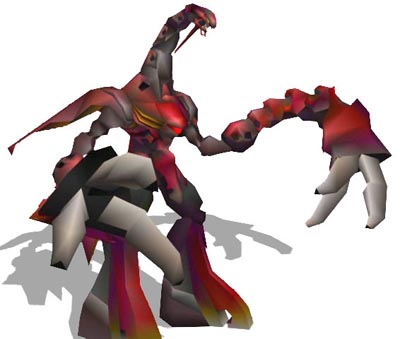
What this mode gives you is a sense of the epic. Fighting dragons, huge robots, an archmage from aeons past, a prince of demons, et cetera. If you look at the picture provided, many a Final Fantasy VII fan can tell you the ways to beat the weapon bosses, which required certain tactics in order to successfully beat them. Notably, Shadow of the Colossus is nothing but these fights, cutting out the fluff of weaker enemies.

Surrounded

Next you see a notable difference. You are the one with more health, however, you are limited in number. Enemy units can and will quickly surround you. While they may easily be felled in fewer attacks than the bosses, the main issue becomes crowd control. Seems basic and simple enough.

This is the model most games have until a boss fight. The player is given a feeling of having slaughtered an entire army and being a tireless champion of whatever cause the game has you pursuing (in fact, this is causing some concern over Diablo 3 with the disappearing of corpses over time).

On Par

Here is the model that was causing Cap’n Perkins to think through these models. Instead of fighting enemies that are built on a different model than yourself, you are fighting what could essentially be you, but controlled by a computer. While many games have toyed with fighting your doppelgänger, I speak specifically of games where you fight a number of humanoid opponents who can wear the same armor, have the same skills, and utilize the same abilities.

Of course, Oblivion was the catalyst for this thinking, though Dungeons & Dragons also can play off this model. Needless to say, this one requires a little more thought than the previous two models. Another way to look at this is PVP, though there you are actually fighting another human player, not just an AI. This system means that not only does the enemy have access to all that you do, but that you also have this advantage.

Here we also see a different character reaction and knowledge. To a certain extent, metagaming helps by allowing one to acknowledge what was just cast, what ability was just used, et cetera. Yet, we do not necessarily get the epic fight feel of fighting a boss, nor do we feel as if we’re wading through an army. Instead, I’d venture to say there is a certain sense of accomplishment due to knowledge.

I say certain sense because I realize all of these modes gives some sense of said accomplishment. What I wish to examine next is exactly what we are gaining from these models in both game and player terms.

Tagged , | 1 Comment

I’ve Still Got My Health: I <3 You (Part 1)

In games with some sort of conflict through arms we have established one basic norm: health.

This seems a very fundamental fact of games with any manner of fighting against which it is hard to argue or find an alternate system. In the course of discussing Oblivion and its combat system with Cap’n Perkins he mentioned something that caught my attention and has had me ruminating these past few days.

Now, the manner of implementation of a health system changes from game to game (and most notably, from one genre to the next certain trends become apparent). To start we have Gary Gygax and David Arneson implementing a hit point system for their tabletop roleplaying game Dungeons and Dragons. From there we have progressed in various manners including, as we see above, Link’s iconic heart system. Mario and Sonic were two whose health systems were slightly different to begin. Sonic had his rings, which essentially gave him two ‘hit points,’ with a quick manner of ‘healing’ himself. Mario had his size. Small Mario could take one hit before the game would end, large Mario two, and so the game goes. Notably, Mario has changed to a health system in his later games, but with a very different premise than Link.

From percentages, shields, heart system, the traditional hit points, red globes, et cetera we’ve created some dynamism within the framework of this seeming requirement, including on how to restore said health.

In college I played a fair amount of Dungeons and Dragons and in one play session I realized it was rather odd that my character was getting so healthy so as to survive a sword cut multiple times. Really, it made little sense (though quibbling about realism in a game that involves magic is perhaps one among many definitions of futile) until one friend offered an alternate way of thinking on this system: with each level my character has more experience. This experience means that he or she knows how to better dodge an attack or take the brunt of it in a less painful situation. Therefore, hit points represent the accumulated experience my character has in this manner of avoiding and mitigating damage.

This works on many levels, but Dungeons and Dragons is not a very visual game. While one can play with miniatures (and is most certainly requested to do so in the Fourth Edition), one does not see combat happen real time, leaving things such as being hit to a player or a particularly loquacious and/or creative DM’s imagination.

Videogames do not afford this luxury. When Link gains enough pieces of heart or defeats a boss to find the coveted full heart to add to his life meter, he literally can take more hits. Hit points in video games do mean your character just becomes more ‘healthy’ than those surrounding him or her.

Is this a system that works?

Quick answer: Yes, it allows for a scaling of difficulty through progress of the game and gives a visual indicator of progress.

But on further contemplation, there are games that succeed without it.

Some games, such as the later Mario series, do not have a mechanic by which you gain more health (unless temporarily). Then there are games such as the Metroid series, or most FPS games, where your basic level of health is a percentage and you have a shield which you can increase.

It is the fantasy games with any elements indicative of an RPG that refuse to budge from their Dungeons and Dragons roots, however. Which will lead into part two of my discussion, the three ways of implementing a world in which health factors as proposed by Cap’n Perkins with an examination on what rewards and difficulties it offers the player.

Tagged , | Leave a comment

Open ended

In 1994 one of my father’s friends came over to our house and brought with him a game, Elder Scrolls: Arena. We loaded it up and my entire family (yes, all of us: mother, father, brother, and I) watched in awe at the game in front of us. The game was ahead of its time in many aspects, and while my family later acquired said game, I was a bit young at the time to actually make it far through Tamriel.

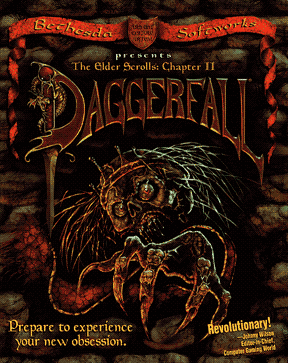
However, I recall playing the second installment, Daggerfall, for quite a number of hours. I never did beat it. In fact, this can be said of any of the Elder Scrolls franchise. Recently, Versus CluClu Land made some posts about playing it wrong, inspired by 1up.com editor Shawn Elliot’s blog post of the same name, that had me thinking about this series in conjunction with another event.

In college I made a rather wonderful friend in Cap’n Perkins. We had similar majors, interests, and gaming background. Mine tended to be more focused on videogames, though I had also been playing tabletop RPG’s since age four. He had fallen out of the loop on videogames, for the most part, beyond cultural references and a game or two here and there.

Recently he acquired an XBox 360 and among his first purchases was Elder Scrolls IV: Oblivion. Since I was among those that had recommended the game (I was not the largest fan on the latest in the franchise, but it still stands as a solid title) he came to me with many a question.

During these discussions I came upon a realization of how I play games.

In tabula rasa type games, where I am given a character for whom no background exists, I have developed the habit of creating my own background. Having been a theater major, always having an avid imagination, and playing RPGs and MMOs as long as I have, I have a whole cast of character personalities upon whose history I draw when playing these games. These do one important thing: they give me a framework with which to operate my character. Well, no, this character would not join the Fighter’s Guild. Why do you ask?

This is one reason I can slog my way through the Diablo series or any number of MMOs despite the grind, that personal connection I have with a character whom I’ve just translated. Meaning, I often break the mold of the main story to fit my needs. Here I am not playing the games wrong in terms of gameplay, but through the necessity of wanting to see my character’s progress in the way I wish to see him or her do so.

Perhaps this explains why I also have yet to actually beat any of the Elder Scrolls titles (though I am very set upon doing so on my most recent pick up of the game), as I never felt the necessity to do so. The world is wonderful, and I enjoy the options presented to me. But, Daggerfall, which is the game in the series on which I have lavished the most amount of time, never inspired me to actually follow the main plotline. I love the world of this series, but I could not tell you most of what is happening in the games’ plots.

Yet, on speaking with coworkers and other friends who’ve played the game, I am left contemplating, am I playing it wrong?

The Sims franchise proved to the gaming world in a large fashion that there is no one way to play a game. Despite what expectations one may have for how people should play a given game, someone will come along and break that mold. However, the first time it is broken, it starts to see more people taking on that role and then making that particular version of gameplay canon. Having recently picked up Diablo II: Lord of Destruction again, I am again amazed at all the builds people have created that were not in what I believe the original intent of the designers of said characters.

Therefore, when I speak with my coworker Luci, I feel a kindred spirit in someone who just wants to roam the world, go into dungeons, and let her character with bright pink hair be herself. Oblivion gates? Sure, eventually she might get there, but the majority of her time in this game involves buying her houses, making her character rich, and just living out her fantasies. I have to say, I see nothing wrong with that (nor should Bethesda, as she is planning on picking up her second copy to have on a system over which she does not need to battle for time with her son).

Tagged , , | 2 Comments