My Issue Is With Gearbox

Hemingway said some stuff. It’s an indication of a wider problem with casual sexism, sure.

I’ve slowly been building anger over how the issue has unfolded, but largely because there is a request from some quarters that the tone of the argument be dialed back a bit for an honest mistake. Perhaps? There are arguments to be made about what tactics work best when, though I tend to view it as take all the approaches, use what works for you (I do not operate under the assumption that all activism is to win hearts and new recruits: sometimes it’s just to give myself some fuckin’ catharsis), and let others sort it out. No movement is ever one with one brilliant tactic, after all. You didn’t build it on your own and all that jazz.

No, the issue is that this is a year where we have seen constant furors over issues of sexism and general cluelessness when some privileged party says something insulting and is surprised when they are called out on it. While there are certain folks who want to hand wave this as everyone just being too “Politically Correct,” I’ve stated my opinion on this asinine defense and stand firmly behind it. It reeks of hand wringing and whinging by people who don’t see what all the fuss is about, and can’t we just focus on the real issues here?

However, on top of this, I don’t have much patience when it comes to Gearbox opening its maw and firmly sticking its foot in there, slavering over it in some disgusting display of its sexual politics. Considering Duke Nukem in general or its use of fags as hur-hur we made an ‘edgy’ joke that has no relevance or real context? Or taking journalists to a strip club as a press event? While I applaud the addition of Ellie as a seemingly positive portrayal of a plus-sized woman who doesn’t give a shit, I’m still wary of the company’s overall culture and marketing.

Therefore, it isn’t about making sure Hemingway has proper PR training. That’s just admitting that we need to put a piece of furniture of that nasty stain on the carpet. Let them air their opinions so I can rightly decide how I wish to approach their company. They also do not have a blank slate, and if they want people to not throw the word sexism around, they might actually want to work at combating that label.

Posted in Politics | Tagged , , | Leave a comment

Marriage Equality

When I was seventeen I started up a LiveJournal. Part of the reason behind this was I had a close friend with whom I IMed, and he would constantly send me links to his, so I wanted that social aspect of it; the other part was that I wanted a place where I could just dump my thoughts, every thought no matter how inconsequential. There was also wanting to record my life in a diary of sorts. Among my first entries was despair that I knew the country in which I was living had no care for me in its systems of equality for discrimination, marriage, or life.

Eleven years later, I am not entirely sure whether my opinion is more favorable, though the needle for such equality has surely shifted toward my desires a bit. Of course, the difficulty is that I myself have changed, and what I believed about life, love, and the world at the age of seventeen does not hold true for myself at twenty-eight. I now find myself at an odd intersection of holding opinions that don’t hold up well on a national stage because they are not simplistic enough, and are generally not regarded in the fight for marriage equality.

Here’s the thing: I believe in marriage equality. If we’re expanding that beyond just same-sex marriage, I also believe in marriage beyond just two consenting adults, to include polyamorous relationships.

I also don’t believe in marriage for myself and never plan on getting married (I say plan because I already know how I can change in eleven years). Instead, I would prefer a system whereby I could choose to enter contractual agreements with any close friend, and end them just as easily.

In the past I’ve had roommates with whom I would have wanted to share such, particularly as I have no close relatives anywhere near me in the country. The longer I look at it, the more I wonder what marriage’s function in society is anymore.

The exchange of property? Ensuring a place for a woman in society? Finally giving into to literary romantic themes of love? Keeping together a family and encouraging it to stay together?

It’s an institution I just don’t see fitting anything I desire, even if I do want a long-term committed relationship. I just do not see that desire for a relationship meaning I have to enter marriage to ensure that I can share all manner of benefits others can have simply by signing a document. It seems a bit daft, really.

In my increasing desire to understand the world and privileges around me, I wonder why we give so many benefits beyond just hospital visits and the like to a couple that is wed. I would like to see more debates on what marriage means in these contexts. I certainly haven’t figured out my own feelings towards this, but entering the debate is quite draining these days.

As that is a conversation that will not be happening, and I do not absolutely oppose marriage (the benefits are benefits, and we make do with what we can), I find myself fighting for marriage equality for the LGBT community.

The other part of it is also naturally that I do find myself a bit at odds with cultural norms and expectations. I have been fascinated by the history of the LGBT community in the past, where groups existed that believed we did not have to conform to the relationship power structures that existed at the given time. We did not need have the same families, lives, and expectations. Being queer was a celebration of the fact that we could break from the mundanity of what was expected to be a contributing member of the world.

This desire of mine is a desire of mine, and even I must eat. I want to contribute to society, though I often find myself (even when I do have a job) valuing my outside hobbies and volunteer work as more defining of that contribution. Life is full of compromises, and other such adages. Though I say the desire is mine because I recognize there are many who just want to be a part of society, feel welcomed, and to live the lives they were promised growing up.

It was in my sixth grade social studies class that my teacher talked about how the average family unit in the US has 4.2 family members, and in my mind, I pictured having such a family. When I was disillusioned of the fact that I would grow up to have a wife and children, I realized I had no interest in the dream at all. There are times where I wish I could have held on to that vision and pursued it, even if just changing out a wife for a husband.

I am often critical in my life. Of the institutions around me I think could do better. Of the communities for whom I believe the same (and the LGBT numbers among those). And of myself. However, while I can critique the institution of marriage and how we privilege couples over individuals, I find that I want to support those who want to be a part of the system that currently does exist.

In another decade, perhaps I’ll join them. Or perhaps I shall remain a stubborn, curmudgeonly single gay male writer who thinks and opines too much.

Posted in Politics | Tagged , | 1 Comment

Gotta Keep ’em Segregated?

Back when PAX was being started, I recall that it was frequently said this needed to exist to fulfill a need. E3 was not for fans, necessarily, being focused as a trade show and somewhat difficult to attend unless a journalist or in the business. PAX, and later PAX East, was meant to give the fans a convention to attend that was for them. The focus was on them. That need was being filled.

This week we saw the launch of GaymerCon’s Kickstarter, and I have been happy to see the games news outlets covering it. Having attended other conventions where I had fun, but was aware of my own presence and who I represented at the time (GayGamer), GaymerCon sounds like a place I  wouldn’t have to debate whether my identity is an issue. I do have further questions about it, but as it hasn’t fully formed, I am willing to see what it has to say about harassment policies, how it plans to cater to the full spectrum of the LGBT community, etc.

When I wrote ‘Yes, It’s Fucking Political‘ earlier this week, I was making the point of my mere existence in non-LGBT spaces being political. When I attended PAX East and E3 in 2010, I was quite aware that I was representing GayGamer. Thankfully the PR I dealt with never blinked, had anything to say, and when it was remarked upon, it was friendly and led to more conversation. Among some other press that were there, I was the odd man out, however. Particularly as the games I covered included Assassin’s Creed II: BrotherhoodGears of War 3, and Bulletstorm. Machismo galore.

This mostly manifested in trash talk that was at times specifically aimed at me and my outlet, due to assumptions about my gaming capabilities. It created an atmosphere where I felt I had to prove my right to even be there with other outlets, which left me a little sour about the affair (I more than excelled, but I shouldn’t have to feel the need to do so).

What has been curious about some reactions to GaymerCon is the perceived ‘segregation’ that gay people are trying to establish in games conventions. This argument confuses me, because GaymerCon sees an unfulfilled niche and need and is trying to fill it. This really is not too horribly different than when PAX formed, but instead of just being focused on fans in general, it wants a place that is specifially LGBT-friendly. This is not segregation, it is safety, it is comfort, and it is community.

It may be difficult for those not in a minority to understand not necessarily feeling safe due to one’s perceived sexual orientation or gender identity, but it is a very real thing. However, even in an ideal world where discrimination, hate, and long lines coming out of Chick-fil-A to prove a point weren’t a thing, there would be nothing segregationist about wanting a convention for LGBT people.

There have always been LGBT people who stuck out and sought to be just outside of societal norms. Increasingly we see LGBT people also trying to fully integrate by having traditional family structures (monogamously married with kids), passing fully in society, etc. I am not one of those people, but I understand why they wish to do so. I also understand that due to my rejection of such, I am often in a position that I find myself wanting to go to specifically queer events so as to find others like me.

That’s what this is about. A safe space to find other people with similar interests. It is not segregation, it is a common ground. Particularly as GaymerCon is open to allies as well. Just because something nifty is coming into being and it doesn’t target you doesn’t mean that it is trying to exclude you. If we want to go by that logic, E3 is definitely not for me with its booth babes and heterocentrism. A niche was not filled, and now it may be.

Posted in Conventions, Politics | Tagged , | Leave a comment

Yes, It’s Fucking Political

With Facebook’s advent of being able to be placed in groups/pages, I somehow found myself in three different groups: two for the graduating classes of the high schools I attended and one for my graduating class at Wabash. In an attempt to keep us abreast of where everyone is, the latter asked us to share a short synopsis of where we are, encouraging us to list if we had married, where we were, what jobs we’re holding, etc. Shortly after such, it then asked us not to get into politics/religion on the page.

That last bit caught my eye for a number of reasons. Is marriage divorced from religion? If so, then what is the fuss about same-sex marriage again? If it isn’t, then isn’t that encouraging people to post about ‘religion?’ The honest answer is that marriage is many different things to different people; not everyone who gets married is religious, not everyone who is religious and married went through the same process, etc.

Then, the thought occurred: what if I were married? People are talking about their lovely wives and such. If I mentioned my special guy friend, would that cross the realm of religious/political? Having graduated with those men, and having been vocal about LGBT issues while I attended Wabash, I doubt anyone would pick a fight over such, but any relationship I publicly share is by default political.

Granted, any relationship is political and is saying something about the culture in which it occurs, but I am always constantly aware of when I am advocating for LGBT issues and how what I share is considered more political than the average. This even filters down to wondering what public PDAs are acceptable in the area I may be in, as well as what reads as me being a couple with a close straight male friend, just because I am gay and not exactly quiet about it.

Which is not to call out this particular group or the moderator in charge of it, but to serve as a reminder, for some of us, living our daily lives is a political statement. Every time I send out a résumé, I debate whether or not to list my work with GayGamer. While a person needn’t be queer to work at GayGamer, most people will make that assumption anyway. This is particularly noticeable because there have been recruiters with whom I’ve spoken who refer to my ‘latest work online’ and do everything they can to even avoid saying GayGamer, as if that is breaking some taboo.

This even breaks down to my writing, where I am often afraid of pigeonholing myself into being that writer who only writes about gay things, though I have a wide range of interests and topics on which I consider myself knowledgeable (currently I’m working on a piece about how Brecht’s principles can be used to understand some games in a different light). The work that most often gets recognized is that which concerns LGBT issues, because for the longest time there was little writing on it, and ‘political’ issues tend to get discussions going on all sides.

Oftentimes, it becomes difficult to parse what of my life is my own and what is pure politics. More often than not, it’s a mixture of the two, serving as the gray area between ‘just the facts’ and ‘political!’ in a way that makes me constantly conscious of how I say things on Twitter, in my job applications, and in groups of people who are not close friends.

And yes, I realize exactly what the group was asking: we have connotations for what we mean by religious/political, but in a year where the DNC is seriously considering putting marriage equality as one of the planks, it is difficult to divorce such thoughts from my life.

Posted in Politics | Tagged , | 2 Comments

Politics of Localization: Mein Kampf

I have been participating in a weekly trivia for a few weeks now. It meets on Wednesdays at a local Pub/Pizzeria place in downtown Knoxville, and has been intriguing to highlight what I don’t know anything at all about (sports, celebrities, brands, and my geography is rusty).  Last night my team (The Royale Court, in reference to our love of Latrice Royale) looked up ‘this day in history,’ as some event is always referenced. Yesterday just so happened to be the anniversary of Adolf Hitler’s Mein Kampf.

Except, the question that was asked was what the English translation of the title is. I somewhat squirreled my eyebrows (they dance, it’s lively, but they don’t eat nuts), before telling my team to write down My Battle, though I was fairly certain the most common translation is My Struggle. Now, for many people, I am sure the differences between Fight, Struggle, and Battle may not seem huge, but I have a degree in English, so the question of connotation does concern me. Also, as someone who was raised bilingual (but is no longer perfectly fluent in German), I am very intrigued by localization.

What is the goal in translating Mein Kampf? The book has been mired in controversy, rightfully so, for decades. There are varying translations that are abridged, a recently discovered Nazi-authorized translation, and the question of what the goal of the translator was.

If I were to be true to the words, to get across Hitler’s meaning as closely as possible, I imagine I would likely translate the title as My Struggle, as it portrays a more sympathetic light. We struggle against something, and there is a certain connotation that this is a hardship on us. My sympathies as a gay German-American citizen do not at all lie in Hitler’s direction, hence my immediate response of My Battle.

To my ears, battles are something we are more often said to ‘choose,’ or enter into with premeditation. It is our choice, whether right or wrong, to engage in battles. It is not sympathetic, and is fairly neutral. Fight, in this instance, seems far too weak a noun, though still having that air of somewhat neutrality.

Of course, if I am basing my argument on connotation, this depends on which connotations, which change as language adapts and shifts. I am not necessarily right, and there are more ways to translate Kampf (though those are the three most common for this particular instance), but these are the thoughts I had about the entire affair.

Thankfully, the trivia host accepted any of those three (with a somewhat begrudged note in his voice, which made me think someone had addressed this concern to him). Of course, as I mentioned, this book is full of controversy, as are the translations that have been offered over the years.

Posted in Uncategorized | Tagged , , , , | Leave a comment

’90s Politics Are Dead, Long Live ’90s Politics!

Opinion: the term political correctness can go away now, please.

The title of this IGN article is “Opinion: The Problem with Political Correctness in Video Games.”

Mattie Brice has already critiqued it heavily (from erroneous ‘free speech’ issues to the issues of the free market in an industry that is expensive). This is also a day when Leigh Alexander wrote a piece entitled “Opinion: In the sexism discussion, let’s look at game culture” (focusing on moving the industry forward now that we’ve had many recent battles with sexism).

What do I have to say? Well, first, freedom of speech, thought, or whatever you want call it, is not freedom from criticism. Simple. So painfully simple. Every time you make the suggestion that ‘we can just ignore it,’ I will point out that by your logic, you can just ignore my criticism (and the larger media often does). Or, I am perfectly content for people to argue my criticisms in a respectful manner. I am not actually trying to censor people (though I would question my ability to do so anyway, but that’s another discussion). There is, however, an expectation from some of us gamers for the industry to do better. I critique largely because I care and want to see games improve.

Criticism should not be seen as an enemy, it should be seen as an opportunity to engage.

Should certain topics be off the table? No. As Brice pointed out, the problem with Tomb Raider is not that rape is involved, it is the public’s access to what that rape looks like, and how it has been framed. Games can (conceivably) handle rape and discussions of it, but so far we have not many, if any, good representations of it. So, yes, given what we know, some people have been offended so far. That is for Crystal Dynamics to deal with. We had concerns, we had questions, and so far they haven’t really been addressed.

As Alexander points out, there is an issue with the marketing teams and what we are being advertised, what we’re being sold, and what gets decided as kosher. These are questions we need to ask of games and the industry at large. We will continue asking these questions, because we love games, we want them to be inclusive, and we want to see them tackle more subjects. Games are in a unique position to communicate as a medium, and right now the larger industry is seemingly stuck in a rut.

Now, the idea that everyone will be offended by someone is akin to just throwing your hands up in the air and saying we may as well not to anything and just let things be. There is a certain person for whom this is a viable response, and it is typically a person to whom the market is advertising. Even if it is in an increasingly puerile and stock manner. For people who are not represented fairly or equally, it is not just a matter of being ‘offended,’ it is a matter of desiring a more rich landscape. Leaving that to the free market might sound good, but unless a desire for better and more is expressed, companies, who are typically conservative in how they want to spend money, will continue pumping out the formulae they feel are safe.

Also, today has been a day where I have seen ‘political correctness’ thrown about, as if it is a bane against people who may bring forth their concerns about inclusiveness. Political correctness, at this point, has become a phrase that automatically signals to me that a person has less interest in actually discussing the matter, and wants to automatically place me on the defensive for believing in being inclusive and fair. As I’ve heard it said, it is not about political correctness, it’s about not being an asshole.

P.S. “Don’t let the few ruin everything for the many?” Yegads, talk about upholding the status quo. This also assumes the many are all wanting to stay in a stagnant medium.

Posted in Community, Inclusiveness | Tagged , , | Leave a comment

The Attempt to Devalue Anita Sarkeesian

Feminist Frequency's banner.

Feminist Frequency’s banner.

Among the evolving ways to criticize Anita Sarkeesian and her Kickstarter for Tropes vs. Women in Video Games, one I have seen crop up quite a lot recently is how she has received so much money (gasp, horror, shock!). Despite the fact that every donor knew the amount that was already donated to the campaign and made their own decision to become a supporter of her project, some seem to believe she has been duplicitous in some way or another: she did not clearly post all of her intended goals, and somehow played the ‘victim card’ in order to play on peoples’ guilt.

The criticism here involves a few points of entry, from what I can see. First, she should do this for free, so why did she even need the campaign and money? Second, it is her fault for raising so much money. The last point is implicit: her work has no value.

The first point has been explained in varying ways. Videogames are an expensive medium to study: from systems to games to time spent playing those games to video production value. These all add up. Therefore, this money is a supplement. Anita Sarkeesian’s time and work is worth money. The value people saw in that time and work has been determined by the Kickstarter crowd (as well as through people who donate through her site).

Historically, women’s work has been devalued in many ways. Whether that is not paying them, paying them for less work, or delegating work that is considered too demeaning for men to them. In matters of criticism, we can see it whenever a woman speaks up in a public forum and is argued with for her sex, rather than addressing her work and argument. See any number of female journalists who have written about sexism in the games industry of late, versus their male counterparts.

In this case, the public — the donors — decided Sarkeesian’s efforts will be worth the money they are providing her. The excess amount allows her more freedoms in completing the project: more videos than initially planned, higher production values, and more time spent in the project itself. She entered a social contract, whereby the donors chose her salary and budget. While some could criticize the initial scope of the project, that does not seem particularly relevant, as enough backers did find those compelling enough to want to see her work on them.

Which leads into the second point: Sarkeesian kept people informed of what the additional funds for the project would provide as quickly as she could, given how the project jumped quite rapidly at times. Beyond such, if the ‘fault’ (if one wants to see anyone at fault here, which is an issue in and of itself) is to be placed on anyone, I would probably lay it at the feet of those who harassed her. Not because this guilted people into donating to her, or because this meant people felt they needed to compensate her for the harassment she received (which I find dubious claims), but because it highlighted the very real issues at play.

Sarkeesian is a pop culture critic. For this particular project, she is critiquing women’s portrayal in videogames. The mere thought of such caused such a furor in a portion of the public. As a reaction, another portion of the public decided this had worth. The very fact that Sarkeesian received such vitriol, and in a gendered manner, is very indicative of the level of problem we have on our hands. Not just in videogames, sure, but they are a part of our pop culture landscape and are not completely absolved.

Who is not at fault? Those participating in this Kickstarter or Sarkeesian herself. They agreed on a loose social contract: Sarkeesian would receive money. For this money she will produce videos using her particular lenses of criticism. These people do not necessarily know what her exact arguments will be, but given her body of work, and given the backlash she received, there was some knowledge of what this would entail. The attacks on her highlighted the problems she would be discussing through context clues of how the arguments against her were quite often framed.

Now, the cost of those videos? I, for one, am not insulted if not all the money goes directly into the videos. After all, there are many indirect costs, and among those is time itself (as argued in the first point).

Which is where we get to the last point. As an arguing tool, just arguing that one will not like her work does not give much of a standing point: if you don’t like her work, you did not have to contribute, and faulting those that did only proves you do not share what they value. Therefore, this entire argument seems to get at the point that Sarkeesian should put all the time and money into the project herself, without financial assistance. She is working not only to provide a service (much as critics and journalists often do), but is offering a particular viewpoint and frame of reference for other people who may or may not share her particular goals (examination of women in media), but wish to see her produce her arguments.

Criticism is a constantly evolving argument in itself. I cannot speak to the exact tactics Sarkeesian will use (though given her past work, I would imagine they will be friendly to people unaccustomed to discussing feminism and its vocabulary), but another way she is providing a service is to both give people a new tool for critical discussion and helping to create a framework for future criticism. And yes, she will likely be teaching feminism 101 concepts and more.

The long and short of it is that not everyone will find value in Sarkeesian’s work. However, some people did, and those people were the ones that decided the value of this particular project. Sarkeesian is well aware, I am sure, of what that trust entails, and will work to retain that trust. A lack of trust on some peoples’ part does not necessarily mean others’ is misplaced or misguided.

I, for one, look forward to this project. While I do not know if I will agree with Sarkeesian 100%, I do know it will provide another viewpoint for diverse discourse, more critical engagement, and a gathering post for more discussion in the future. That has value.

Posted in Criticism | Tagged , , , , | 3 Comments

Queering Stealth: Failure is an Option

I love stealth games. For me they are an appropriate mix of strategy, puzzle, and action games—when done correctly. Unfortunately, among the reasons they are often criticized is what happens when you enter a fail state.

Which is why I would like to see a stealth game predicated on being in the closet. Books, film, theater, and celebrity lives are full of coming out stories. Most of them, in an effort to make you feel good about coming out, tend to be happy to a point that they manage to alienate me, though I keep coming back in hopes of seeing my own experience emulated somewhere.

Interactivity, though? The ability to help even straight people have an inkling what their QUILTBAG siblings go through? I would like to see that. It could even be used as a historical marker, for that fabled day when ‘celebrities coming out means nothing’ (we’re not there, though Anderson Cooper’s statement today has reminded me that people seem to want to adopt that attitude already and seemingly dismiss the courage it takes to come out on such a large platform).

The premise would be fairly straightforward in that you would be a member of the QUILTBAG, and seeking to keep your identity a secret. The trick would be in how you implement the stealth components, as they would not be purely predicated on occupying physical space and would require more of a concentration on social cues, norms, and with whom one spends one’s time. I imagine something akin to the dating sim portion of Persona 3 in that regard: with whom you hang out matters, as does with whom you are seen, in which activities you participate, and how you are perceived.

To avoid being overly maudlin or alarmist, being outed or coming out would not be the end of the journey. Being outed would be what we now equate with a fail state, because of our intended goal of keeping a secret. However, what would proceed is the process of dealing with being out.

The reason this wouldn’t even be the end for coming out is because there is a further story to tell here: what happens once one comes out? Many coming out stories end as soon as the coming out occurs (depending on the media, this typically coincides with the person’s first relationship—at least when it comes to sexuality), rather than dealing with the consequences and coping and strategies for what happens afterward. There is always an awkward phase, particularly with people you knew previously.

Something that could require more thought.

Also, it would be great if this could be a game that could be easily modded, so that more people could tell their stories, and share their experiences.

Other thoughts: how do we highlight people for whom being outed is a much more dire prospect? Can games do this respectfully, and how?

Posted in Game Ideas | Tagged , , | 1 Comment

Bussing Blunders

To begin, I offer the caveat that I have not worked in marketing for a number of years, and never in the entertainment industries.

However, this latest interview Jason Schreier had with Crystal Dynamics is rather perplexing. At this point, I am not sure if I am to be skeptical of the game, the marketing of the game, or both.

Regarding Ron Rosenberg’s statements that did include the word rape, Karl Stewart, the global brand director, said the following:

“He said something which is certainly a word that is not in our vocabulary and not in our communication,” Stewart told me on the phone yesterday. “He did say it… It’s his personal opinion and certainly… like I said, it’s not something that we communicate.”

This makes me wonder what I am supposed to make of this. If someone on your own team can have the ‘opinion’ that something is a sexually-charged assault, it seems quite reasonable to believe that people who are your audience would as well. At this point, if you did not intend it to be rape (which is not an argument I would find hard to buy based off that trailer alone), I believe it would be time to try and understand that viewpoint, because it is not something that will just vanish by saying you don’t call it rape, or that the company’s handbook does not include it in its verbs to use.

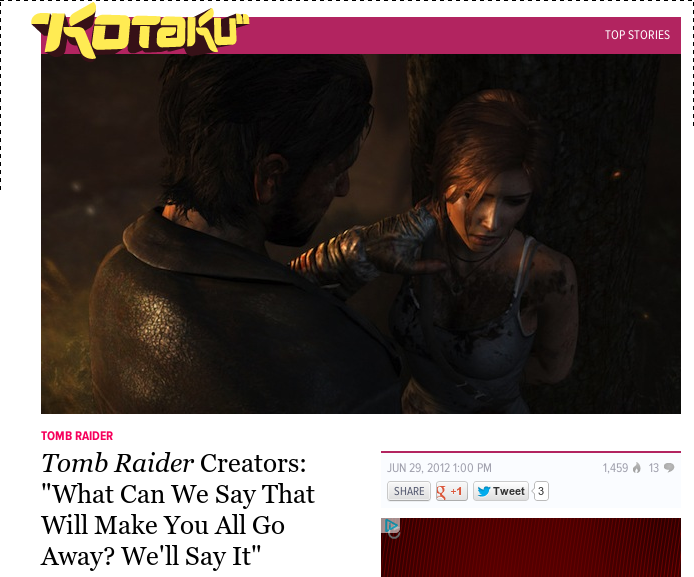
Here’s the thing: someone had to decide what to highlight in this trailer. The violence that Lara Croft supposedly faces at the end of that scene, which we don’t see in the trailer, ends with her being choked to death. And yet, Croft is still put in a situation where her sex matters. To quote:

Kotaku: Karl, do you think that a male protagonist in that same situation would have- do you think the scavenger would do the same thing, rubbing his hand against his thigh?

Stewart: No, of course not.

Which begs a number of questions. If it were a male protagonist and this happened, it would be almost impossible to deny there were sexual connotations to that touch. We are brought up to understand men don’t touch each other that way, because that is queer in some fashion. Women, however? They are of an entirely different set of expectations and how we may treat their bodies.

Regardless of what we call that sexually-charged moment (we could call it rape, sexual assault, or, as Stewart calls it, “close physical intimidation”), we do recognize what is going on in that moment: Lara Croft is being touched in a manner that is intimate and sexual in nature. Intimidation and sexuality are not mutually exclusive. Part of rape culture is that women are often intimidated by what they are told men will do to them unless they make sure to stay out of certain situations.

Image by Darius Kazemi.

Image by Darius Kazemi.

So, here we stand. As many have been saying, rape is not an uncommon trope to be used in media. And yes, it can be done in a way this is harrowing and respectful. So, either Crystal Dynamics is using the threat of rape to up the stakes on Lara Croft’s ‘development’ (and really, rape as an empowerment trope is not the way to tackle that subject matter), or it put this in the game, did not consider how this could be viewed (particularly by female gamers), and is now in a mire digging themselves into a hole of mixed messages and saying people are overreacting or blowing things out of proportion.

Which is a tactic being used by Ian Livingstone, the president of Eidos. As Alyssa Rosenberg points out, such a message can often be an indicator that this is a reaction that was not expected. It is at this point that Crystal Dynamics seems like they have the option of removing the content to just remove the controversy (and make their marketing team look rather blotchy in how they decided to highlight things), or owning up to what is happening and getting in front of the message. Saying it is ‘not rape’ and getting into arguments over semantics (because even if we go with intimidation, that still informs rape culture with how this has been gendered) is not the way to get in front of that message.

It might be trying to argue that in their dark and gritty remake of Lara Croft’s origin (and the dark and gritty trope is another thing to tackle in games), they wanted to recognize what women face in the world. How does that experience go? I haven’t played the game, and I couldn’t tell you. Is this a constant threat? Is this a one-time thing? Where is its placement in the game? How does that juxtapose with the oddly sexual-sounding grunts of pain and gasps we hear from Croft?

Or, is the sexual violence that is present to Croft’s character acknowledged in any way, or just beat down before it can be culminated?

Lara Croft has been a very sexualized figure. It is somewhat disheartening to think that someone, somewhere, would not have thought of how these things have a connotation beyond what their own (I’m am presuming mostly male) experiences would dictate.

N.B. Image courtesy of Darius Kazemi.

Posted in Marketing, Tomb Raider | Tagged , , , , , | 1 Comment

RuPaul’s Drag U, Season 3, Episode 2

Dear Drag U,

What happened?

I know last week I praised you for having a bit less focus on the drag queens of your show, and how you highlighted the struggles of the women who were on your show. This week went on the deep end of that spectrum, however. The queens were barely present, and the depictions of the women we saw were so uneven, I’m left wondering whether  I was watching a competition at all.
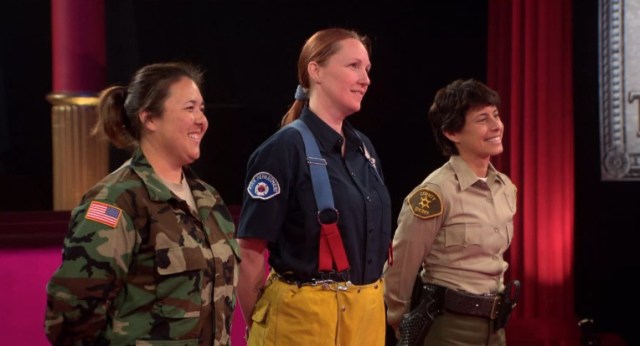
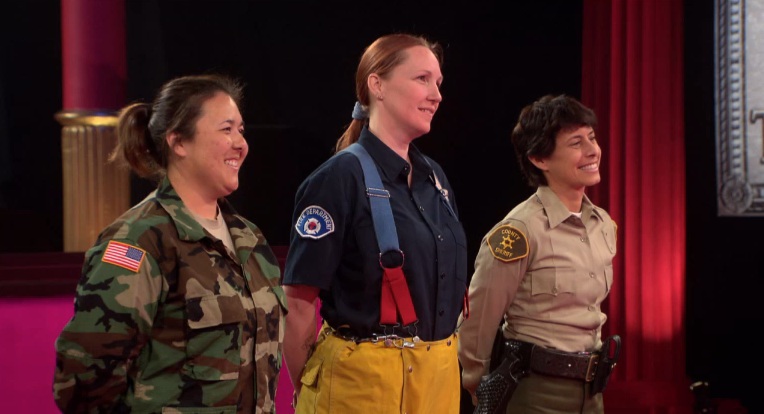
The sheroes: Christine, Virginia, and Bernadette.

The sheroes: Christine, Virginia, and Bernadette.

The contestants this week were Christine, a marine sergeant; Virginia, a firefighter; and Bernadette, a police sergeant. The theme of the week was “Heroes to Hotties,” and upon entering the stage to greet the women, RuPaul saluted them, calling them <strong>s</strong>heroes. It’s an amusing little twist on a word. Then this statement was made, which is when I had to pause the streaming video (which is when I noticed the typo in the link name, hereos) I was watching to reflect for a moment:

“But in the line of duty, you’ve sacrificed the most important thing of all: being a woman.”

What does that mean? All the women made comments about seeking their feminine side, and at the very start of the episode, I was left wondering if we were tying feminine to non-heroic, or if this was just an odd phrase that really just didn’t deliver correctly. Because, if we were to state, “But in the line of duty, you’ve sacrificed the most important thing of all: being a man,” to a male firefighter, it would sound a bit odd. This particular lack of awareness of what we expect out of women is a bit jarring.

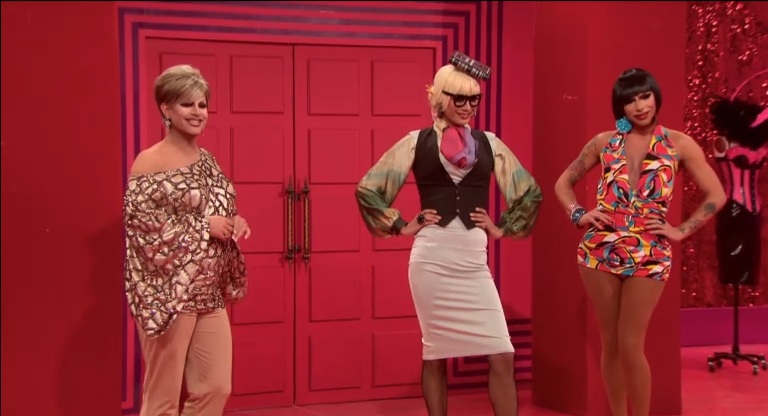
Then the drag professors! Raven pairs with Christine, Shannel with Virginia, and Raja with Bernadette. Almost immediately this turns into an odd affair.
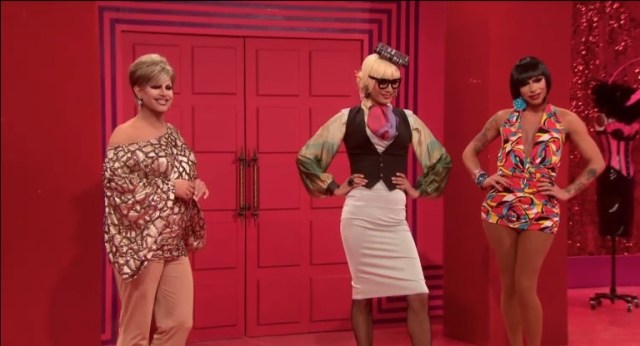
The professors! Shannel, Raja, and Raven.

The professors! Shannel, Raja, and Raven.

Virginia became a firefighter to honor her daughter’s wishes and memories (she died of cancer, and wanted to be a firefighter when she grew up). This isn’t really expanded on beyond that.

Bernadette lost her wife, Mona, and it is a struggle for her. Raja is seemingly confused and is not quite sure how to handle the situation initially, though the popular tactic of, “She would want you to love life and live it to its fullest” is trotted out.

Christine? At first it seems to be how she’s a very dominant person, orders dates’ food, and such. Then when sitting down with RuPaul, it’s about how she wants to appear feminine for her children, who have hurt her in their comments gender policing her.

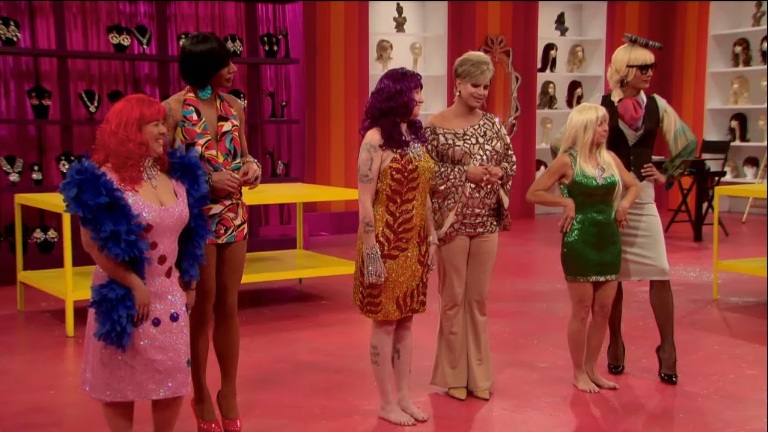
Which is where the episode gets even more confusing, as two of the three outfits and looks chosen are very androgynous, punker-esque looks. They land more firmly on the side of the feminine, but the presentations and appearance we receive by the end are loaded with strong people. They have aspects of femininity, but the way femininity was harped on before, it was as if these women were too butch. Is this to compromise?

I suppose I find the entire episode baffling because it seemed to have no real aim or end point, and just kept tumbling along in its formula until a winner was announced. We received a very similar product as last week in terms of what was present, but the edits and focii ended up being so askew that by the time Bernadette was announced the winner, I was left wondering what I had watched.
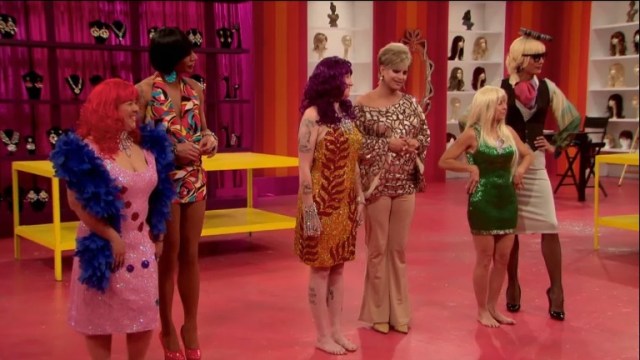
Quick drag! The women in what was thrown together to meet the Dragulator.

Quick drag! The women in what was thrown together to meet the Dragulator.

There is a touching story in Bernadette’s breakdown, and how she is struggling to get by day to day, accepting the loss of her wife. She isn’t doing this to attract a new woman, she is doing this to live life again. That is pain. It was palpable. It also completely dominated the episode, but not wholly enough that it didn’t feel crowded by all the glitter and wigs.

And I was left wondering between the lady lesson on high heels (good tips littered throughout, but it seemed far too much information in too short a time) and Latrice Royale’s tips on acne-prevention whether or not the show really needs to switch formats and become about helping one woman at a time. As it was, we saw almost none of the queens really interact with their students this time, which left everything feeling hollow.

It felt uncomfortable to not really get to know all these women but watch them strut about. Despite being the same allotment of time, I did not feel the editing managed to convey everything we could have had. Bernadette was the clear star and focus, Virginia had a few good moments, and Christine struggled to find a voice (what information we did have was never explored in a manner that gave me a full view of her as a person).
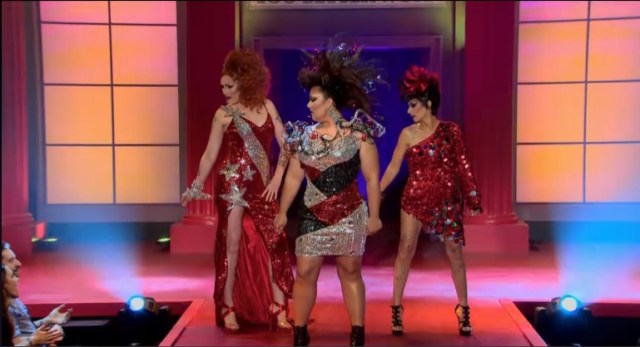
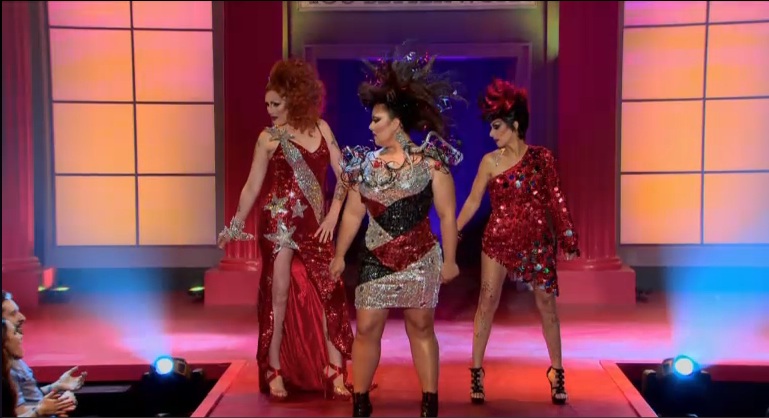
Our sheroes strike a final pose to "She Works Hard for the Money" by the late and great Donna Summers.

Our sheroes strike a final pose to “She Works Hard for the Money” by the late and great Donna Summers.

So, why?

Part of the issue may well be the queens we had at hand. Raven and Shannel can be loving and sweet when someone is in pain in front of them. They can also be rather vicious, their claws out and ready to tear someone down. That has no place with the way the show is now focused (though we did get one moment where they sassed each other—unfortunately with one of the women standing there, having what she was wearing critiqued).

On the other hand, I may have missed it last episode, but the judge’s panel is a lot less critical of the women to their faces. Even when they leave the stage, the commentary they give on the women is that they tried, they did well for the amount of time they had, and that they are making progress.

Seeing some of them walk in heels, it once again dawned on me how little time these women have here. Unless they are comfortable walking in heels before they arrive, that will be a hurdle that seems daunting in two days’ time. Which is a similar hurdle the show faces. Clocking in at forty-two minutes, if the editing slightly skews towards one person, it becomes less about the class of draguates, and instead becomes like so much yestergay.

Posted in Uncategorized | Leave a comment