Rape Confusion

In an effort to get writing more frequently, this blog will no longer solely be categorized and concerned with solely videogames. If that is not to your interest, I apologize.

N.B. Content warning for rape.

This post went up on the Escapist yesterday (further content warning for rape). It took me a while to read, though once I got past the first page, it went by at a rather brisk pace. What caught me off guard is that the first page has references to worrying about being HIV+, and concerning one’s self with AIDS. I wrote about part of the story of my rape and how it lasted for years, but there are a few memories that are more present than others. What has shocked me over the years is finding out which ones.

The first is the FBI being at my doorstep one day. Matt, who died in prison last year, had been apprehended while crossing state lines to supposedly have sex with a minor. I say supposedly because it was entrapment by the FBI, though that entire situation still confuses me. What proceeded was my family having most of our computing devices taken away, confiscated so they could examine them for any incriminating evidence. This included the family’s computer, and the one they had built for me (along with Matt’s—he was an IT person).

It would be a year before any of it was returned, and only after we got in contact with our senator and had him look into it.

Meanwhile, it was a long year of dealing with the government. In my post on Kotaku (and here), I detailed how the state made me feel like a heathen. Someone unworthy. On top of that, I had to go under a lot of medical examination for ‘legal purposes.’ It was very odd to be forced to disrobe in front of strangers and have them poke and prod my body and its orifices—in many ways it felt akin to being raped anew.

Then, after that was done, my mother took me aside. I had learned what HIV/AIDS were when I was in second grade, and as I watched television, it was hard to escape notions of it. It never dawned on me that it was described as solely a ‘gay’ disease until I hit my teens. My mother told me was going to have to have my blood drawn for an HIV test.

What I felt at that moment was a constriction in my throat, as if some rubbery mass was threatening to cut off any attempt at every swallowing again. Due to poverty, family issues, and slowly realizing I was gay, the four years prior to that had already been a harrowing experience. To think that I might then be HIV+? It was a little overwhelming.

Then there was the more insidious part. My father left the military when I was ten. It had created a rift in the family, as he refused to go look for a job. My mother, being a German citizen, was refused most jobs to which she applied, though she took whatever she could find. Money quickly ran out, and it created an entire mess. Matt entered the equation, and to my mind, he was helping out family with quite a few of our bills. He also slept in my room.

In my mind, for years I created a scenario where I had to keep silent because he was helping the family. I did not want my family to suffer because I rid ourselves of Matt, so there were quite a few issues with considering my rape (sometimes while I slept) necessary to keep my family economically afloat.

Then there was being gay.

A person I dated wondered aloud to me once: “Are we gay because we were molested?” It took me aback. There was little question in my mind that my rape and molestation had nothing to do with my sexual orientation, though it did complicate matters of how I felt about the entire ordeal. Matt had other victims, and they, to my knowledge, are all straight. I’ve only ever spoken to one at length, and I know what he went through with his sexuality is quite different from my own.

While I never questioned whether or not my sexuality was altered, I did question for a long time if I would be able to have sex with another man in my future. It took a few years to broach that topic, but that is no longer a concern. Further, while I know everyone who is sexually active should get tested for HIV/AIDS and other STIs, my first times going to get tested were anxiety-ridden affairs.

No, what I found out is that for me, the act itself is not the issue (something for which I feel fairly fortunate?), but everything surrounding rape. The trivialization of rape victims’ accounts. The need to point out that being raped ‘made’ me into a different person (read: gay—or, you know, a superhero). It is sitting in public transportation, reading Yes Means Yes, and starting to cry as I read this passage by Latoya Peterson.

That day in court was the day I fully understood the concept of being raped twice—first during the act, and then later during the court proceedings. That was also the day I realized that telling someone about my not-rape would have netted a similar, if not more dismissive response. I had no evidence of the act, no used condom wrapper, no rape kit, no forced penetration.If the defense attorney was attempting to sow the seeds of doubt in the face of indisputable evidence, what would have happened if I had chosen to speak up?

It’s being able to have a sex life not haunted by my rape, but to have everything surrounding it be a potential trigger.

Which is why I found talking about it useful; a means to recognize what was happening to me, and to gather that information for others. I have had multiple male friends come to me over the years, confiding in me their own rapes, just as deeply ashamed as the female friends who’ve done the same.

There was even the case, while I was at Wabash College, where I knew a young man was raped. He came to me, and I talked him through it. Part of this included asking him if he wanted to report it. I even went to the president of the college, discussed the matter, and was assured the guilty party would be expelled. He acted surprised that I would even ask the question, but my own experiences dictated that I had to ask. The president wanted me to name the person right then, but I decided to first check with the victim—did he want to do this?

When he said no, I felt equally frustrated and relieved. This would be a young man who would at least not have part of that experience; the rapist would go free.

When I discuss rape culture (and I use the first-person here because I am solely speaking for myself), this is what I am talking about. How everything surrounding this is a potential trigger because our society is grounded in such a way that I felt helpless in the name of an uncaring, hostile system.

I couldn’t speak for years, so I find it odd that I now so often do speak about it. Because it’s important. Back then? I couldn’t speak about how it made me feel like I was prostituting myself, because we don’t discuss money like that. I couldn’t speak about how I was worried about my fears of having a healthy gay sex life, because I was already being called fag all the time. I couldn’t speak about the legal proceedings, at times because I was threatened with gag orders, or because my family didn’t have enough money to get consulting on how the district attorney’s office was treating me.

Whenever I meet another rape survivor, my reaction is to let them speak if they want. It is also watching to make sure I don’t treat rape as a character-building exercise. As the Escapist article pointed out, it’s not. It changes one? Yes. However, the nuances that this requires are not something a marketing blip or somewhat odd quotations from a designer (looking at you, Tomb Raider) can address. Because it isn’t just the rape that has to be considered. It is everything surrounding it, and how it changes your life.

Posted in personal | Tagged , , | Leave a comment

Just Another Voice: Booth Babes

Quite a few discussions of booth babes have popped up post-E3. If you’re following me, I’m assuming you’ve read the arguments against them by women who feel it hurts their professionalism, makes them feel judged, and is just generally problematic.

I do not have their experience.

No, my first experience with booth babes was at was once known as Chicago’s Wizard World. A Suicide Girl approached me, flirted with me, and gave me a card, assuring me something would be for me at their booth. My reaction at the time was likely a stunned silence, which may have been taken for being a salivating horndog. I was not a salivating horndog.

The first thought that struck me was that for everyone talking about how I supposedly force my sexuality on them in public, I just put up with an example of such that was far more uncomfortable to me. One: I was apparently assumed someone who was interested in women sexually. Two: I am someone who apparently attends conventions to ogle women and have them assuage my ego, as if I actually matter to them beyond a paycheck. Three: I know I was meant to feel flattered, but I just felt dirty for even having the card in my hand, and promptly trashed it.

Then came my experience with E3. Thankfully I was press, and spent quite a bit of time in appointments and the press room, so I didn’t have to interact with many booth babes. When I did, it was typically at the front of the convention halls, where they were trying to sell me energy drinks. Or, watching a woman in a bikini shivering while in a bikini. LA may get warm, but being in the shade on a morning can still be cold. I wanted to give her a coat.

My one interaction with a booth babe type person was walking up to a stall (for which product or company I can’t recall), and being asked for my business card. I knew the reason for this was largely to be put on a mailing list, but the woman asking for it was doing so in a flirtatious way, as if she personally wanted my contact information. Sighing, I raised my lanyard that displayed my organization was GayGamer and walked away. She seemed a bit stunned, and I’m still not sure how I feel about the entire event.

It is her job to flirt with men, or to draw their attention. It is not in my interest to flirt with women in general, and since I was being flown there for GayGamer, it was the furthest thing from my mind. I was much more interested in meeting developers, fellow journalists, working, and enjoying my time there.

So booth babes? They do make me uncomfortable. I don’t necessarily consider my discussing my sexuality as shoving it down peoples’ throats (I could give details, and have no qualms about such, but I generally think that is not for public knowledge or consumption), nor do I tend to flirt brazenly with people. Therefore, it is very odd to me to suddenly be forced into a position where I felt I had to keep outing myself. I wanted to consider myself a professional, and part of that was not having to be put into an uncomfortable position (and women flirting with me generally puts me into a mode where I wonder what the best way to escape is).

Posted in Conventions | Tagged , , , | Leave a comment

RuPaul’s Drag U, Season 3, Episode 1

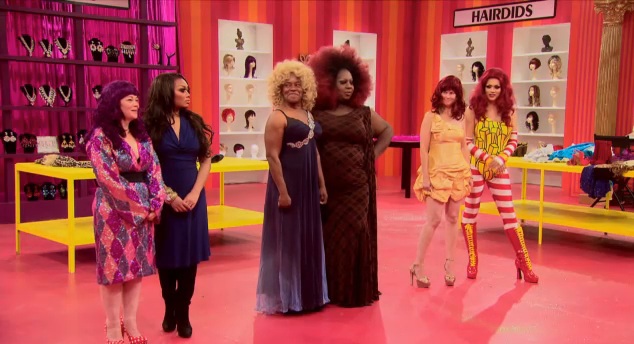
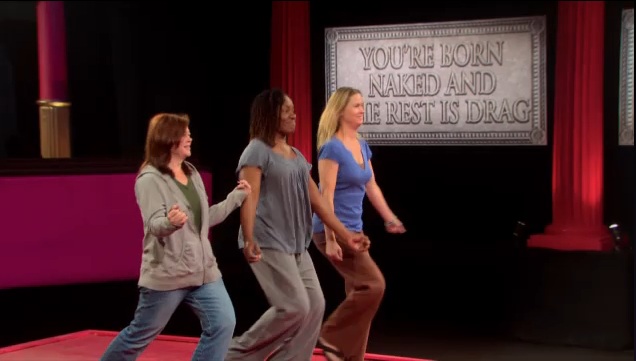
The drag professors: (L to R) Manila Luzon, Jujubee, and Latrice Royale.

The drag professors: (L to R) Manila Luzon, Jujubee, and Latrice Royale.

The premise of RuPaul’s Drag U certainly sounds promising enough: take three women per episode, and have them receive mentoring and self-esteem boosts from drag queens. The difficulty has been in its cross-brand marketing of the queens, all stars from RuPaul’s Drag Race. How to feature them without undercutting, or insulting, the women present? The first season started off in a rather rocky fashion, grading the women on their performance, and featuring far too much of the queens being catty. Season 2 already diminished that in some regard, and it seems like Season 3’s start in this first episode is furthering the message of the empowerment of women.

To start, RuPaul addresses her drag professors, but does not single out which ones are to be featured in this episode. Instead, it goes immediately to the women of the show: Hilary, Faith, and Shana, all women who are divorced and have suffered hits to their self-esteem because of it. In each woman there is a different tale to tell, which gets teased out as the episode moves along.

The women of the first episode.

The women of the first episode. From left to right: Hilary, Faith, and Shana.

Hilary lost quite a bit of weight, but is not sure what to make of her body. Her confidence took a hit because her husband left her to be with a woman who is fat. Pictures we see indicate she has no idea how to dress for her body type, and that she was actually happy as a fat person. Which prompts the theme her drag professor Jujubee has to tackle: how to take a woman who was happy plus-sized and give her confidence now that she ostensibly fits ‘society’s standards’ of ideal weight and is unhappy.

Faith is angry. In her we get the story of the woman who set aside her own ambitions to support her family. She loves her children, but now that she no longer has her husband, how will she move on? Thankfully she is paired with Latrice Royale, who has had her own ambitions curtailed a few times, and can give her lessons on how to move forward. Having Latrice in the first episode also seems like a rather savvy move from the producers, considering her fan following after season 3, and the love she has gathered for being a drag mother.

Then there’s Shana, who married only to find her husband visiting on ‘porn sites’ (she says porn sites, but when she later describes the situation to her drag professor Manila, it sounds like an adult hookup site). In her we find the story of a woman who has not had any good models for relationships, and thinks herself unworthy of a good one. I should also add, Manila’s McDonald’s couture continues to showcase her designer’s eye.

Quick and dirty drag that serves to highlight its fabulous ridiculousness.

Quick and dirty drag that serves to highlight its fabulous ridiculousness.

The episode does have some amusing interactions among the queens, but it strives to cut itself into a show about making sure we see these women transform. To start, and to showcase the ridiculousness that can be drag, they are tasked with quick drag: a quick transformation that is truly adorable and shows how much work appearances can take, but how lovely even the effort of trying can be.

Hilary takes the drag persona Tatiana D’Amore and learns how to appreciate her body again. Part of her concern is that her breasts have also lost weight, and there is some concern about showing them, as they no longer present in the same manner. To quote RuPaul, “So the girls dropped out of school?”

Meanwhile, Faith learns that her anger may now be holding her back, and is encouraged to channel that into Elantra Sizzle. She’s encouraged to embrace her life again. Enjoy her children. It also helps that Latrice is there to make sure she knows she is accomplishing quite a few remarkable tasks just doing what she is, whether or not it was her original ambition. I am all for anger when it helps spur the moment, but it may well be valuable advice that like any emotion, too much of it will cause burnout.

Shana’s transformation does not come into full until she sits down with RuPaul, where we learn her family history and how it has affected her personal outlook. Manila serves primarily to give her the core skills of walking in a train, learning to appreciate herself, and to try something different. However, when she steps on to the stage to perform as her drag alter ego, Callie Tropicale, we see someone wanting to embrace this, and to have fun.

It’s the minutiae of the episode that serve well to break it all up much better than catty infighting all the time, however. Lady Bunny walks in for a lady lesson in smoky eyes with Anton Khachaturian as the expert. Bunny lands a low blow attacking Latrice’s weight, to which the response is a delightful: “She keeps sassing me, I’m gonna show her a lady lesson.” If Lady Bunny’s role is to be the slightly grating administrator, who still manages to come off as mostly joking in a loving sense, she has it down pat thus far.

Drag tips are also a welcome return: while revealing the ‘secrets’ of drag might be considering ruining the magic. In another sense, it gives a better way to gauge how well and why a queen may do something an untrained eye might miss. Knowing the illusion doesn’t necessarily spoil the illusion.

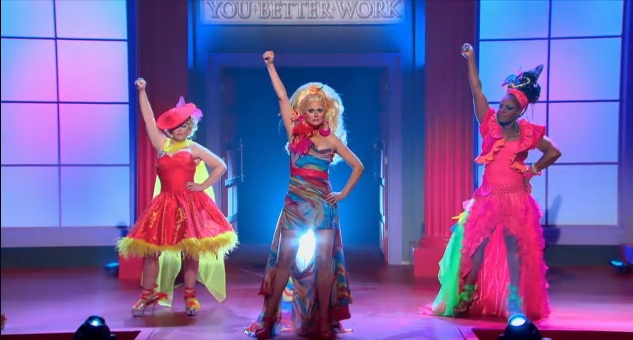
The women strike a final pose.

The women strike a final pose.

This season also adds a new element by gifting all these women one outfit that is not necessarily tied to a drag mask. They are given a choice of two outfits, and all three this time around were fairly different stylistic approaches. It brought up what the women feel comfortable in, and allows an endcap of seeing these women adopt not just their drag mask, but a comfort in new clothing, as if to step into a new appreciation for what they can do and how they can appear. Or, as RuPaul says, “This week our class of divorcees filed an anulment on their old lives, and signed a prenup with fabulousity.”

When Shana is announced the winner, it is not wholly surprising, given how she owned the stage during the final performance, though it was comforting to see an episode not highlight these women’s fumbling towards dragnificence (a word taught to us by this episode), but succeeding in their goals. To highlight such, there are cut-away panels of both Hilary and Faith espousing how they are also winners, serving to make the ‘win’ almost an unnecessary after-effect of showcasing how ‘life can be a competition,’ to use Ru’s words.

Posted in RuPaul, TV Review | Tagged , , | 1 Comment

Men As Tropes In Games

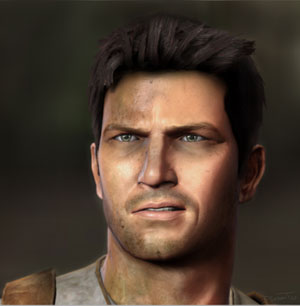
The 'ruggedly' handsome, smart-ass Nathan Drake.

The ‘ruggedly’ handsome, smart-ass Nathan Drake.

Surely you’ve read about the Feminist Frequency Kickstarter brouhaha by now. I’d write about it at length, but others have done so with far more aplomb and expediency than I. Here, read Carolyn Michelle’s interview with Anita Sarkeesian, or John Walker’s post on such matters. While I haven’t written about it in a blog post, I have argued with people on it, pointing out Sarkeesian is not being misandrist, and other such folly.

Sarkeesian is not being misandrist. Part of the difficulty of explaining feminism to people is that it does at times cover how men are oppressed and pigeonholed by the systems in place. This is not the job of women to explore, as they are largely concerned with their own sex, which is worse off than men. Thing is? Men are also shoved into tropes. Many of them are power fantasies and unrealistic, and also limiting.

Those tropes tend to be more varied and often inspirational, however. There’s a difference between having the models for your sex be based on serving others and on being the bastion of all manliness, who has to provide all the time, and has the emotional range of a plant. Both are harmful, but I can understand how women are more concerned with their own section right now. Particularly considering the various structures in place whereby women’s voices are not even at the design meetings for these characters.

I, however, have been interested in how men are represented in media for quite some time. As someone who grew up between two cultures, and never belonged wholly to either, I was constantly questioning what it meant to be a man, which meant I was constantly watching examples to see what behaviors were expected of me, though I largely avoided them.

So, yes, the patriarchy, kyriarchy, or whatever term you wish to use is harmful to men. It is very connected in how it is harmful to women, and can often be as binding. I do not expect women to study that in depth at this point when they have so much else on their plates. I would like to create a video series similar to Sarkeesian’s Tropes vs. Women, but focused on the question of, “What about the men?”

As a man who has studied gender studies and these tropes (my gender studies degree came from an all-male college, so it was not wholly women’s studies based in the slightest), and has written about it, I would like to believe I could do this project justice. I do not see it as a chance to distract from Tropes vs. Women, so much as to complement it. At least, that is my goal.

I also do not exactly trust this initial document by another group of men; a document that uses faggots as a derogatory term.

Past examples of my writing on this?

Who You Callin’ Macaroni?; about the male dandy (or what that document calls faggots).
Anti-anticitizen One; the culmination of a series about Half-Life 2.
Final Fantasy VII’s Drag; self-explanatory.
Playing Boy: Ezio Auditore da Firenzi; about the playboy that is Ezio.
Homo say Gears?; why were journalists convinced there was a homosexual undertone, rather than just homosocial?
Two Cogs in a Gear; the relationship among Dom, Maria, and Marcus.
Albus as the Romantic Hero; from Castlevania: Order of the Ecclesia.

The question is naturally what happens now? I haven’t edited video since I was in high school. My initial post on Twitter gathered at least three interested parties, however, and I will be discussing with them how to best divide up this project. Will there be a Kickstarter involved? I don’t know. I have no idea how much support there would be, and I have to discuss this with the people with whom I’ll partner and get more of a framework first.

I will keep you posted.

Posted in Men in Games | Tagged , , | 1 Comment

Lords of Waterdeep

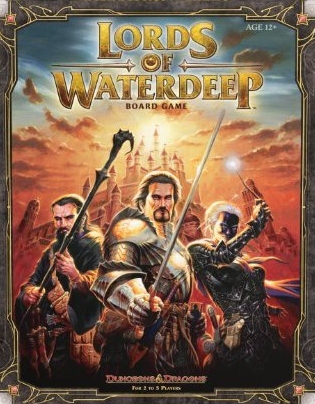
Lords of Waterdeep's cover, featuring two white men and a half-drow woman.

Lords of Waterdeep's cover, featuring two white men and a half-drow woman.

The city of Waterdeep has a certain allure to those who grew up consuming books, maps,  and box sets about the Forgotten Realms’ City of Splendors, imagining being part of its political intrigue–or that could just be me and my love of skullduggery. Therefore, when it came up on Amazon, my roommate decided it was an instant purchase. We reminisced about Khelben, the Undermountain, the Yawning Portal Inn, and the older PC game, Descent to Undermountain (where I never managed to make it particularly far).

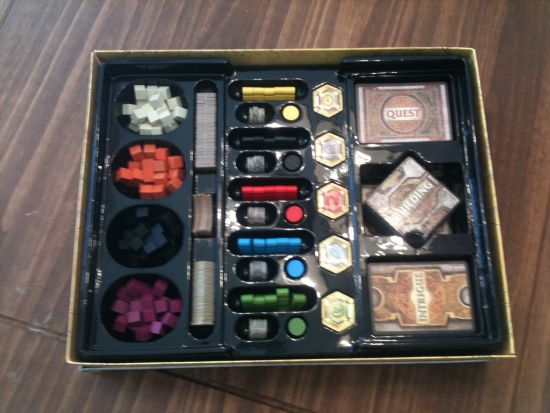
When it arrived, we were first rather astonished at how well the box and its content were put together. It was a mini-puzzle in and of itself–one that the manual spells out for you. Stephen and I looked at each other and made the remark that if the game is designed anywhere near as well as the box, we would be in for quite the treat. So, what about the game, then?

When you’re not spelunking into the Undermountain, Waterdeep is known for intrigue, plots, and the fact that the lords (and ladies) who rule it are quite secretive, many of them not even publicly known. Which is what the game quickly makes clear: the lord you are randomly assigned is to be known only by you, as you place their card under your player mat. These player mats are ostensibly tied to an organization such as the Harpers or Red Sashes, but these have little in-game effect outside of your color choice and whether you wish to roleplay as the particular group. Then again, to be caught in by the intrigue of Waterdeep, you will be performing all manner of deeds, whereby alignment of a particular organization almost seems quaint.

The layout of the inside of the box.

The layout of the inside of the box.

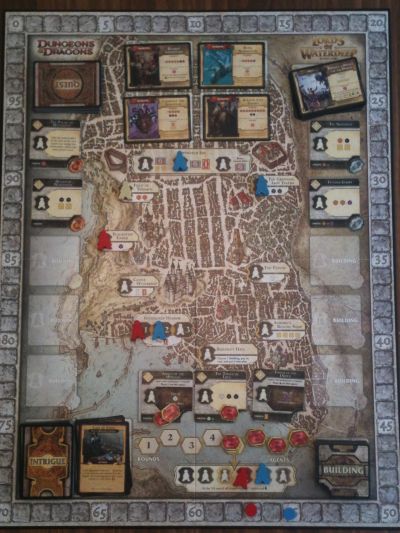
As a Euro-style board game, there are a number of pieces that move about with player precision, while a victory track circles the entire playfield like some obscene vulture waiting for the carrion that is sure to come. While it seems like there is a lot of information to absorb at first, the board does a remarkable job of telling you exactly what each part does, and where what goes. This is a game all about strategy and becoming the premier lord or lady of Waterdeep by gaining victory points through various actions, whether they be completing quests or purchasing buildings and using them. These are the actions that are seen by anyone walking the streets of Waterdeep, so accordingly, you record their impact on your score immediately. However, it is by placing your agents that this all takes places, and whereby you control the game.

A lord whose identity is secret, you are never involved directly until the end, instead relying on your agents to be placed turn after turn. Where this matters is that outside of a few special card effects, once an agent is placed on a map tile, no other agent may occupy the same space. Need to recruit some fighters but someone has already tied up the Field of Triumph? You’ll need to find some other way. This also means that if I know you need to have some fighters, I can well decide I need some for myself.

The board acts as the city of Waterdeep, clearly outlining which cards and tokens go where.

The board acts as the city of Waterdeep, clearly outlining which cards and tokens go where.

This is where strategy starts being affected by the luck of the draw. Depending on the intrigue cards in your hand (which provide bonuses, hindrances, or direct-but-weak attacks), your available pool of adventurers (used to complete quests–you’re not delving into the dungeons yourself, after all), and the quests available (some of which provide permanent bonuses), you’ll find your available actions are either quite limited, or you’ll be chaining actions in an ever-increasing spiral of victory point laps. Of course, this means that you could well be doing something else instead: preparing yourself for future successes.

Of course, you’ll be juggling both preparation and being able to improvise if carefully wrought plans go awry. If you know you are going for primarily Arcana and Piety quests, you’ll want to stock up on the harder to accumulate wizards and clerics. Of course, too much preparation can make it very obvious what your aims are, giving opponents more chances to block your attempts, though they’ll have to balance it with achieving their own goals. The game is a constant decision of how much time you are willing to invest to stop your opponents, which won’t necessarily score you any direct victory points, and to further your own desires and aims.

Given the level of chance involved, thus far each game I have played has led to enough of a difference that it has never quite felt like playing the same game, nor has it felt like the entire game was ruled by luck alone. The more players that are involved (up to five) means the scores tend to even themselves out more, as there are fewer windows of opportunity, and more chances to be blocked. Thematically this fits the City of Splendors ruled by secretive lords, though if you’re not a fan of the Forgotten Realms or D&D, it serves quite fine as a strategic gamble that will last anywhere from 45 minutes to an hour and a half.

Posted in Board Games | Tagged , , | Leave a comment

Foreigner In a Strange Land

Upon first coming to the US at age three, I knew barely any English. Culturally, I was completely thrown off by every day obstacles such as door knobs (instead of door handles), managing to lock myself into at least one bathroom while crying to a bewildered mother on the other side of the door. Then there was overeating peanut butter, thinking it would be a suitable substitute for Nutella (these days the smell of peanut butter makes me feel queasy). I was out of my depth, but I learned.

Videogames often work in similar ways, throwing us into a world where we know the basics (a door is still a door, whatever the means of opening it), but have to actually learn the specific language of its mechanics. In both Demon’s and Dark Souls, there is a strong feeling of having stepped into a strange land where you are not welcome, underscored by its difficulty and its lack of any full tutorial. Even playing other games that are ostensibly action with RPG elements will not necessarily prepare one for the particular lessons the Souls games wish to impart.

Instead, I was learning a language that was very similar to others I’ve studied in the past, but remained lost, confused, and stumbling in my language acquisition and use, despite knowing the basics. If interaction with the game is how we communicate, I was stuttering along, surely making many errors in simple syntax, but practicing, learning, and watching the response so as to alter my own communication with the system. This happens in most games to one degree or another.

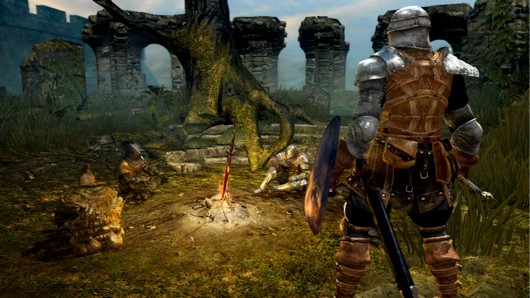
However, in both games I am not only a foreigner, but one who happens to be making space in a world where xenophobia is the norm. My mere presence was a transgression. I learned to use guides in various forms; this included not only the games’ messages left by other players, but also various Wikis, YouTube videos, and whatever else I had at my disposal. In many ways, it felt like I was residing in some insular neighborhood that was both part of the game, but clearly its own world—forever attached but clearly marked as other, with its own language mapped onto the world to both create a sense of community as well as create order so that I could understand the world around me. In Dark Souls, this feeling is more deeply entrenched in seeing other people quite commonly around bonfires, giving sword and flames a sense of home not only in their recollection of hearths, but in the ghostly apparitions of other players. This allowed me to claim some sense of ownership, some sense of belonging.

Two players around a bonfire.

Two players around a bonfire.

The worlds’ stories are fairly straightforward in terms of having to save the world, even if the particulars are a bit blurry. It is not because of the overarching plot itself I found myself playing. It was both for the thematic qualities the game conveyed, the sense of accomplishment, and then the feeling of community. I could share this experience with people, there would be stories of exultation and stress, victory and controller-gripping defeat. We were all fighting a larger fight, even if in our individual stories. We could aid each other to help defeat the next big milestone.

Which means in the stead of the plot, I found myself questioning what I was doing, exactly. There was a land that was riddled with demons, undead, and other such beings that are generally considered ‘not good.’ Perhaps it is because I am the heathen I am, but I started looking at the political meanings of the entire affair, whereby a foreign agent had come to the land, taken over, and I was now doing the same to supposedly rescue the land. I was the immigrant who could change the culture around me, though it is largely seen as me trying to completely stamp out the culture that existed. In either case, it is done through violence and force, as it is my only way of making my mark.

The games seem to depict a war against a different culture in order to restore the land to the way it was, a tug-of-war between conquered and conqueror, whereby there is a constant shift, though no one ever wins. As soon as the final confrontation is resolved, and a new order theoretically established, I was sent back to do it all again. Theoretically, the pattern recycled, and I was now back in a different incarnation, recalling my past skills, as the challenges increased in their difficulty.

What does not change is the AI, however. The enemies are stronger, have more health, and yet they are really the same. Given the same patterns, the challenge was therefore merely spending more time rehashing over the same basic game elements as before. Nothing wholly new was introduced, so much as the game fully becomes a test of what you have learned, rather than an exploratory exercise.

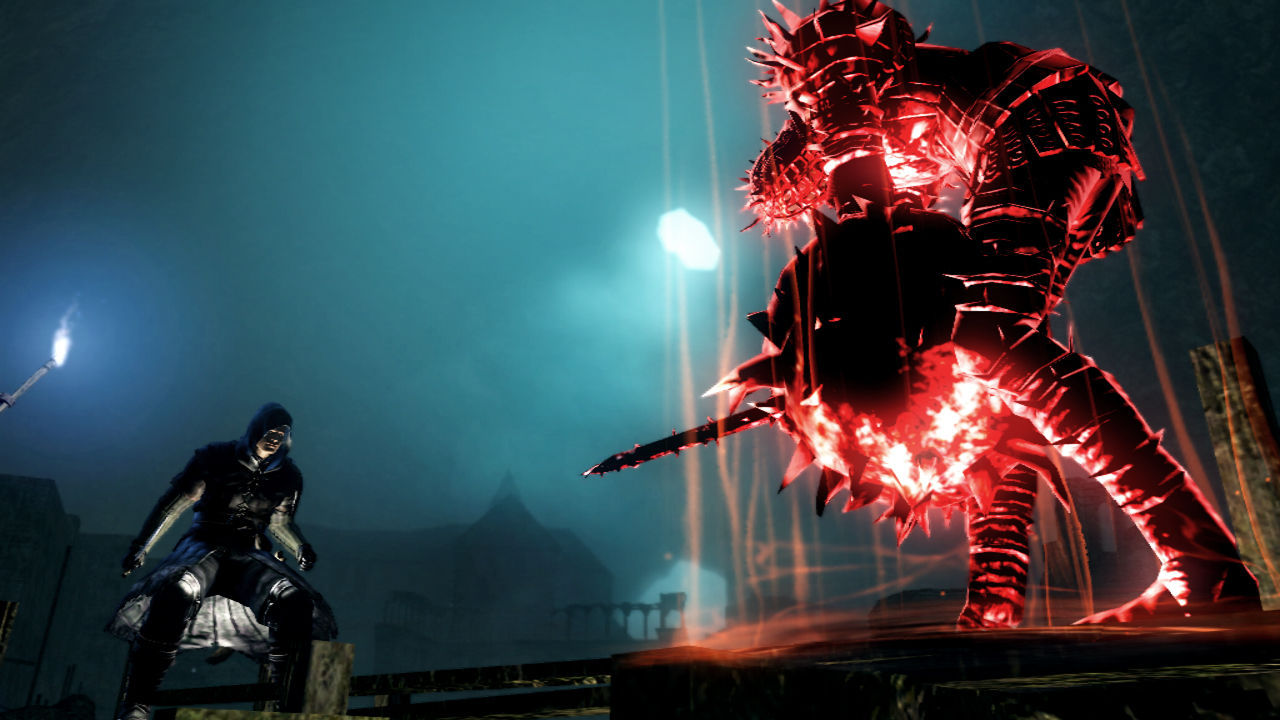
A player, left, looking on at the glowing red invader, right.

A player, left, looking on at the glowing red invader, right.

Given such, PVP introduces community strife. No community is ever fully cohesive, and in these games, this is seen through the invasion of a world by a black phantom. These traitors manage to rob you of corporeal form or your humanity, setting you back. In Demon’s, the game forces a PVP confrontation via the end boss of the third world. In Dark, there exist factions that encourage such behavior in return for rewards (both on the side of sadism and retribution).

There is a lot to learn in the Souls games, and the first voyage into them lends a feeling of being out of one’s depth. Given both the subtle and blatant online capabilities, it does have a feeling of unity and discord without the unnecessarily aggravating elements of multiplayer I typically tend to avoid. While I didn’t need the community to teach me how to open the physical doors that were placed about, I found myself relishing their contributions anyway.

Posted in Dark Souls, Demon's Souls | Tagged , , | Leave a comment

This Gaymer’s Follow-Up

As with the predecessor to this post, trigger warnings apply for homophobia and various attempts at internet bullying.

Before I published This Gaymer’s Story, I’d never quite put out there the major instances of all the homophobia I have experienced. Bits and pieces to friends, but it was largely something that was only known to myself. As someone who refuses to be classified as just a victim, there was something in me loathe to put all of that information in a public space, but I felt it was important for a few reasons.

Before I get into that, it might be useful to outline the order of events: I was in Fulda, Germany, having just left Berlin, and preparing to move to Tennessee to live with one of my best friends from college. News of the Blizzcon event caught my attention, and after it was posted on GayGamer, I promoted it to other sites, including Rock, Paper, Shotgun. They wrote up the occurrence, and I happened to read the comments. What I read fueled such a level of bile in my throat that I felt the need to spew out a post explaining why straight men were not the ones capable of ‘reclaiming’ faggot as an insult that supposedly removed gay men from the equation, nor dictating who could be offended by it. It grew a bit while writing. As Walker himself noted in the comments, the fact that the comments occurred showed a prime example of why homophobia still is an issue in games. At that point, it honestly stopped being just about Blizzard or Blizzcon, which is why I first posted it on Vorpal Bunny Ranch. It was about the community that comprises gaming.

So, I hesitated in posting, but felt it was necessary. I was opening my personal story, and was also quite cognizant that I may well be verbally attacked for posting such, but that I was in a position to be able to take the brunt of those attacks in whatever form they came. In fact, in the past two months my posting has dropped off a bit, largely because of an international move and figuring out I feel about the entire affair, but not because I have felt particularly unwelcome (gamers, you can keep saying these things and it serves to irritate me, but won’t get me to stay away).

A few hours after posting my story, I received an email from Kirk Hamilton: Stephen Totilo had read my post and apparently mentioned it to Kirk. Their next step was asking me to repost it to Kotaku. Shortly after that Tami Baribeau from The Border House also contacted me, asking to repost it there. While I am a staff writer for the latter, the former presented a curious opportunity for me: it would put the story in the exact place where I felt it could reach people who might not have thought of it in such terms.

As should be apparent, I am not opposed to being confrontational. I have been fortunate in my life that I have always been sociable in a way that I never failed at finding friends (despite how caustic I can appear at times online, I’d like to think I have a certain charm about me in person), which has led to constantly having a core support network. This in turn meant I felt empowered to come out of the closet, become an activist, and generally suffer whatever was slung in my direction. That is not to say it hasn’t been difficult, or painful, but it allowed me a level of defiance that I do not recommend for everyone based on their own circumstances.

Therefore, I chatted with Kirk via IM and arranged for This Gaymer’s Story to be published on Kotaku that evening. Some trepidation entered my mind: that week was supposed to be my down week between Germany and my return to the U.S. On the other hand, I felt that mixture of audacity and carefree attitude that commonly happens in liminal phases of one’s life.

I knew what to expect in some regard: tl;dr. Threats via email. Comments picking apart individual points of my story, seeking to ignore the larger picture I was painting. Straight men selectively quoting Louis C.K.’s ‘faggot’ sketch (and failing to link to a later point in his career: this poker game with some of his peers, one of whom is gay). I even predicted, and was correct, that some people would try to verify the facts of my molestation case in Clarksville (which I found both tiring and amusing, largely because I was a minor and my name was never used).

What I did not expect was all the people emailing me to thank me, or sharing their own stories. Those were the ones that wrecked me, in truth. Reading about other peoples’ pain only further drove home how my story was just one in many, in just the games industry alone. After all, in my own life I have known all manner of people, and in particular LGBT persons (what I get for volunteering at LGBT centers), who have had much worse lives than mine. Which is to say I was confused that some people made the argument that I was saying my life was the worst! No, it wasn’t, and I’m quite aware of this fact.

Of course, I am also quite aware that I opened myself to be ridiculed. As many reported, on WoW predominant sites I was seen as annoying and trying to ruin peoples’ fun. The thing is, I am okay with that last part, particularly if someone considers the use of faggot to be a requirement for their fun. Predictably, here was where entered discussions about having thin skins and just needing to deal with it. As I’d stated already, having a thick skin is something I tend to have. Of course, just because one has a resistance to some manner of jackassery, that does not mean one enjoys being poked and prodded with insults and predictable arguments.

No, you see, I would call someone who has a thick skin and allows people to constantly test the limits of it — without doing anything — apathetic, completely desensitized, or afraid. One accusation in particular that caught my eye was saying I was just putting my life out there for attention, which I feel is actually perfectly true. Generally speaking, in order to make a point, it is required to have peoples’ attention.

What I did was not just for myself, however, but to get a conversation rolling in the opposite direction of where I was seeing it headed. The truth is, I rather doubt I’d ever be able to convince everyone of my point of view. I have never been quite so idealistic. My method is to give people a voice, an example, a point of reference. Eventually, what I would like to see is enough voices in opposition so that faggot is not erroneously ‘reclaimed’ as ‘just an insult that has nothing to do with gay people.’

Of course, the argument against such (despite addressing it, people felt they still had the right of it and my attempts are futile) tends to be that language changes, mutates, and that one is unable to stop such. Which is a convenient excuse isn’t it? To assume that a societal change cannot be stopped? We could probably have a good conversation about fate when it comes to that. However, I feel it probably says quite a bit about the feelings of powerlessness some people have in thinking they can effect change. And a person by their lonesome? That might be difficult, but it isn’t about doing it alone.

It is about reporting those instances of people using such words when you see it come across your screen in an MMO. If you have the patience and ability, it is about confronting them on various voice chats and telling them to knock off their behavior, letting them know such is not welcome, nor will it be harbored. Boys may be boys, but that does not mean boys need be assholes in public. While some may be perfectly willing to say it is inevitable and we are asking for change, I tend to believe it is change that can be effected, and it requires this discussion right here to let others know it is okay to stand up against any language that seeks to denigrate someone for who they are, whether that be related to their sex, gender identity, sexual orientation, race, disabilities, or any such things that make just one part of our identities.

Posted in personal | 2 Comments

Polyamory In Game Romances

Doesn’t really exist, does it? Due to the romantic systems in place, the simple fact of polyamory almost always seems to be shut out, as you pursue the tree branch to get to the end of the romantic storyline with a Liara, Garrus, Morrigan, Anders, etc.

However, in the first Dragon Age there is a hint that it could have happened. If pursuing a romance with Zevran, and also one other person (with my first character, it was Morrigan),  he will have similar dialog to anyone else in the instance of following a dual-romance: you need to break it off with them or me. How he phrases it is very different however, as he pins the blame on the other party, as they would be too jealous and just muck up the entire process.

Fanart of Zevran by *sandara. He is fighting three Darkspawn.

Fanart of Zevran by *sandara. He is fighting three Darkspawn.

(The above lovely fanart done by *sandara.)

It would seem that Morrigan might be open to such, but despite her free-spirit ways, she does admit to a certain sense of possessiveness. If one continues on a path with her and goes through the epilogue, and later Witch Hunt, she will discuss further her views of love, and come across as someone who has kept people distant to save herself. Early Morrigan views love as a weakness that makes people susceptible to all sorts of silly behavior and means they will compromise.

Zevran? He was born in a whore house, is perfectly willing to engage in threesomes, and talks about sex at a great length. While this has drawn various criticisms to him, he is very much a Lothario. I have written about him thrice so far: once looking at his construction as a character, another with the romance I had with him, and the other time as a representation of a bisexual male character. Depending on whom you ask, he’s a stereotype of what one should expect from a male same-sex romance option, or someone whose construction fits rather well.

The fact that he is also open to polyamory and queer in some sense of that word is also not that large a surprise. Again, depending on the queer friends you have, you’ll encounter various mindsets, and two schools of thought are that LGBT people are capable of the exact same relationship constructs; on the other hand, there is the thought that they are able to break free from a system and explore alternative options.

Zevran just so happens to be stuck in a game world, where unless an intrepid modder does some work, he cannot have that poly relationship with the Warden and whomever else the Warden may desire. If the player did such, it would also bring up the question of what form of a relationship would it be? A triangle where everyone is together? A V, with the Warden being the crux of that particular relationship?

Dragon Age 2 did take the step to allow characters to interact with themselves and to have lives that did not necessarily revolve around Hawke. If a romance is pursued with neither Isabela or Fenris, they pursue a relationship, which seems to be mostly sexual, by themselves. Again, considering Isabela, it would seem that a  polyamorous relationship model could possibly have been open to her, but we are denied the option due to the system in place.

Therefore, we are now at a step where BioWare has given us options of characters who could likely be in a poly relationship on some level, but the system and toolset in place are not supporting it as yet. Then again, the argument could be made that systems tend to resemble our own, and while poly relationships have existed throughout history in one form or another, as the main set of relationships, they’ve rarely been highlighted as desirable in modern times.

The question would then become how does one create a system that supports poly relationships on a level, and how would that change the writing? Instead of writing a simply linear romance that could end up in couple of ways (here I am thinking of the hardened paths one can take with certain characters like Leliana or Alistair), there would have to be that option and the option to allow for either the romance to acknowledge another path being taken, or somehow merge the romances together. In terms of the systems we’ve seen thus far, I imagine a V shape would be the most likely (and this is assuming that the first step would be a poly relationship that is just three people).

Posted in Dragon Age 2, Dragon Age: Origins | Tagged , , , , , , | 2 Comments

This Gaymer’s Story

Because it needs to be said, I only speak for myself. Trigger warnings for suicidal thoughts, sexual violence, homophobia, child abuse, life.

FAGGOT is a dirty word

FAGGOT is a dirty word

I made the mistake. The mistake I warn others of not doing. I read the comments. In case you haven’t heard, Blizzard made a rather poor decision in its choice of how to close BlizzCon. The comments are as to be expected. Largely predicated on academic reasons or “my gay friends/I’m gay/I’m straight and it doesn’t offend me.”

Let’s make this personal.

It starts around the age I was nine. I realized I liked boys. My first crush was in the PASS program with me (Program for Academically Superior Students), and I could not get him out of my head. Nothing sexual, but just imagining hugging him, marrying him, etc.

Then middle school began. I had always been a rather odd one in whatever society I found myself. At first it was my German accent, then my not being masculine enough by American standards, then my lack of interest in sports, my general nerdery, my intelligence, my liking games, etc. It also became getting called fag or gay every week through middle school. It became administrators taking me aside and telling me I was odd. It became teachers sitting down with my mother and telling her they were worried I was ‘immoral,’ which was code for not fitting into mainstream thought and probably queer.

During this time, from the time I was ten until I was almost fifteen, I was also being raped and molested almost every other week. I’ll let you do the math, but suffice it to say, I began having serious questions about myself, my sexuality, and guilting myself for sometimes enjoying the physical pleasure even while my mind loathed everything that was happening to me. I was also coming to terms with being gay.

But! Molestor/rapist was caught! Yay! He was out of my life (not really, he only exited my life this past year when I learned he was dead and no longer stalking me on social networks)!

I began coming out to friends at this point, when I had just entered high school. Not many, but here and there. It was also at this time that I had to deal with a court process that would drag on for five years. Five years of being threatened by the DA of Clarksville, TN, being told because of my age, I wasn’t quite as important to this case (rapist had raped other children), and various juries of varying sorts looking at me like I was a freak. To this day I am more likely to be triggered by reading stories of juries being judgmental toward victims than I am towards rape itself (which is my experience, and not to be ascribed to others). This time is known as when Denis really hated himself, thought himself a whore, had both the FBI and Clarksville Sheriff’s office tell him he was dirty, and was being tested for STIs along with HIV/AIDS, because he didn’t have enough to deal with being a gay teenager.

During this time I also dealt with school administrators, this time high school, calling my mother about ‘concerns.’ Then there was my father finding out about this and threatening to disown me if I ever ended up being gay (while my mother let me know fiercely that she was a fruit fly when she was young, and I would always be supported). Don’t forget the constant yelling down various hallways, “FAG! QUEER! HOMO!” Also, passing cars. I have dealt with passing cars calling me various anti-gay slurs since I was fourteen.

Thankfully, I never experienced any immediate physical threats during high school. This was likely partly due to the fact that once I stopped being raped all the time, I got very angry. Very, very angry. People generally thought I was crazy and that to involve themselves in an altercation with me would result in me not having any qualms about hurting them quite a bit.

Therefore, when college came around, I was grateful for the chance to leave Clarksville, TN. I would get to be in a liberal place! I might have a boyfriend! I might not have to be worried about being openly gay! If that was the case, I’m still not sure why I chose Wabash College (answer: scholarship money for creative writing and academics).

What resulted at Wabash was immediately being out and once again hearing the usual: “FAG! QUEER! HOMO!” Y’know, the usual. This was my rebellious phase. I yelled back, I gave the middle finger, I and a friend printed off bumper stickers that stated, “FAGGOT is a dirty word” and plastered them all over campus. Yet every time I put that sticker on my door? It was taken down.

Apparently I was a faggot, but daring to confront that language was not something I was allowed to do. Instead, some kind chaps decided to write FAGGOT in permanent marker on my door. Because I was visiting with a friend at Oberlin, I was not there that weekend, and by the time I came back, my good friends, and my RA, made sure the offending evidence was gone from my door, having sanded it off. Every time I now entered my room I saw a sanded off portion of the door, reminding me what some people thought of me and my personal space.

That still didn’t stop the harassing phone calls at 2 AM, though. Now, however, I typically only ever heard faggot, queer, or homo muttered under peoples’ breaths. It was understood I was confrontational. It was understood I was not going away.

Graduation was an amusing affair, largely because I had no idea what was in my future. I was off to Chicago and I finally thought I would have the life I dreamed of: a steady boyfriend, dating options, and being accepted. Come to find out, as a gay gamer who was generally nerdy, I wasn’t exactly popular in the gay community. Oh well, I shrugged, maybe I’ll find a group of gaymers somewhere. Over the years I slowly did—that or gay people who didn’t ostracize me for liking games.

Unfortunately, it was during this time that I was also coming home one evening and one of those passing cars happened by. “FAGGOT! QUEER! HOMO!” My response was a rather tired middle finger and shrug. Their response was to quickly turn around their car, jump out, and beat me into the sidewalk. I wasn’t seriously injured, though I did have a concussion, and still have scars on my hands and knees.

Whereas faggot was a word that annoyed me before, now it became very, incredibly emotional. Thinking on that night is still painful. I had built an armor of anger strong enough that the words only kept adding plate after plate, scale after scale, chain after chain. Words followed by that action suddenly turned all of that to nothing.

What was the point of this story?

Dear fellow gamers, I am tired of explaining this to you. I wrote this out so that you can stop saying I am seeking special treatment. I wrote this out so that you could connect it to an actual experience, not some academic exercise of “this is now a general insult.” You do not get to claim the insult so that you can go use it however you wish. Let me repeat: you do not get to reclaim this word that way. The assumption that language changes is one trotted out by people who get to make those changes, which is typically people in power, or those privileged. I am not letting you change that word on me.

Society has used that word on me since I was eleven years old in New Providence Middle School. Society allowed that word to be thrown at my back while I walked the halls of both Northwest and Clarksville High Schools. Society encouraged those college men who decided I could not reclaim it, but they could smear it on my door. Society gave strength to and encouraged those men who jumped out of a car and beat me for my sexuality.

When you say I am asking people to be too politically correct, I hear, “I want to keep kicking you, raping you, and subjecting you to painful court processes that go nowhere, and you’re not allowed to ask me to stop.”

Because, if you think I am oversensitive, I dearly hope you never go through a fraction of what I have. Otherwise, you might find that your skin isn’t so much thick, as it has been largely untested. I am still here. I have been suicidal, but I am still here, ready to raise a middle finger, yell, and demand that I not be subhuman.

Faggot is a dirty word.

Posted in LGBT | Tagged , , | 39 Comments

Impressions: Metal Gear Solid

Spoilers: Metal Gear Solid (PS1). Please also note that this is only concerning the game I played, not the rest of the series. I have not played the rest of the series. I do not yet want to discuss the  rest of the series until I play through it. I also want to figure out my own way through the main series before delving into its minutiae.

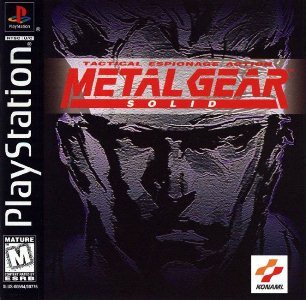
Metal Gear Solid's  box art for the PlayStation. It has the name  of the game over the forehead of the shadowy face of Solid Snake.

Metal Gear Solid's box art for the PlayStation. It has the name of the game over the forehead of the shadowy face of Solid Snake.

Over the weekend I started, and finished, Metal Gear Solid. I feel I should preface this with the fact that I’ve known about this series for quite some time and have some basic knowledge of it—enough to know it is intricate and says a lot of things people really like, as well as to know I am only aware of the tip of the iceberg. From my time with roommates in college to my time in Chicago, I have been on the periphery of one roommate who almost always seemed to be replaying Metal Gear Solid 3, and heard eggs frying in a pan and a little girl singing in Metal Gear Solid 4 at least twice as two separate roommates played through it in the other room.

So, going into the first game was a rather different experience. I had been primarily under the impression this was a stealth game series, and in many ways this game is. Going up against multiple opponents is suicide. Snake is painted as a soldier who is extraordinary, but even he has his human limits. He may be genetically altered (not sure on the full story, only operating on what I know from playing the first game—I ask you not to spoil it for me), but even human genes have their limits to some degree. Therefore, like many stealth games, you have quite a few limits, and outright combat is not really probable in your chances for survival (though probably not impossible).

That being said, it doesn’t quite work in this game. I found the controls to be a bit finicky. Reading the manual, I know pressing a directional button while grabbing an enemy would throw him, but even when I did not, half the time the guards would fall through my hands, rather than be held while I was going to attempt to choke them. It left me avoiding combat whenever I could, and later sneaking behind enemies and just shooting them with my silenced pistol. This is not necessarily a problem, but left me frustrated in the early portions of the game—it felt the game was inconsistent and I could not trust it. Perhaps that was the goal, though my gut instinct says no.

Instead, the game really shone for me during the boss fights. While I find the cutscene generally not my preferred method of information delivery in a game, Kojima is rather known for the ridiculous lengths of his. What resulted was it felt like a different flavor of the play experience in Shadow of the Colossus: focused so much on these boss encounters with the world in between forming the feel of the environment and my place in it. The codec transmissions would be the extra flavor that weave a more wordy story than SotC had, however—the trade off of roaming an open, desolate world would be a world with distinct other people who have their own personalities and specialties.

So, instead, it felt like I was entering a Western, ready to engage in a  duel. Considering each of these bosses was a personality unto his or herself, it really felt like a clash of personalities in which you were able to know your opponent. Raven’s stature along with spirituality made for a curious blend when he was using these very man-made weapons to try and kill you. Sniper Wolf’s expertise with her weapon of choice led a calm sense of superiority which was only confirmed in the cutscenes. Psycho Mantis was perhaps the most unique fight, and seemed the most psychotic of your opponents; in order to defeat him easily, you have to actually physically change the way you input your controls.

Therefore, while the game deals with the macro conflict of nuclear proliferation and use, the micro conflicts are what steer it along and remind us that behind the macro conflicts of the world are human beings who make these decisions. It is not so much the nuclear weapon that is a threat as it is the person who would be willing to use it. There will always be a means to destruction, the question is who will use it, and for what goal.

Considering how each person has an organization to which they are beholden (even if it is a terrorist group), and how even those organizations are not infallible—after all, Snake is betrayed by his own government—even the group, or the nation, are held together by a group of people whose loyalties are in question, whose motives are not always clear, and who are not so easily labeled friend or foe. Snake’s world is one where all the people aid him, even the ones he kills, because they provide him with some form of perspective—something he has been receiving via codec transmissions since the start of the game. And even those people, who have been helping him since the beginning, are betraying him in various forms.

Other points that caught my attention were that in the end it was revealed Liquid Snake was the dominant gene experiment, while Snake was recessive. I was under the (perhaps erroneous) impression that blonde hair was recessive, but Kris Ligman assured me that Snake dyes his hair. Which makes me wonder about Snake himself. I will likely write another post, purely about this singular game, about how Snake’s sexuality is presented. Largely because he goes through a similar action hero sexuality shift, where he is seen as a womanizer until he isn’t, when he somehow falls for Meryl (around the time she is wounded, which creates a whole power dynamic about saving the princess niece of your superior), who ends up humanizing him a bit. I know Meryl shows up later, so I will keep an eye out on that in future games.

In fact, knowing bits and pieces about the rest of the series, I am curious to see what will change, what will be further explored, and if any of these themes will be later subverted or changed (as I imagine they might in such a series that deals with political issues).

Posted in Character Analysis, Impressions, Metal Gear Solid | Tagged , , | 12 Comments