September was an interesting month for me, most notably in my actually getting the start of plans together to move back to the US come November. The exact specifics on that are in the air, but slowly falling, and I am sculpting them into my own little snowperson.
Which means writing has generally been less than prolific in all sources, but here’s what I have for you.
Then, working with Erik Hanson over at Gamers With Jobs, I started off a new series about playing Pokémon, but in drag.
No idea where October will find me. Have a few freelance bits and bobs up in the air. I also get the feeling I should play Gears of War 3, as in the last week, due to my previous posts about the series, I’ve had a resurgence in traffic to those posts.
Meanwhile, this video rather captures how I feel about producing content for blogs at times:
Recently I read all three Mass Effect novels released thus far. I will likely review them more in-depth somewhere else, but what I found interesting was how it gave further insight into the world BioWare has built, specifically: Captain Anderson, Cerberus, how humanity has changed. This post will concern itself primarily with Cerberus, and spoilers for the games.
Cerberus is a shadow organization. As was hinted at in Mass Effect 2, each operating team is its own cell, so that one tendril has no idea what the other is doing. The only one who has a massive overview is the Illusive Man, though various of his closer workers can surmise more truths, particularly as they are often sent to communicate between these various tendrils. At the end of the third book, Retribution, it is hinted that the organization suffers major losses, though Shepard has finished her business with the organization for now.
What this made me think of is the stark contrast of the open-galaxy exploration in the first Mass Effect versus its sequel. I’ve already made known my thoughts on how the level design disguises well the fact that Shepard is essentially walking down one long corridor after another, with each battle scene making its presence known with carefully placed barriers and chokeholds. Yet the game is often treated as a critical darling for its whole, which indicates we do not have as much problem with hallway gameplay as we do with how it communicates to us and what we get out of it.
What I would argue is that the bent of the first and second game is vastly different. The first game sets out to get us to know the universe. Since it is the player’s first interaction with the world, the general feel that you can explore at your own pace, and take your time, gives a sense of wanting the player to explore what has already been mapped, but to make it personally known. Shepard has more knowledge than we, but she is still not as well-versed as other species, indicating humanity’s relative newness to the entire intergalactic community. The first game is about giving us a sense of what this universe is about and how we fit into it.
The second is decidedly not. Its design features the aforementioned hallways (which, admittedly, have more variance in appearance than most of the locales of the first game), a set of conditions that force your hand into certain missions, and a feeling of being on someone else’s time table. Which makes sense given that Shepard is working for Cerberus. She is not given autonomy, even if the Illusive Man keeps harping on about how Shepard had to be as she was before, and given enough slack on the leash so her activities are not hampered. Which is where our decisions come into play, though we are manipulated via the game’s progression as much as we are by Cerberus itself.
What I find endlessly fascinating is how the fiction that is being created has a lot of second-guessing. For the most part, the novels manage to skirt around what Shepard is doing and has done, as her actions are surrounded by a certain sense of mythic awe and skepticism. Having her work for Cerberus also grants her a shield from the eyes of most of the other people in the galaxy. All any reader of the novels who hasn’t played the games would really know is Shepard is a hero who is off doing heroic things, but the details are hazy.
For quite some time BioWare has been asking that question: how does one define a hero? What this question is not asking is how one becomes a hero, but rather what happens after the fact. Regardless of what Shepard has done with Cerberus, she has focused the Reapers on humanity, defeated Saren, and become the first human Spectre. What they set up in the first game is someone who was given a free pass by the council to deal with threats facing the greater galactic survival (note, I do not say good, as Spectres are not so easily defined as ‘good’ heroes).
However, in the first game, Shepard is a huge icon: first human Spectre, in the council’s employ, representing humanity’s strengths. It makes sense that she would be given freedom to explore, express herself, and find her place. The second game is not about that. The death at the beginning makes even her resurrection a topic of myth and incredulity. Everything after is naturally given a much more streamlined and closed-off feel.
Shepard is being led in Mass Effect 2, and the final decision she makes is the one that sets her free from that obligation in one way or the other. Which is why the Arrival DLC is somewhat confusing: it aligns Shepard more closely with Cerberus in that her actions set her up to be a scapegoat in order to bring about accountability for the tension between batarians and humans. Again, Shepard is a pawn on the chessboard of Alliance politics, as she was in the beginning of Mass Effect, when she was only going on their missions and confined to the Citadel.
Shepard is making key decisions, but she is never her own woman completely. She is constantly being used by one organization or another, and her fight against the Reapers is beset by the problem she faces herself: that of being a larger-than-life concept. At the same time, she is able to work within the organizations to achieve her goals, but the question is at what cost? The trial that awaits her on Earth is likely only one piece of that equation.
Therefore, the first game is exploring the rise of the hero. The second is how the hero has lost control of not only her own image, but of her own future. Given the way the games communicate how we interact with them, it seems to make a lot of sense in that regard. Which only makes me wonder if the third is Shepard as the rallying leader, a whole new role for her that builds on what she has done previously. This is Shepard’s résumé.
At the same time, Shepard’s own limits mimic our own. As I’ve also written, despite the fact that there are choices to be made, the game is not wholly open-ended. What is being asked of me is how I interpret the actions Shepard takes. Every limit Shepard faces is another one that is translated to me. Being an icon and hero of Shepard’s magnitude can be as hampering as it is freeing.
I fell off the blogging bandwagon for a bit, largely because I relocated to Berlin, and have since found myself not being able to fully settle (yet, I’m hoping to do so in the coming months, though it may mean another move). Which is not to say my working on writing has completely stopped, and I recently started up again, so there may be use of this spot yet (which, incidentally, you can now also reach by typing in vorpalbunnyranch.com or denissfarr.com into your URL box).
Meanwhile, three pieces of writing I found noteworthy, and you may as well:
I want to interview more people, as I find it an interesting endeavor. Interviewing drag queens who game, for instance, allows for a lot of fun.
Choice of Games let me catch an early peek at Choice of Intrigues, which is their sequel to Choice of Romance (and only the second in a planned trilogy). My review is here. Largely it’s a look at how the game functions as a reflection on our own society, but then I played two same-sex romances. There’s something further in the works on that title, however.
Then there’s my step back into writing for The Border House, with a post about the Politics of Game Hair, particularly natural hair. I know from the technical side the argument will be that there’s still a lot of work to be done in general. I get that, I understand. But unless someone points this out, I fear it would be all too easily ignored.
Beyond that, you can now add me to Circles on Google+, which I’ve been using to post all manner of short-form thoughts.
Articles on which I’m working include:
The history of the Sims franchise as it parallels the fight for same-sex marriage.
More interviews, particularly for the upcoming (in October) Ada Lovelace Day.
Some fun stuff with Choice of games.
The ending to my posts about Half-Life 2, which will be on The Border House.
Examining the story of Tactics Ogre: Let Us Cling Together.
Possibly something examining how playing many Facebook games often makes me feel like I’m playing at an Advent Calendar.
Spoilers: Dragon Age 2 and Mass Effect 2: Arrival.
BioWare has become known for the choices it presents its players. Are you going to be a Jedi or Sith? Open Palm or Closed Fist? Paragon or Renegade? However, with Dragon Age, the choices were slightly more varied, and did not plot you on an overall either/or scale. Unfortunately, this led to some quests being approached in a manner to game the system and receive the ‘best’ result. What seems to have happened is BioWare questioning how players make decisions and how to tinker with their own formula.
In particular, this appeared to have happened quite frequently with the Redcliffe quest, where one has to make the choice of how to deal with Connor. As David Gaider points out in a post on the BSN, this meant many would just look up how to ‘Save Everyone’ and take that route, thereby bypassing any actual decision making. This led to a different view of how to accomplish certain goals in the game, and in a forum thread, Gaider talks about the murder of Leandra:
If you’re of the opinion that every story should have an outcome that the player can directly control– I’m not going to argue with you. Not everyone is going to like that sort of tale, and certainly I think there’s a limited amount of that you can really do inside a game. But this is the sort of thinking that led to the “Save Everyone” option in the Redcliffe Quest, which ultimately became the quest option that everyone thought was the only “real” solution even though it was the least dramatic. I don’t really intend to do that again, and I’m not about to re-write it simply because some people feel uncomfortable about it.
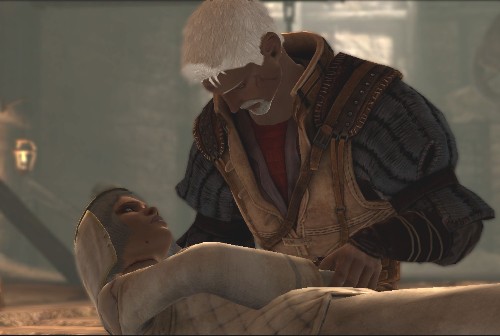
Redgren Hawke holding the Frankensteined corpse of his mother, Leandra.
In general, I agree with Gaider about the fact that sometimes things can be outside of the player’s control, though it needs to be handled differently. Apparently, according to Gaider, the original quest had an option to save Leandra, but when people were presented with the option, they felt they had to save her, rather than it being an option.
When Anders blows up the Chantry, thereby forcing action upon the player? I see it less about Hawke changing the world, so much as Hawke taking command of the situation. You’re still making decisions, just not the ones we have come to expect. The big, moral decisions are supposed to be made by us, after all, right? Otherwise we’re just railroading the character, right?
While it is a form of railroading, it is one that I assert can be useful. In the case of Anders’s bomb in the Chantry, it paints a picture whereby Hawke is not the only important character in the world of Kirkwall, which makes the fact that she’s become a legend all the more intriguing (and speaks to politics, image, and Hawke’s own privilege). If all the big decisions are made by the Champion, all we’ve done is provide the typical empowerment fantasy, whereby the player is the only character worth anything in the world. Everyone else is just a tool to use as Hawke’s ends may require. I, for one, was glad that my companions such as Isabela and Anders had their own goals, quests, and were not just waiting quietly for me to direct the course of their lives.
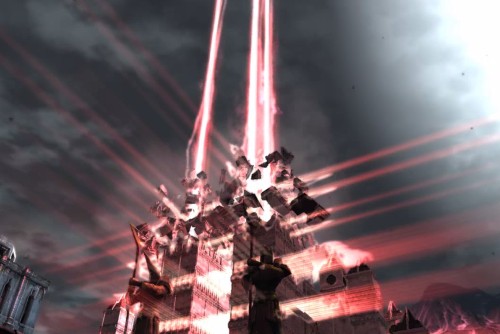
The Chantry of Kirkwall being blown up, emitting a red light.
However, it is important to note that in Dragon Age 2, these big decisions are never presented as Hawke making decisions without your input–it is the intervention of other characters that forces you to make decisions on how to proceed. Mass Effect 2: Arrival does not use such a tactic, rather using the railroading technique to force your Shepard to make a decision. What results is that regardless of a Shepard’s approach to things, the decision is always the same, and ends up with Shepard ready to face trial upon return to Earth.
It’s easy to see why they made this decision: it forebodes an uncomfortable situation for Shepard in Mass Effect 3. At the same time, it also does something the rest of Mass Effect 2 did not: force a decision upon me by wresting control away from my Shepard. In technical effect, it’s much the same as happened continually in Dragon Age 2, but the way it is handled, by making Shepard the locus of that action, is much different. Rather than roleplaying a character and feeling I am having an effect on the universe the game is portraying, I am being told some of my decisions simply do not matter because Shepard and I will part ways on whether to save a planet with Batarians or to destroy them to hinder the Reapers.
Naturally, the setup was such that Shepard only really had one choice to make which would make sense with what was planned. While it can be argued that it was necessary for Shepard to make that decision, at the same time, the setup itself was subject to change. In an effort to tell a compelling story and set up Mass Effect 3, what has happened is I’ve become distant from one of my Shepards. This is not a case where I can decide how I will react to Isabela and Anders and determine if I can forgive them, but one where I am distanced from the very character I have been playing, and whom I have been encouraged to inhabit.
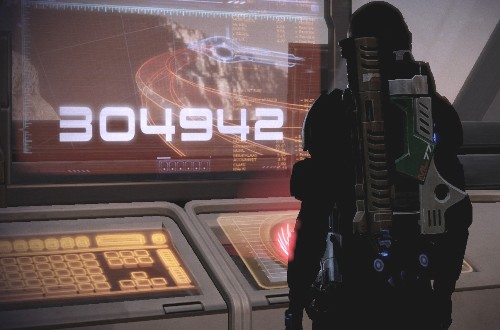
Ronia Shepard standing in front of a panel displaying the population she will sacrifice.
In theatrical productions, it can be the case where I may play a role with a character who makes decisions I do not quite understand at first, but whose decisions help me build a character. I have argued that I often see the act of playing a game as rehearsal (and am coming to the decision that it includes a fusion of such with performance), but games are an extension of such thought, and when I meaningfully inhabit a role that is predicated on making decisions, it seems forceful to make a difficult decision for me. It distances me from the avatar I am theoretically controlling, which may well be the desired result.
With a scripted character, the decisions made become a matter of figuring out why the character did such, whereas the way Mass Effect 2 had previously approached such critical plot points was one where I questioned which motivations struck me most. Actions easily define a character, and when made by an NPC, they help write that character as much as, if not more than, the dialog. The difference is between losing control of the trajectory of the plot and losing control of the character I am supposed to be playing. The former allows an in-game response, while the latter shifts that focus to the player’s response.
If you’ll forgive me, this has nothing much to do with videogames. However, I saw this video of Michael Abbott discussing Wabash College’s environment, and wanted to post my own feelings about it; since I feel my Tumblr would not be the appropriate venue for such, that meant I felt I would put this here.
My own experience with Wabash still leaves me confused. At times I’ve contemplated writing a small book about it, largely focused on how Wabash both defined and challenged me as a genderqueer-identified gay male.
My first experience with Wabash was a brochure that gave me the typical spiel about the college, trumpeting facts and statistics for which I had no comparison other than the other brochures that cluttered my mailbox. Coming from a family where my parents were educated in Germany, I pretty much waded into the information that was being thrown at me by myself. What struck me about this particular brochure is the back had the mail-in card and asked a question: “When I come to Wabash I will be: (check either boy or man). When I leave Wabash I will be: (check either boy or man).” In a tongue-in-cheek manner I checked both as boy and sent it off.
When Wabash finally did send me the application, I recall taking it to school with me and sitting with my group of friends who were bedecked in black eyeliner and t-shirts that proudly displayed names like the Misfits, Tool, and Nine Inch Nails. I was never known as straight at this particular school, so we all had a good guffaw at the notion of myself attending an all-male college whose brochure was full of men who would be more prone to wearing Abercrombie & Fitch and other such labels.
At the same time, I applied to every college where I didn’t have to pay an admissions fee. My living situation at that time was such that I was without electricity, had no phone (at one point Wabash wanted to call me, so I gave them the number of a payphone near my house, and waited by it at the prearranged time), and my family was always one accident away from eviction and the homelessness that would entail. I wanted to go to college, and was encouraged to do so by teachers and counselors who never acknowledged my situation openly, even if they danced around it. This also meant I applied to every and any scholarship I could find: Wabash has quite a few to which I sent off materials. One of those was for creative writing and, to my surprise, it received a response.
What resulted is Wabash College offering to fly me out to Indiana and to stay with them for a Fine Arts Weekend, where I would read aloud some of my writing, attend a few classes, and stay with another Fine Arts Fellow. It was an offer I didn’t feel I could refuse. The weekend was as confusing as I’ve previously claimed my whole experience to be.
While meeting people around the fraternity in which I was staying, many topics were broached: my interests, in what I was involved, in what I thought I would major, my high school, and if I had a girlfriend. One thing I refused to reveal was my sexuality, even though I knew it would be a ‘thing’ were I to attend.
In the same fraternity in which I was staying was another Fine Arts Scholarship applicant, though for music. As often happens at Wabash, that weekend featured a rather raucous party atmosphere, where the main attractions were to be alcohol and women. As I wasn’t really interested in either, I mostly stayed to myself and used someone’s computer to catch up on my email and such (something I did rarely then, and mostly at Clarksville’s public library). The other scholarship applicant came in to talk to me, and his very first question? “Are you gay or something?”
In complete opposition to this party atmosphere in which I felt uncomfortable, were the professors. From Abbott’s tour of the Fine Arts building, to the interview I had with Professors Castro and Hudson, and then the classes in which I sat, I was given the impression that the academics I would be presented would be exponentially more rigorous than the classes I was taking in high school, where I never took homework home, and easily participated in multiple extracurricular activities (as much to be involved as to stay away from home). I wanted to be challenged in that way.
In the end, I did receive scholarships and grants enough that my loans were not really that much. Wabash became, in my mind, the only college I could attend and not plunge myself into severe debt. With a hope that it would spell something new, I sent off my materials to acknowledge I would be attending, and spent that last summer torn between excitement and a quiet dread.
Over my four years at Wabash, I learned quite a bit. The lessons I learned foremost were how to educate myself, and how to question both that education as well as my surroundings. While the culture the Wabash professors seemed to want to press was to question and critically address topics, the feeling I received from a majority of the student body was one of just wishing I would be more normal and be quiet for once. I spent my time there constructing an identity that was not me.
I was not unaccustomed to putting on masks. The one I happened to put on at Wabash was one of being completely brazen, and daring people to question me. I put myself out there as much to question others’ beliefs, as to make myself a target and gather attention to the fact that there were other experiences. In many ways, it felt like a playing field where I could test how far I could push buttons and make people change their views.
Had I not attended Wabash, I doubt I would have become as outspoken as I have on certain topics. I would not have learned to check my own privilege as regards race when I did; this was a topic I forced myself to acknowledge when speaking with close friends who were participating in their own activism as regards race (I still recall some of my earliest conversations, and cringe when I think of what ignorant words came out of my mouth). It’s not as likely that I would have taken up my Gender Studies area of concentration. I would not have started writing about videogames when I did. There are many things Wabash introduced to me both in and outside the classroom.
Yet, when I left Wabash, I was completely lost. I had no idea how to function as myself, but almost completely as a caricature of a human being. I knew how to be an actor, how to be an activist, and how to be a spectacle demanding attention. I knew how to be openly gay at an all-male college. I also knew how to be male in sex, but not in gender in such an environment. All of this was mixed with the fact that I was nowhere near my family, and felt a deep sense of loneliness (which is not to say I was alone, I had very close friends with whom I still talk regularly). There was so much time spent wanting to make other people question their own beliefs, that I had not firmly established my own. By the time I walked away with my diploma, my hair both black and blonde in splotches, a rose clenched between my teeth (they were given us to give our mothers, though mine could not attend), I only had the vaguest ideas of who I was.
For quite some time I’ve acknowledged that Wabash gave me the voice I have, and that it stoked my passion for desiring to be critical. At the same time, I realize that as an all-male institution, if it wishes to remain such and not crumble into complete irrelevance, it needs to embrace a culture of questioning, as Abbott discusses during the embedded Chapel talk.
In my circle of friends there were people who were not-white, trans, gay, bi, and many other identifications besides. Wabash was stuck in between two environments: an academic body that seemed to encourage diversity against a predominantly white, straight, cis, able-bodied, and middle-class student body that did not want to question their own behavior, let alone how to accept something ‘other.’
Being all-male is one matter. Expecting everyone to conform to one type of male experience is completely another (especially when it typically engages in rhetoric and behavior that treats women as both objects and Other).
It’s been a somewhat productive month, dominated (not surprisingly) by Dragon Age 2. As I am headed to Berlin for an indeterminate time that may end up permanent on Wednesday, I am not entirely sure how productive this month will continue to be. I certainly have enough to write about DA2 still, but actually playing games? Outside of my PSP and browser-based games, that will not likely be happening until I get settled in some way.
This interview was conducted a while ago, but then publishing was delayed for various reasons. Regardless, my interview with Tale of Tales is finally up (P.S. I love talking to devs and creative types in the industry)!
I reviewed the Facebook gameDragon Age: Legends, which claims to be the first ‘real’ Facebook game. Not entirely sure of the validity of that claim, and I do wonder at introducing such high levels of difficulty into a more casual-oriented space. The mixture is jarring.
Wrote a spoiler-ridden inclusivity review of Dragon Age 2, not really touching on anything in depth. Have seen it passed about here and there, so was glad to see that.
Then I wrote a piece defending the decision to have all the romances in the game be open to either sex.
There was a brief break to put up this piece on Sander Cohen, for which I had the wonderful opportunity of talking with Ken Levine (it was rather surreal to be discussing it with him over a phone when it was 21.00 here, but during business hours in the U.S.).
Originally, I didn’t want to post about this, but saw a few sites reporting it as gay gamers wanting Gaider’s dismissal from BioWare, rather than A gay gamer (allegedly), so wrote that GayGamer did not share those views.
It delights me when a company will direct us to their games that are providing avenues of inclusiveness, which is what Lucent Heart did concerning their poll to include same-sex relationships (relationships have an in-game bonus).
Wrote this review of Mass Effect 2’s latest piece of DLC. Have a post brewing in my head comparing its decision-making process to Dragon Age 2, and why I didn’t like the railroading as much in the DLC.
So, hopefully I’ll have some posts up during the course of the next few weeks both here and other places. Really, need to push myself to write more for The Border House.
The world view the writers of Dragon Age espouse is quite fatalistic. In their world, power does beget responsibility, and people normally manage to abuse it. Kings, queens, humans, elves, Qunari, Andraste, etc. It’s all a big battlefield of power where people are exploiting each other left and right (though not equally, as issues of privilege are explored in the series). Then, there’s not just mages, but blood magic.
First, there is the mages’ lore page over at Dragon Age 2’s own website, which describes the Blood Magic specialization as such:
Nothing inspires as much wild-eyed terror as the Blood Mage. Mages of this type take the raw energy of life and twist it to their own purposes. They can corrupt and control, and sustain their power by consuming the health of others, willing or not. The effects can be vile, but this specialization isn’t limited to madmen and monsters. Many see it as the only form of magic that is truly free, because it’s tied to the physical, not favors to spirits or demons. It remains an undeniably violent and self-destructive discipline, however, and the Blood Mage must be careful. The temptation to take just a little more is always there.
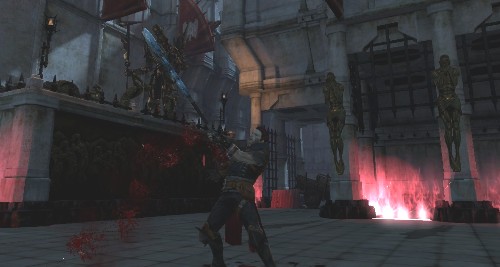
Zel Hawke stabbing his staff into his chest.
Outside the Tevinter Imperium, access to blood magic seems to be most easily gained from demons. In the first run of a Dragon Age: Origins play, one can make a deal for the secrets of the specialization by making a deal with the demon possessing Connor in Redcliffe. Presumably, Hawke could have either learned it from her father, or other blood mages in Kirkwall. Merrill also gains access to it via a deal with demons.
Blood magic doesn’t have much to do with demons outside of the method of obtaining it, however. As it does not rely on the Fade, as the lore states, it is the one school of magic that is purely reliant on humankind’s own life force and power–and is much stronger for it. Comparisons are often made in the measure of a room full of lyrium or the life of a slave can provide the similar amount of power.
Which is where the issue of power comes up: given the cheaper access to it, why wouldn’t one use blood magic when one has access to it? Well, why wouldn’t one use golems, made from the life of a dwarf, if one had access to it? This has been a central theme in Dragon Age: what costs are we willing to endure in the name of power over opposing forces?
A recurring sentiment right now seems to be that many would feel sympathy for the mages, if it weren’t for the prevalence of blood magic in Kirkwall. The issue is, again, not the use of blood magic, but what that magic has the power to do. Zel Hawke never actually used the possession skill in the tree, using it instead to damage foes directly, and gain access to a mana pool based off his life force. Curiously, Merrill also never gains access to the spell to possess and control enemies.
Therefore, blood magic is a tool like any other. The ways in which Zel Hawke used it were no more damning than hurling a tempest of storms at them to blast them into exploding bits of flesh. There are other mages who don’t use it in a wholly negative manner, and it’s their use that helps explain how the question of whether or not it should be used is trickier than it may at first appear.
Alain, for instance, can use it to awake whomever the mages have kidnapped in Act 3. Beyond that, he isn’t seen using it in any negative manner. You first encounter him when he’s terrified of its uses, and the fact that he’s learned it at all seems a testament to the power struggle for self-defense against the Templars. Yet he never uses it against people.
Gascard DuPuis does have shades and demons who attack you, but blood magic is not required for such magics at all. Instead, he uses blood magic to track down Quentin, who does use it. He is using blood magic to combat one who uses such for harm, though not taking it to the same extremes. If you allow him to bring you to Quentin, he can fight on either side, depending on how you approach the situation.
Merrill’s situation is complicated because she never uses blood magic in a way that can be seen as harmful. If allowed to construct the eluvian, she will eventually go back to confront the demon, only to find Keeper Marethari has taken the demon with whom she previously made a deal inside herself, preventing any further contact with Merrill. Merrill never gets to the stage of doing something horrendous, and it’s hard to say if she ever would have.
Ultimately, there is also Hawke, depending on how you play her.
Zel Hawke removing the staff from his chest to see an outporing of blood spurt out.
There are people who can use blood magic and not do horrible things. Blood magic is also not required to do such: Anders is adamantly against blood magic’s use, yet blows up the Chantry. The tools exist in varying fashions, and it’s how we use them that counts.
Which is why I was confused at Orsino’s seemingly sudden turn at the very end of the game. On replaying the game, however, I was curious to find that in the quest where I’m tracking Quentin, there is a note that talks of how his research has been aided by the Circle, signed with -O. What it shows is that Orsino was allowing the study of blood magic the entire time, but that he was short-sighted in seeing the consequences for his own actions.
That’s the difficulty of power in any situation, and the one this school of magic brings up for us to examine. We can use a devastating force against our enemies, but depending on its application, and what we sacrifice to gain that power, we end up damning ourselves. Zel Hawke started off as selfish, and when his fortunes improved, he became a beneficiary of people in lower classes. The plight of mages was personal, and affected both he and his lover. He still used blood magic. The game’s own systems require no inherently evil task in using it, showing that in the larger world of Thedas, its use is not inexorably tied to evil acts.
However, Zel never used blood magic in a way that was worse than any other tools at his disposal. In that way, his fight against Orsino made all the more sense, because he was a gate of that power used for the wrong purposes. Even his cousin from Origins, Aeazel, eventually stopped using the power for his own means, fighting a Tevinter mage, rather than allowing the room of slaves be slaughtered to give him power. This then means we need power to check power.
Given access to such tools, I believe it’s a wonder we don’t see more mages resorting to it. The question of blood magic then becomes a curious example of the oppressed being able to be the oppressors. This does not have to be the case, but if the Templars are so willing to stamp it out, they reflect the world of Thedas, and what it knows is possible not just in the Tevinter Imperium, but in the hearts of people with no access to magic; the same people who try to instigate wars against the Qunari, leave kings to die on the battlefield, or force elves into ghettos.
I had it all planned out. My first Hawke was going to be of male sex, based off of my main alt in most games, Aeazel, and be a mage. I even had planned out who Zel Hawke was going to bring along as companions. As a gay man, I wanted to bring along the two male companions whom I could romance, so that was automatically Fenris and Anders. Isabela reminded me of my mother’s sarcasm and unabashed joy of sex. There we go.
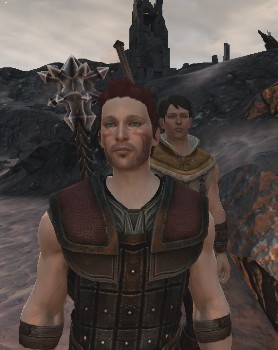
Zel Hawke standing in the foreground, with his brother Carver standing over his left shoulder.
It didn’t really end up that way, though. By the time I was running around Kirkwall, earning coin for an expedition into the Deep Roads, I found the arguments my brother and I kept getting into rather endearing. Well, not endearing. Intriguing? I overuse that word–it’s become as meaningless as interesting or stuff.
Personal.
Here is where I’ll delve a little into my personal life to lay the groundwork for this discussion. My mother’s favorite example of how different my brother and I are that when we were both three (I’m the elder, and we’re four years apart), she put puzzles in front of us. I grasped the concept and started attempting to put the puzzle together. My brother chewed on the pieces.
Growing up, I was the son who was known for his scholastic achievements both academically and in extracurriculars. My brother’s interest was not in school, and while he made an effort to live in my grade point shadow for a time, he eventually just rebelled against that concept entirely.
We’ve had our fights.
Carver’s being alive is contingent on you playing as a mage. If you play as either a warrior or rogue, he will be killed by the ogre, and Bethany will live. As a mage, it means that your family makeup was such that Bethany and you were both apostate mages, and he was born without that talent (or curse, as some may see it–being able to throw fireballs does not seem like a curse to me, demon possession chance or no). He was both living in the shadow of not being a mage, as was your father, and also having his family life constantly dictated by hiding because of said magic. While your mother loves him, her noble lineage and background has estranged me in both playthroughs so far, especially anchored as I have been by my siblings’ behaviors which indicate that is not our own identity.
He hates the life into which he has been thrust. He wishes to rebel against it.
So my party instead became Anders, Isabela, and Carver. My interest in Anders, and in not condemning mages (hey, that’s me!), meant rivalry points with Carver stacked up fairly quickly. Still, despite the fact that my mother worried about us both being lost if we went into the Deep Roads together, I respected his ability, if not his personality. He was both my little brother in game, and the little brother I have in real life.
In other words, whether or not they intended it as they did, my roleplaying Hawke hit the nerve of an older brother who recognizes the shadow he has cast, and how that makes life difficult for the younger brother seeking approval from not just parents and peers, but the world at large. I could see how much that meant when I gave Carver the letter that told him how his namesake was a Templar our father deeply respected. It was an admission of pride in his son, regardless of who he might grow to become.
The end of the first chapter in the game can go three different ways as regards Carver. If you don’t take him with you on the expedition, he goes and becomes a Templar. If you do, and don’t have Anders with you, he is infected by the darkspawn taint, and will die. If Anders is there, he knows of a wandering Grey Warden troupe that can go through the Joining ritual to save him.
If Carver dies, it was trying to prove himself just as capable as his elder sibling. You have to go on the expedition, as your ability is the one specifically recognized by Varric. He bristles at your mother’s suggestion that he stay behind. The message he receives again and again is that he shouldn’t go on the trip, because it’s not his place.
The other two paths are ones that remove him for your game for most intents and purposes. As a Templar, he is pushed to the point of opposing your very being–a free mage. As a Grey Warden, he must undergo their Joining and training, and becomes involved in their politics. Both speak to carving out his own name, and making his own place in the world. He had tried at Ostagar, under King Cailan’s orders, but found failure.
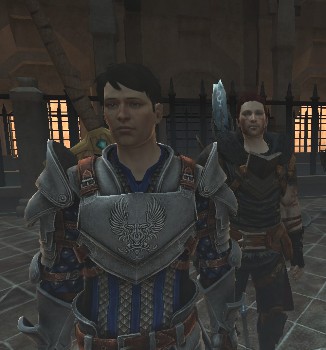
Carver standing in Grey Warden armor, Zel Hawke standing behind, over his left shoulder.
When my Hawke found Carver again while searching for Nathaniel Howe in the Deep Roads, Carver explicitly states he finds himself once more in my shadow. While I’d normally kept my responses to him sarcastic (and my Hawke had a semi-permanent sarcastic tone due to the response stacking system the game uses), I suddenly found myself being kind to him. He was my little brother, and he didn’t hate mages, he hated being in the shadow of his elder brother, who was renowned for being a mage.
It was both personal to Hawke, and not personal to mages. Or so it read.
Meeting him again during the Qunari invasion of Kirkwall, I told him about what happened to our mother, and I did so again with kindness. He was the only family I had left whom I respected. Neither Bethany nor my father played much a role in my time in the game beyond being a story to which I had no connection. My mother was a well-meaning woman whom I found cloying and demanding at best, and who was killed. My uncle was someone I loathed and could not respect.
Carver had both been a battle companion, and was someone who had interacted more heavily with both myself and the other people with whom I traveled who became my extended family. His role in my group had been a tank–my protector. It influenced how I saw him: despite my quibbles with him, he was someone on whom I could rely.
When he finally showed up in the game’s denouement, I put aside the better tanks I had crafted out of Aveline (whose sword and board style was more fit for tanking) and Fenris (whose Lyrium ghost ability gave him extra bonuses in defense and crits), just to have my brother by my side. My brother who had earned his own armor, and his own place in life, but still wanted to fight by my side. He still wanted to protect the enemies from attacking me.
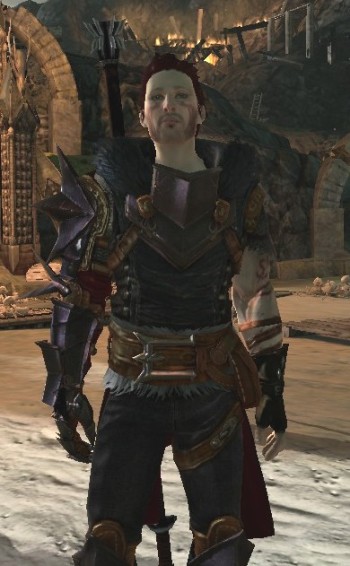
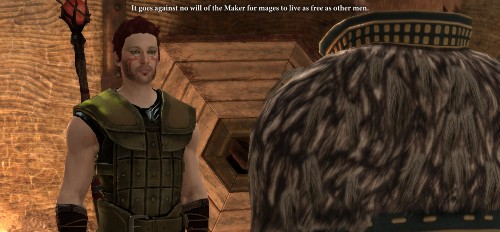
Zel Hawke after earning his Champion armor. He's a scruffy, auburn-haired white man in his twenties, wearing pointy mage armor.
I’m getting into the habit of not posting again, which tends to occur when my mood shifts down. In trying to combat that, I’m writing down some general thoughts about Dragon Age 2 that are relatively spoiler free–at least as regards specifics.
The frame narrative is used sparingly, as is the unreliable narrator. This will come as a relief for many, and in playing the game, it did for me as well. In order to utilize those elements, they would need to be at the core of the story, which is not the case here. It simply serves as a vehicle to move the plot and explain things without a conventional cutscene.
Levels are recycled. When I first read this, I thought perhaps just the environments themselves, but no, that one cave you just entered? You’ll learn the layout of it very well by the end of the game. The problem with this is multifold. First, it is wearisome going through the same level multiple times. Second, the minimap in the upper-right corner never changes to reflect which areas have been walled off this time. At the beginning this led to some confusion. Third, the level designs themselves are uninspired and dull.
Kirkwall itself is fun to tromp around in for a bit. While there are minor changes from chapter to chapter (usually skipping three years), the city sees relatively little change. This is a letdown, and is a concern. It had such potential that it squandered.
Zel talking to Anders, whose feathered back is to us. Two snark mages together? Mmmm.
The game addresses mental health issues multiple times, and in a generally failing way. Most of these people are violent, and must be violently stopped. Some fall into the, “picked up item of power, went crazy” trope that fantasy seriously needs to reevaluate. It’s ignorant at best.
You can’t interact with your companions as often. The longer conversations you could have in Origins are not there anymore. However, and this is where I shift from negative concerns to positive comments, the relationship status that exists does away with meaningless gifts to game an opinion. You can still game opinions of your companions by certain actions you take, but it will affect your story. Your choice.
Instead of the focus being on building up to a relationship, the relationship I had with Anders was more concerned with the relationship we did have. The poignant moments for me were involving the scene that led to sex (which almost seemed an afterthought after the emotional outpouring that occurred just prior), and when certain plot points happen later in the game. It didn’t use sex as a commodity, and it allowed me to have a relationship over years, not just a fling.
The combat was an enjoyable affair. The shift is away from standard tactics the first went through–enemies now come in waves. This meant my tactics weren’t as planned, and also meant I was kept more engaged in it. It also helped that my mage’s spell trees were much more streamlined, and I didn’t have tons of useless spells. Everything I selected, I used. When I didn’t like my choices, I could upgrade the talents and spells I did have.
Since I am a micromanagement type, that meant I also turned off tactics in the game, so I cannot speak to such. This meant I paused a lot and ordered my companions around. Anders was almost always by Zel Hawke’s side (I imagine them flirting between spells).
Redgren Hawke with his family. Showing off how the darker skin models translate to other family members.
The story itself falls into a three act structure (I should probably don my theater critic hat for this game at some point). While they seem not very connected at first, how everything ends brings up the ever-true everything is connected point. What affects one character can set off reactions somewhere else, etc.
Conversation was more enjoyable for me. Zel started off a snark mage, but after the second act, he realized he had the ability to make peoples’ lives better, and started fighting against oppression. This led to some nasty rivalries while cementing certain friendships. In general, not tying my responses to my alignment allowed for a character shift, and didn’t result in me gaming the system. It allowed me to roleplay Zel Hawke.
The second act plot twist was also endearing. The third act’s plot twist gave me pause. It was one of those moments I loved so much in Origins, where I had to weigh the pros and cons, and how this character would feel. Could he make the decision he was about to make, and why would he? Could he justify it to himself, and if he could, what did that mean?
Then, the last fight happened. I’m going out on a limb and saying the last fight may have soured my opinion on the game a bit. They used a Chekov’s gun that wasn’t necessary. Everything to which the game had been building had a perfect excuse, and then it threw in an insulting last boss fight that was as implausible as it was unnecessary (the fight itself? Fun. The final reasoning for it? UGHH). Spoiler: remember that bit about magic items making people go crazy? Wasn’t necessary and both insulted me as someone who has had mental health issues, and made my story critic just cringe in pain.
Overall? I enjoyed the game. It ended on a cliffhanger where I’m less concerned with what my Champion goes and does (beyond living as an apostate with Anders–this means in my world the Amells have created two mages that have drastically altered Thedas) and more concerned with what will happen in the world at large. There were many strings which were left untied on purpose, and I’ll be curious to see whether they are addressed in DLC or the third game.
Last note: the references to actions in Origins were appreciated on this end, and caused me quite a bit of mirth to see my decisions acknowledged.
Tip: have Isabela banter with everyone. Banter is still hilarious, and Isabela’s may be the best. That is, next to the one time Anders asks Sebastian about his armor and the placement of Andraste’s face.
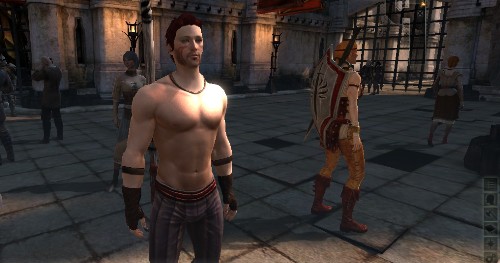
Minor annoyance: Lady Hawkes stripped of armor are in ‘sexy’ panties and a bra. BroHawkes stripped of armor are in pants (picture of that below).
Zel Hawke standing, shirtless, in The Gallows. Aveline turns her back to him.
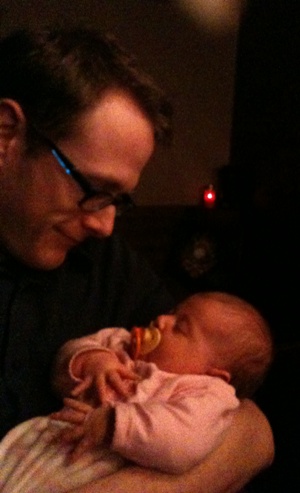
Myself holding my niece, Alice (age: two months). She's also been a healthy distraction this month.
February has been an odd month in that I’ve been seemingly extremely busy and not focused, leading to less productivity overall. For instance, I only wrote one piece at The Border House this month, even though I had plans for more, started rough drafts, and never finished. Also, I’ll be adding two pieces from March, as they both appear on the first day, and one was written during February anyway.
I had a lengthy e-mail exchange with Deirdra Kiai about her game, Life Flashes By. It was my only piece for The Border House this month, but I was also really glad how it came together and allowed Deirdra a chance to discuss her game a bit more.
I questioned the quandary in which I found myself: I wanted to review Magicka. Unfortunately, the game was too bugged to get an accurate depiction of the final product. In the end, it caused me to not review it until…
Today, where I finally reviewed it. The difficulty was I was so hopeful, and I wanted to give it a positive review (for the most part, I did), but could not in good conscience do such. I suppose it brings up the question of what I see the worth of my reviews being. Questions…
“Coming Out of My Virtual Closet” is exactly what it sounds like: a recounting of the first person to whom I came out. It just so happened to be in an online space, which is rather imprinted on my mind.
Pitchford asks feminists to use Duke Nukem. I examined the fact that someone seemed to want to make use of the word fag and made sure we understood it was a cultural thing. I wondered why an American hero, developed by Americans, was trying so hard to be ‘edgy and funny’ with a British colloquialism. It doesn’t offend me, it just confuses me.
I wrote something for Paste (and may do so again soon)! I pitched the idea to Kirk Hamilton that I wanted to look at the evolving morality system BioWare is using, and how it’s become decentralized, and allows for much more fluid interactions–I wanted to focus in on Dragon Age 2. He suggested we talk about the demo and have a conversation about it.
That’s all for this month. Things to come? I’ve been taking screenshots of X-Com and Stronghold for a post at The Border House. There have been a couple of playthroughs of Portal. There are two posts bouncing about using both Donne and The Awakening as comparisons (not a direct comparison, mind). Also, Dragon Age 2 releases–anyone who read this blog when the original released will probably know where that will lead.
Hi, my name is Denis. I originally started this blog over at Blogger in July 2008. I tend to write a lot about videogames, and have made various rounds of the web. Was formerly a staff writer for both GayGamer and The Border House. This blog serves to explicate my thoughts on any number of issues, not solely focused on videogames anymore (though they still make up the majority).


 Vorpal Bunny Ranch