Trade Wars To Facebook Games

Gaming has always been something social in my family; if you wanted to be alone, you opened a book. Everybody gamed, so we would often watch each other, talk about games, and reference them. If you’ve never laughed while family members jokingly toss Insult Swordfights at each other, you’re probably missing out. What this also means is that my memory of moving to Clarksville, Tennessee is quickly followed by a memory of a few more things: receiving my own computer (there were two family computers already), and having my mother introduce me to two BBSes. The first one’s name I can’t recall, though I do remember the SysOp’s son came over once and we were supposed to make fast friends–it was an awkward event, to say the least. The second was called Nifleheim, and was host to people I would come to know quite well, though mostly by their handles.

What I recall specifically about this time period is my earliest click! moment, when the part of me that would snuggle up with feminism started coming alive (there was another, larger event later in life, but it doesn’t have anything to do with videogames). There was a chap who went by Elvis Hitler who attempted to explain to my mother how she would be rubbish at the BBS game Trade Wars.
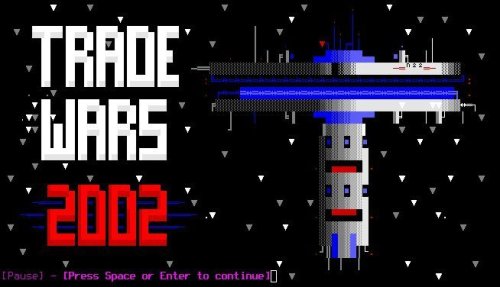
The splash screen for Trade Wars. The title, "Trade Wars 2002" scrolls down the left-hand side, while a space station hovers right.

The splash screen for Trade Wars. The title, "Trade Wars 2002" scrolls down the left-hand side, while a space station hovers right.

There were a number of reasons her female mind wouldn’t get it. It was sci-fi (my mother still recalls standing in line to see Star Wars in the theater). There was a lot of math involved. Not only that, but it had to do with economics. Then, that ever ‘scary’ word of strategy cropped up–after all, all the great generals in history are men, or some such tripe. Oh, and women just weren’t as good at gaming as men.

From my view point, and I was likely eight at this time, these all seemed ludicrous claims. In an era before GameFAQS and online guides, I had my very own hint hotline known as my mother. Every game I played was one she had played previously, and could help me in any spot that might trouble me. The fact that she might not be good at a certain type of game because she was a woman never entered my mind–she was a gamer, my mother, and therefore I assumed all people were capable of gaming–it was not divisible by sex.

What ended up happening was her using a different handle to play the game, and her purposely hunting Elvis Hitler to demolish his trading capabilities, along with his ego. I’m not sure she planned on it, but this resulted in his coming over and divulging various secrets to her. “Whoever this new person is, he’ll never find my planets in this sector!” My mother, approaching thirty, and having handled sexist asshats on two continents at this point, had played mum to his explanations of how she was an inferior gamer. What she had done was declare war without letting the other party know–much as he’d already done with her.

A character portrait of Arlana, my mother's character in The Realm. A white woman with a brown mane of hair.

A character portrait of Arlana, my mother's character in The Realm. A white woman with a brown mane of hair.

My mother is a social gamer. She always has been. There have been stories of playing Donkey Kong in arcades with girlfriends. BBSes. The Sierra Network. The Realm. UO. Diablo. While she certainly enjoys single-player games, being a social person at heart, it wasn’t hard to see why we eventually had three computers with modems and four separate phone lines in the house, and many, many LAN-playable games. It wasn’t always necessarily playing with other people, as she has little patience for people who don’t understand the game as well as she, but having the ability to talk to people in game.

As MMOs have marched on, however, I’ve noticed a trend that was established quite some time ago. My mother only plays games where she can solo if she desires. She very carefully chooses her parties, unless completely impossible. One of her last frustrating moments was when a PUG member declared something as gay, at which point she declared quite firmly that she was a mother to a gay son, and that some people needed to stop typing.

My mother is approaching fifty. There are no signs of her giving up gaming at any time in the near future, or ever. When discussing Dragon Age: Origins, she grins as she confides that she found it a challenge to deflower the virginal Alistair. Talk to her about The Sims and she could go on at great length why the third installment’s move away from being friendly to community mods has ruined her interest in the series. At this point, most of her gaming is done within the confines of Facebook.

I kept contemplating it as I watched her play. She would pop open four different windows (she despises tabs for some reason), cycling among them while their various timers kept spinning onward. Her line of work is online, so she has a huge swathe of followers who gladly play these games with her. In effect, she has jettisoned most parts of MMOs that began to annoy her:

  • Being a woman has no bearing on what people perceive to be her capabilities.
  • Avatars she selects are by and large not sexualized, nor do their female incarnations prance.
  • The community with whom she plays is of her selection–if she doesn’t like someone, that person is easily removed.
  • It allows her to play in varying ways, by her own methods. Since she works at her computer, she’ll take a break at least once an hour, and this provides a welcome relief from staring at text.
  • Even when playing other games, she can pop in and keep things moving.
  • As a min/maxer, the challenge of getting as far as she can without paying anything is more thrilling than the achievement systems at which she looks with a disapproving eye. She’s allowed to set her own goals.

At this point, my mother has been playing MMOs and online games longer than most people I’ve met. Rather than continue to suffer the toll of being a female gamer in an environment that still seeks to estrange a veteran, I can hardly blame her for creating her own games with their appropriate boundaries out of what’s available.

As I look at my recently born niece, I can only hope I can affect a change to where it will be easier for her if she follows the family hobby.
Posted in Community | Tagged , , , , | 4 Comments

Half-Life 2: Gordon Freeman

Spoilers: Half-Life, Half-Life 2, Episodes One & Two, Portal.

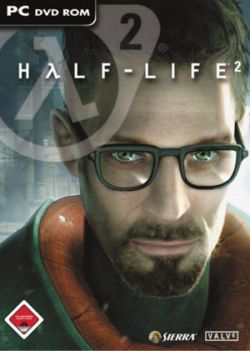
The cover of Half-Life 2. It states the name of the game at top, with the central focus being Gordon Freeman, a white male in his mid-twenties, wearing glasses, sporting a vandyke, and having short-cropped brown hair.

The cover of Half-Life 2. It states the name of the game at top, with the central focus being Gordon Freeman, a white male in his mid-twenties, wearing glasses, sporting a vandyke, and having short-cropped brown hair.

I’ve mentioned before that I often see playing games as a performance–not that I necessarily make up my own character from scratch, but inhabit the life of one while building his or her backstory. Between Portal and the Half-Life series, Valve seem to be experimenting with how a player interacts and responds to the character he inhabits. At least, this is how I would interpret having characters who say nothing–they want to give you a character as open as possible to your interpretation, so you can perceive your actions however you want. Is Gordon a nice guy? Is he shy? Does he have anger management issues?

It’s really hard to tell, and the game seems to want to acknowledge that in some sense in Half-Life 2 when Alyx states, “Man of few words, aren’t you?” This also highlights for me the difficulty in playing as Gordon Freeman and having the game make certain assumptions about me. On the one hand, it has a very open approach to my personal reactions; on the other, it presents Alyx as a love interest. Now, this is not to say I want to ‘act’ out Gordon as gay (I’ve been on the stage, and any time I was romantically involved, I was straight), rather to state that while I have plenty of agency in the world to bring down injustice, I have none to interact with my fellow humans. Which is where Half-Life 2 starts budging against immersion, and making me aware of my limitations.

Contrast this with Portal. There is a strong connection fans have had to the companion cube–an object for which we have a lot of responsibility. There is a constant interaction with said cube, and while its destruction comes without a choice, it comes at our hands. There seems little of that between Gordon and Alyx, which makes the moments when it does occur stand out (the hug I mentioned in the Alyx post, for instance). By interaction, I do not just mean touch, but the one-sided conversation is also distracting.

Half-Life thus far has been a game that excels at communication with the environment around you, as well as its feedback to you. While I do not think that the game needs to start implementing dialogue choices a la BioWare (in fact, that sounds like a tremendously bad idea, despite the fact that I’m a fan of them), having a character who is so blank is difficult in a world where there’s so much human interaction.

Which, seems to fit in well with what we do know about Freeman. Consider that in the first game it seems he is a fairly new employee at Black Mesa: twenty-seven years of age, with a doctorate in theoretical physics from MIT. His ability to interact with people whom he probably hasn’t known long during a life-threatening situation likely isn’t that strong, mimicking our own state of confusion as to what’s happening. In that game, we are told nothing concrete until its conclusion, which means we are left to surmise and assume. Then he’s frozen in a stasis for at least twenty years.

The amount of dissonance that exists for someone who enters a world he cannot really recognize is theoretically what we experience when we turn on a game. We are presented with a world that relies on our basic assumptions, but the finer details of the world, as well as the politics and culture of its people, are something for us to discover. As a player, we are allowed to engage with that material at our own pace by turning the game on and off, saving, and coming back to it. Which I feel is similar to what this world must now be to Gordon. His silence speaks more to his inability to express himself in anything but heroics.

Gordon is a tool: of the player, resistance, G-Man, and forces of which we have no idea yet. He isn’t wholly humanized, as I’ve argued in previous posts. It would be difficult for that to occur. At the same time, he has more history than Chell (as of right now, we’ll see when Portal 2 releases). Even from the start, we knew his age, his field of study, and various other, smaller bits about him. He is a character, and has a story. He is not a blank slate.

The difference is, while we can have emotional reactions, that silence is a key for us, as it also expresses frustration. To me, playing Gordon Freeman was a lesson in frustration at my inability to have any effect on my world but by force. In contrast, there are references to my building a new world with Alyx, the insinuation that children would be in our future. As yet that cannot be a reality, as I, Gordon, lack any way of communicating with Alyx beyond my actions on the world. Even when her father is being killed, I remain powerless. In the face of G-Man, I remain powerless.

Sean Beanland, in previous comments, stated that he finds it difficult to imagine Freeman remaining silent in the coming Episode. At this point, I believe if he were to do so, it would mean Gordon remains alienated from the world he inhabits. To be able to only interact with your world through its enemies and environment spells only half of a person’s worth. It is the equivalent of sending out a soldier to do nothing but be a hero, and never allowing him to reconcile himself to becoming someone whose life does not revolve around such. It speaks of someone who cannot live in the world he has saved, a world whose characters do have warmth and empathy, and are fleshed out, rather than being metaphors for ideologies. It speaks of an ultimately tragic ending, where we pity the person we’ve become.

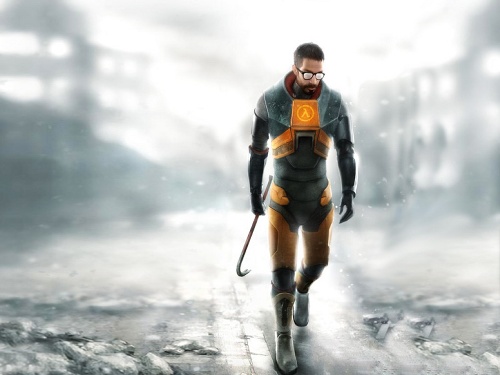
Gordon Freeman in his HEV suit, carrying a crowbar in his right hand.

Gordon Freeman in his HEV suit, carrying a crowbar in his right hand.

Perhaps that is Gordon’s lot. I would hope otherwise, however.

Half-Life 2 Analysis:

Posted in Character Analysis | Tagged , , , , , | 6 Comments

PA

Trigger warnings: Penny Arcade (read: rape and rape apologism)

I’ve been watching this Penny Arcade business with some interest. After all, I wrote about it for The Border House way back in August. August, mind you.

Many, many people have written about this topic now, and what I wish to contribute at this point is one more voice to make clear that I find how this has all unfolded abhorrent. One of my best friends in the States and I had this discussion–we disagreed on most points about the original comic. At the very least, we had a calm discussion about it and were able to not resort to mocking each other over it. I’m not sure if I communicated my viewpoints on rape culture to him effectively, but he was willing to listen.

However, mocking has come from the side of Penny Arcade. The threats by many anonymous people on Twitter to persons who spoke critically. The invalidation of rape experiences.

I will quite clearly state that I am a survivor of both rape and four years of molestation. The fact that I would be asked to prove such by some rather angry Twitter folks (which hasn’t happened, Courtney has taken the brunt of that, unfortunately) is only more triggering. See, the other side of the coin, as people have been pointing out over and over again, is the dismissal of other peoples’ triggers and experiences. Have you sat in front of a jury and had their judging eyes leveled at you, while sneering? Had your gender and sex called into question because of what happened to you, not something you did? All of this on top of reliving an experience you would rather not.

Asking for the burden of proof for someone who has been raped, as I have seen done to Courtney, is absolutely out of line (besides, one does not need to have been raped in order to find something worrisome). Yet our judicial systems, alongside that of our peers, shames most people into wishing to avoid the circus of a trial. If this cannot paint for you the picture of a rape culture, I’m not entirely sure what can. Systemically. Systemically there is a rape culture reinforced by our very courts–victims’ rights are a joke. There is very little cultural support for a survivor of rape.

Now, I’ve had discussions with people how the fans who are doing such are a fringe of the main Penny Arcade fanbase. Which might be true, for all I know. However, I also know the vehemence and number I have seen are hiding behind the Penny Arcade jerseys and team, and are not being dismissed in a public manner. One person being told to knock it off does not set an example.

The two men behind Penny Arcade have a public forum. What is not being said is just as loud as what is. This is a matter where not being forthright gives fans leeway to speak for you. The dismissive air with which Mike has acted only further incites fans who would attack people on Twitter, particularly when he tells people if they don’t like it, don’t read it. What is being said is that you should only cater to the part of the world with which you agree.

If only it were that simple.

As I’ve stated on Twitter a few times now, what it looks like to me, and this may or may not be true, is that Mike and Jerry have not fully grasped of what their community is capable. This also means they are not quite aware of their own impact on said community. Instead of focusing on such issues, the projection from Mike has been to set a clear line where there are the fans, and there are the other. The dissenters. The crazies. The “rape culture” people.

Dismissing someone for offering criticism and calling it censorship is a quick reaction that says one does not actively wish to listen. As I stated in my Border House blog post, I felt ashamed that I hadn’t spoken up when I found something offensive before. Not because I wanted to censor, mind, but because I wanted to raise awareness. After all, when the first person openly asked me if I was gay when I was in high school, I outright denied it. Sometimes I just don’t have the proper resources or energy to confront things. I am only human.

Which is why Mike’s reactions are confusing me. From my end, all the way in another part of the world, he has assumed the persona of the character in the comic. As I know he is not just a cartoon character, the disappointment stems from his not being willing to have more than a caricatured reaction. Whether or not he wishes it to be so, he is a public face of an organization.

Given the recent discussions the U.S. has had over both bullying and the very recent discussion of forcible rape (which is a term that brings a sneer to my lips), it is not difficult to understand why I enjoy having a community to which I belong, and where I can, as Mike has suggested, just not look at times. I don’t read the comic anymore. However, I had an inclusive experience at PAX East last year. That experience is not ruined, but I fear it can no longer be replicated at that particular venue.

Posted in Community, Uncategorized | 1 Comment

Writing Roundup: January 2011

I asked on Twitter if anyone would find useful my linking up pieces I’d written elsewhere. The idea came to me when I realized I wanted to put together a portfolio, but that I’ve written a shitton (actual measurement) of articles for GayGamer, and while I wouldn’t want to link most, sifting back through them would require an inordinate amount of effort.

Therefore, this is as much for me as for any readers who might be interested in such.

  • Technically this came at the end of December, but I felt like including it here. I finally tackled the Cloud in drag post I’ve had in my head for two years (true facts). What I found was that it wasn’t as offensive as I may have feared and approached gender in a very playful way.
  • I’ve been slowly building myself up to continue writing about LGBT characters in games. This led to a write-up of Fiona and Mickey from The Longest Journey. Perhaps the observation that struck me most while writing it? “In fact, in thinking back on it, what becomes apparent is that this is one of the only actual couples in the game.” It floored me, to be honest.
  • Continuing on with The Longest Journey, I wrote about the moment in game that struck me the most, which happened to be the Tale of Homecoming, particularly because of this bit: “Words themselves are not as important to the Alatien as the meaning the words convey, and how they reflect the current teller.”
  • One of our new writers at GayGamer wrote about how he wouldn’t trade in The Darkness. In turn, I wrote a bit more about the most poignant moment I found in the game–which led me to realize that it was a classic woman in the refrigerator moment. It really made me cringe as this is a game based on a comic. Oi.
  • In my head are all these ideas of what elements make up a horror game that actually affects me in the manner they seek, and it’s an idea I need to test against a few more games (Hi, there, Amnesia!). Therefore, this was prep-work for my getting back into Half-Life 2 and recalling why Ravenholm affected me.
  • I wrote about Abu’l Nuqoud quite a while ago. In an effort to provide more serious content to juxtapose the Top 20 Gayest Characters at GayGamer, however, I rewrote the piece, and finally reworked that last paragraph with how his initial non-violent ways seemed to me. As a character, he still fascinates me.
  • Krystian linked to this game from the Global Game Jam on his Facebook account: H.I.V. Extinction 1981. It is set in a disco club in 1981 and has to do with HIV/AIDS. There was no way I could ignore it. When I started thinking about the game and its meaning, what I found was one of those puzzle boxes where you keep solving one layer to be confronted with another. Considering how often games have even mentioned HIV/AIDS, it was a very evocative piece for me (most of my mothers’ gay male friends from an earlier time are now gone, and you can guess why).

That’s all for this month. While I haven’t fully met my goal that I set at the year (one post a week both here and at The Border House on top of my five-day-a-week posting at GayGamer), I can say I’ve been pretty pleased with the results pushing myself has achieved.

Posted in Monthly Roundup | Tagged | 1 Comment

Half-Life 2: Dr. Breen and G-Man

Spoilers: Half-Life, Half-Life 2, Episodes One & Two

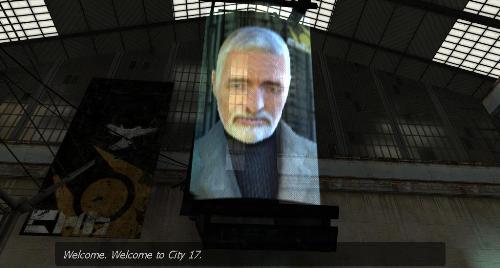
The first two significant characters Gordon Freeman encounters in Half-Life 2 serve well to establish the conflicts he will face. First, waking him up from one of the proposed two endings in Half-Life is a person simply known as G-Man (seemingly a reference to the often derogatory term to name government officials). Then, upon leaving the train on which Gordon finds himself, he hears the voice of Dr. Breen–a voice that will follow him quite a few places.

A monitor suspended above the player that holds Dr. Breen's face. He is an elderly white male with a full head of hair and beard, both white in color. The subtitles state, "Welcome. Welcome to City 17."

A monitor suspended above the player that holds Dr. Breen's face. He is an elderly white male with a full head of hair and beard, both white in color. The subtitles state, "Welcome. Welcome to City 17."

These two men are seemingly opposite in the power struggle into which Freeman finds himself thrown, seeing as it is G-Man who brings back Gordon and throws him into this struggle. Almost, but not quite. While G-Man’s motives are relatively mysterious, and his full import has yet to be laid out in full, Dr. Breen is fairly straight-forward, representing the Combine that is your primary enemy in the game. In contrast, G-Man is a man who works in some interdimensional space, and while he can often be seen about in the world, he is a puppetmaster that makes Breen’s own efforts seem inconsequential, particularly as it seems to be G-Man who is indirectly guiding Gordon’s actions. From here I’d like to work from the outside in, so will start examining Dr. Breen.

Dr. Breen is revealed to be the former administrator at the Black Mesa facility. It is quickly revealed there are deep-seated issues between he and Eli Vance. It becomes apparent that Breen negotiated a peace with the Combine, that included selling off humanity. As is usually the case with power, he obtains it by willingly trading off other peoples’. While that power seems absolute, the way Breen is depicted shows how precarious his position actually is.

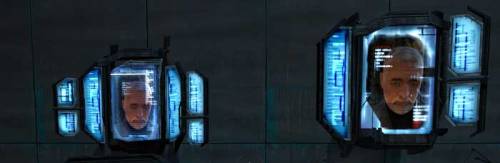
He sits high in an office in the Citadel, far away from the rest of the world’s concerns. Our first encounter with him is over a loudspeaker and through a monitor. While broadcasting those messages, he always has the demeanor of someone patiently and stridently defending his choices as the best for humanity–arguing away freedoms and instincts in praise of a larger plan. Yet, early on, when a teleporter incident goes awry and Gordon twice finds himself briefly in Breen’s lofty office, the man is shown to panic, losing the composure we see through most of the rest of the game.

Dr. Breen's face as seen on two of the computer terminals in the Citadel itself.

Dr. Breen's face as seen on two of the computer terminals in the Citadel itself.

Contrast how we can interact with Breen through most of the game as to how we are forced to do so with G-Man. While Breen’s voice drones on in the background, we have the option of moving on, not looking at his on-screen images, and progressing before hearing his speeches in full. G-Man on the other hand? Every encounter where he speaks is one where the player loses control, directly mirroring the impact Freeman is to have on the story. He cannot touch G-Man, let alone affect him in any way directly, whereas he is to be the cause of Breen’s downfall.

Ultimately, Breen is the face of the organization that is the Combine, and like many men in such a position, only a representative of the larger, underlying power. He is certainly a problem in his own right, but removing him does little to stop the larger issues at hand, as we find in Episodes One and Two.

Breen also offers a bit of a comment on gaming, as well as Gordon’s placement in the larger scheme of things. When Gordon is brought into Breen’s office at the end of the base game, he makes mention how Freeman is a fine pawn for those who control him, and almost mockingly states that Gordon didn’t understand that his contract was open to the highest bidder. This works on two levels: alluding to the contract that has been established at the end of the first game, and is invoked at the start of the game, as well as alluding to the issue of player control. As I read the scene, Breen was mocking my inability to alter the course of the scene at that moment. Yet, while I am immobilized in a trap, I can still move my head around and look about the room. Again, this serves in contrast to G-Man, who remains an unpredictable force in the story, who seems to be dictating not just Gordon’s, but my actions as well. This makes him a far more menacing proposition, despite our not directly fighting against him.

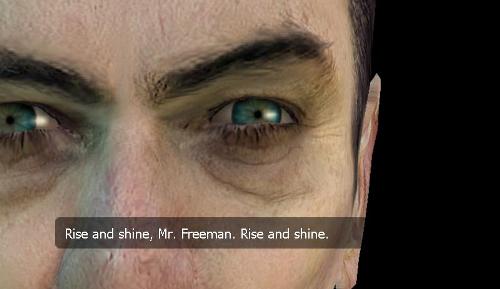
G-Man's face in extreme proximity of Gordon's own. He is a white male who appears nearing his later middle-aged years, with black eyebrows. The subtitled text reads, "Rise and shine, Mr. Freeman. Rise and shine."

G-Man's face in extreme proximity of Gordon's own. He is a white male who appears nearing his later middle-aged years, with black eyebrows. The subtitled text reads, "Rise and shine, Mr. Freeman. Rise and shine."

As I stated, every encounter where there is discussion with G-Man involves complete forfeiture of control. One cannot look away, move, or do anything but stare at him. Furthering the unease, the first-person perspective is used so that he vacillates between being far away and uncomfortably near. His speech patterns are off, and he has stresses on syllables that denote someone who is taking pleasure out of drawing out an interaction, and toying with his sentences–he is in no hurry, and his entire attitude seems bordering on flippant. The final note is that his facial expressions often seem misleading, offering opposing motives and reactions to Gordon within the same scene, leading any reading of him to be full of conjecture.

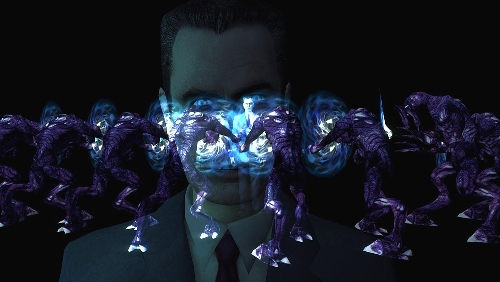
Throughout the series, he can often be seen at a distance, yet rarely ever reached. What comes of this is the air of someone interested in your actions, but watching from afar, constantly appraising and judging your actions. The one time this is called into question is when the Vortigaunts show up at the beginning of Episode One and drive him away from Gordon, which grants a reprieve for some time (and it is the one time his emotions seem fully keyed to the events at hand, as he is both flabbergasted and has a tinge of anger in his voice), until Alyx is wounded, and the Vortigaunts are distracted in healing her. It is upon his return that G-Man casts more doubt into the overall plot, outlining how it was he who spared Alyx’s life after the events of the first game, seeing a ‘potential’ in her. When he whispers a message to give to her father, it recalls a name of one of the chapters from the first game, Unforeseen Consequences. As is revealed when spoken to Eli, somehow, G-Man seems implicated in all the events as we have seen them, starting from the very beginning of Half-Life.

An image of multiple Vortigaunts proffering a line between G-Man's body and Gordon's, with an image of G-Man's face imposed over it.

An image of multiple Vortigaunts proffering a line between G-Man's body and Gordon's, with an image of G-Man's face imposed over it.

For G-Man, all people seem merely pawns who may be used, have their actions contracted to the highest bidder, and directed as he sees fit.

The struggle in this game therefore read to me as parallel to many of the struggles against kyriarchy one can see today. In particular, the word kyriarchy works well here, as it is not as simple and straight-forward a menace as patriarchy. It alludes to a struggle against interconnected forces that act as an oppressor. While Dr. Breen and G-Man’s aims seem wholly different, their predatory behavior and work at controlling those around them has much the same effect, and paints them in the same light. Particularly in contrast to the struggle being fought by the likes of Eli, Alyx, and the Vortigaunts.

This quotation from Breen, clearly angry as Freeman walks through the Citadel, is rather telling:

Tell me, Dr. Freeman, if you can. You have destroyed so much. What is it, exactly, that you have created? Can you name even one thing? I thought not.

As anyone familiar with Derailing for Dummies can tell you, this is not far off from a common tactic used by varying degrees of privilege in marginalized spaces that offer critique of the larger kyriarchy.

Unfortunately for Dr. Breen, he is merely the face of a larger force and not the overarching lord he believes himself to be–hemmed in by the same restraints he hopes to use to control others. This force is one which we cannot fully conceive of quite yet; while we have small hints available here and there, as with the appearance of the Advisors, thus far the forces we face remain an unseen, but ultimately felt, oppressor with agents running through the world–even briefly taking on the others who have been part of the resistance, as seen with Dr. Mossman.

The G-Man’s involvement in all this becomes all the more sinister as he appears to be someone who is at once offering you small glimpses, as well as deliberately withholding information on the larger scheme. He is a gatekeeper of the larger events occurring in the world.

Half-Life 2 Analysis:


Posted in Character Analysis | Tagged , , , , , | 10 Comments

Half-Life 2: Alyx and Eli Vance

Spoilers: Half-Life 2, Episodes One & Two.

For me, a large part of the appeal in Half-Life 2 was how it humanized its world. Playing the first one was a lesson in navigating a very mechanical world–there were followers, but the graphics along with the general non-distinguishable NPCs left the world populated with automatons. Instead of fleshing out Gordon Freeman, the sequel instead fleshes out the world both mechanically, which many have praised, and by speaking about larger issues in its world through its characters. You can tell a lot from the world in its level design, for instance, and while it provides an atmosphere and gives you a sense of the micro-conflicts you’re facing, the macro-conflicts still feel better expressed through the characters, who are more distinguishable and nuanced.

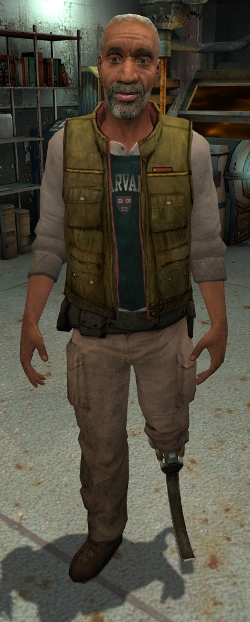
Eli Vance, an older black male with white hair and beard. His left leg is replaced by a prosthetic, and he wears shirt that states Harvard under a green vest.

Eli Vance, an older black male with white hair and beard. His left leg is replaced by a prosthetic, and he wears shirt that states Harvard under a green vest.

Enter Alyx and Eli Vance. Going directly from the first game to its sequel, I was struck by the fact that there was some manner of connection between Eli and Gordon that wasn’t apparent previously. The first game, to be quite honest, surprised me when it featured not just old white male scientists, but also showed black male character models in the same labcoats. That Eli is black is therefore less a shock, but that he is the face of the resistance in this world has some interesting connotations.

First, to address Eli: he is a man who could easily be described as warm and charismatic. An implied graduate of Harvard, he was also part of what is depicted as one of the top-notch science teams of the world at Black Mesa, and continues that work with the resistance against the Combine. He is responsible for both Freeman’s gravity gun and the mechanical friend whom Alyx has in Dog. In short, while he is shown to be a man with a disability, he is also shown as resourceful and necessary to the plot.

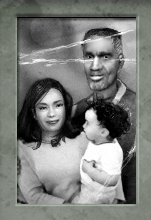
A black and white family portrait. Left is Azian, holding a baby Alyx on her left, placing her in the right of the image. Eli stands above and behind Alyx.

A black and white family portrait. Left is Azian, holding a baby Alyx on her left, placing her in the right of the image. Eli stands above and behind Alyx.

Eli is also the father to the most important character to the series (outside of the protagonist–more on that later), Alyx Vance. What we know of Alyx’s mother is that her name is Azian, she is Asian (yeah…), and that she died during the Resonance Cascade at Black Mesa. This makes Alyx a racially mixed woman, which is displayed in game (one can never be too sure…). Your first encounter with her is indicative of her character as a whole–running from the Combine soldiers, without weapon, you are suddenly trapped. As you black out from their beatings, you hear sounds of fighting, and find Alyx has come to your rescue, dispatching the soldiers. Her first impression is that of both saving the supposed savior, and doing so through combat.

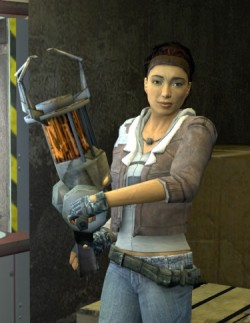
Alyx continues to be present during the base game of Half-Life 2 as well as its two episodes thus far. She is scientifically minded, a mechanic, a hacker, and a useful companion to have for her skill with guns. Following her father, she is a resistance member, and likewise as warm and friendly as he. While there are moments when it is indicated that she and Gordon have a romantic relationship in the making, she acts embarrassed by it (the suggestions are often made by her father and imply an embarrassed father-daughter relationship concerning such).

Alyx, a woman of mixed heritage (Asian and black), wearing a jacket over a Black Mesa sweatshirt, jeans, and a loosely slung belt. She is holding the gravity gun.

Alyx, a woman of mixed heritage (Asian and black), wearing a jacket over a Black Mesa sweatshirt, jeans, and a loosely slung belt. She is holding the gravity gun.

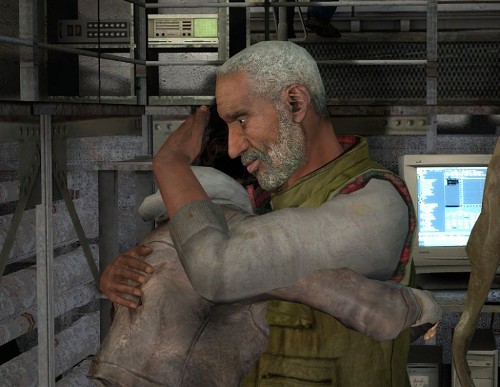
In an action-oriented game, Alyx follows suit by being best defined by her actions. Which means she is every bit as capable as Gordon, often by his side, and also handling security systems he cannot. Therefore, considering Gordon’s mute and vapid nature (more on that later), she is the lynch pin for most of the emotional expression in the game; Merle Dandridge (who, it should be noted, is of a similar racial mix), the actress who voices Alyx, does an exemplary job of such. While she is shown to embrace Freeman after unearthing him from the rubble in Episode One, for instance, it is her voice work that carries the relief and emotional weight of that moment–the on-camera action being somewhat awkwardly displayed in first-person perspective.

Considering she is often by Freeman’s side during both the subsequent episodes, and is essential to the ending portion of the base game, it is she who is better left to voice the tension of the events occurring, alongside the per-usual noteworthy work on audio and pacing for which Valve is famed. She is the voice Gordon cannot be–as Gordon is presumed to be the player, it is therefore left to us to interpret the events. Again, while Valve is generally good about providing audio and visual cues to this effect, the addition of Dandridge’s acting adds a human voice to the mix, which is sorely needed when we are to believe humanity is at stake.

Alyx and Eli embracing in a laboratory.

Alyx and Eli embracing in a laboratory.

This was something I felt was missing from the first game. While there were characters who would follow you, their impact and cookie cutter models left no real impact, and deadened getting close to any of them in particular. This was also not aided by the very computerized-sounding voices they had (note: this is in retrospect–had I played the games at their release, I might feel differently, but it is hard to make such assumptions).

What is also of note is that the first game takes place in the year 200-, while its sequel is two decades later, depicted as 202- in various Wikis and such online. Considering these events, and considering this fictionalized world is parallel to our own, the racial tensions that make up what would inform Eli’s own life make further sense for his actions before the second game begins.

Namely, in regard to the Vortigaunts. During the actions of the first game, our knowledge of Vortigaunts is sparse–they were merely an alien species to kill in the Black Mesa facility. It is later hinted at in the sequel that they were slaves of the Nihilanth, the end boss of Half-Life. Notable here is the fact that the first time you can see one in the second game, zie (I’m using a gender-neutral pronoun because we have yet to establish the Vortigaunts’ true anatomy or culture, therefore gendered pronouns seem a folly) is sweeping, in a uniform outside of the train station that ferries you back to the world. In many ways, it looks like indentured servitude, a motif that is repeated as you see them around the Combine.

However, in the second game they are given a voice through a language we understand, and communicate accordingly. What one hears amounts to much praise for Eli Vance, which is attributable to his efforts as the first human to make peaceable contact with them. It is due to a similar desire of freedom from the Combine, who took control of the world after the events of Half-Life, that they are partners. They both would understand the yoke of oppression.

Could this have occurred were Eli Vance to be a white male? While it certainly could have, the poignancy of both the time frame of the story (not some far-off utopian future where we can pretend racial harmony is achieved), as well as the depiction of the Combine as oppressors (for the most part, male and faceless, with the one exception being Dr. Breen), makes the reading of this as a story about a mutual understanding more compelling–grounded in both sci-fi and our own real-life parallels as expressed in oppression and discrimination. Therefore, I was also glad to see resistance fighters who were male and female, white and black.

Eli’s death is a catalyst in the series, and would not be so if he was not such a central figure. This event serves as a cliff-hanger that informs why so many fans are clamoring for Episode Three. Without him, the resistance must continue, and its most likely candidate, in my opinion, is Alyx, who has the personality, charm, and ability to do so. She knows these people better than Gordon, she knows the world better than he (mirrored by the player’s own confusion at being thrust into a world he doesn’t recognize). Most people Gordon encounters outside of the scientists are strangers, and yet he is exalted to a legendary and heroic figure. He is not wholly humanized in that world, our own humanity informing his reactions; in contrast, Alyx already surpasses Gordon in such. Freeman makes for a good action hero, whom we control, but his lack of character means he’d be a poor choice for Valve to thrust leadership in subsequent episodes–particularly when they have showcased Alyx’s own capabilities.

Half-Life 2 Analysis:

Posted in Character Analysis | Tagged , , , , | 8 Comments

Dice Rolls

I recently reinstalled and started two games based on the Dungeons & Dragons systems (both well before third edition rules): Baldur’s Gate and Stronghold. What I found, almost immediately, upon starting up both games was my aversion to a system I once encountered quite frequently.

A set of Chessex dice in transparent container. Inside are a set of twelve six-sided dice, these being clear.

A set of Chessex dice in transparent container. Inside are a set of twelve six-sided dice, these being clear.

In both games, you are allowed a ‘roll,’ based off one of the suggestions D&D gives in creating a character. While there are many systems the later manuals suggest, the one I most frequently encountered in groups was rolling for your stats. This had its variants as well, but, again, I most commonly encountered having to roll 4d6 (four six-sided dice), discard the lowest number, add up the remaining three, and then have that number. Do that seven times, drop the lowest score, and then assign as necessary. In person, this typically is done in front of a dungeon master so as to make sure players aren’t fudging the numbers in their favor.

I will quickly state that in terms of tabletop versus videogaming, the former allows for more discretion and control via the DM. If a party generally has lower stats, the DM can account for such and adjust her game accordingly. While we are seemingly getting closer to that goal in videogames, this was a system that just did not exist. In the two games I listed above, you wanted the best stats because the challenges you faced would have set numbers that only changed based on difficulty level selected, not your stat allocation.

In videogames, there may be someone watching the entire time (if we want to personify the system), but there is the option to constantly reroll. Which is what I did in both games. Over. And over. Once more. Again. Noch mal. Schon wieder. Eventually, this would lead me to a point where I had stats with which I was satisfied. Stronghold also has a system in place whereby you can subtract from a non-essential stat for a particular class to give points to the primary attribute of said class at the conversion rate of 2:1.

Looking at one of my favorite series, Quest for Glory, it’s not hard to imagine what drew me to its stat attribution. There is constant advancement in the game, and the character creation is based on distributing a pool of points. The point-based system works much better for getting a player into the game and playing, while it usually communicates two things: if you want to reroll a character because you are not satisfied, it will be much easier than sitting through many clicks to get the same allocation of points that you can distribute (and if you provide the option of resetting skills and attributes, it makes it an easier base off which to start); there will also exist more points that get added to these skills. In terms of QFG this comes through a training system, whereby you use a stat in which you wish to become better. In other games that come to mind, Dragon Age: Origins off the top of my head, you are given a steady allocation of points every level which you may spend as you see fit.

Every system will have its flaws, typically around balancing the attributes’ usefulness, but the one that struck me about the dice rolling stat system is that it delays playing the game. While I was playing Stronghold for another reason entirely (having an idea for a post at The Border House), I found myself instead falling into the habit of making sure I had the proper stats–which led to at least half an hour spent on getting the right rolls. Recently, my mother and I were looking through all the older, disk-based games we had carefully put away, and what I recall about many of the RPGs on said disks was that I spent a sizable amount of time on the character generation screen, just because of such systems. D&D itself seemingly sought to change this in their third edition rules with the addition of gaining attribute points to allocate every fourth level, which seems as much to please players with a more steady mark of progression, as to make the various videogames based off their ruleset more friendly to the average player (ultimately, these two instances are the same).

It is not hard to realize why, even in the early days of the internet, I scoured websites looking for third party character editors to allow me to eschew this process and just have the stats I wanted. I had games I wanted to play.

Posted in Design | Tagged , , , , | 2 Comments

Battling Ghosts

From the blogs I read, it seems like BioWare is rarely praised for the intuitiveness of their systems. While I never praise them, I also rarely seem to encounter too many problems (had some complaints about the skill bar in Dragon Age). That is, until Jade Empire; as it is an older game, I imagine BioWare learned a lot about interacting in 3D space with close-combat encounters. This is not really tactical RPG combat, being much more action oriented.

Therefore, it has become increasingly annoying when I run into invisible walls during battle. The first few times this actually resulted in dying, reloading, and scratching my head as to why when I did a back roll, I didn’t go to the place intended, but seemed to hang in the air.

Invisible walls.

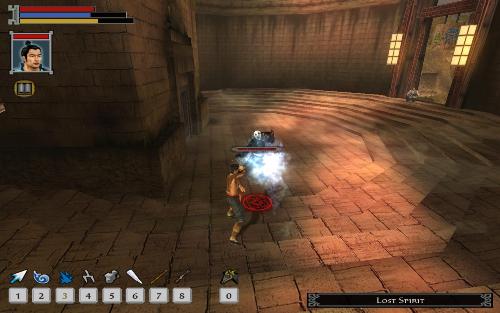
I wish to first present a picture of a combat I recently encountered:

A battle scene, my character being at the bottom of the screen, Sky chanting in the upper right, and a ghost preparing a spell in front of my character. We're in an amphitheater shaped space that's actually part of a cemetery.

A battle scene, my character being at the bottom of the screen, Sky chanting in the upper right, and a ghost preparing a spell in front of my character. We're in an amphitheater shaped space that's actually part of a cemetery.

In this picture, the battleground is fairly well indicated. There is a clear demarcation for where the battle’s boundaries lie, and where I cannot go. Instead of having the encounter be part of the actual world, as soon as battle starts, there are boundaries set in place which I cannot cross. Seeing as this is supposed to be about martial arts and close-combat, I can see why they would wish to do such. It is also likely because of limitations in the system itself.

However, when in combat in a field, or a path, having my character run into an invisible wall is not only jarring, but creates problems of actually knowing what my battle situation is. My first thought, upon realizing this was what I was facing, was wondering why they didn’t just have a line that told me where these walls were located. Since battle happens in some fairly open spaces, I don’t expect to have each battleground be as above, where I can clearly understand based on physical objects.

An argument I could see is that it might ruin a sense of immersion, and considering BioWare’s obsession with the ‘cinematic,’ I would not place that too far off what might be possible (though I cannot speak for them, obviously). In opposition, having my character bump into invisible walls, when no such magic spells exist, is even more immersion-breaking. Beyond such, I really fail to understand how this slipped past anyone who played the game, unless they were expecting everyone to constantly be fighting, and never goading opponents and reassessing situations.

In general, the combat in this game feels a bit weak. It may well be just because I’m playing the PC version, but the camera has some rather egregious issues as well. I’ve found myself circling an opponent to suddenly have the camera stuck behind a wall, or hanging lantern, which creates all manner of panicked reactions depending on my health and the position in which I last saw the opponents.

As for the skills themselves? It’s been an amusing time figuring out what works against which opponents (it helps to read the scrolls littered about the world, which give you information as regards such), however, once I figure it out, the difficulty seems to have stopped scaling, leading me to consider them the least interesting part of the game (outside of the schmup mini-game).

There are things I truly do enjoy about the game, however, and I’ll be discussing those in another post (and on other blogs).

Posted in Camera, Combat, Design | Tagged , , , | Leave a comment

Beyond Literary Allusions

Spoilers: Beyond Good & Evil.

When handled well, I enjoy stealth games, or portions of games that have stealth. I will reiterate ‘handled well.’ This meant that my recent playthroughs of both Alpha Protocol and Metro 2033 involved a lot of skulking about and taking out enemies unseen. Beyond Good & Evil doesn’t really have assassinating going for it, or at least, does not press the concern thematically.

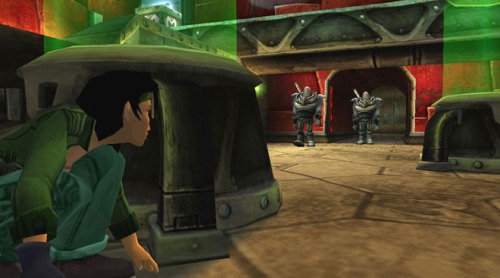
Jade (left) a woman of color (though I'd hesitate to say which race), hides behind a vat while two guards in armor from head to foot stand (right) by an archway.

Jade (left) a woman of color (though I'd hesitate to say which race), hides behind a vat while two guards in armor from head to foot stand (right) by an archway.

Which is not to say it isn’t possible. There were a few times where knocking out a guard through his weak point, and then sneaking past were necessary. It wasn’t the focus of my game, however. Largely, it was one of photojournalist. I was Jade, breaking into factories and slaughterhouses to uncover an insidious plot. Jade, a champion of the people.

The world that Beyond Good & Evil presents is compelling, in that a large part of it is not told directly (and underscored with art that still speaks well of it). It requires paying attention to small bits of dialog, surmising things based on the environment, and even the animals that inhabit it. Using my camera to capture a part of this world not only provided Jade with monetary compensation, but allowed me to wonder what sort of ecosystems were in place in Hillys, and what levels of aggression could be found. It would be intriguing to note how many times I captured photographs of violent versus non-violent creatures, for instance (I want to say it tends more toward the latter).

Then there were puzzles. For me, a large part of playing as a stealthy character is figuring out the puzzle that is navigating the world unseen–there are typically patterns in the guards, or tools I have to use. Therefore, the majority of the time I spent with Beyond Good & Evil did not seem centered on combat at all (other peoples’ play may differ, I’m sure). Given the plethora of options the game presents, through the use of minigames, photography, stealth, the races, etc., most of my time in Hillys was spent enjoying figuring out the world and who Jade was, and what her place was in her world. A place that begrudgingly engaged in combat when presented.

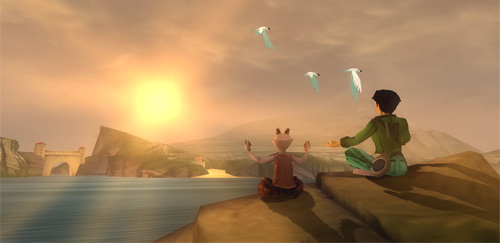
Jade and Fehn, an orphan who is a mixture of human and goat, are engaged in joga on a cliff, the sun rising to their left.

Jade and Fehn, an orphan who is a mixture of human and goat, are engaged in joga on a cliff, facing away from the viewer, with the sun rising to their left.

Which is why the ending didn’t work for me. It felt like it was in the game simply because it was a videogame, regardless of the way it had achieved that route. Sure, the game had boss battles before, the Factory having two that recall themselves to my mind, but they seemed a footnote in regards to the other actions. They rarely felt like story stoppers, basically. They certainly did not stand out as the highlights of my experience.

Further frustrating me was the reversal of directional controls midway through the final boss battle. I believe I understand the goal that they were trying to present, Jade being disoriented and shocked, but it just felt a quick way to complicate the boss battle without putting in another puzzle to figuring out how to defeat this particular boss. No, it felt like a trick instead, one which didn’t take much effort to figure out once I was punished the first time. The effort became less about Jade’s resourcefulness, and more about my skill (note, it’s always about my skill, but even the illusion of Jade’s part to play seemed missing).

Storywise, I understand that they were trying to hint at the larger struggle Jade has in figuring out who she is for a sequel, but it was all too rushed in at the end. In hindsight, there was some vague foreshadowing, but of entirely too broad a stroke to make it seem like the twists they presented me at the end were ones I should have expected. In particular, the scene which packed the heavier emotional gutpunch: when the children of her orphanage are kidnapped. She proceeds to project her own feelings of inadequacy on to the dog, telling of a greater role in store for her; she was already on that track without the magical nature that was revealed, however. Granted, she did have strange connection sequences after some of the bosses, but they were only really resolved at that particular moment–there was no investigation to figure out anything more concerning it.

Again, it’s a point where I do not begrudge the additional powers that she comes by at the end, so much as how it felt all too much rushed in the final hour. Despite the end, I did enjoy the game, and I am curious as to the sequel, if it ever truly lifts off the ground.

N.B. I read both David Carlton and Dan Bruno‘s posts about Beyond Good & Evil before writing this. There are also plans to write further on this game, especially as regards race and species.

Also, the game has no actual allusion to Beyond Good & Evil by Nietzsche.

Posted in Uncategorized | Tagged , , | Leave a comment

Exit 2010, Writing For 2011

Among the reasons I’m never positive on how to elect a GAME OF THE YEAR is the fact that it depends on when you ask me. I play a variety of genres, and depending on my mood, I might have a more kind eye toward a particular title. Instead, what I want to do is merely publish the list of higher profile games I played and finished this year. Among these titles are a number that were not released this year, at least three were replays (Mass Effect, Dragon Age, and BioShock).

An * next to a title means there are plans to write more about that game, with the parentheses that follow offering note of what I plan on writing. Please let me know if you would like me to look more deeply at another in the list (even if I’ve already written about it).

N.B. These are in order of completion.

  1. Mass Effect * (journal of gay male Shepard)
  2. Mass Effect 2 * (Asari, Ardat-Yakshi, same-sex flirtations with femShep)
  3. Bayonetta
  4. flOw
  5. BioShock * (Sander Cohen)
  6. BioShock 2 * (further character analysis)
  7. Heavy Rain
  8. Shadow of the Colossus
  9. Final Fantasy XIII * (character analysis)
  10. Metroid: Zero Mission
  11. Katamari Damacy
  12. Metroid II
  13. Metroid Prime
  14. Metroid Prime 2
  15. Metroid Prime 3 (for all three, possible sense of isolation)
  16. LIMBO
  17. Castlevania: Harmony of Despair
  18. Death Spank
  19. Dead Space
  20. Heavenly Sword * (Kai, Nariko, characters with depth)
  21. Super Metroid
  22. Metroid: Other M
  23. Castlevania: Symphony of the Night
  24. Dissidia: Final Fantasy
  25. Alpha Protocol * (choice in games)
  26. Dragon Age: Origins, Awakening, & DLC * (likely in contrast with DA2)
  27. Sid Meier’s Civilization V
  28. Oddworld: Abe’s Oddysee * (cannot master, can only imitate)
  29. Baldur’s Gate: Dark Alliance

This list serves as both a quick way for me to remember what I played (because while I have a Backloggery profile, it’s ability to navigate the library is lackluster), and a reminder of titles about which I should write.

Also feel free to recommend a title you think I would enjoy that released in the last year. On that note, I already have and plan to finish Fallout: New Vegas, Metro 2033, Amnesia: The Dark Descent, and Assassin’s Creed: Brotherhood

Posted in Uncategorized | 6 Comments