Economic Truth

Spoilers: Alpha Protocol, Dragon Age: Origins & Leliana’s Song DLC.

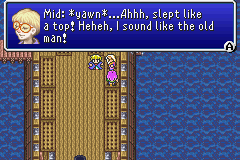
Recently having bought Alpha Protocol during a Steam sale and playing it shortly thereafter (also known as an anomaly), among the things that caught my attention was that the story was told through a framed narrative. That is, the game’s antagonist and protagonist are sitting together in a room, discussing the events of the game up to the point where you are caught up and continue the narrative.
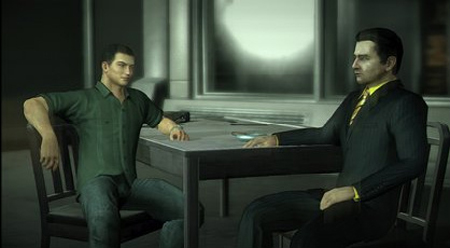
Scene from Alpha Protocol: Michael Thorton (left) leaning in his chair while speaking with Henry Leland (right) at a table.

Scene from Alpha Protocol: Michael Thorton (left) leaning in his chair while speaking with Henry Leland (right) at a table.

What is interesting about these exchanges is that you have more information than the antagonist, who is piecing together your actions and weaving a tale of your exploits (though he does believe he knows everything). Your responses often either confirm or rebuff him, therefore adding a layer of mystique to what you do. This largely comes down to how you wish to play the game, as the dialog system is dynamic enough among its NPCs that you have to read them and then respond in a manner that you believe will garner the results you want in order to get certain information about them. NPC A might deal better with professionalism, and treat you with a modicum of respect, whereas NPC B will consider you too droll, and you may have to cajole and irritate her in order to gain the reaction you want. Choosing one tactic throughout the conversation would then seem to behoove you once you figure this out, but is also a liability if you wish to gain the most information you can. The conversation in itself is a game of lies and subversion.

After each major section of the game, therefore, you are set in front of the antagonist and go back and forth, having conversation with him that either does not fully reveal what you did, or confirms it and paints a picture for him to better understand your tactics before hinting at the consequences of your actions. In terms of actual impact on the game? It does not offer much, as you already performed the actions and those are on what the consequences hinge, and since it’s your story being told, the only unreliable portion of the narration comes from yourself in those liminal scenes.

This is among the reasons that I am excited for Dragon Age 2. An example it has frequently given is that of Varric, a dwarven companion of your protagonist Hawke, relating a story to Cassandra, a female member of the Chantry hunting down the protagonist. In the tale, he relates a battle, which he embellishes abit, until apparently Cassandra asks him to scale it down a bit. The effect on the game is apparently that the battle becomes less grandiose than it was previously, which adds an interesting bit where we both fuse an unreliable narrator or companion and mechanics–whereby we not only hear the not-truth, but experience it as well.
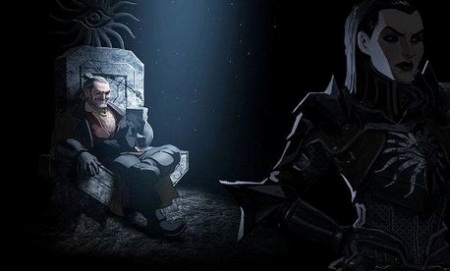
Varric (left) sits in a throne, well-lit and holding a goblet while Cassandra (right) stands facing away from him in the shadows.

Varric (left) sits in a throne, well-lit and holding a goblet while Cassandra (right) stands facing away from him in the shadows.

We could already somewhat see this in effect in the DLC for the first Dragon Age, Leliana’s Song. In said DLC, Leliana relates her betrayal by Marjolaine, at which she hints in Dragon Age: Origins (and which becomes her companion quest). She starts the DLC stating firmly that she knows the truth, but that she does not know how it ends; perhaps you and she together can see about that. The ending is just as veiled, revealing that she may well be embellishing the tale to give the audience more of what it wants, rather than merely stating the facts as they are.

This is then reinforced through the differences in the story she relates in the base game of Origins and what you play in the DLC; in the base game the betrayal takes place in Orlais, she is tortured, and Marjolaine disappears after the betrayal. In the DLC, this is changed about so that it takes place in Fereldan (where the crime of which she is charged, treason, becomes foreboding, rather than an immediate threat), she is put in a prison but her friends are tortured, and you confront Marjolaine at the very end. There are both practical and narrative reasons for this. Practically, BioWare could reuse its environment assets for Denerim and its places, thereby not costing as much. Narratively, it does give us more of what we want, which is to know more about the conflict that occurred between Marjolaine and Leliana, and about the lives they led as bards of and for Orlais.
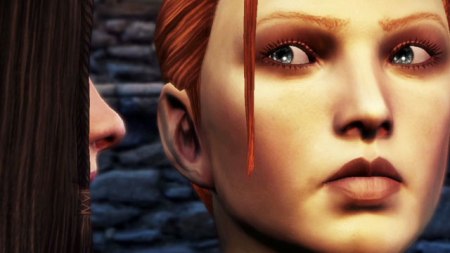
Leliana (right) glances to her right at Marjolaine (left).

Leliana (right) glances to her right at Marjolaine (left).

At the same time, Leliana only slowly begins to open up her whole story in Origins, and we are relying on her to be honest there, which may well be a fallacy. She constantly has layers of what she tells and does not, which is in keeping with her profession as a bard, or what we would perceive as a secret agent.

The fact that she is never fully truthful to begin, if she ever is, even begs the question of whom the party is that is listening to her DLC’s story. Is it the main character of the game? That seems too simple, and largely depends on which character you played. Were you her lover? Did you leave her in Lothering? Did she turn on you as you defiled Andraste’s Ashes? Instead, it seems to be told to us, with whom she has no particular attachment, and therefore may be coated with many lies in order to entertain us–which one could argue is the purpose of the game and its DLC to begin.

Yet, this does not really affect the mechanics of the game itself, which is why I’m patiently awaiting Dragon Age 2 and what it may promise in both the exploration of a further sculpted frame narrative told from multiple perspectives over the course of ten years (and the majority of it seems to not be in your perspective–I say majority in case some of it is), and the chances it has to explore the unreliable narrator.

N.B. In preparation for writing this I read the following three pieces, which may also be of interest if you wish to further think on this topic: Trent Polack’s Lie to Them, Ben Abraham’s Unreliable, and Emily “Adarel” Bembeneck’s Dragon Age 2: Framed Narrative?
Posted in Uncategorized | Tagged , , , , , , | 5 Comments

Long Corridors

I’ve been on a bit of a BioWare binge of late, having picked up Dragon Age: Ultimate Edition (was cheaper than buying Awakening and the DLC I didn’t have) and the story-based DLC for Mass Effect 2. As I never finished the second playthrough of ME2 with the other character I’d imported from ME1, it has been a bit of a treat to go through it again in another style with a different sex, class, and philosophy.

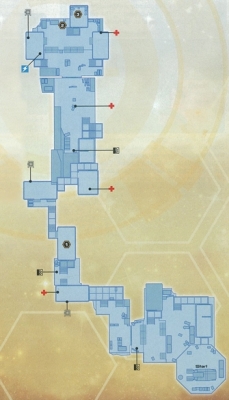
An image of a map from ME2, showing its linear nature.

An image of a map from ME2, showing its linear nature.

Yet something has occurred to me as I’ve been playing.

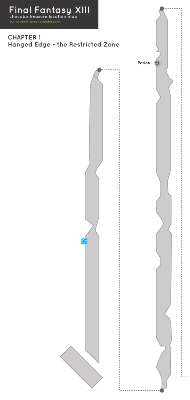
Among the complaints I’ve often heard levied against Final Fantasy XIII, its ‘long corridors’ that ‘don’t allow exploration’ have been among the highest. Melodramatic plot comes second (whole other post). Yet, as I was going along as Commander Ronia Shepard, I couldn’t help but notice that all of my missions had very linear paths. The only standard of deviation might be that I would be herded into a larger room so I could decide on the tactical use of where to place my companions and myself as I took cover and shot at my enemies. Those little alcoves and cul-de-sacs that might have an item or two squirreled away? Both exist, but don’t feed the same exploration need I find myself wishing to indulge.

I enjoyed Mass Effect 2, though among the things I missed in that franchise were the vast amounts of space to be explored–though after playing ME1 twice back to back, I understand the need to cut down on how much space there is to explore (fatigue!). At the same time, the long corridors of Final Fantasy XIII didn’t bother me as much, and it took me a moment to figure out why that was exactly. Expectation and my own gaming habits as a sometimes perfectionist.

There are many Final Fantasy games I’ve never finished because I’ll set them down for a month while picking up another game, and come back completely confused as to what I was doing or where I was going. There was no help to be found in a journal, and the open world environment would often mean stumbling along, second-guessing in which direction I was supposed to go. Since I typically leave these games somewhere along the halfway mark (long game, suffer fatigue, need break), that means I have more options for exploration, and am not as guided as I would have been in the beginning of such a journey.

An image of a map, showing the linearity of FFXIII.The linearity in Final Fantasy XIII ensured I finished the game. When the world does start opening up, I have the option of going about and doing some sidequests, though I can’t complete them all very successfully until I finish the game and am allowed to come back. That’s the real brilliance of FFXIII for me. It saves all the grinding and more ‘hardcore’ gaming for the very end.

This means that gamers who do not feel the need to explore every nook and cranny for the best way to finish the game (read: ones who don’t wish to pour hundreds of hours into the game) are allowed to finish the plot, and then decide whether or not they wish to engage in more grinding. Though this isn’t a perfect explanation either, and made me wonder about my own gaming habits.

It’s certainly true, I never had to breed toward the goal of having a golden chocobo and grab Knights of the Round to finish FFVII. However, the fact that it was there, and the game ends when the last boss goes down meant I wanted to go for it. Knowing that FFXIII‘s end was not truly the end and that the rest of the game waited for me if I so wished meant much more to me in terms of how I approached my gaming.

While I could put more criticism on the game from other aspects, this was not one that concerned me as much. Among the improvements it could have made is one that probably aided in not bringing up the criticism to the same extent when ME2 released, which is allowing a hub from which you travel (even if that hub/space had that damnable probe mining minigame). At the same time, the sense that FFXIII wishes to impart is that you are on the run, whereas ME2 wishes to give you the feel of a Commander amassing an army and making decisions to assault an enemy. Two different goals.

N.B. Originally this post had no images, but both Gunthera and TheMirai kindly pointed out maps that would serve well.

Posted in Uncategorized | Tagged | 6 Comments

Quest for Classics

Among the first questions I am asked when first meeting other gamers is what my favorite game is–a trial by which to ascertain what type of gamer I am, and if I have valid taste. Or perhaps a common point of conversation on which to jump and nerdily compare notes. It is rare that I receive the latter response when I explain that the Quest for Glory series is my favorite of all time to this day. What I wanted to do now is explicate why that is, with my clear enjoyment of Dragon Age, Mass Effect, Flower, Shadow of the Colossus, and many, many more (Note! I am not saying older games are better than newer, and I find many of the newer games much easier to both comprehend and play than their predecessors).

Part of QFG’s appeal is its simplicity. While it meshes two genres, both the point-and-click adventure games of old, and the stat-driven RPG, it adheres wholly to neither. This was a bit confusing to me when I first played the game (I believe I was all of seven at the time), as it meant I was not only looking around for various items to use in puzzles and interacting with NPCs, but I was also engaging in combat and working on my stats with either my fighter, wizard, or thief (later paladin as well). Since my mother loved Sierra’s adventure games, and my father the SSI Gold Box series, I was knowledgeable of both, so it did not take long to catch on how this worked.

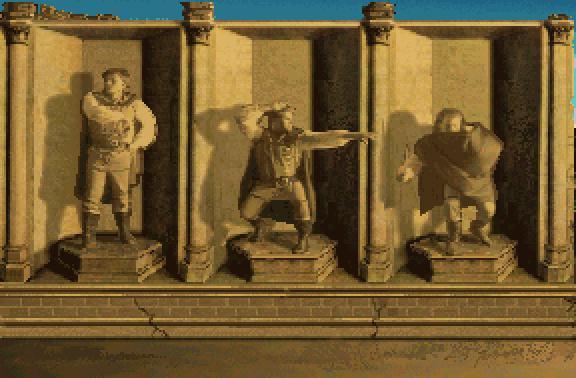
Quest for Glory I Character Roster set in sepia: (From Left to Right) Fighter, Wizard, Thief

Quest for Glory I Character Roster set in sepia: (From Left to Right) Fighter, Wizard, Thief

QFG had no levels, which seemed an oddity to me at the time. Instead, if you wished to become a stronger fighter, you exercised, climbed trees, fought, trained, or any of a myriad of physical activities. To get better at magic-use you used magic. It was a system that was largely intuitive (though some stats were less so, or sometimes had few opportunities open to progressing them).

This system could sometimes become a grind, but it was a welcome one by which you could distract yourself if you couldn’t figure out a puzzle. Excepting the second, Trial by Fire, there are relatively few time constraints, so if you are stuck at a period in the game, you can go off, fight a few goblins, cast some spells, and then come back after you’ve given your mind a bit of a break. Rather than asking you to put away the game once you’ve hit a progression block, there are often more options available.

There were also typically multiple options for solving any given puzzle. If I recall correctly, Lori Ann Cole has been cited as not really enjoying the game of making her players guess what was inside her head when she designed a puzzle. If you are a mage and need to get past a door, you’ll likely have a spell that will aid you. Warrior? Bash the door. Thief? Pick the lock. There are some item-based interactions that are specific, but I cannot recall any that were so painfully ludicrous as the penultimate example in how obscure those became.

Perhaps among the biggest allures was the ability to both export my character from one game and import him into another. While it did not have quite the story-choosing impact that BioWare’s latest two franchises have had, it still allowed me to grow attached to my character, and why I was disappointed that the expansions to Quest for Glory V: Dragonfire never saw light (in which case, those decisions that BioWare chooses to make an impact in sequels would have made such an occurrence in choice of wife (furthermore, who one rescued from Hades) and whether or not one became King or Chief Thief).

The games also walked a fine line between comedy and tragedy, with the earlier games being much more jovial in mood, and the stakes raising as the series progressed. I imagine this was likely due to both learning to write for a new medium, as well as taking more risks in such storytelling. After establishing certain characters, it is also easier to make one feel more involved with their plights, and their connections with the player character.

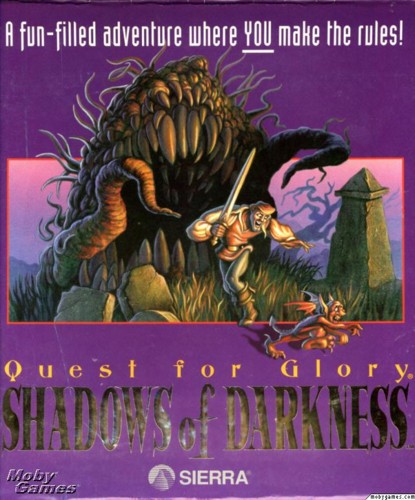
Box art for QFGIV, featuring the hero terrorizing a small imp, with a larger, betoothed plant figure about to devour him from behind.

Box art for QFGIV, featuring the hero terrorizing a small imp, with a larger, betoothed plant figure about to devour him from behind.

Among the reasons my favorite remains the fourth installment, Shadows of Darkness, is that it seemed to balance both equally, having a mixture of tragic figures alongside silly antwerp puzzles. Its Avoozl imagery managed to both be silly in its tentacled goodness, and still grow to be a menacing Cthulu homage.

At some point or another I’d like to do a more in depth analysis, but I wanted to at least put these thoughts out there, as I’ve been kicking them about my head for some time. There are definitely flaws, and I wish to more closely examine those as well, to see why the games succeed in spite of such (and bugs in the fourth title are a given).

Posted in Uncategorized | Tagged , , , | 7 Comments

Puzzle Luck

I have been playing Puzzle Quest off and on since the week of E3, being the first game I purchased on my rather new iPhone. As a portable game, it worked quite well, as I was able to finish a battle, save, and then exit the game.

At first, the game drew me in for hours at a time, my focus being on constantly bettering my character, expanding the story so as to get more quests (read: not to advance the plot; you’re saving this fantasy world from some ancient evil, gather allies–been there), and finding new spells.

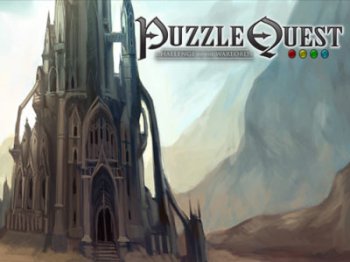
Puzzle Quest's Splash Screen

Puzzle Quest's Splash Screen

Now I have hit a road block. I find picking it up to play somewhat of a chore, to be quite honest. Moving across the map will often find me encountering paltry enemies for whom the options are either fight or not go down that path (something I hear they corrected in the sequel). While this is slightly annoying, it is not what has caused a cessation of it being my go-to game of choice when on the go; no, the game has changed.

The way the stats system works is that once you start pumping more and more points into a magic of the appropriate color, you get a higher and higher chance of receiving a second turn for matching that color. There are a few more ways to receive additional turns that include casting spells that don’t end your turn and matching either four or five gems. All fine and dandy on paper.

It has turned into chaos on my gem-bestrewn battlefield, however. Instead of having my character feel like he has become progressively stronger, I feel he is barely in control at times. It’s not a feeling I particularly enjoy, particularly when paired with battles whose experience point value grants me nothing anymore (having reached the level cap)

But then I stepped back a moment and contemplated what was happening. Having reached the level cap, it seems that I would be like unto a one-person army at this point, but considering I am at a point in the story where I am fighting very powerful undead, the game seems to want to be sure the way the battles are played out is that we are evenly matched, but that our stats are the part that throw in those moments of uncertainty in battle.

It reminds me of the way my collegiate Dungeons and Dragons group would explain hit points to newcomers. Hit points as a system, if you take them purely as health, seem pretty silly. Suddenly because I’m a level twenty fighter I have the ability to withstand more attacks with a sword? No, the way to look at hit points is that they measure your experience with battle. Not every hit that takes away hit points is going to actually connect, but it whittles down your overall battle strength so that the next one could. Perhaps it was a blow that put you off balance, and you have a difficult time recovering from such. I preferred that method of thinking to imagining my veins just pumping more blood, and staunching its own wounds immediately (then again, with magic…).

With that in mind, the way the battle flows seems like it could be satisfactorily explained in Puzzle Quest. There are constantly elements in our environments, which aren’t really pictured, of which we are taking advantage, or which throw us off guard against each other. I have tried with this mindset, and yet I find myself often dealing with battles where strategy really doesn’t matter–or only a few select ones are worth my time really contemplating. On both the enemy and my turns, we will often cascade gems after gems after gems, and it becomes a field where my spells matter. That is, if they aren’t resisted, or if the board doesn’t empty (which seems to have a higher likelihood of happening–though it’s likely just a consequence of more rotations of the the gems on less turns) alongside my mana pool.

In reading reviews, this is often a warning given to players however: don’t get too frustrated with how the battles seem out of control on the side of the enemy, eventually it gets out of control on the side for both. Perhaps my biggest gripe might be how the game of strategies has changed, and it seemed there was little warning. While there is still some strategy inherent in the system based on which spells and equipment you take with you in battle, the board itself seems to be a dubious partner in which to trust.

This then makes me contemplate two things: does the sequel at all address the issue of the endgame’s chaos? Or, am I just trying too hard to find a reason to finish this game to move on to Undercroft?

Posted in Uncategorized | Tagged , , | 5 Comments

Before LIMBO

Beware spoilers for LIMBO.

While there is a lot of current-day media focused on World War II and its shocking effects on history, if one pays attention to those who lived through World War I, there is much media by artists, heavy in what they believed was the inhumanity that had entered the battlefield at the hands of their fellow men: what technology and the nation-state could do to destroy the individual. Due to both my heritage (and copious studying of it), and the germ being planted in my head of the inspirations behind LIMBO by the fine folk at Playdead Games, my mind naturally drifted to this area while playing the game.

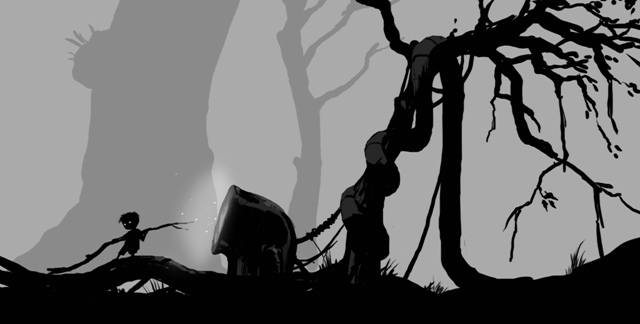
Image is grayscale, the forefront black being a young boy holding a stick in front of a glowing, bent pipe, while behind both is a crooked tree.

Image is grayscale, the forefront black being a young boy holding a stick in front of a glowing, bent pipe, while behind both is a crooked tree.

Worth nothing is that you start off on the ground, slowly waking up, and what comes into focus is not just the shape of your body, but your eyes, the large stand-out in the pitch-black of your body’s shape. As you progress through the game, what all other figures lack is a set of eyes. They are lost to the world, which you are seeing, with which you are interacting. From which you stand apart.

The game’s challenges steadily progress from the more natural to futuristic technology, with a bit of creepiness and ambiance added to taste. Beyond environmental puzzles, you quickly encounter bear traps, and then the ‘boss,’ the torpid, giant spider. It is while dealing and running from the spider, the natural elements, that you come across your next foe: other young boys, whose eyes are missing, and who set to bedevil you with flaming tires, blow darts, and one can assume have set the various traps you encounter.

Watching my roommate play this section, I was struck by how one can lose one’s self in the moment. In a fight to not see your own self die, you suddenly find yourself leading others to their death. You engage in activities to forge ahead. You are not mindless, but you are doing what is required. These are the parameters, and to progress, you must stay within their guidelines while following this path–and LIMBO is pretty much one path you travel from start to finish, a few back and forths here and there.

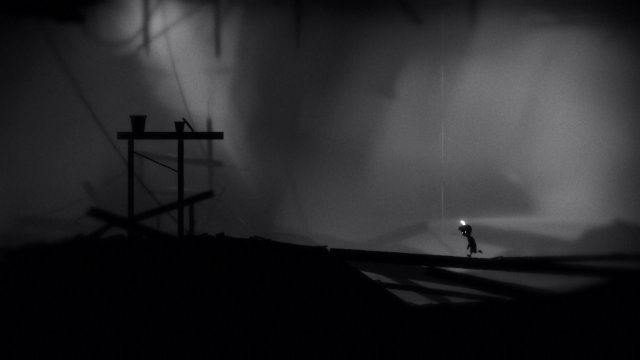
A small boy, on the right, has a glowing parasite worm atop his head, and is running to the left, a flimsy shelf being on the far left.

A small boy, on the right, has a glowing parasite worm atop his head, and is running to the left, a flimsy shelf being on the far left.

I knew that he would soon find the parasite that would drop on his head and control him; this event only seemed a more overt depiction of the activity in which we were engaging already. Before encountering the first of these, I was taking my time, enjoying the backgrounds, the grainy and blurry effects that mimic the silent film era projected on a screen, and the sparse sound that worked together to create an indelible experience. Suddenly I had a force controlling me. I would run right, though I could slow the passage of my footfalls, and their quick staccato suddenly became a reluctant pattering. The world was only something to which I paid attention to accomplish my goal.

For most of these cases, not knowing exactly into what I was heading, the reluctant pattering is what stayed in my head, knowing I was headed into almost certain doom, and hoping I had set myself up to make it through the experience. I both did and did not have a choice to continue. Naturally, as games go, I managed to survive, and in this case by casting off my commanding parasite, feeding it to eyeless, toothy worms.

The perils continue in a more urban landscape: electricity, large circular saws, and even machine guns threaten, steadily building forward in time’s momentum of ways we can manage to kill one another. The only real text to grace the screen in-game comes in the lit sign crackling ‘Hotel.’ There is no home, and no comforting presence to be found in such. This is probably not even your city, even in limbo. After traversing it for some time, suddenly you are met with an industrial soundtrack of saws, electricity, and hydraulic machines of some sort pumping, grinding, and creating a cacophony in what has previously been a comparatively quiet experience. You are traversing the industrial machine now, and you can grow accustomed to the experience.

You continue on, the goal being only given in the XBLA dashboard description: find your sister.

This is not to say my interpretation is what Playdead had in mind, nor what you will encounter and experience. What I saw when I finally managed past the implausible, and ultimately fantastic gravity switching buttons (accompanied by circular saws into which I could plummet and eviscerate myself) was finding my sister. What I happened to see was statistics of the number of men, and a substantial number of young men and older children, who never came home from either World War; never came home to the women that were their family, and who had little to offer in terms of solace.

Even outside of the battlefield, that little girl has lived in the same world as you. And she no longer has eyes bright enough for you to see into them. She is a mystery, like the entire world has been, and all you have on which to rely is your own experience.

An experience which you can relive, your deaths becoming a languid snapshot, longer than usual, but not long enough to dwell too harshly. Sure, this serves as being able to survey your surroundings and ascertain what you did wrong, but it also shows the once-bright light of your eyes snuffed out, becoming part of the darker world around you.

Stay an individual.

Posted in Uncategorized | Tagged , , , | 2 Comments

Love Life, Run 1

I tested Love Life. Having given myself the deadline of May 31 to complete the game (when I made the original post, inspired by the Blogs of the Round Table), I had guests over June 1. I will run through my impressions bit by bit, but first offer some general reporting on the event itself.

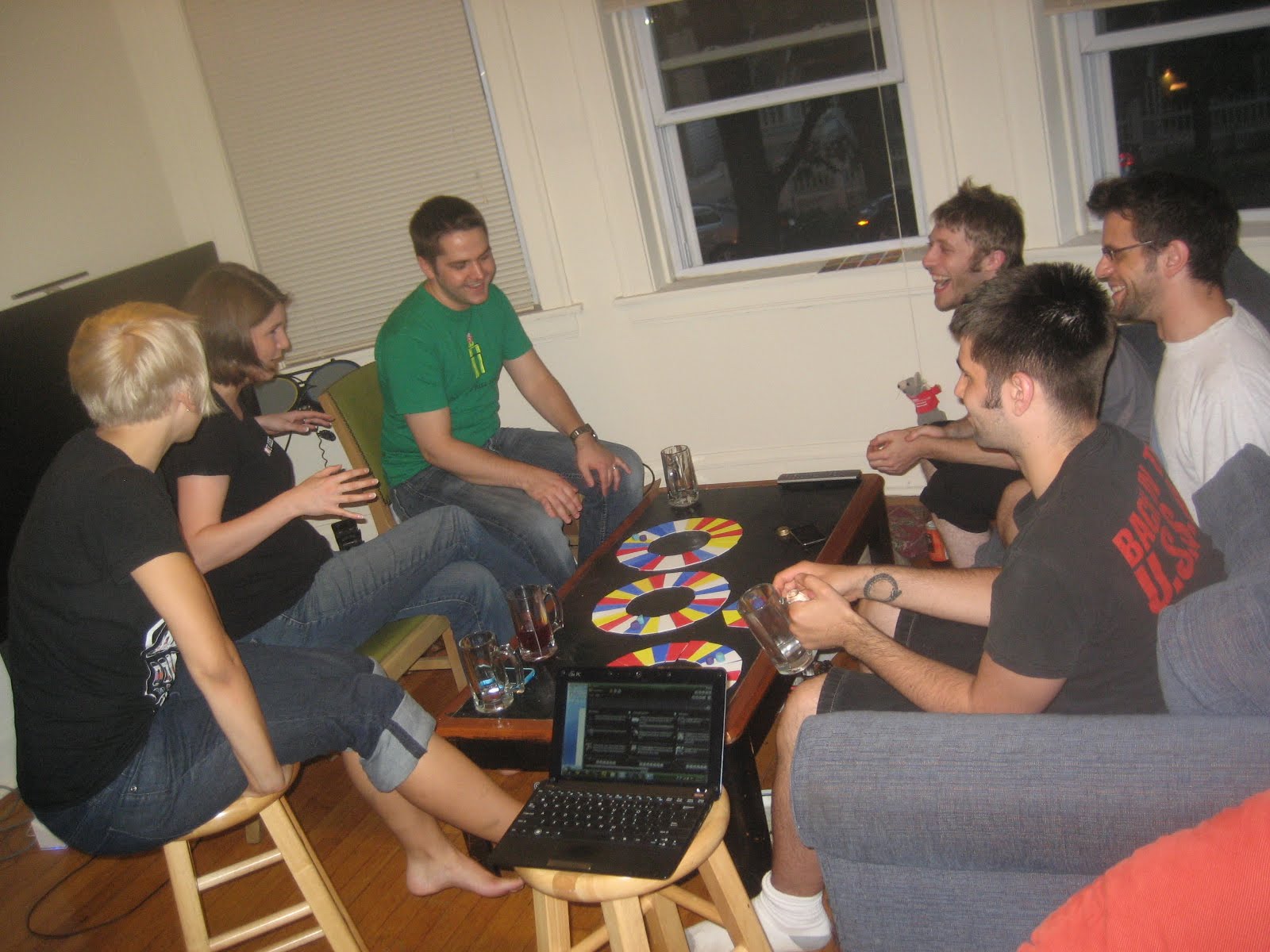
There were six players. They split off into three groups of two, which ended as follows:

Dramatis Personae
Couple 1
Raina | Han Solo
Peter | Princess Leia

Couple 2
Josh | Octopus Housewife
Erik | Shoe-wearing centipede

Couple 3
Drew | Sonic the Hedgehog
Marion | Vision-blessed naked mole rat

I started by asking the couples to create personae for themselves (also determining how much backstory they wished to make up for their couples–most seemed to opt to construct it as they went, allowing greater freedom in their storytelling), making the off-hand remark that they could be dragons for all I care. That set the tone for the group, and gave me the first note I made for the evening–how serious or silly Love Life plays is dependent on the gamers, and the game should support both types of play. At least, that’s the theory I have and will be testing in the coming weeks.

The next game I will artificially restrict to only human personalities, and see how that functions.

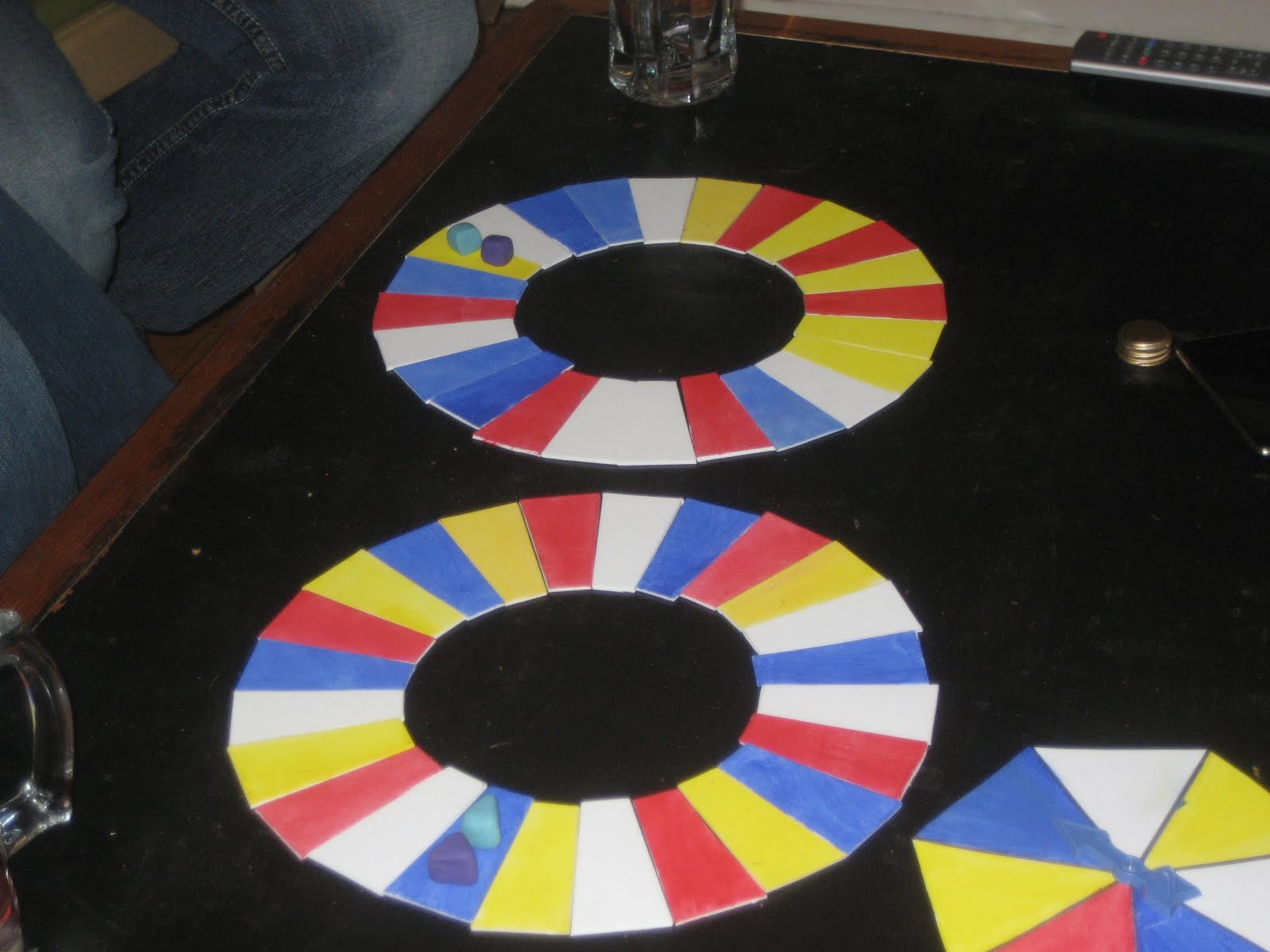
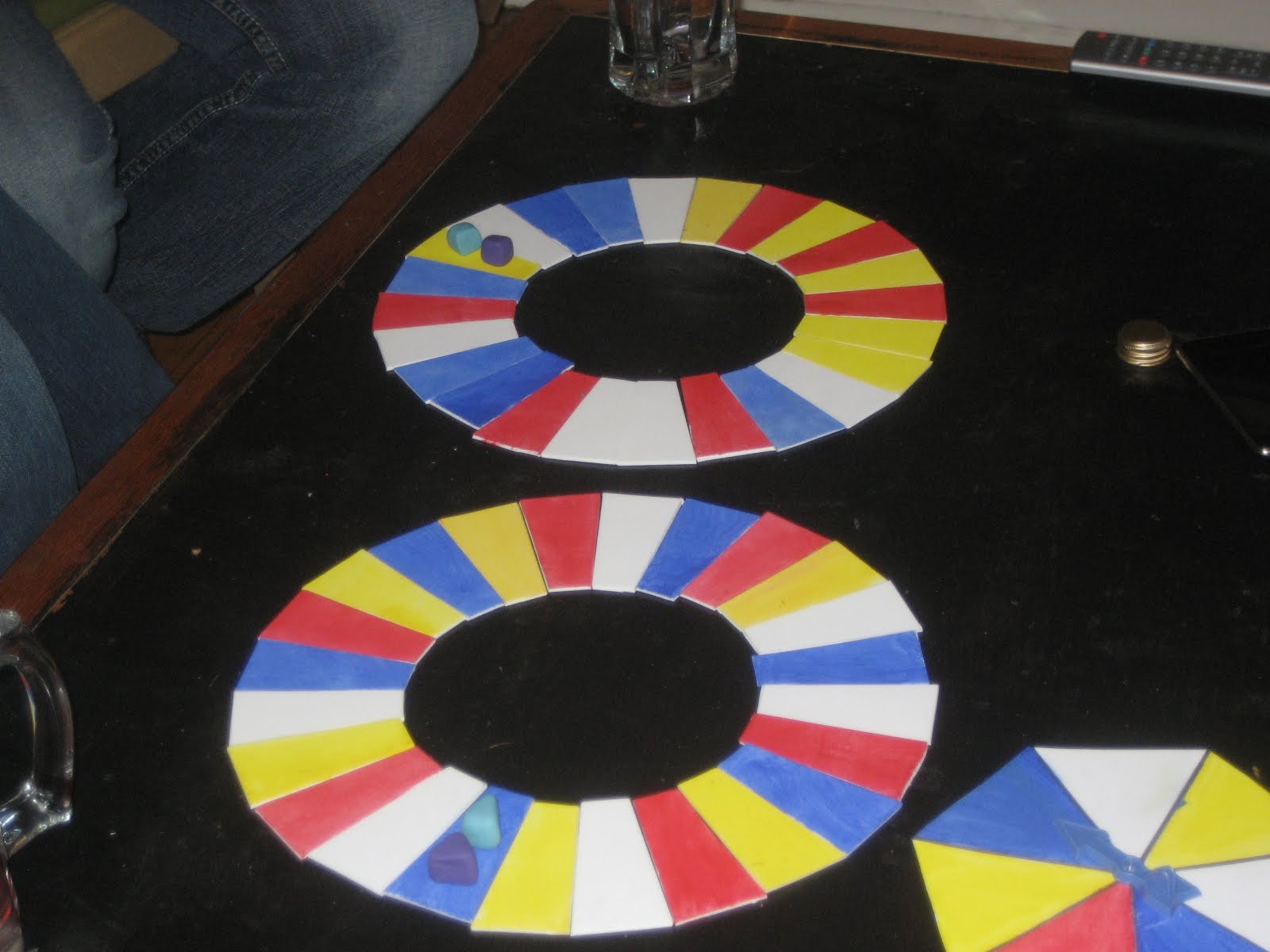
Board
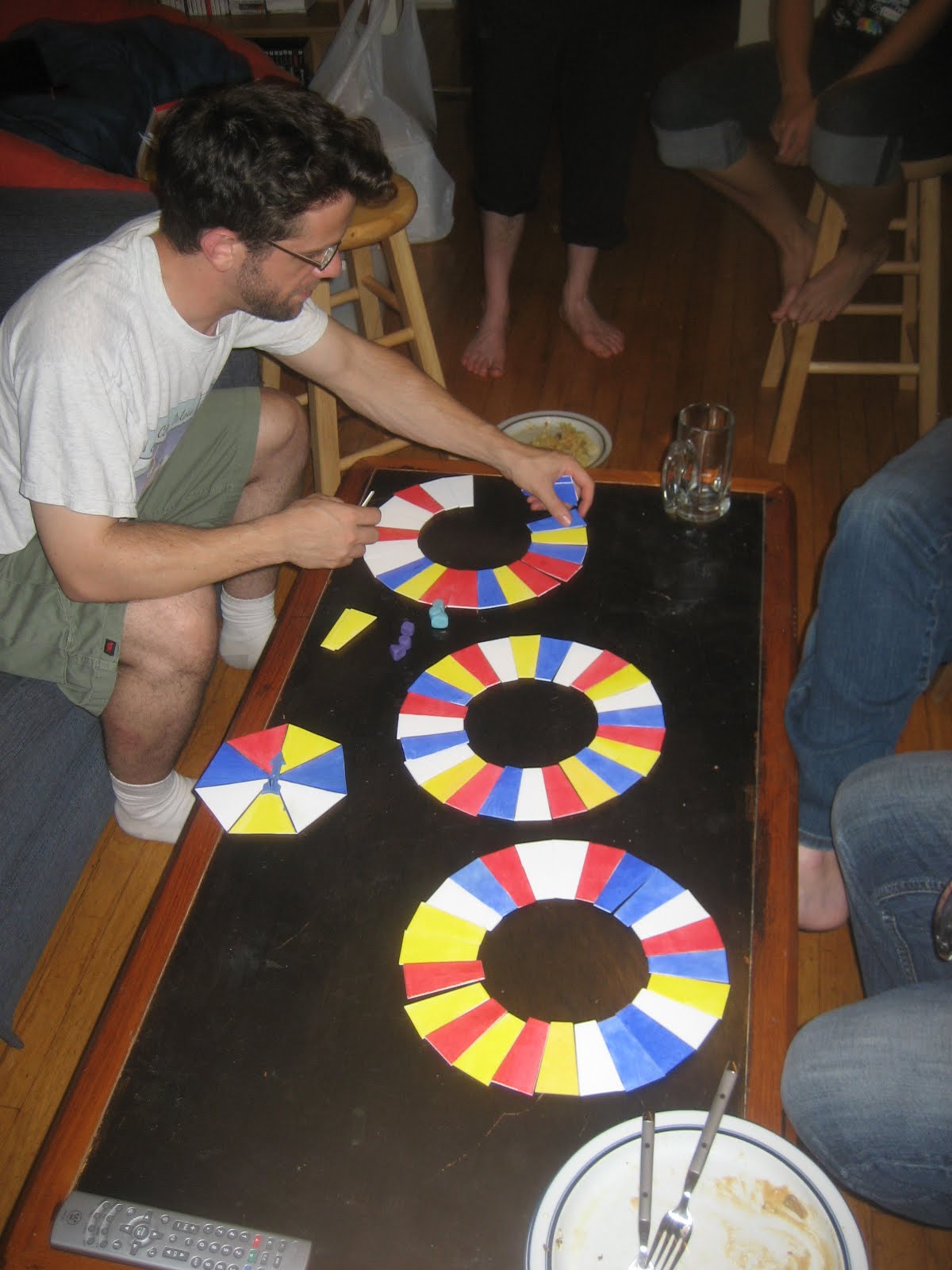
The picture to the left is Peter constructing one of the boards. To the left of the boards is a spinner, with seven spaces on which to land (to slightly compensate for the fact that it has only one square, the red portion is fifty-four (54) degrees, rather than the fifty-one (51) shared by the others). Each circle consists of twenty-four (24) separate pieces, six in each of four colors. The colors indicate certain general parameters for storytelling were one couple to land on a tile.

White: Relationship-oriented
Blue
: Education-oriented
Yellow: Wealth-oriented
Red: Effect

The general idea being that if one lands on one of these tiles, the couple starts cooperatively telling a story that advances their relationship, education, or wealth. If landing on the red, they immediately spin again. If the arrow lands on white, blue, or yellow, the other players set an obstacle based on the parameter. For instance, Solo and Leia landed on red, then span again and landed on white. The other players gave being encased in carbonite as an obstacle. Leia decided to take that as a chance to run off with Lando and explore her own freedom.

Eventually Leia came back and freed Solo, but two years had passed, and it became a recurring theme whenever they had arguments (frequent).

If one spins red and follows with another red, that is when one in the couple contracts a terminal illness. This never happened in the game, and I will address this later. Suffice it to say, at this point an inner circle would appear, mirroring the outer circle, and the affected individual would walk side by side, but in the smaller circle, with zir partner.

Two things became immediately apparent: on top of the colors presented, I should have a symbol to associate with these four elements, in consideration of color-blind players (as pointed out by Erik). Also, I decided to have each couple restrained to going around their own circle. The point was never to have full meaning in the distance traveled, but the movement became even more superfluous.

In the coming games, I believe I will have everyone travel down the same board, setting a zero-point, from where they will spring to the next circle, and continue during the next cycle. It will have no real effect in-game, but is meant for its aesthetic appeal of advancing time.

Community
The original idea was to focus the couples on themselves, but I wanted to add an optional rule that worked well for this particular game. If a couple lands on the same tile-color (in the future, add symbol) as someone else, they are then in the same space, interacting not only with each other, but the other couple. For instance, at one point all three couples landed in a salsa lesson, which led to some rather annoyed exchanges with Sonic, who kept pricking everyone with his spines.

At this point I am willing to allow it to remain optional, but also want to see how it works in a more serious-toned game. After I test that, I will know whether it will become a codified rule or remain optional. As it was, the couples interacted quite often, though it did not seem to detract from the couples themselves ‘advancing’ their own relationships. As the stories grew, more reference points were made, and more character was added.

The mole rat and Sonic, for instance, became bank robbers, who became general thieves and stole from the other players rather frequently. Being anti-capitalist idealists, they also would comment on materialism and lived a bohemian lifestyle in the face of the other two couples slightly more status quo existences.

Themes
Despite the humorous quality of this game, certain serious thematic patterns kept reoccurring: trust, (in)fidelity, sex, money. The mole rat and Sonic, for instance, were very distrustful of each other at first–though as partners in crime, they quickly trusted each other against the other players when they were forced to interact with them. They never fully established a firm trust in each other, from what I could see, but their attachment seemed to grow closer over time.

Or, the octopus housewife often fretted over how she and her husband would provide for themselves. When the centipede spent their Publisher’s Clearing House winnings on nothing but shoes, he became a shoe salesman, until such a point where the mole rat and Sonic offered to include them in a heist they had planned.

Solo and Leia played true to their canonized selves for the most part, which led to amusing banter and many heated arguments–eventually leading to a semi-open relationship. It was complicated.

Conclusions
The game needs more testing. I had envisioned something more serious in my own head, ut was glad to see the players take my basic idea and run with it. Instead of breaking the game whose rules I had constructed, they stayed within the boundary of the rules and managed to enjoy themselves (judging from the laughter and tears resulting from laughter that ensued). As for length? We played approximately one and one-half to two hours, which is when we decided to stop. The ending of the game is reached when either one individual dies, or the players all decide to stop.

While I am almost tempted to tweak the math to allow for a great chance of the game to end with rules, I realize that is my trying to impose what I expect from games, but I find I like the idea that not all games will encounter the end-game. If it were to become something that happens every time, it might seem like that’s the only purpose of the game, which is not the case at all. The game itself is both about our love lives, as it is about the imperative statement, Love Life.

I will update more upon playing and watching more games having been played. Originally I used the Twitter hashtag #LoveLife, but find it is peopled with people already using it, so in the future will be using #LoveLifeBG, if you wish to follow any further news outside of my blog posts.

Thank you to all my players!

Posted in Uncategorized | Tagged , , | Leave a comment

Gardening

I live in a major city. Since I neither have a car (nor wish to ever own one), nor have I acquired a bicycle and the courage to become one of those bikers with nifty fashions you’ll see about the city (just remember your helmet, please), this leaves me with public transportation. The CTA. The Chicago Transit Authority. While the organization leaves much to be desired, so do many of the passengers.

Today had a curious interaction.

Since my commute is semi-lengthy, my time is spent either reading (currently finishing The Beauty Myth) or gaming (currently Final Fantasy V). The latter produces many more onlookers: people watching over my shoulder, but looking away quickly when I remove my eyes from the screen. It’s as if they do not wish to admit a fascination or interest in ‘that.’ I’ve had one chap engage me in conversation about whether Final Fantasy V or VI was the better. I knew the answer immediately–he agreed.
Today, a woman sat next to me. She was my age with a thick accent. White. I wanted to peg her as Eastern European. Pausing me for a moment, she asked permission to ask a question. I agreed to hear it, and then she proceeded, “What about this gives you satisfaction?”
I didn’t know where to begin. Prattling off a few short sentences seemed the best response. I made mention of a new form of narrative, the level of interactivity, the sense of progression (this is a Final Fantasy–one has to love some form of grind to get through the pre-XIII titles), and quite simply entertainment.
She paused again. “Progression? Do you garden?”
Do you mean in games or in real life?
With a sneer, “In real life!”
No.
“Maybe you should try. Is physical progress.” It was said with a triumphant grin, as if she had put me in my place–put one over on me.
I looked at her for a few seconds, before rather innocently-sounding, but snarkily-meaning, and plenty of theatrical aplomb, “On the L? You wish me to garden on the L? I’m afraid I know of no garden as portable as this game–can you suggest one? (beat) What you’ve done is just make an assumption based on what you think you know about gamers and that I do not enrich myself outside of this–that this in itself has no redeeming qualities. You are making far too many assumptions and value judgments. Think harder.”
She seemed confused.
Perhaps I should have remained silent?
Perhaps.
For the most part, when Ebert goes on his trolling sprees, I feel no particular need to prove that my gaming is worth my time or that it is art. I choose how to spend my time every day like so many people. Years ago I gave up television to be able to balance both school and being able to game–that was my choice. I do not necessarily look down on people who watch TV–they are seeking to entertain and engage themselves in another way. Nor people who read. We all choose our forms of entertainment and art, believing it will enrich us, or keep us engaged and entertained.
Perhaps I could have pointed out other activities in which I engage. Going to the theater, cooking meals, trying vegan and vegetarian recipes, engaging in off-kilter sports (late-night dodgeball, urban golf, et cetera), volunteering for HIV/AIDS intervention and funding, having lengthy discussions with friends, making clothing, and any of a myriad of activities. Except that would be making a judgment that gaming is not worth my time, which is not what I wished to communicate either.
No, I felt my response conveyed what I wished. I had no hope nor inclination that I would convert her–she was judging me from the moment she asked the question. To people such as those? I have no desire to prove my gaming worthy.
My gaming is worthy of my time; it does not have to be of yours.
Tagged , | 5 Comments

Vegan Nutella Cheesecake

An idea I’ve contemplated for a while is posting various things beyond videogames in this space–particularly as I have other blogs for which I write; which was never particularly the plan when I started this blog (there was no plan, to be honest). The idea was to include recipes (I cook and bake fairly frequently) and a gendered analysis of various other media (films, advertisements, novels, comic books, et cetera). I will appropriately tag these posts.

Therefore, I present to you a recipe I tried yesterday, by mixing together three separate recipes. Vegan ‘Nutella’ cheesecake. The dietary concerns were because I was with one friend who is vegan.

First, for the crust, I opted to buy a spelt crust. Typical store-bought 9″. On to the other bits:

 Vegan Nutella
Ingredients were as follows:

2 cups raw hazelnuts
1 teaspoon vanilla extract
3/4 cup vegan sugar
1/4 cup of cocoa of preference
4 tablespoons canola oil
8 tablespoons hazelnut milk (can be subbed with any non-dairy milk–I figured hazelnut made sense for this recipe)

I used and altered the recipe I found here.

Instructions are simple. Putting the hazelnuts in a food processor, I ground them until they were as fine as they could be with the particular processor I was using. Then I slowly added the other ingredients and let it grind a bit more. I didn’t time this section, as it seemed to be self-evident when the ingredients were well mixed.

The original recipe called for much less milk, but I wanted to be sure this would be creamy, so added a bit more. I figured because I was using hazelnut milk, it would also not detract much from the flavor or intent, so had no concerns there.

I may make some on my own again, outside of using it for this recipe. The hazelnuts were the most expensive ingredient, but everything else was either in the kitchen or easily, cheaply obtainable. If you have concerns about real Nutella having hydrogenated oil, non-vegan products, or any other such things, this is a great substitute.

Vegan Cheesecake

Ingredients:

One 14 oz package of silken tofu *
One small tub of Tofutti’s Better Than Cream Cheese
2/3 cup vegan sugar
1/2 teaspoon vanilla (or almond) extract
2 tablespoons all-purpose baking flour (I’ve also used corn starch in the past)

The * note is to make sure you drain the tofu for at least an hour beforehand. In case you are unfamiliar with this process, I normally just put the tofu on a plate, press another plate on top, and weigh it down with heavy books. Tofu tends to retain a lot of water, so to have something a bit less messy, this is highly recommended.

Pre-heat the oven to 350 degrees. Here you want to blend the tofu until it’s nice and smooth. I used a food processor; I’ve also hand-whisked this in the past. After the lumps are gone, put in the Better Than Cream Cheese until they are blended. Afterward, it’s just a manner of blending in the rest of the ingredients.

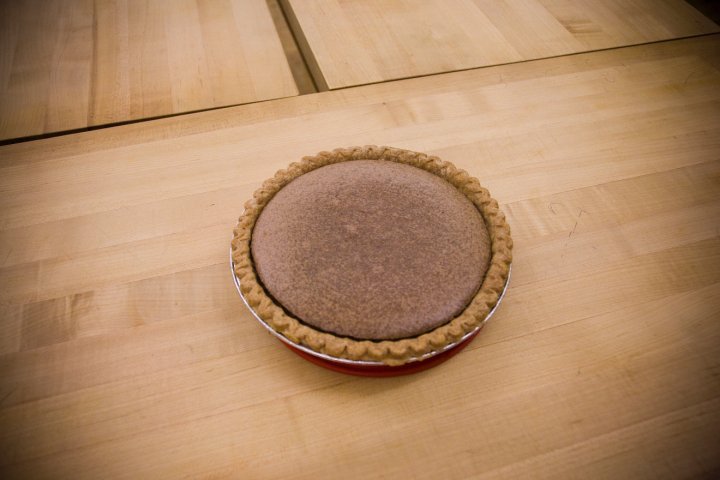
Once these two parts were done, I just whisked them together until the mixture was smooth, and the color was even. The picture below, by Rachel Renee Photography, shows what the remnants of said mixture resembled.

Evenly filling the 9″ pie crust, I placed it in the oven for 45 minutes.

After it was done, I recommend cooling it somewhere between 1 – 2 hours before placing it in the fridge. Following this, ideally, you would let it sit overnight and enjoy it the following day. This tends to be rather important if you want a firm, consistent recipe. Otherwise it will be a bit runny.

Rachel, Rachael, and I were a bit impatient, and it passed our taste tests. Obviously, this is a very rich recipe, so smaller portions are recommended. Perhaps with some of the hazelnut milk you probably have left.

The final product, again, photo by Rachel Renee:

Posted in Uncategorized | Tagged , , | 1 Comment

Love Life Continued

My main/gaming PC is currently under repairs, which has been odd. Using a netbook for my primary PC purposes means I haven’t had access to Illustrator, but that should hopefully be fixed soon. Meanwhile, my thoughts are often with Love Life and how I wish to progress.

Among my next steps is to actually go in Illustrator and design out the board so that people have a visual, and so that I can make a vector image so as to know on what scale I wish to be working. The materials for making a physical copy sit in a box (oh hey, I recently moved), so once I get everything finished, it’s just measuring, cutting, baking the moving pieces, et cetera. I started a Google Wave to update on progress, though my own updates on it have been sporadic at best. The more I talk about it, the more I push myself into actually finishing this project, however.
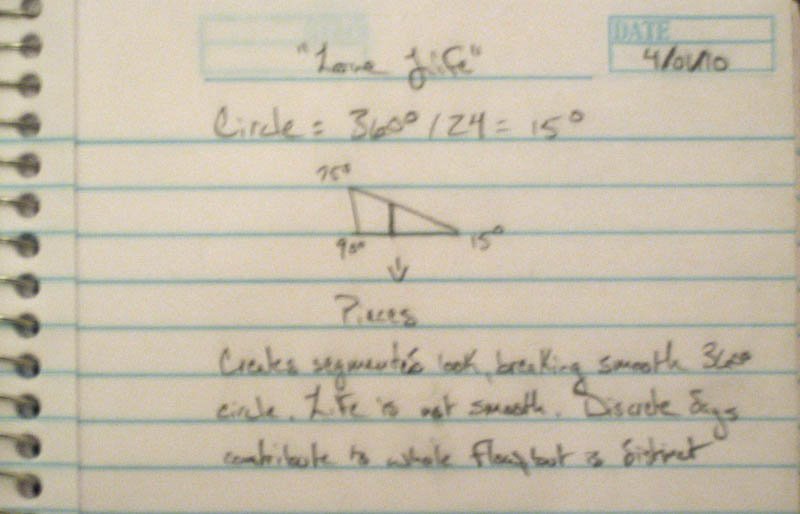
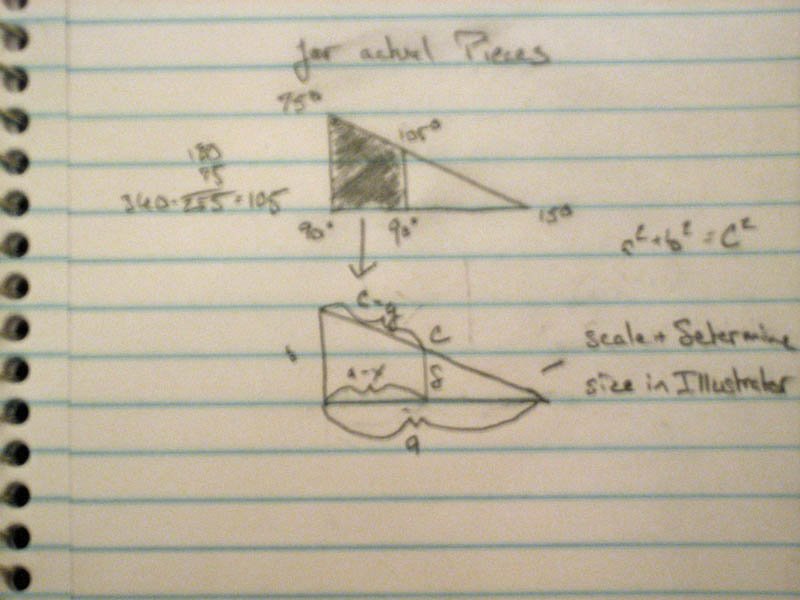
Back in January I took out a notepad and scribbled down two drawings–it was amusing to use geometry, considering I hadn’t in ages.

Image 1:

This was a simple measurement to figure out how many pieces I wanted in my clock, 24 to represent the hours in a day. From there I figured out the degree my triangles would take. As you see, there is a bisection, because the right half is not needed–or so I thought, but more on that in a moment.
The note below it reads: “Creates segmented look, breaking smooth 360 degree circle. Life is not smooth. Discrete days contribute to flow, but is distinct.” The decision for a segmented look was a practical one that later made sense in how I wished to portray the game–since I will be making the first copies by hand, having a full circle would make creating it a bit more difficult. I also believe the segmented look will contribute to the idea that while this is a clock, what is being represented is as much about an hour as it is about a day–events. While they all lead into each other and contribute to the whole, they are not one giant mass. They are each their own self-contained story contributing to the greater whole.
Image 2:
Here is where I focus on the actual pieces, figuring out the angles the four point would need. This little rhombus also gave me a basic understanding of the type of scale at which I was looking, though not providing any actual numbers.
Originally, I was going to only use the left half of the piece, ignoring what would be the center of the circle, or the right half of what I’ve illustrated. The original concept of the game was such that the couple who was playing, after one became terminally ill, would drift apart physically on the board. It occurred to me that this was an inelegant solution for two reasons:
1. It required more math than was necessary (and besides, I want to switch from using dice to color-coding the board and using a spinner–so as to simplify the game, and focus on the storytelling).
2. This is not always the case. I believe I want to change the rules so that at any time, one or the other of the partners could decide that they wanted to leave the relationship–or they could go on together. However, instead of ending the game through this departure, I wanted to reintegrate the inner circle.
The inner circle already has its math drawn out, so I just need to incorporate it into my design and not just cut it out to leave it to be discarded. The other reason for this becomes symbolic–as they go on through their life, they go through circles, yes, but ever tighter ones where the focus is much more rapid, and the inevitable becomes clear. It becomes a downward spiral the players are forced to traverse.
The other concept on which I was thinking was how to make this a more inclusive game. As it stands, the stories told are wholly separate from those surrounding them. I have always observed people, and among the things I observe is that while couples often have a tendency to seclude themselves away, when they do often socialize, it comes in groups with other couples, or people in relationships. This is why, with only four colors on the board, it seemed perfectly conceivable to expand the storytelling aspect so that if all parties agreed, if two parties are on the same color, the one who lands on it second can expand on the story of the first.
An example: let us say that the couple prior had landed on a space to allow themselves to tell a story whereby they went to a class together to learn more about cooking; the second couple, once they landed on a similar space, could then add they were in the class and interact with the former couple, adding both another perspective, and building on the concept of communal storytelling.
The purpose of this is also devious, to be honest. I wondered how much people would be affected by the death of a couple whom they barely knew. Human interaction colors how we react to events, and if there is a tendency for everyone to be involved with each others’ stories, I believe the end goal of the game, one person’s death, would have more of an impact.
Just further thoughts I have now recorded.
Now to replace the fan and secondary hard drive on this PC.
Tagged , | Leave a comment

hush

Among the things I like to call myself is a writer. Of late this has transformed itself into writing creatively again for the first time in a while–at least seriously and daily. Poetic prose has always been at the forefront of my tools, and when I was presented with hush, it was my go-to.

Here is hush for you to try. Credit goes to Gregory Weir for informing me of its presence. Before reading further, I suggest trying the game and then coming back here–it won’t take long, depending on how long it takes you to write. Spoilers ahead and what not.
Here is where I enter the realm of personal a bit to explain my reaction to this game.
There are periods of time where I will go without dating, often burned and stressed out by the other set of games that comes with that territory. Recently I started again to almost immediately be burned, and found myself writing out my thoughts in metaphors and drawing forth my own experiences with a bit of illusion.
hush has a simple missive: Describe a scene of intimacy in 50 words.
First I started writing down, from memory, a snippet of something I wrote two years ago. Since college I have taken the task of writing down every romantic encounter that ranks as more than fleeting into some set of poetic form, and therefore it came easily. I even have a personal creative writing blog where I set them all with the tag “Letters to That Boy.” When the words in hush started erasing themselves, it spoke volumes to me, someone who has been quite accustomed to having these scenes of intimacy typed into a small white box.
I can write all these scenes of intimacy down, and my habit of not sharing them, except occasionally with the party about whom it was written, relegates them much as hush did, a form of public communication that is really not so public at all–it exists between myself and the game, another form of intimacy in itself. The first thing I typed into that little white box, though, remains a moment of intimacy that cannot be shared, no matter how hard I try.
This is the curse and blessing of memory, of any recorded thought trying to capture some snippet of time. While we can set down the scene, give the details, there are always factors that escape our notice that probably inform the scene in some small fashion. It is often the aim of art to present a particular view, a particular frame when presenting these scenes.
hush is a true form of intimacy, because it purposefully tells you that intimate moment is yours. It cannot belong to the box, it cannot be contained within 50 words. Eventually, typing nets you nothing.
This will not stop me from being a futile dreamer/writer, however. It remains food for thought.
Meanwhile. The second attempt was the more recent intimacy I shared–something entirely new. I have certainly attempted and started to write my thoughts down on that experience, but as is often the case, I like to try many different ways of capturing what the intimacy with a person meant. Typing it in, knowing it was to be erased served as a form of catharsis and relief–this was something new to me, something I could not reclaim. While I could reform much of it into a document and then flesh it out (between theater and writing, my memory of recent things I’ve written stays with me a while), perhaps I won’t. It was. I am now. hush offers no judgment, no metric. hush just acts as a confidante.
The third attempt was a simple repetition: you and I over and over, until even that was gone.
Tagged , , | 1 Comment