Daddy Complex

Heavy Rain is an interesting beast. I think Michael Abbott succinctly sums up my difficulty with it from an emotional standpoint. It was a game to which I felt connected, but not in the ways the game desired from me. Yes, I was tense, but felt so because of how the cutscenes were presented, and due to the anticipation of the QTEs. With that caveat aside, I wanted to look at one of the central themes of the narrative and how it affected me, and what it says about the world they were trying to write and the one they managed to present. Heavy, heavy spoilers ahead.
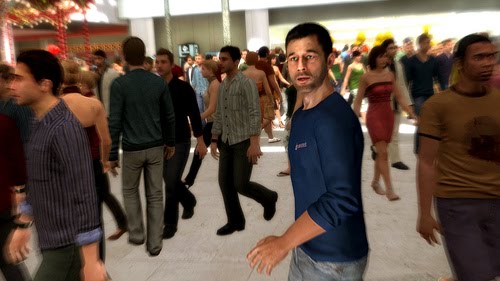

Ethan Mars loses his son Jason. Jason gets lost in a mall, Ethan chases him, and then, when Jason crosses the street to reunite with his father, a car comes tunneling toward him; Ethan jumps in front of him, shielding him, but still losing his child and ending up in a coma for six months.

The loss of Jason is perhaps supposed to be a traumatic event that is supposed to evoke sympathy, but the game is pulling a diversionary tactic. In the early scenes, Jason’s brother Shaun plays second fiddle to Jason’s birthday party, yet at the scene where the family sits down at the table, Ethan is tasked with finding out where Shaun has disappeared. He is upstairs, crying over a bird that has died, which sets up rather dense foreshadowing when Ethan instructs him that these things happen, and life isn’t fair.

As it stands, there was not much chance to create an emotional attachment to Jason, who sets up the emotional impact we are supposed to feel for Ethan due to the threat of losing both his sons. As an aside, Ethan’s running around the mall is not aided by the voice acting, which sounds stilted and very poorly edited every time he shouts out, “Jason!” While the pace is frenetic, the camera frantic, and the scenes somewhat blurred as you push through the crowd to find the red balloon you bought Jason, there simply wasn’t enough of a connect or time spent in making me care about the child at stake.
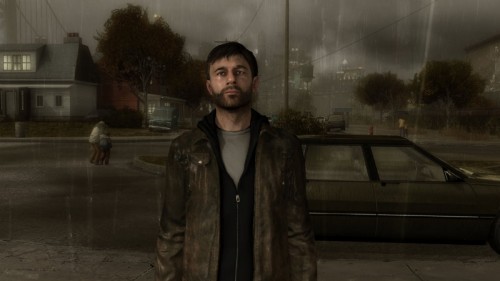

Contrast that with Shaun, who becomes the primary focus of the game. Our next meeting with him shows him as a sullen kid who just wants to watch television and be left alone. You can follow a schedule: give him a snack, get him to do his homework, et cetera. Mundane tasks, and he won’t open up to you, until you get him to bed. Here is where the trick starts happening.

Most of the characters are never fully lifelike, but in a comparative analysis, what we are given with Shaun is both more time and a chance to see his life. The empathy I felt for him was over his situation: parents separated, brother had died, and he is already seen and labeled as a sensitive child–a particularly negative connotation for a boy, unfortunately. It was how he was perceived that caught my interest. His quiet nature coupled with his desire for his stuffed animal before he goes to bed tell us about what needs he has, despite his withdrawn attitude to Ethan’s queries.

It is when you play with him on the playground that I became hooked to his story. His laughter, his joy in play, his desire to have fun. These were traits that made sense, and the fact that I could aid in them meant something to me. Did they mean something to me as Ethan? No. I felt no particular connection to the avatar I controlled, and while I could see what Quantic Dream had hoped to achieve, it was not pity for him I felt.

The game focuses on fatherhood, but as with Scott himself, I feel it deludes itself in what it seeks to prove about it. I found the story of the young boy and what must have been going through his mind much more interesting. Then again, I have no children.

Therefore, when I wanted to connect with the tale of parents, and I know all too well the tale of the distant/alcoholic father, I found it oddly strange that the mothers in this game were primarily absent. Kramer speaks for his son and protects him, Shelby’s mother’s absence does not seem to affect him so much as that of his connection with his father (and yet all of his primary interests stem from her, another nail in the coffin of how I disconnected from his story), and both Jason and Shaun’s mother seems like a plot device rather than a person who exists as a mother. The mothers who are present are the ones left with the aftermath of their husbands’ needs to prove themselves in increasingly dangerous trials.

In many ways, the game feels like a macho contest of wills between Jayden and Blake, and Ethan and Scott. Which is also why Madison feels like a more interesting, if problematic character–particularly as both she and Shaun are the ones navigating both very much within and outside these spaces. Maybe Heavy Rain does emulate the world entirely too well.
Tagged , , | 2 Comments

All men and women are merely players

During my podcast conversation hosted by Abbott, the point came up that I see games as a rehearsal. I’ve mentioned it here before. I give the caveat that I have been and still remain a: theater student, theater historian, actor, director, and playwright. So, I hope to explicate what I mean when I say I rehearse games, which is the same as playing them. This method is not indicative of all games, nor is it a method I think everyone should employ. I do believe it speaks to a larger part of how our function as player, or acter, in a game unfolds.

First there is the role. I make it a point to not play myself in games where I can create a character; hence my reliance on a stock of characters for whom I’ve created my own codex of personality quirks and clearly defined markers.

Unlike the stage, I have the opportunity to take on the role of not just a character substantially different from myself, but am given many more options as not merely the actor, but the playwright as well. What separates this from theater is Corvus’s idea of what makes a game:

“Game is a set of rules and/or conditions established by a community and intended as a bounded space for play.”

While I have freedom to interpret and express my own thoughts through the verbs and words I am expressing through play, I am still constrained by the script. This sounds very much like acting on a stage. I can have an idea of what I want to do on stage, but the play as a structure binds me to certain actions, and grants the ability to provide different interpretations of that action as collaborated upon by the playwright, director, actor, and various designers.

If games are the communication between designers and players, theater is the communication between actors and perceived audience, as well as among the production crew. There is no absolute freedom, and there is often compromise and working together to achieve a full production (in an ideal world–not all stages are created equal).

It is within those restrictions that I am currently interested, as they inform my own behavior and how I view my interaction with both my inhabited play space (role) and with my internal dialog.

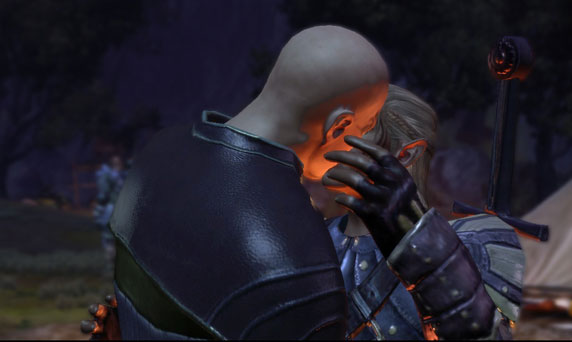
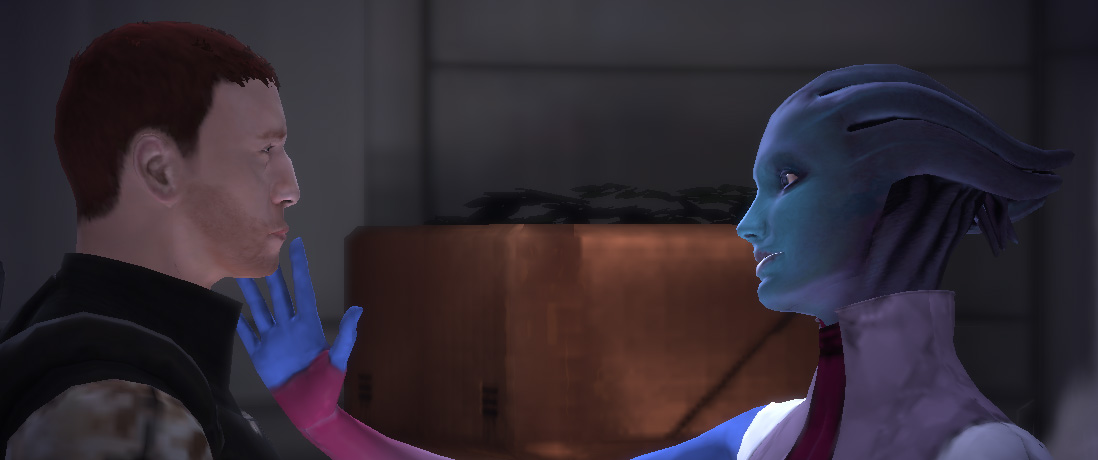
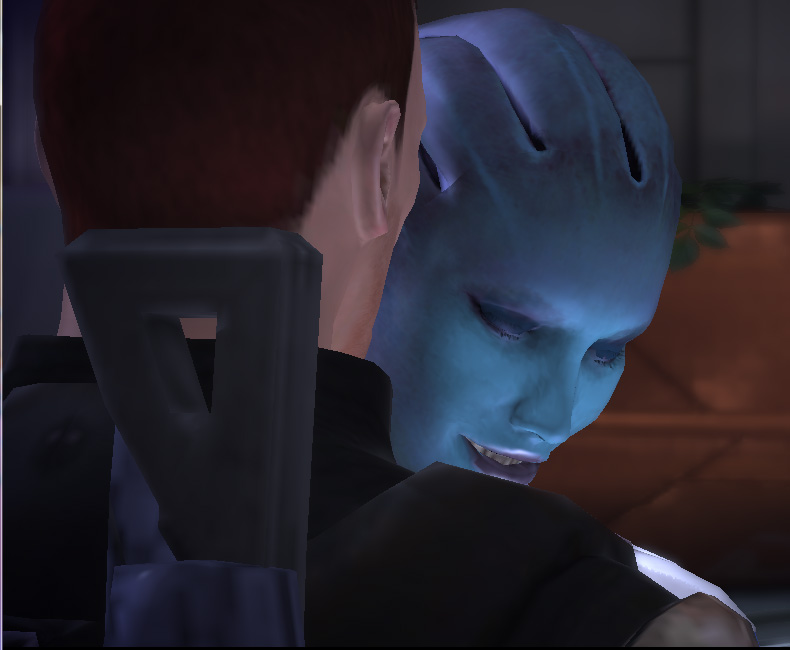
Take, for example, my current, second playthrough of Mass Effect (from here on forward will be minor spoilers). I am playing my tried and true Aeazel, who is very stand-offish, and not a fan of being touched by people he does not know. My fellow actress Sha’ira, the Asari Consort in the Presidium of the Citadel, did not receive this message. Her blocking runs counterintuitive to Aeazel’s own personality.

When Sha’ira touches Aeazel, he lacks any response I can see. My initial thought was to criticize the game for not allowing me to react to this, but then again, I agreed to help her, so within the confines of this small plot we call a side quest, I was agreeing to interaction with her and had already marked myself as friendly. I could have just said no and walked away to start.

Here’s the key, I can still walk away and never return. While I cannot express in more fine detail how off-put Aeazel was by her touching his face and then hugging him, I have that option. The fact that I do not says as much about me as a player, as it does about the confines of the system on my emotional depth being conveyed physically.

There is yet another option, and the one I claimed, which was thinking within the restriction and examining what it said about Aeazel in this instance. Let us say the director and playwright have firmly insisted that this is how the scene will play out, how it will be blocked, and I cannot flinch or express disapproval in my face. My thinking, my beat (how I carry out this thematic interval in my script), then becomes on concentrating on what power this Asari can grant him.

She has been talked of as a powerful person to know in the Citadel. While I, as the player, know what lies ahead of me, and the prestige and power I will wield, I as Commander Shepard, am only somewhat renowned for my ruthless tactics on Torfan, but have not even become a Specter, and am merely a human in the larger playing field of the galaxy’s politics. Knowing this, knowing her level of fame, Aeazel knows that he must suppress his own natural instincts in order to attain what he wants, which is her favor. She is useful to him. He can accept this touch.

Some may argue, and if the facts were not so easily able to be put together as such for me, I would likely be among them. However, unless the scene is completely immersion breaking (say, making me a female in the end text of a game where I had a male same-sex relationship), there can often be an explanation within the more grand context of the entire game, outside of the immediate, discrete action of the scene at hand.

This is rehearsal, when I figure these things out. This is not performance in front of an audience, a marked distinction. Like with a play, each person who inhabits this role brings his or her own experiences and ways of evoking those experiences and emotions to the role. Some may enjoy the character more than others, some may have a deeper connection, draw more out of the character, or just go by rote through the lines, not really giving a spectacular performance (not because of lack of talent, so to speak, but lack of connection). Here, this, is what excites me about games as we progress to more player interaction.

This is also what appeals to many of us about other media: books, film, et cetera. We are able to view the actions of those in said media, discuss the motivations behind those actions, and extrapolate larger themes and idea from those images, words, et cetera. What games provide is a more direct interface in which to maneuver the plot, and to have those actions provide a deeper level of feeling in control not of the narrative necessarily, but of how we perceive the narrative within the role itself.

There are, of course, different games: games more scripted, games that have a very clearly defined reason behind them. These are interesting games by themselves, but they evoke a different reaction in how I approach them; ones that are informed by my understanding of taking the stage, but ones where I do not necessarily feel the acter, so much as the directer (terms I have deliberately misspelled to bring more focus on the first part of the word, and not the historical roles). I will formulate a different example and discuss that later, however.

Tagged , | 5 Comments

Favorite Game of 2009

Michael Abbott asked me to be on a gamers’ confab podcast to discuss my favorite game of 2009 alongside Alex Raymond and Matthew Gallant. I wish to thank him for having me, and to my fellow podcasters for the discussion we had. If you have been reading this blog, you can probably guess what my favorite game of the year was.

Parts one, two, and three are also available, and you’ll notice that excepting Demon’s Souls (a game I will pick up again), the games vary pretty widely.

While I could wax poetic about the games of last year, I will say it has been my gamiest year yet. Being involved with this community, writing here (and other places), and having discussions on Twitter, in IRC channels, and on forums has been the highlight of my increasing interest in games.

Thank you all.

Also, it looks like I will be traveling to Boston in March to attend PAX East, my first gaming convention, and my second convention ever (the first going to Wizard World Chicago). I’ll be covering it for GayGamer, but plan on having plenty of time to socialize and enjoy my fellow gamers’ company.

Tagged | Leave a comment

To Not Be Ezio

This post will contain spoilers for Assassin’s Creed 2.

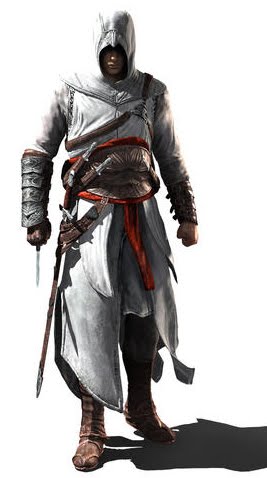
I did not like Altaïr. Despite what challenges the game threw at him, despite epiphanies that destroyed the world he knew, he was always an arrogant ass who knew that he would succeed. He was completely and utterly static. Iconic, badass, and static.

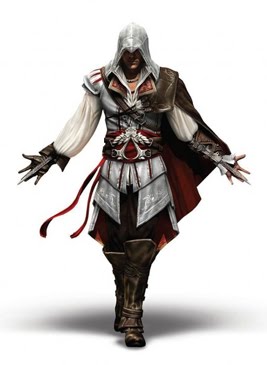
Ezio does not have his style. He is bumbling, capable of mistakes, cocky and yet insecure, and a womanizer. He is brash, but has a personal investment in the events of the story. Sure, so did Altaïr, but his was never developed, it was just told and given to us without any real scenes to show why. I didn’t like Ezio, but I felt interested in his story (moreso than the metanarrative, whose premise just made me shrug and tell myself it’s a game–an excuse I hate).

The opening of Assassin’s Creed 2 is perhaps the slowest and ill-paced, but it sets the groundwork for why I cared enough to collect 100 feathers; why I was struck by the fact that Ezio matured physically (even if it was really only growing a beard), but no one else did; and most importantly, why Ezio struck me in a way many other videogame characters do not. Hope. I saw a glimmer of something I liked, and wanted to see if it developed as I hoped.

Physically, Ezio changes dramatically from a spoiled brat in breeches and a very stylish vest to a downtrodden assassin attempting to hide. He is garbed in the traditional white that we saw on Altaïr, updated for this time period, but that doesn’t quite fit in the lush environment we are presented. The game reflects a few truths in the changes from his appearance, and the ability to shift beyond the white.

The first is that the game you are playing has now altered its rules, or at least how we may think about them. You are given new freedoms (the ability to unlock weapons), responsibilities, and hurdles with your new outfit. A plot threshold has been reached. This is further reflected with the capes, which serve as beacons of safety and danger depending on the mixture of cape in city–Ezio has a chance to show his colors. Officially, you have made the leap from the lengthy tutorial to that of being an assassin and having more freedom in what you do (in a linear plot).

Second is the fact that this reflects a nod to history. The history of fashion is fascinating, particularly as populations grow, certain industries blossom, and new technologies develop. Each of these facets allows for more variety and options for people with less money, and yet, is constrained by notions of a particular time period. While people are always wearing what they will, and probably deviating from the norm, there is a reason I can say Victorian and have people think of certain costumes (even if they don’t know enough to ask which part of the Victorian era). It is a game mechanic, but considering how large a part the (fictionally altered) history of the game plays, it is something I felt worth noting (we are talking about the Renaissance, which saw a shift from a view of the collective to that of the individual).

Third is the fact that you have stepped into the iconic view of the assassin. Now you are not just Ezio Auditore, a kid who just lost his family, but have taken on an entire persona to exact your revenge. Literally and metaphorically, Ezio is adopting the mantle of his father to complete a task, meanwhile marking himself as different, as breaking the rules, and donning that distinctive hood.

This last point also highlights the problem that the focus is purely on Ezio as someone who sees change, meaning any other character is left to languish and be wholly undeveloped. A weak supporting cast only strengthens to undermine your main character. Throw in Machiavelli and just have him stand there as you mull over the fact that he was an assassin (who apparently wrote a treatise on how to conduct war and yet ineffectually handled the Templars). Have da Vinci in the game, mention his homosexuality, and then just delegate him to vehicle sequences (I hate vehicle sequences that aren’t part of the core game) and upgrades. Introduce a strong mother who vaguely reminded me of my own, and then just shut her up for the rest of the game–for years. It is also reflected in having the assassination missions be far less interesting, having them serve as milestones for progression of plot and story, but not actually being a goal toward which you worked.

Ezio himself, however, sees change. It is often shallow, and is something to be found in a not particularly well-written young adult novel, but the intervening years of the game do reflect that he has grown up past being a (wholly) brash youth to being someone who contemplates his past, reflects on his tasks, and is able to ponder at the inevitable conclusion toward which he is hurtling. Had he been able to chew a bit more on whether or not this was his fate, I’d likely start drawing parallels to a more action-soaked Hamlet (though Ezio is far older than the Dane).

Unfortunately, what the game does not do well is reinforce this notion through its gameplay. These are scenes relegated to the non-interactive sequences, just telling me this information and forcing me to be passive. I had interest in his story, and wanted a hand in it, but was firmly told no. In doing so, these cutscenes also detracted from most of the gameplay elements I enjoyed. Instead of interweaving a graduated system whereby Ezio reflects his pensiveness or reluctance, the gameplay gives me parkour (which I enjoyed) and repetitive combat that felt like a chore.

I would like to argue that Ezio is a compelling character, full of flaws, triumphs, an arc, but it means very little in this game. Even the ending sequence when Ezio reaches Minerva, he is succinctly told to shut up after he expresses confusion–this is not meant for him. At this point I actually frowned because I felt sorry for Ezio. This could have been his story, but really, it wasn’t.

Tagged , , | 6 Comments

Maturing Game

Spoilers for Dragon Age: Origins exist in this post.

I’ve previously stated I’m not a fan of games who give me my morality on a scale with two polar ends. It is making me roll my eyes at my current playthroughs of both Mass Effect and Star Wars: Knights of the Old Republic, but it made my time with Dragon Age: Origins particularly meaningful. Instead of aligning myself with an abstract concept of good or evil which was actualized on a scale with points, my actions became tied to my companions (with points that I was able to see…).

My stock of characters evolves in various ways, depending on the game. At this point, when faced with problems in most games, I can pinpoint how they’d react. Even if the game might hone the specifics, the generalities are easy to gauge and plan before the game has even gotten past its introductory stage.

Dragon Age threw a wrench in that expectation. Twice.

The first was with Shale. When finding the Anvil of the Void, the choice is presented of using the Anvil to create an army of golems, or to destroy it. As I wrote on The Border House, Shale is a character I deeply respected and enjoyed. The fact that she was being serious in this situation with the Anvil put a pause on my pressing the number corresponding with the dialog option I knew Aeazel would take. Aeazel is an opportunist, and wanted to agree with Morrigan, who enticed him with the thought of having an army at his behest.

Slavery of people to the cause? Did not bother him. An elitist misanthrope, he believes some people are useful for only his gain, and that they’d squander their lives anyway.

He fought off Branka, destroyed the Anvil, and faced disappointment from Morrigan. Shale thanked him. Shale had earned his respect, and he knew he could not disappoint her. After her burly and often hysterical comments and childlike lines of questions she would ask the other companions, to suddenly have a dramatic shift in her tone and manner made him realize he could not fathom facing her story himself.

Then came Zevran’s admonition during the Alienage in Denerim. Zevran’s constant wit and comedic relief served to make Aeazel appreciate him beyond his services in the tent. At first he was annoyed by Zevran’s braggadocio, then pleased at his desire to remain NSA (no strings attached), and touched when Zevran round-aboutly asked him to stop his sleeping with Morrigan (Aeazel is bisexual).

In fact, out of game, I was growing anxious that Zevran was not asking me this beforehand, though Morrigan had already derisively noted my relationship to Zevran. It is hard to explicate whether my heart was bleeding all over my sleeve because I wanted to see if Zevran would continue this relationship, offering me the first queer long-term relationship in an RPG, or if I felt Aeazel would actually fall in love with the Antivan Crow who had made an attempt at his life.

However, as the relationship continued, it became more clear that Aeazel, based on the circumstances of his origin story, wanted these friends. He despised people because he had been shut away and told they would fear him, and now he was able to have people respect and honor him. They also weren’t helpless and capable of making their own decisions. They could leave him. Zevran loved him.

So when Zevran quickly condemned the initial step of allowing the Tevinter mage to abscond with the elven slaves, I knew what Aeazel would choose, despite the fact that he would be offered more power through a blood magic ritual.

These two interactions gave me room for reflection, paralyzing me with the options. I would be able to finish the game fairly easily either way. Tanks other than Shale existed, the loss of Zevran meant that I would just use another person for my DPS. Yet, both characters meant more than their respective roles to me. It was easy to get involved and care about their stories because they had them.

They had lives outside of what happened with my character, they had their own motives, their own desires, and were written to be fully-dimensioned. To see their positive approval ratings meant Aeazel would learn more about their stories, would open up new conversation options. In an almost Pavlovian style, my initial reactions to events was countered by the desire to see their approval ratings. In many respects, this is switching one set of rules/sliders for another.

However, instead of having an overarching good/evil hierarchy that everyone could invisibly detect because they could see the 1s and 0s a la The Matrix when they saw me, all that really mattered was my personal interactions, which not only enhanced my giggling over the decisions I made with characters, but over the decision on which characters I would take with me.

BioWare has been building up to this steadily, as I am just now halfway through Star Wars: Knights of the Old Republic and am a good ten or so hours into Mass Effect, and can tell that having certain companions with me during certain worlds and quests has an effect, and nets me extra dialog options. But it has thus far encouraged me to ‘game’ the system so that I get all possible ‘key points’ with characters.

Perhaps this is possible with Dragon Age, but I felt myself more invested in the characters because of a set of numbers that readily told me how reactions were poised. It is, of course, still possible to game that system, but I, in particular, had no desire to do so.

Acting the part of Aeazel meant considering the other actors on stage for their own stakes, and not just for his personal gain. If the game had a morality scale, he would very easily have been evil, but considering how he changed in this game, I am not sure such a label or assertion has much merit.

Posted in Dragon Age: Origins | Tagged , | 4 Comments

Zevran Arainai

Welcome to VBR’s LGBT Spotlight, an on-going, non-consecutive series highlighting my stumbling across LGBT characters in videogames, explicating their use as a character, and examining how their sexuality is treated. This particular post will contain spoilers for Dragon Age: Origins.

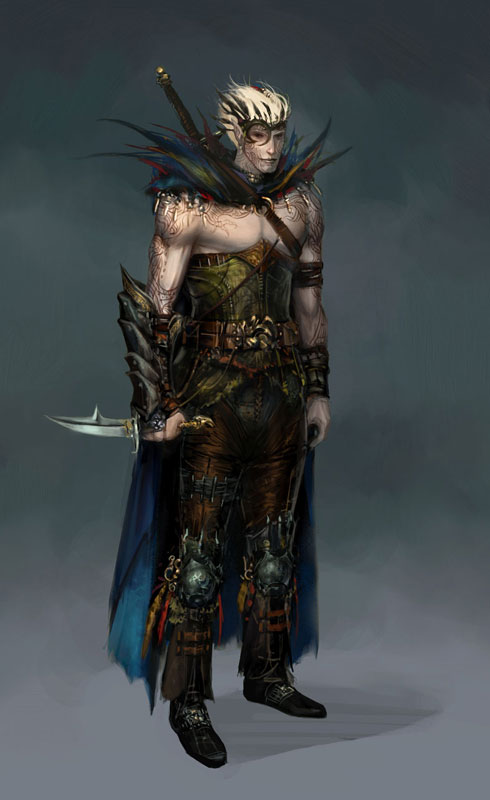
Zevran Arainai is hired by Loghain to assassinate your character, the Grey Warden. After the initial encounter, the player can choose whether to grant him his life, or kill him where he has fallen in his botched attempt. Granting him his life also nets you a companion, with whom you can choose to have sexual intercourse, regardless of your own sex.

The initials interactions with Zevran would have many believe him to be a rather stereotyped gay or bisexual male: he’s easy to bed, willing to sleep with many people without romantic attachment, and, as has been the case for non-heterosexual males in many media over time, cast in a villainous light.

Except this is only the initial interaction with him. Reading over a forum thread on the BioWare Social Network, in the Gay Wardens group, many people have not been the biggest fans of him. The divide seems to be along the lines of, “I like Zevran as he has been written, but I would personally never go for his type.”

While I will not be discussing my own type here, I find it important to note that for my own playing of games, I do not play myself, but treat my characters as a role to inhabit on a stage–the stage and play being encompassed by the game. For this reason, my amoral, self-serving mage got along rather well with Zevran.

And yet, Zevran made him reconsider a decision (one of two characters to do this to him, which I consider brilliant). Upon going to the Alienage in Denerim, the player is tasked with finding out why the revolt happened in this part of town, which caused Loghain to essentially cordon it off from the rest of the city. Advancing in the story finds that people from the Tevinter Imperium had Loghain initiate a lock-down of the Alienage because of a deal struck between them where Loghain was receiving coin (to fund his own campaign against the player) to sell off slaves–elven slaves.

My character, being a blood mage, received an offer from the leader of this group to let him go with the slaves and he would use his own magic to bolster my abilities. After initially wanting to go along with this proposition, Zevran stepped in and told me to look into these elves’ eyes and tell me I could condemn them to slavery. I ended up killing the leader.

Zevran is not amoral, though he may appear to be at first. This interaction highlights many things about his character that are never explicitly stated: Zevran’s own past has influenced who he is. While normally irreverent and flippant, his stance on this issue brings to light that his past is something that has had an effect on him, and like any good assassin (and the lesbian romance option, Leliana), he has learned to put forth an act.

To expect an assassin to reveal his own character, even if he is part of your group, seems folly. Zevran’s actual personality became among my favorites because he was able to roll with punches, accept humor at his expense, and offer the same back. He is, in many ways, a larger metaphor for the masks, closets, and facades many people in the gay community put on to this day to be able to function in society.

Here is a young elf male who was brought into the world by a sex worker, sold into indentured servitude to a group of assassins, and finally meets someone who accepts him for himself, not for what he can provide. His role in society had been mapped out as an assassin, and it is the player who can bend that path and give him a new life. If he were not an assassin, he’d be seen as a lesser citizen due to his being an elf, which plays an important role in the construction of his character.

Zevran is a victim of his circumstances, and if the character can establish a bond, he will eschew his past. He no longer becomes just a one-dimensional figure who sees everything as an innuendo to be made and enjoys the thrill of the hunt, but explodes into a character who is afraid of exploring a portion of his life he has been led to believe could never be within his grasp.

Which is exactly how the romance plays out. Upon refusing the player sex, Zevran starts to admit he does not know how to deal with the feelings he has established. Considering his usual bravado and over-confidence, it is a sign that, again, he has been wearing a mask and playing a role.

Antiva, from how the game portrays the country in its codices and talks with Zevran, is a place of appearances. There is a ruling class, though they are no more than mere puppets. It is the Antivan Crows, the assassin group to whom Zevran belongs, that rule the country. They are the reason no one assaults a seemingly weak country with no real standing army, and they must put on an appearance of having no weaknesses, using guises and subterfuge to their advantage.

So, yes, Zevran initially is portrayed as a superficial stereotype, but so is every character; the problem therefore lies in the fact that the LGBT community is more aware of how these stereotypes have been used negatively in the past to create a stock character. However, from my initial play of the game, I would venture to say that none of the companions in the game are wholly a stock character, though some may be more problematic than others. They all have a sustained narrative that the character affects in some manner.

For instance, it is intriguing to note how subtle factors like race and gender expectations shape how people feel about Zevran, and also feed into the way they feel about his representation. Elves through the Tolkien-inspired fantasy world are considered lithe, less muscular, and by this rote, more traditionally feminine in their portrayal. The fact that Zevran is not human already puts him at a disadvantage for many, particularly in a gay community that now puts on a face of being more ‘straight-acting’ and masculine.

Zevran is not really feminine, displaying traits of sleazy bravado that borders on machismo, and fitting more into a stereotype of a Don Juan. His sexuality and openness to sex are products of his own upbringing, from which I can speak personally as someone who was raised in a sex-positive family, for whom the notion of only ever having sex with one person was a bizarre concept. This brings into question the morality of a society, and like the game’s decisions, the ‘moral good’ has no clear-cut path, and begs to be brought into focus as something that has no particular merit in terms of quantifiable stats.

While Zevran is easy to bed, he feels no easier to win over into a romantic relationship than the other romantic options, who all require care brought to their individual desires and backgrounds. This fact alone makes me appreciate the way the male same-sex romance was included as a romantic option no different than any other.

Posted in Dragon Age: Origins | Tagged , | 6 Comments

Apologies and Housekeeping

First, I wish to apologize.

In my post FAGS, I wrote a paragraph which was both erroneous and damaging to my point:

I do not absolve Infinity Ward or Activision of any culpability in this. Whether or not the developers or marketing team, or a combination of the two, is fully part of this is not the point to me. The point to me is FAGS. If that word were a certain word starting with N (used against African Americans), another starting with S (people of Latin American descent), or perhaps C (generally used against Asians, specifically the Chinese), we’d be having a different discussion (and the use of the words pussies made me realize that I was going to possibly use a C word used against females, that is, unfortunately, likely considering their use of the word pussies). The use of FAGS is rather popular on Xbox Live, however. We come to accept it as just something that boys do while mocking them.

Avalon’s Willow appropriately called me out on this, and it does engage in unacceptable behavior. Specifically, in oppression Olympics. Considering the racism still present in videogames and media the world over, the paragraph makes certain assumptions which I cannot back, nor which have any validity.

My original intent and feelings about the issue remain. The use of fags in the video was a gross misstep, but that particular paragraph did nothing but dilute my point with insipid rhetoric.

I reiterate, I apologize and hope to not step into the same blindness again.

Second, I have started writing for The Border House, a collective of diverse personalities, sexualities, sexes, genders, races, et cetera to:

celebrate diversity in gaming from a wide variety of cultural angles. We aim to be a friendly space for women, feminists, people of color, gay, lesbian, transgender individuals, those with disabilities, and any other marginalized group and their allies to read news and opinion on and discuss video games, MMORPGs, virtual worlds, and social media. Our goal is to provide up to date relevant news and opinion journalism without cultural bias and using a feminist lens.

Regardless of my own involvement, I believe many people who read this blog would also appreciate such a space.

Of late I have fallen off my post weekly horse, but hope to crawl back on. I imagine a portion of my posts from here forward will also be discussing my own writing and further pressing points. I like to view blogs as a place to put forth words that can be discussed and turn into a conversation.

Tagged , | 3 Comments

Dragon Age: White Origins

I will note that while I am critical of Dragon Age in this post, I am enjoying the game and it has taken over most of my gaming time.

Ronia is a character I make in most games where I can customize. She is the first ‘best friend’ I made who made me realize the impact of a true friendship based on respect and admiration. She is both similar enough to me while having a very distinct personality from my own that playing a game while imagining how she would see things presents a delight. Like many, I started creating characters in the pre-released generator that BioWare provided for Dragon Age: Origins. Ronia was the second of these characters. I have not mentioned it yet, but Ronia is black.

Ronia has great, curly hair that I wanted in game. Nothing doing. Okay. Maybe something close? Nope. My options for non-European centric hair for both sexes were cornrows, cropped hair, or bald. I went with bald, because I know real Ronia doesn’t use chemical relaxers and straighteners, and this character would be no different. In general, the hair options in the game are wanting, for a POC they are beyond wanting, and border on the non-existent. Unfortunately, this is nothing new in games.

Seeking Avalon has written much more about this issue, and expresses aptly other issues I have with the character generator and race. The same blog also explores the issues I have with Tolkien and how this game falls into the old tropes.

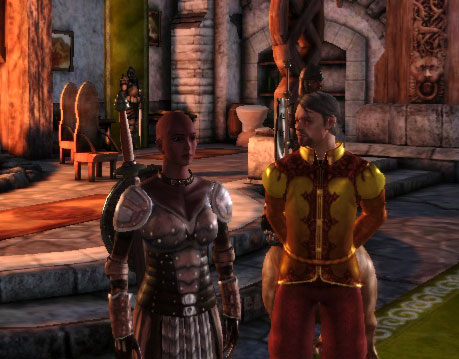
I will continue by examining the game as I have played it. After selecting Human Noble Warrior and assigning skills, talents and attributes, I was given a brief video explaining my origin. Then I show up in a castle with my father talking to me. My white father (pictured left). Proceeding, I meet my white mother. My white brother.

As a noble, I find it difficult to believe I am adopted, but I think back on my other character, the mage who is a blown up personification of my misanthropy. Perhaps it might be true that I was adopted and not one person mentions it, but that does not explain this troubling question: Have I seen any POC in this game? If so, no one notable. Certainly not enough to explain my presence.

What I am presented with is another Tolkien-esque, Eurocentric fantasy game that has a dark-skinned menace, with all the ‘good’ races being white, even if I have the option of opting out of such.

However, the nail in the coffin is hammered some more when I begin to realize that the game has a lot to say about race. I was rather taken aback when I first met Sten, asked him about the Qunari, and he told me my ignorance was my own fault, not his (nor his problem to correct).

The non-human races, both dwarves and elves, have strong allusions to race problems and issues we know in our own world: a belief of inferiority leading to enslavement and being treated as lesser, ghettos, isolationism, a main religion that subjugates others’, et cetera. In fact, there’s a lot to explicate in terms of what that says in a rather smart manner, but is for another post.

All these parallels to racial tensions and mistreatment are just that, however: abstract reflections of what we know in our own world. As soon as I create a POC and start playing him or her, it strikes me when I see no other POC and no one comments on it, but they are willing to see elves as slaves. If we are talking immersive gaming, I am already shunted out of any role playing, because I was never allowed to enter the role.

There are many ways to address such issues, but ignoring it shows a big gaping hole of logic. If the game wanted to have a cast that is almost all white (I have not fully played the game thus far, but the front-end of it is packed with them), then turn off the option to select skin tone in the character generator. That is a poor option, and not one I would endorse.

Then it behooves putting NPCs of color in the game. Since most major characters look to be designed individually, this would merely require someone to decide that this particular NPC will not be white. The character generator already exists (flawed as it is), and it tells us that we can choose these options for ourselves, after all.

I do want mature games, and that includes games that focus less on blood spatters that cling to me ridiculously while distracting from the scenes in which I am interacting (yes, I did turn this off, as it was making me giggle at its ludicrousness) and more on making a world in which I can believe the inherent logic concerning not just the races as it concerns humans, elves, and dwarves, but also the inclusion of a variety of skin colors. BioWare set out to make a game to divorce itself from others’ stories, and create something original, but they still brought the Tolkien-esque privilege with them. Which is odd, as right before this I was in the middle of playing Star Wars: Knights of the Old Republic and was impressed with how many POC I encountered.

When someone creating a story decides that it is okay to talk at length about race issues but ignore the fact that as the only person of color in the world, I might feel a bit alienated (and I’m white), we’ve reached a point where I believe the developers wanted to say, “Your skin color doesn’t matter! We won’t treat you any differently! You are Human! Elf! Dwarf!”

Yet all I hear is, “While you may want to create POC, we are still blinded by our own privilege and didn’t think you might want to see others!”

Posted in Dragon Age: Origins | Tagged , | 6 Comments

FAGS

A while ago I made a conscious choice not to address games that have yet to be released, though I never formally codified such a rule. That lacking of a formal code is what brings me here today after Infinity Ward’s latest video for Modern Warfare 2 (about which I was slightly interested after leaked footage of the terrorist mission). After a night of sleeping on the matter and reading other persons’ opinions, I wanted to record my own for both my own sake and an explanation why such a seemingly innocuous video makes me hurl angry expletives at my monitor. Mostly, I realize this is preaching to the choir, but I’ve really had enough of such a flippant attitude from the gaming community in which I’ve been involved since I was four years old.

[At this point I would ask you to stop and read my apology here. This paragraph was initially much more damaging to the overall point of what I was trying to say, and I wish to both learn from and show others what to avoid in such discussions.]

FAG is a word I’ve had to live with since middle school, when I did not display the proper masculine characteristics that were expected of me in the middle of Tennessee. Hurled at my back, it made me stay in the closet three years longer than I would have otherwise.

FAG is a term that was screamed at my back angrily as I walked down the halls of a high school in Tennessee or down the streets in any city I have lived thereafter, deciding that yes, I was genderqueer, and I was going to dress the way I felt.

FAG was written in permanent marker on my dorm room door at Wabash College when I went to visit a friend at Oberlin one weekend.

FAG came through my dorm room telephone around 2 AM nightly for a whole week and intermittently through the next four years at Wabash. This would be accompanied with harassment about seeing me at a gay club in Indianapolis, then insinuating sex acts and being very crude with me.

FAG is the sound of three men yelling from a car and deciding to jump out, punch me to the sidewalk, and kick me, leaving scars on my knee that still persist, and that comes up every time I wear something that shows them to the general public.

The point? The point is that the word incites equal parts anger and pain in me. The word used casually when not referring to a bundle of sticks (or a cigarette on certain islands) is not excusable in any form, by whoever might wish to use it, less so a rather large videogame company.

There is no attitude today different than any other that regards an insensitive demeanor in males. It has always been the excuse of persons that others, the victims of such language or their friends, are taking things too seriously. That the company using it is not the problem, the problem lies in general society; I have friends who are ‘insert word’ and they are not offended by it; ‘insert word’ is used by the community itself, so I should be able to use it!

The problem, of course, is based in a general cultural milieu, but that does not mean we can and should not call out a large company when it uses such language. It sets an example and a precedent to continue such usage.

Edit: The video has been pulled, and I have had a pleasant exchanging of words and an apology from Robert Bowling.

Tagged , | 10 Comments

Raydians: Persons of Color


de Blob is deceptively simple. The goals of the game are to combat the evil INKT corporation, who have sapped all the color from Chroma City, and made corporate drones of its citizens, the Raydians. Blob is on a mission with his crew to restore color and hope to the city.

Simple, right?

There are layers to this puzzle, and it goes beyond just mixing your primary and secondary colors to coat the buildings and trees in coat after coat of your choosing.

The story of a rebellion and leading that rebellion as its most able ‘fighter’ is by no means new; but de Blob parallels some rather poignant cultural signifiers. Not only are you coloring the city, but bringing function back to important landmarks; among these landmarks you will find jazz radio stations, sports centers, churches, and all with a slight graffiti drawl across the buildings you liberate. You are bringing an urban feel back to a metropolis that has become completely corporate.

The game has a rather funky soundtrack, with such titles as righteous, smooth, and funky. Its urban locations recall slums, factories, and a teeming city with discrete neighborhoods. The colors are bright, vibrant, and scream against the brownish gray overlay often seen in current-gen games. You are meant to bring back life to the game.

Now, pair this with the fact that the INKT Corporation very clearly draws on Nazi imagery with their marching, ‘Comrade’ Black (while socialism is not communism, the two often are conflated and considered in the same political direction in today’s political climes), and ridiculously tall headgear. They have rushed in to a city, demolished its morale, and consigned its citizens to work for and obey them, essentially making slaves of them. At one point you learn their bodies’ liquids, or the suits that encompass their bodies, are used to create the very ink that coats their city and robs it of life. They have stamped out all individuality, and suppressed the color of its citizens.

Instead of allowing them their culture, they have imposed what they believe right. They have white-washed the city, literally. Sure, it is a critique of the rise of corporations and what they mean for individuality and persons in the real world, but that coincides directly with how those effects are quite often felt even more by persons of color in this world, who are still vastly ignored, unless pandered to specifically with a token character or photoshoot here and there.

At this point it is very difficult not to draw parallels to race relations; and particularly those of African Americans in the U.S. and Jews in Europe, and how they were viewed by Hitler and his ilk. For myself, fighting this liberation struggle, freeing these poor Raydians from their tenements that had lost their color (by giving them back their culture through color), and breaking them out of the prisons that held them struck a chord in me that kept me playing through an infuriatingly designed game that assigned its jump function to waggling the Wii remote.

Again, it’s hardly new to be faced with the tale of a liberation in videogames, but to have one that is such a parable to the plight of non-white persons in general, and what I saw as African Americans and Jews in particular, intrigued me. In many ways, it is the easy way out. Much like with Abu’l Nuqoud in Assassin’s Creed, this is a story that can easily be glossed over, overlooked, and just be ignored by a player not really looking at it in the same angle as I was. There is also the fact that the game treats all this in a fairly light-hearted manner. The design itself is supposed to be whimsical.

This seems to have largely been designed with a childlike (not to be confused with childish) appeal to it. Given such a game, it would likely not directly address race relations, or the horrors various white cultures have inflicted on those deemed different. Then again, I have no idea if the designers themselves intended that to be the message, and my sneaking suspicion is that the foremost thought was to paint as evil corporations, and imply that the organic lifestyle of individuals and our cultural weight was what mattered.

However, when this is paired with distinct cultural landmarks that speak of a culture reminiscent of New York’s Harlem or draw allusions to the Third Reich, it can take a meaning on its own. Considering how personality-devoid the protagonist, Blob, actually is (he, in fact, is a colorless blob until he picks up color), it became very easy to see myself performing these acts, not Blob. Other than the cool-guy bravado, Blob himself brings nothing to the table, meaning for the story elements of why I was doing this, my own reading became much more important to me.

Tagged , | 7 Comments