I am not Jokanaan

When I learned that Tale of Tales was working on a game inspired by Oscar Wilde’s play Salomé, I grew excited. There are many reasons I love the play, and among them is that when I read it and start staging it in my head (the curse and joy of being involved in theater and reading plays), I can see what themes are important to me. What themes strike me in this play? Looking and sexuality.

My GayGamer.net look over the game Fatale covers this, but I had more thoughts on the matter I felt better for this space.

The game has an assertive Salome who wants to kiss Jokanaan, and will do it with or without his body attached. While the Young Syrian describes the beauty of her body, she describes the body of Jokanaan. She uses her body to get what she wants from Herod, whose motives are lascivious in their own way.

Everyone who is warned against looking comes to a painful loss. The young Syrian jumps on to a sword to end his life, because she loves Jokanaan. Salome is ordered to be put to death by King Herod. Herod loses both.

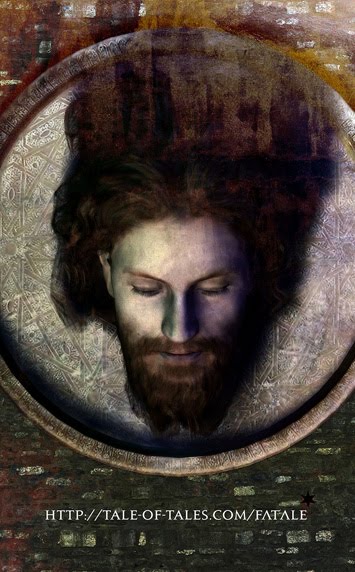
Looking. I embody Jokanaan, but at no time does the game explicitly tell me I am Jokanaan. Without any prior context of either the Biblical story of John the Baptist or Salomé (to be honest, I know next to nothing about the former outside of how it is represented in the latter), it would be difficult to say who you are in this game. The view is first person, and that decision feels to have been made to put me in this body.

Words linger over me while I am in my cell, and they speak in strange half-truths and realities. I am a prophet, so this makes sense. I am being given words, as prophets are said to be given the speech of gods. At the same time, while I am embodying this ‘game’ body, I am very clearly not meant to be Jokanaan. There exists a grain over everything, excusing the typical fallacies of first-person games and their unrealistic expectations of how I see.

There even include controls, as illustrated in the accompanying text file to the game, to increase of decrease the level of this grainy filter. Jumping is a futile effort, given to me, but accomplishing nothing (have you seen most people actually jump?). There are boxes in this space, but there is nothing to do with them. There is only the grate through which I can watch glimpses of Salome dance, and the door which holds the portent of death by way of a neutral-looking skull ringed in red.

When I am attacked by the executioner, I do not process that he cuts off my head–there is no cutscene to inform me of this fact. The next thing I know when I have control again is that I am floating, being able to move in a full 360 degrees.

The focus is to extinguish the lights; both signifying what I myself have lost, the flame of life, and to allow me to explore this space that was taunting me before. While there was a door, I could not understand what lay behind that door, the grate allowed me a glimpse into a world I was forbidden to explore. Now I play.

There is the ring that stands as literary irony, though still holds the same symbol of the skull that I found on my door. The two are linked, but unless I know the story, it likely could just be the kingdom’s standard (it is not). The little matchbox with Salome’s number? It is outside my cell, with plenty of blood; an allusion to the young Syrian, and to Salome’s interest in me, the person in that cell.

When I do focus on a light, the colors skew, the shadows climb in, and numbers and letters (whose import I have not established) ring around, until with an obscuring black smoke I smother them. Even the light of the iPod, even the candle in front of the instruments, such as an acoustic guitar with amplifier, that beat the rhythm of the angel of death whose flapping wings were accompanying Salome’s dance. These two items, again, draw me out of the game experience.

This is not about the game. This is about what I see, what I notice, at what I am looking–again with how my eye is drawn. For you see, this is about my present day response to what is presented in front of me right here, right now. That includes feminist responses and considerations, looking at the history of art criticism and how interactivity means this is more than just a painting on a wall, a play on a stage, a song being played to me.

What Tale of Tales has done is put me in the game space, deliberately putting me in the first person perspective. Am I Jokanaan? Yes, and no. Yes, I am Jokanaan, it is I who was beheaded, whose spirit bedevils the lights, and who watches Salome dance.

No, I am not Jokanaan. I am Denis Farr, who understands what an iPod is, what a guitar and amplifier are, and understands that electricity did not exist in this Biblical time, so we are not in this Biblical time. The game wants me to remember that I am Denis, the game does not want me to lose sight of that fact.

Yet, the game wants to direct my attention, my vision, through the eyes of a beheaded prophet. It wants to tell his story, the story of a man who starts in the play as a disembodied voice calling out from his cistern. The voice of someone who refuses sight to one who would love him. The voice of a man whose knowledge of the proceedings above him exhibit exactly what the game itself tells me. Yet, I am none of these things, bringing my own context.

This game begs for reader-response, but in the way Brecht envisioned. I am to divorce myself from immersion, because it is an opiate that accomplishes nothing but an escapism and allows me to not think. It allows me to adopt someone else’s thoughts, but never to think for myself. Show me the inconsistencies, remind me it is a game, put me in a body that is not my own, give me only my eyes with which to create a sense of self. Give me the glimpse, but make sure I know I don’t really inhabit this space, and that I need to think to piece together the clues.

As Nels Anderson has stated games should be, this is not fun; it definitely is engaging.

If this is an experience that at all interests you, be engaged.
Tagged , | 1 Comment

Charted! Mapped!

Spoilers for Uncharted: Drake’s Fortune lie ahead.

Theater in Medieval times is not often brought up for lengthy discussions; there wasn’t much. This was the era of mystical, mystery, and morality plays. Setting their themes to those of the Bible, they were performed with the acceptance of the church, and not really pushing much in the way of innovation (though it did see the first recorded female playwright, Hrosvitha). It was during this period of theater history that we see the emergence of the play Everyman, however.

In very plain symbolism, Everyman encounters God, Death, Good Deeds, Goods, et cetera. Its function was to provide the watcher with a means for self-reflection. Were you living your life in a way that eschewed earthly temptations and instead paying attention to Good Deeds, or were you letting her languish and grow weak due to neglect? Pretty basic stuff. Symbolism 101.

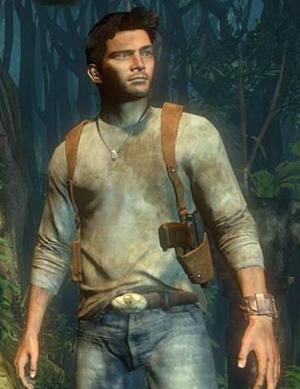
According to Naughty Dog, Nathan Drake of Uncharted is an everyman. He is not a space marine, gruff soldier, experienced veteran, or belonging to any such profession; if anything, he seems a slight bit like a scholar and educated man (though no professor). His charm is that of the every day schmuck who gets caught in situations that are beyond what he knows. Nolan North does a rather excellent job of conveying through voice Drake as someone who is constantly fatigued and somewhat daunted by what has become expected of him in this hero’s role.

Videogames, in many ways, are about empowerment. They are about fantasy. Providing us a canvass of situations with which we normally have no first-hand experience, they allow us to play the game of What if…?, meanwhile purposely putting constraints in who we are, of what we are capable, and how we interact. Uncharted: Drake’s Fortune is about an everyman only in so far as Drake is not distinctive. As Shoinan of You Have Lost! explicates, Drake actually fails to have anything distinctive enough about him to become an icon in anything but the videogame-playing world. Cultural cachet? He lacks even the slightest manifestation of a physical quirk or costume.

It has also been hinted at that Uncharted: Among Thieves will let us see a darker side of Drake, a trend Michael Abbott rightly displays as old hat by now. At the same time, this seems to be following not just a formula that videogames have now displayed, but that of the old morality play. Everyman cannot be redeemed, and cannot show us he is worthy of being redeemed, until we see how he has led his life. We see those bits of his life that make us cringe, make us recoil a bit, and, ultimately, should cause us to reflect on what we ourselves do in our lives that is worthy of being elevated.

Drake has foibles and flaws, lots of them. They are almost a joke to him, and like with Indiana Jones and many, many heroes through the ages, they are endearing as they show the classically flawed hero. A hero who stands too tall, too stoic, and too amazing ultimately pulls us back into reality–this is not real. We may be awed, but we cannot relate as readily. We cheer with the foregone conclusion of a win; not so with the everyman. We know ourselves, we know of what failures we are capable.

Which is also why near the end of the game, it managed to become of the survival horror genre for myself. I found myself engrossed in playing this game because it was generally well-paced, the voice acting wasn’t nearly as bad as I expect, and the story was familiar. Therefore, when the gameplay deviated as the story predictably did so, I was thrown into a panic.

No longer were the tactics of run behind cover and take careful aim of use. From a gameplay perspective, this is horrid. As Manveer Heir states, when introducing a new form of enemy (in this game, Nazis and Spaniards transformed into pasty white monsters), the strategies one must use to fight them should be skills upon which we built from previous game sessions. Uncharted fails at this. Due to my lacking the time to properly aim, I was often blindly firing, hoping to hit the creatures.

This proved to me two things: I wanted to use the shotgun at point-blank range as often as possible, and I was thrown out of my security blanket. Mixed with the proper lighting and sound effects, I became terrified in a way that only games that do not set out to be survival horror have managed in me (Vampire the Masquerade: Bloodlines and Half-Life 2 have also done this). The creatures themselves were not frightening to me, their history was not anything at which I even blinked (perhaps in that lazy, sardonic manner), but the inelegant way in which I was handling them shook the hand on the controller.

I was barely in control.

Part of me now wonders about the old debate of the original titles like Resident Evil, where inelegant controls heightened the factors of tension and anxiety. This certainly holds true for Uncharted, and before this, while certainly adrenaline-pumping in action, I did not feel odd in the slightest shooting at fellow humans (desensitization). Were I to face an inhuman being in real life? My reaction would likely be different, would likely imitate how I reacted in this game.

Faced with the consequences of dealing with said situation, it is little wonder the first game resolves as it does. In many ways, Nate has already plumbed and excised the avarice and pride many of us would face in such a situation. It is a formula that works, and one can only wonder how the sequel will alter it; and if it can be as successful.

Tagged | 1 Comment

Ch-ch-changes


I am now an official writer over at GayGamer.net. Appropriately, I am known as VorpalBunny over there. The plan is to write a post to be published at 14.00 EST every weekday.

Here’s my first article, thanks to Simon Ferrari. The things I left out were due to trying to be more professional, but someone at Kotaku should be slapped for daring to use the pronoun its in conjunction with a person of ambiguous sex (virtual or not).

What does this mean for Vorpal Bunny Ranch? Better things. The problem with my life has largely been trying to figure out what I want to do with it. Those decisions have been made: games, whether that be acting, writing, designing, et cetera. I’m still working on my prototype of Love Life, and will beta test and publish the results and design documents and scribblings here when done.

Now that my ennui is over, and I find myself looking at many projects while keeping busy, I am spending more time focused. The plan is to be a weekly blog; publish one article a week. This includes the LGBT Spotlight, Gayble, game criticism (not reviews, however), and general thoughts on gaming (and, of course, Corvus Elrod‘s Blogs of the Round Table).

Not to mislead, my stint at GayGamer will not be as in depth as I frequently strive to achieve here. If I write reviews, they will be proper reviews. There will be news stories covered. Opinion articles are accepted, but I don’t wish to be that guy. This will still largely be my space to critically engage games themselves.

There are also a few ideas I have for Critical-Distance, including a possible critical compilation of Uncharted: Drake’s Fortune, which I just finished last night. So, you know, if any particular posts on that game caught your fancy (or you’re proud of your own), please let me know in the comments.

Thank you for all of your support over this past year plus. When I started, I would never have guessed at making so many informative and delightful friends, or to learn nearly as much as I have. Here’s to another year of much learning and reading from you all.

P.S. Thanks to SnakeLinkSonic, this site will have a new banner coming as soon as I finish making the font to accompany his lovely artwork seen above.

Posted in Uncategorized | Tagged | 7 Comments

Jean Armstrong

Welcome to VBR’s LGBT Spotlight, an on-going, non-consecutive series highlighting my stumbling across LGBT characters in videogames, explicating their use as a character, and examining how their sexuality is treated. This particular post will contain spoilers for both Phoenix Wright: Justice for all and Phoenix Wright: Trials and Tribulations.

The Phoenix Wright series operates largely on humor; much of that humor is drawn from gross stereotypes–sometimes subverted, at other times not.

This is why I raised an eyebrow during Phoenix Wright: Justice for All during the third case, Turnaround Big Top, when I first encountered Maximillion Galactica.

Max, to put it one way, is flamboyant. Think Richard Simmons, except a magician and you have a pretty solid picture. Words that I recall being used quite often were along the lines of ‘Fabulous!!!” Considering what I have said of the previous titles in the series and the construction of characters as farcical stereotypes, I expected a gay male. Mea culpa.

No, for you see, the case brings to light that Max has proposed to Regina Berry. The two coo sickingly sweet opines to each other, which serves to play on the vacuousness of both characters. Max does have a rather large secret to be revealed, however, and it’s that opposed to the world-famous magician he is known as now, he used to be country bumpkin. The last behavior anyone would expect of a person from the country is that he would be flamboyant (they’ve obviously never lived in the South).

What we need is a man of refinement. Enter case three of Phoenix Wright: Trials and Tribulations, Recipe for Turnabout. Enter Jean Armstrong:

Jean is the owner of Tres Bien, a restaurant in which a rather confusing murder took place. Jean Armstrong is very, very gay and there is no mistake about it. Beyond his overly dramatic mannerisms and expressions, commonly associated with the stereotype of the gay queen, and his penchant for pink (code: feminine), he openly flirts with other male characters in the game, eliciting rather confused expressions. In fact, he calls himself a coquette, a word whose definition is a woman who flirts with a man for his favor or admiration.

It’s odd looking at Jean critically. In many ways, it’s reminiscent of the early days of gay men appearing in mainstream, non-niche television shows and movies (I’m thinking of the 80s, particularly the movie Mannequin); if they were not dying of some sickness, they were commonly flamboyant, colorful characters. They were essentially dramatic, fashion-obsessed people coded as feminine, but possessing an XY configuration in their genes. This is what made them gay moreso than any actual attraction they professed.

The comedy, therefore, lies not in the fact that Jean is gay, necessarily, but that he is a character of contradictions from what we’re supposed to expect. He plays himself as dainty and a delicate flower, but is a heavy-set gentleman. As Phoenix can state in case five, Bridge to the Turnabout, “There’s only one reason. One as obvious as Jean Armstrong in a thong on the Riviera.” What’s supposed to be funny is that it’s Jean, in particular, that is in the thong, and that he would likely be the chap to do it. We are supposed to be similarly disgusted and laughing.

What does one make of a gay man being himself being the butt of jokes and being a joke himself? Rather than just being shocked that a gay man could desire the male cast, it’s as much an issue that this type of gay man has these desires. It is one thing to be desired by an attractive male, but another entirely from someone coded as not desirable.

The entire case hinges on Jean being involved in creating a phony murder and thereby being an accomplice. This is all due to rather exorbitant debts he has accrued in buying his restaurant. In every sense, we are told, Jean is a failure. He cannot present the right gender, run a business, and is ultimately too much a woman to stand up and grasp control of his life. He submits to the Alpha male. In almost every way, we are given essentialist feminine traits as Jean’s personality, which is the cause of his mishaps and misfortunes.

Again, this is what I would expect of a gay representation from film and television in the 80s. Even though almost all bit players in the series are couched in foibles and comedy, I found myself extremely uncomfortable when the game wanted me to laugh at Jean, rather than the situations he caused (a criticism to be leveled at more than just Jean in the cast of the characters, unfortunately).

Tagged , , , | 3 Comments

Sex in der Wüste

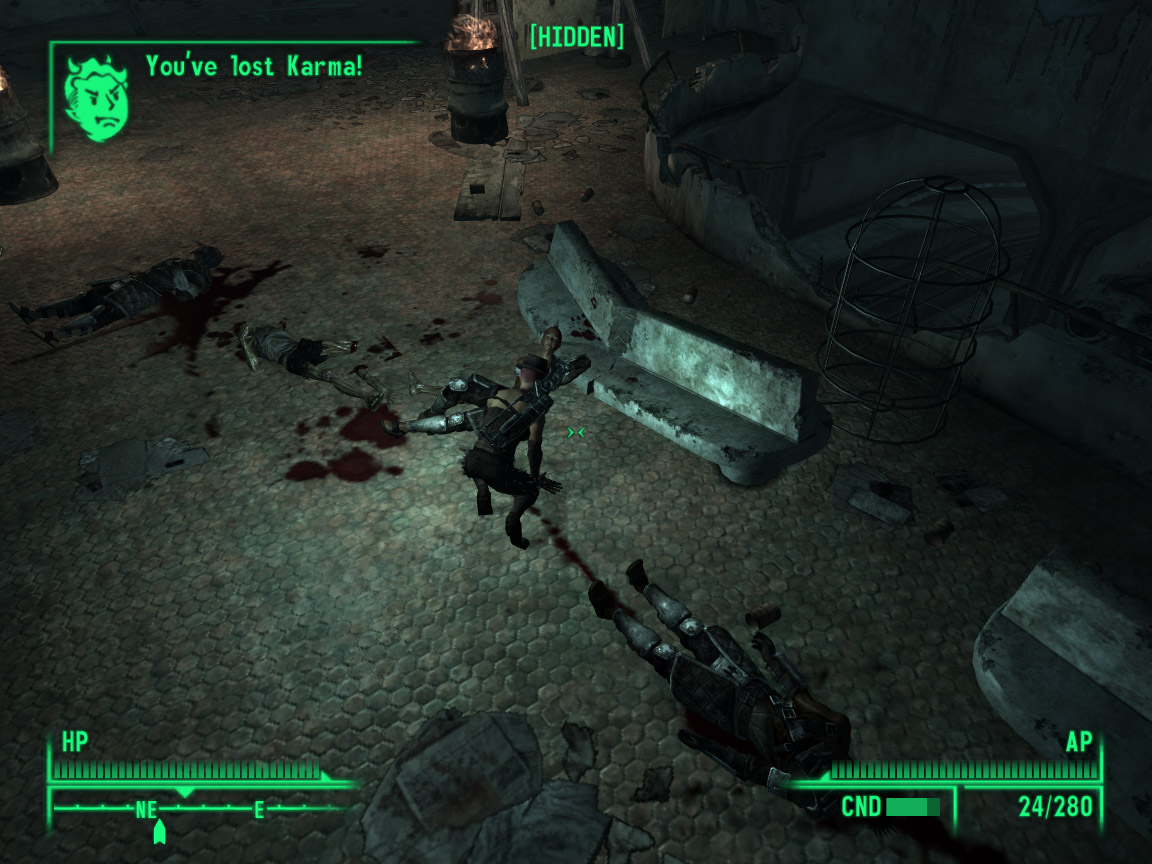
Among the complaints leveled at Fallout 3 was the fact that some features of the previous titles had been removed: notably killing children and the exploration of sexuality. The only act of sex to be sought after in the game is with a prostitute, which brings up once again Alex Raymond’s Women Aren’t Vending Machines. Instead of plying one with minigames, the model of sex is purely monetary, however. Oh, and will you look at that, Nova just so happens to be female.

In the narrative itself, we have Dukov, but I fail to recall any other explicit sexuality being present; while Greta and Carol are a lesbian ghoul couple, it never brings up their sex life, so I cannot comment on it other than that they are partners.

Therefore, within the game itself, the only model of sexuality we are presented is women as objects for purchase.

As for the players options for sexuality? As compared with the previous titles in the series, they are quite limiting, which is disheartening. Beyond the removal of more sexual options, there is a very constraining way of viewing the little sexuality one can express.

In Fallout 2 there was a perk called Karma Sutra master; this was a perk that was non-sex specific and either a male or female could select. In a similar, but vastly different, vein, Bethesda provides both the Lady Killer (male) and Black Widow (female) options, which actually draw closer parallels to the Sex Appeal trait in Fallout 2 (again, a trait that was non-sex specific).

While some may consider it amusing in its use of language (the perks both give an additional 10% damage to the opposite sex), there are some points of consternation here. Simon Ferrari examines how to explicate the term Black Widow in terms of the waves of feminism in his Thoughts on Playing Female in Fallout 3. But otherwise?

While the Sex Appeal trait in Fallout 2 was dependent on sex (males appealed to females more, females to male), there were other options in the game to explore. Without those other options, Fallout 3 locks the characters into a heteronormative existence. Even if a female avatar can pay to sleep with Nova, it’s worth noting that using female with female sex is something that plays to the stereotypical lust of male sexuality; a maturity level gamers are not willing to rise above if one takes a look at games like Bayonetta. It’s not an issue I would press further if, as the conversation at the boards of Iris Gaming Network and Ferrari point out, the game didn’t go out of its way to show how the female sex is very much an afterthought to playing the game.

Instead, if one is a male, one can be a Lady Killer; if one is female, a Black Widow. To some extent I can understand the game not wanting to press the issue of a gender that may conflict with the sex of the character, but this could be solved by, again, a non-sex specific perk. In their zealousness to be clever in naming perks, Bethesda has not only closed the door on a more open world with an exploration of a character’s sexuality through act, but in mere words.

Or, as an alternative, what if Bethesda were to offer either the Lady Killer or Black Widow perk to either sex? As it stands, the Black Widow perk is more advantageous, as more of the human adversaries you face are male (Talon Company is entirely male, as is most of the Enclave–the Raiders may be the most egalitarian, for all the sense that makes). Why should male characters be cut off from that option? Then again, from where does the bonus of this perk stem?

Is it an intimate knowledge of that particular anatomy that allows a boost to damage? Or perhaps being a distraction of sorts? In the case of the former, the need for creating such a specific perk is moot and can easily be explained as either sex picking up either perk. In the latter case, one could once again easily ignore any desire to play anything but a straight person, arguing, rather fallaciously, that the enemies you encounter are all straight. It would seem less complicated to not have to create any sort of programming for determining whether or not the Raider whose head you just exploded like a melon was after a penis or vagina.

Then again, this all assumes that anyone actually cares about providing options to be anything other than straight in an open world game. Or, for that matter, exploring sexuality in a meaningful way that isn’t about just kissing and penetration, whether that be on or off camera.

Tagged , | 5 Comments

Hum-drum Morality

I’ve been replaying Fallout 3 with its DLC and along a different moral path (the first time was as a good character, which seems, for me at the very least, the easiest path to choose from a narrative stance). This time I’ve concluded that it’s a very different game; the character I’m choosing to play is a feminist who is very neutral about her stances on various factions. Most of them are run by males, most of the main NPCs are males, and she’s already been referred to as a ‘chick’ who is disposable in Operation Anchorage (in which she was also referred to as a he by a subordinate).

The problem with it all is the term neutral. Fallout 3 has already come under scrutiny for its morality system (Justive Keverne illustrates how the game judges us, whereas both Shamus Young and D. Riley explicate the problems with the Tenpenny Tower quest). Thus far, however, most of the complaints have been from the extremes of good and evil (see also Michael Clarkson’s explanation of how evil is ultimately a worthless choice). There does appear to be Nick Dinicola’s comparing Fallout 3 and GTA IV, but I have yet to come across the Oasis quest (which saddens me, as I’ve seen Harold in both prior games). In this, Dinicola argues how the neutral option still wasn’t quite neutral, because it based itself off moral judgments of what the other two choices were.

The main problem with the morality system in Fallout 3 is that to really be neutral, you have to game the system. At the same time, the developers saw fit to give achievements for attaining a neutral path, obviously wanting to encourage people to use it (along with a perk that allows a plus to the speech skill if you remain neutral). To complete most quests, Oasis seemingly an exception, requires choosing either a good or evil option–or walking away. To be neutral is to remove yourself from making decisions and giving up quests.

This is not what I’ve done in the game, so the character has taken to stealing from innocents and eating corpses.


This leads to problems, as Jorge Albor told concerning what type of evil he wanted to play. I cannot play a neutral character that solves most quests in a neutral, judging manner. There is no room for me to judge and influence, there is only room for me to choose.

Which is how morality systems in games seem to go. Perform an action. We will now judge you.

There is no room for you to judge, only react. Which is the problem to which Dinicola alludes, as long as there is a judgment being placed on my actions, and a moral system to encompass it and blare its signals at me, I cannot make a real choice that has an impact or any consequences I cannot foresee.

Gamers themselves seem frustrated by this lack of a neutral playing field, despite assumptions that we all want empowering gameplay. The original ending to the game saw much backlash and crying out at how simplistic the choices were, and how there was no way to choose the neutral option of having Fawkes enter the chamber in your stead–the one character who would not be affected by high doses of radiation.

When constructing a moral system, it appears the extremes are mapped out quite early, giving no thought to how one would navigate the situation in a more neutral manner. A binary system is automatically put in place, even if the system allows for movement in between. Neutral factions or alignments are seen as not desirable for the most part, even by the mechanics presented (the evil and good-specific perks allow for a mini-quest of sorts and direct benefit in terms of earning bottle caps, as opposed to the earlier speech benefit).

Seeing as no neutral space is ever given room to be explored by itself, without vacillating constantly between what the game sees as ‘good’ and ‘evil’ acts, the entire morality system ends up feeling hollow and flat. In truth, without the middle space to occupy, ‘good’ and ‘evil’ choices merely become status quo, displacing them to opposing stand points without any real argument for either option beyond self-interest in what you wish to see come of the game, or which one allows you to power-game the best. Think Bioshock.

Tagged , , | 4 Comments

Abu’l Nuqoud

This will be part of an on-going, non-consecutive series highlighting my stumbling across LGBT characters in videogames, explicating their use as a character, and examining how their sexuality is treated. This particular post will contain spoilers for Assassin’s Creed.

Assassin’s Creed works on a basic premise which one can largely ignore: one investigates the targets given and learns about their activities in the city. This usually centers around what they do or an event that will take place; along the way the player learns the placement of soldiers, scholars with whom to blend, and the location to which one must head. Naturally, one learns a lot about the intended target, their goals, and their fears.

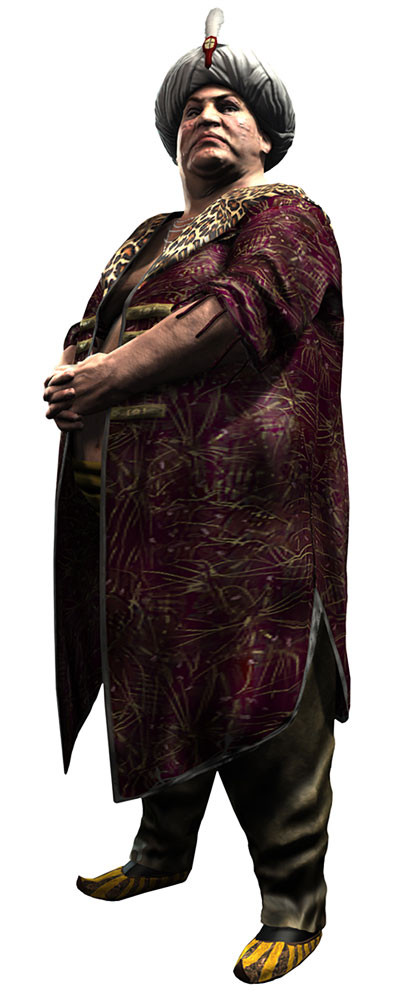
Much like any of the other targets, Abu’l Nuqoud, a corpulent and opulent merchant king of Damascus, represents the entirety of the Knights Templar and their eventual fate. In particular, among the heresies leveled against the organization were accusations of sodomy among the men in the order. While it is not because of Abu’l Nuqoud’s implied sexuality that he is assassinated, it serves as an impetus for the reasons why he seeks revenge on those who speak ill of him.

Implied sexuality, only, however. The game dances around the issue and never decides to plainly tell us that Nuqoud is man-loving. Instead, the player gets implications of having a peculiarity which leaves him with shame, and besmirches his name among people. This is vague enough that I merely raised an eyebrow and wondered if he had a particular deformity that people found abhorrent. It all confirmed for me during the last block of memory that is unlocked, however:


Around the 3.30 time mark in the above video, one sees Nuqoud, in a very tongue-in-cheek manner, caress one of his guards. It’s notable due to the fact that there is very little touch in the game that is not forceful: Altaïr uses touch to push or tackle people out of his way and you’ll see characters attacked, but an actual gentle touch? The only other such occurrences are after Altaïr has assassinated one of his victims and holds them in his hands as they pour out their lifeblood and philosophies. This is one of the only touches that communicates no violence to its recipient.

As for Nuqoud himself? While his homosexuality is implied and brought up as a scandal among his peers, it does not inform his entire being. If anything, Nuqoud’s flaws point to his more classist beliefs that the poor and uneducated are contributing to the ills of society. Therefore, his actions of poisoning those at his fête and having archers standing to shoot any still living speak as much to his belief of creating a world where his sexuality can be accepted as it does to his belief that there needs to be a rather high standard to which all humans are held.

His words during his death scene (also in the above clip) are also poignant, however:

“Look at me. My very nature is an affront to the people I rule. And these noble robes did little more than muffle their shouts of hate.”

“So this is about vengeance then?”

“No, not vengeance–my conscience. How could I finance a war in service to the same God that calls me an abomination.”

Like many of Altaïr’s victims, Nuqoud’s death brings up questions that propel the final confrontation of Altaïr’s own beliefs and order. Instead of just being a one-note villain, there is nuance available to his motives, there are reasons for his decisions, and there is a human who is making decisions based off his own desires, not just an ideal as grandiose as good and evil. If anything, good and evil really don’t exist in this game. He’s not just typecast as a villain, nor merely a victim.

As for his representation as a homosexual in the game itself? He is by no means a stereotype of the lisping, limp-wristed fairy (even if my contemporary eyes cringe at the sight of leopard print). Nor is he completely in denial of his sexuality or defined by his bedroom actions, even if the game is rather mum about it. Given the circumstances of the game, his touch is loaded with meaning, and while it is by no means two men kissing, I have a hard time envisioning any kissing scenes occurring in Assassin’s Creed; that touch serves as the most kind of the game (even if lascivious).

The one aspect that makes me raise an eyebrow is his level of nonviolence, as he’s the least hands-on character in the entire game. He initially runs from Altaïr, not engaging him in combat. While this is attributable to his class status and position as merchant, there is at least one other merchant, a scribe, and a doctor who do engage in combat. Not entirely sure how I feel about that portion, however.

Tagged , | 4 Comments

Maslow, Peter Maslow

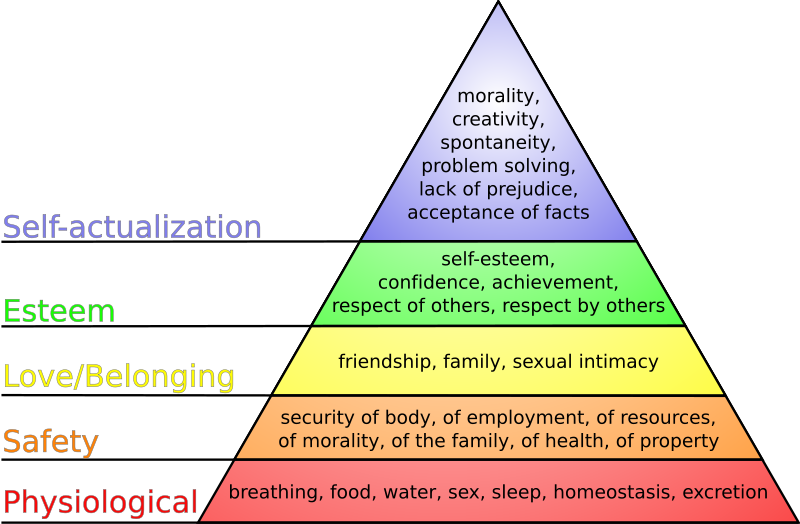
The Sims franchise is known to have had a simple start: imagining a simulation game where one progressed through Maslow’s Hierarchy:


The needs a particular Sim has are based on this model of what we, as human beings, need in ascending order. Now, the Sims franchise has never fully achieved requiring that one needs all the base level before the top level, and this works just fine (and is a healthy criticism that can be leveled in Maslow’s direction).

However, Sims 3 manages to achieve this in a new way. If we consider the first three levels of the pyramid of Maslow to be achieved through the six needs a Sim has (hunger, bladder, energy, social, hygiene, and fun; fun may be the outlier), the top two in this model would be provided by the moodlets: a system of ‘buffs’ or ‘debuffs’ that provide a plus or minus to overall happiness for a time.

As the pyramid moves upward, we enter the realm of more intangible needs and results. Esteem and self-actualization for a Sim are hard to actually present. Sims 2 attempted to provide these levels through wants, fears, and lifetime wishes. While this is certainly one way of approaching the problem, the results were merely lifetime points that you spent on various tangible rewards in a very direct manner. The trade-off was a purely capitalistic model.

Sims 3 has a slightly different method of achieving similar results. Once the basic needs are met, and then exceeded, a Sim receives the moodlets (and there are a variety of methods available to achieve these, from brushing one’s teeth to reaching the top of a career). These moodlets attribute to the overall happiness meter of a Sim; if the basic threshold of happiness is achieved, this results in a siphoning off into the point system in which one buys rewards. Achieving wishes also attributes to this, and gives a boost to the green happiness meter.

What results is that these moodlets and fulfillment of wishes both work together to inform how happy a Sim is. This then leads to lifetime rewards that directly benefit the Sim (in most cases being a new trait for the Sim, in the most expensive cases being a physical object). Sims 2 used only physical objects, such as the water cooler that could make one younger or the contraption that would raise all needs at once. The entrance of rewards that can make that Sim a better gardener, writer, or other such individual trait rewards helps better understand and achieve the esteem and self-actualization tiers in the pyramid above. In theory, they provide the Sim greater skill, autonomy, and understanding of themselves in order to affect their world; rather than providing them with items that allow them to interact with the world through a proxy.

These two top levels also help better understand another game staple that changed with this game: the job system. In the first two installments, to reach the next level in a career a Sim would have to accomplish certain skill requirements, as well as fill out his or her work performance meter (on top of establishing a number of friends). Instead of installing rigid requirements to advance, Sims 3 works on Peter’s Principle: a Sim will continue to advance in his or her chosen career until his or her skills can no longer be considered competent.

The requirements for advancement this time are to have a full work performance meter, which goes up more rapidly if one has the suggested skill levels (and sometimes levels of relationship with coworkers and bosses). However, giving nod to the fact that advancement can be as much a part of nepotism and favoritism, one can increase his or her job performance through special opportunities that will win the graces of one’s boss (or perhaps increase one’s skill levels).

Much like with the hierarchy found in Maslow’s pyramid of needs to self-actualization, the paths to the top of a career level in the game are much more multi-faceted. Instead of adhering to a more rigid set of rules, the gameplay has been loosened so as to both give the player more control and allow many different paths for a Sim to achieve his or her desires and goals. The gameplay is simpler, less demanding, thereby allowing more creativity on behalf of the player, and more options for basic gameplay for a Sim.

This, however, is dependent on the player. The question for many gamers I know when looking at The Sims is: What’s the point? The argument is that one can complete many of these tasks (cooking, sleeping, using the restroom) in real life, and there is no appeal to watching virtual people do the same. This is a matter of taste, and what one seeks.

As someone who plays the game to create narratives with a little aid, the game fulfills the desire to create, rather than just experience. The rules and mechanics fulfill the basic requirements of a game (to borrow Corvus Elrod’s definition: Game is set of rules and/or conditions, established by a community, which serve as a bounded space for play). There is a level of interaction, ease of interface use, and many other kudos to be given to the team; this then paves my own path for creativity from pattern selections and creations to the narratives and stories I wish to see enacted.

While the basis for the series lay among providing an example of Maslow’s hierarchy in a game itself, in many ways, how one approaches the game (and whether or not it appeals) works as a metaphor for how the hierarchy informs what we take from the game.

Tagged , | Leave a comment

Love Life

A Game is Worth a Thousand Words: What would one of your favorite pieces of non-interactive art look like if it had been created as a game first? May’s topic challenges you to imagine that the artist had been a game designer and supersede the source artwork–whether it be a painting, a sculpture, an installation, or any other piece that can be appreciated in a primarily visual way–to imagine a game that might have tried to communicate the same themes, the same message, to its audience.

It doesn’t take long to realize that among my favorite pieces of art is that of Félix González-Torres’s Untitled (Perfect Lovers).

González-Torres was known for a wide range of interactive art, though this one remains largely non-interactive. For instance, one of his installations is (posthumously) piling a 175-pound mountain of his lover’s favorite candy into a room, the invitation is to take away more and more of the candy, eat it, share it, and watch as the representation of his lover keeps losing weight and withering away.

Untitled (Perfect Lovers) follows a similar vein. Two clocks are synched up, but owing to differing battery lives, they will start to wind down and fall out of synch. During the time of problems with what could be represented by the NEA and explicit photography by Mapplethorpe, González-Torres managed to fly under the radar. When asked who his audience was he had one response: Ross, his lover.

It’s no secret that I’m becoming more and more interested in representations of relationships in games. Hence comes this thought for a board game, and trying to imagine how Love Life would work to inspire the installation of Untitled (Perfect Lovers).

The board would be individual set pieces that form a circle when put together. In all, there would be one-hundred and sixty-eight, though only twenty-four would be placed down to start, indicating a day’s time cycle, and having enough to represent a full week. After each passing around of the circle, another circle would be started right next to it, which players would move to once circling the previous tiles. After all players finish circling a particular path, those cards are reshuffled into the pile.

Each tile has two results on its face, split down the middle in a vertical line, which I will further explain in a moment.

Starting players would have to be of an even number and paired off–this is a cooperative game. They would select their token and place it next to a partner, one left and one right. Movement is determined by one of the pair’s die roll on a four-sided die. Following the die roll, both partners would move forward the requisite number of spaces and follow through with the results of the tile.

The possibilities on the tiles themselves would yield four consequences: personal, professional, relationship, and random. All of the tiles would interact with each other and attribute to one score: love. There would be varying point values, both positive and negative, and the real difference is in the flavor text. When landing on a tile, one is encouraged to elaborate: yes, you may have beaten a personal record, but which, and why is it important?

Through all this, your partner is going through similar changes, though perhaps in a different avenue (perhaps professional). Players, upon consensus of those around them, can earn extra points if their stories are worked through together. As the storytelling portion of the game is optional, it would be left in the players’ hands as to what they is allowed.

Then there are the random events on which one can land. These are things such as finding yourself accruing large bills, destroyed property, et cetera. . However, a good number of them (say at least 1/3, though this would have to go through testing) will have a terminal illness consequence.

When this tile is reached, the partner who obtained the illness starts lagging behind the other. For every die roll, the partner with the illness starts falling behind one tile per change of the circle (i.e. 1d4 -1 first twenty-four tile cycle, 1d4 -2 the next). They are no longer in tandem, and once the ill partner reaches the fourth circle (which would result in a die roll of 1d4-4), that player will be finished.

This is the suggested ending for the game. The surviving partner would tell a story of how he or she reacts to the death, and if in accordance with the manner in which they had been playing and sharing their story, can be awarded additional points (again, based on consensus vote of the other players).

The alternate ending would be for those with a particular interest in storytelling, as accruing love points would still be possible for the lone partner, but would require adding that to the tales told when landing on tiles.

I’d appreciate any comments or suggestions, as I am contemplating making a rough copy of this gameboard and testing it.

Please visit the Blogs of the Round Table’s main hall for links to all entries.

Posted in Uncategorized | Tagged | 5 Comments

Fear No Art

Playing the mediums.

Thus far this blog has primarily served as commentary and critiques. Reviews frighten me, as I am horrid at assigning scores (I agonize over my Goodreads list quite frequently). I’ve not really focused on the question of are videogames art because others are wont to do so, and it really does not interest me any more than the discussion I feel people should be having: what is art?

The problem with the question of whether games are art is that it always seems to assume some definition of art based on what we already know in other mediums. I see art as a constantly evolving term, much like our entire language itself. This includes what constitutes the oeuvre of art. I know that every time I seek to define it in a measurable way, someone sneaks in some example that requires acknowledgment, and it revives the whole discussion again. In other words, it’s a never-ending cycle.

No, what interests me is where art (for the sake of argument, I’m firmly in the videogames as art camp) starts being aware of itself. More specifically, where different media start learning from each other.

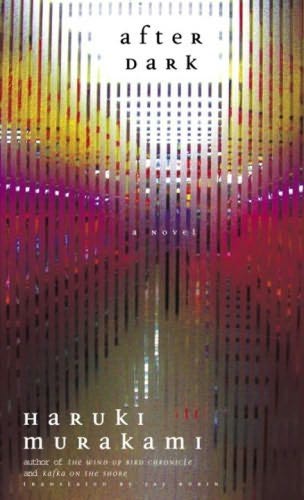
Recently I finished reading Haruki Murakami’s After Dark. While reading it, I could clearly see the images in my head–by no accident. Murakami wrote a novelized screenplay in many ways, even acknowledging the camera that is the reader, and what he’s allowing us to see as the author/camera. Murakami could not have written this novel with the impact he was attempting to achieve if film did not exist. In his method of delivery he was clearly framing a camera lens for us, the reader, to experience the scenes he was describing. He goes so far as to place us in the story and uses this camera as that point of entry, and as an excuse to make sure we cannot interact, as we are recording and watching.

Instead of placing a whole scene before us and continuing the narrative, he very delicately and deliberately chooses how to lead us, using this technique to focus our attention. Much like the fact that the comparison of videogames to film isn’t completely erroneous (only so far as it becomes the only focal point, and doesn’t allow acknowledgment of differences in how it interacts), this book uses techniques that have certainly been available in novel writing and storytelling for some time, but insists on using another medium’s language to inform how we see our own interaction. It bolsters its own techniques by borrowing another’s and creating something different, but with which we are familiar.

I repeat: where different media start learning from each other.

Already I’ve written of one novel that did this with videogames: Steve Beard’s Digital Leatherette. At some point in the future I wish to more closely examine Dennis Cooper’s God Jr, whose premise of a father who has lost his son and therefore gets stoned and plays said son’s videogames serves to explore how that level of interaction can bring out a new understanding of how we even interact with each other.

While it seems some are seeking legitimacy in various forms, I find it much more intriguing to note what the artists themselves are doing. There was last year’s controversy over Douglas Edric Stanley’s Invaders! at the Leipzig Games Convention. We’re already seeing postmodern sensibilities in art pay homage to videogame icons and culture, as well as become more interactive. Whatever critical and ‘honorable’ legitimacy we seek, we’re already acknowledged in many facets, and as newer artists of all media emerge, I believe we’ll start seeing more cross-polination.

This also works in the reverse, to some extent (after all, still a fairly new medium, videogames have quite a bit to explore on their own). Games, as a medium that is emerging more into the public’s scrutiny, may wish to examine more of the world around them, including its art. While I often champion for better writing in games, it is a misnomer, as I believe we need stronger storytelling in games, or at least the tools by which we can tell better stories ourselves. Not all writers are good storytellers and vice versa. Already we’re seeing this attention to storytelling being discussed more often, and that may be an issue of knowing where to look.

Not all of it is written word. Not all of it needs to be written word. The attention that Valve has paid to lighting and guiding a player’s eyes in their blog posts concerning Left 4 Dead certainly made my own eyes grow larger. Richard Terrell also has been writing quite proliferously on such topics, showing how games communicate their stories and lessons to us in very intelligent ways (or not).

After all, until a teacher decided to push me in my own writing, it never occurred to me how versatile the written word could be in conveying anything beyond the words placed in front of one’s eyes (this was before I came across poets like e.e. cummings). She then showed me an essay where she spoke about the ever-increasing speed of today’s world; as the essay progressed and offered more concrete examples, the sentences themselves complemented the points and grew shorter, more succinct, and clipped by one’s eyes in rapid succession.

Not only can the mediums themselves learn from each other, but as Chris Lepine commented in my quixotic ramblings (oh, and I finished Don Quixote last night):

As a gamer, I both feel the need to offer game designers suggestions (as you have) for making games suit our changing tastes. But another part of me, the psychologist, keeps asking how we can suit ourselves to make the games (or books) that already exist, fulfilling and meaningful?

That’s what interests me more than the question of whether or not games are acknowledged as (or even are) art.

Tagged , | 2 Comments